The Toyota RAV4 Hybrid remains one of the most practical vehicles in the compact crossover segment, blending strong fuel economy with everyday usability. For 2025, Toyota continues to refine the formula with updated infotainment, a well-crafted cabin, and the same proven hybrid powertrain that has made it a segment leader. This guide breaks down everything you need to know about the 2025 Toyota RAV4 Hybrid interior, its real-world efficiency, and how it compares to the plug-in RAV4 Prime and full EVs.
2025 Toyota RAV4 Hybrid Interior: What's Changed
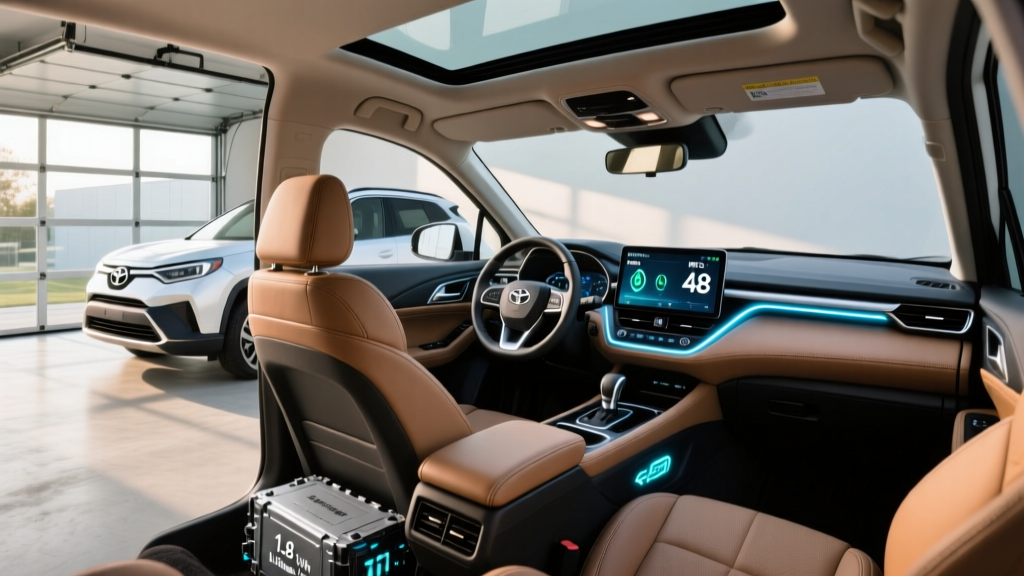
The 2025 RAV4 Hybrid interior carries over the refreshed design introduced with the mid-cycle update, anchored by Toyota's latest 10.5-inch Toyota Audio Multimedia touchscreen (standard on most trims, with a smaller 8-inch unit on LE). The system supports wireless Apple CarPlay and Android Auto, over-the-air updates, and an available 12.3-inch digital instrument cluster on higher trims like the XSE and Limited.
Material quality varies meaningfully by trim. The LE and XLE use durable cloth and SofTex-trimmed seats, while the Limited steps up to leather-trimmed upholstery with heated and ventilated front seats. Soft-touch surfaces cover the upper dashboard and door panels on most trims, though lower door areas and the center console sides remain hard plastic — typical for the segment.
Cargo space remains competitive at 37.6 cubic feet behind the second row and 69.8 cubic feet with the rear seats folded. The hybrid battery pack is mounted under the rear seat, so there's no cargo floor compromise compared to the gas-only RAV4. A power liftgate is standard on XLE Premium and above, with a hands-free option on the Limited.
- LE ($33,855): 8-inch touchscreen, cloth seats, 6-way manual driver seat, dual-zone climate
- XLE ($35,345): 10.5-inch screen, SofTex seats, wireless phone charger, auto-dimming mirror
- Woodland Edition ($37,095): Rugged interior accents, all-weather floor liners, tow hitch
- XSE ($38,090): Sport-tuned suspension, SofTex/synthetic leather, 12.3-inch cluster
- Limited ($41,915): Full leather, heated/ventilated front seats, premium JBL audio (11 speakers), panoramic moonroof
HEV vs PHEV: Standard RAV4 Hybrid vs RAV4 Prime
Toyota offers the RAV4 in two electrified flavors, and the distinction matters for your wallet and daily routine. The RAV4 Hybrid (HEV) is a self-charging conventional hybrid — it never needs to be plugged in. The RAV4 Prime (PHEV) adds a larger battery and more powerful electric motors for genuine electric-only driving before the gas engine kicks in.
| Spec | RAV4 Hybrid (HEV) | RAV4 Prime (PHEV) |
|---|---|---|
| Powertrain | 2.5L 4-cyl + 3 electric motors | 2.5L 4-cyl + 2 electric motors (more powerful) |
| Combined HP | 219 hp | 302 hp |
| Plug-In Required? | No — self-charging | Optional — charges via regen if not plugged in |
| Electric-Only Range | N/A (EV mode ~1 mi at low speed) | 42 miles (EPA) |
| Battery Capacity | 1.6 kWh (NiMH) | 18.1 kWh (Li-ion) |
| EPA MPG (Combined) | 39 MPG | 94 MPGe (EV) / 38 MPG (gas) |
| 0-60 mph | 7.4 sec | 5.7 sec |
| DC Fast Charge? | N/A | No — Level 2 AC only |
| Level 2 Charge Time | N/A | ~2.5 hrs (240V, 3.3 kW) |
| Starting MSRP | $33,855 | $44,415 |
The RAV4 Prime's 42-mile electric range is enough to cover most daily commutes without burning a drop of gas. However, it commands a $10,560 premium over the base RAV4 Hybrid LE. If you can charge at home and your commute is under 40 miles round-trip, the Prime's economics work. If not, the standard HEV delivers excellent efficiency without any lifestyle change.
Fuel Economy: EPA Ratings and Real-World MPG
The 2025 RAV4 Hybrid is rated by the EPA at 41 MPG city / 38 MPG highway / 39 MPG combined for AWD models (the only drivetrain offered on the hybrid). These numbers hold across most trims, though the Woodland Edition's all-terrain tires drop it slightly to 38/35/37 MPG.
| Trim | City | Highway | Combined |
|---|---|---|---|
| LE / XLE / XSE / Limited | 41 MPG | 38 MPG | 39 MPG |
| Woodland Edition | 38 MPG | 35 MPG | 37 MPG |
Real-world expectations: Toyota's hybrid system excels in stop-and-go city driving where regenerative braking recaptures energy. Owners consistently report matching or even exceeding the EPA city figure in urban and suburban use. Highway-heavy driving at 75+ mph tends to land closer to 35-37 MPG. In cold weather (below 30°F), expect a 5-10% efficiency dip as the engine runs more frequently to heat the cabin — the RAV4 Hybrid lacks the heat pump found in some full EVs.
For the RAV4 Prime, the EPA rates it at 94 MPGe when operating in electric mode and 38 MPG combined once the battery is depleted and the gas engine takes over. Total combined range exceeds 600 miles when you factor in the 14.5-gallon fuel tank plus the 42-mile electric buffer.
Powertrain Specs: What's Under the Hood
The 2025 RAV4 Hybrid uses Toyota's fifth-generation hybrid system pairing a 2.5-liter Dynamic Force 4-cylinder engine with three electric motor-generators and an electronically controlled continuously variable transmission (eCVT).
| Component | Specification |
|---|---|
| Engine | 2.5L DOHC 4-cylinder (176 hp / 163 lb-ft) |
| Front Electric Motor | 88 kW (118 hp) |
| Rear Electric Motor | 40 kW (54 hp) — AWD |
| Net Combined Output | 219 hp |
| Transmission | eCVT |
| Drivetrain | Electronic AWD (eAWD) |
| 0-60 mph | 7.4 seconds |
| Towing Capacity | 1,750 lbs |
| Fuel Tank | 14.5 gallons |
| Total Range (est.) | ~565 miles |
The eAWD system uses a dedicated rear electric motor rather than a mechanical driveshaft, providing responsive torque to the rear wheels during acceleration and low-traction situations. It's not a rock-crawling system, but it handles snow, rain, and light off-road duty confidently. The RAV4 Prime boosts total output to 302 hp thanks to more powerful electric motors and a larger battery that can deliver more current, cutting the 0-60 time to a quick 5.7 seconds.
Battery Warranty, Reliability, and Replacement Cost
Toyota's hybrid system has an exceptional reliability track record spanning over two decades since the original Prius. The hybrid battery in the RAV4 HEV is a relatively small 1.6 kWh nickel-metal hydride (NiMH) pack that operates in a narrow state-of-charge window — Toyota's battery management system rarely lets it drop below ~40% or above ~80%, which dramatically extends cycle life. Many Toyota hybrid owners report 200,000+ miles on the original battery without significant degradation.
The RAV4 Prime's 18.1 kWh lithium-ion battery undergoes more stress due to deeper discharge cycles in EV mode, but Toyota's thermal management and buffer strategy still prioritize longevity. Real-world data from earlier Prime model years shows minimal capacity loss within the warranty period.
Out-of-warranty replacement cost: If the hybrid battery does eventually need replacement beyond the warranty window, expect to pay approximately $3,000-$5,000 for the RAV4 HEV NiMH battery (parts and labor) and $8,000-$12,000 for the RAV4 Prime's larger lithium-ion pack. Refurbished and aftermarket options are increasingly available at lower cost. Independent hybrid-specialist shops often offer more competitive pricing than dealerships.
Pricing, Trims, and Tax Credit Eligibility
The 2025 RAV4 Hybrid lineup starts at $33,855 (LE trim, including destination) and tops out around $42,000 for a fully optioned Limited. The RAV4 Prime begins at $44,415 for the SE trim and reaches approximately $48,500 for the XSE with premium packages.
- RAV4 Hybrid (HEV): Does NOT qualify for the federal §30D clean vehicle credit. Conventional hybrids are not eligible — only plug-in hybrids and full EVs qualify.
- RAV4 Prime (PHEV): As of the current tax year, the RAV4 Prime may qualify for up to $7,500 under §30D, but eligibility depends on multiple factors including battery component sourcing, critical minerals requirements, buyer income caps ($150K single / $300K joint), and the vehicle's MSRP staying under the $80,000 SUV cap. The point-of-sale transfer option allows the credit to be applied as a down payment reduction at the dealer. Always verify current eligibility on fueleconomy.gov and consult a tax professional. Source: IRS §30D Guidelines.
The tax credit situation for the RAV4 Prime has been fluid since the Inflation Reduction Act reshaped eligibility rules in 2023. Battery sourcing requirements have shifted which vehicles qualify from year to year. Check the official sources above before making a purchase decision based on the credit.
RAV4 Hybrid vs PHEV vs Full EV: Which Is Right for You?
✓ Choose the RAV4 Hybrid (HEV) if:
- You want better MPG without changing your routine
- You don't have access to home or workplace charging
- Your budget is under $40,000
- You drive a mix of city and highway miles
- You want Toyota's proven long-term reliability
✓ Choose the RAV4 Prime (PHEV) if:
- You can charge at home (Level 2, 240V)
- Your daily commute is under 42 miles round-trip
- You want electric daily driving + gas flexibility for road trips
- You qualify for the federal tax credit (effectively lowering the price gap)
- You want 302 hp and quicker acceleration
✓ Choose a Full EV (e.g., Tesla Model Y, Ioniq 5) if:
- You have reliable home charging and rarely take 300+ mile road trips
- You want the lowest per-mile fuel cost and minimal maintenance
- You're eligible for the full $7,500 federal credit
- You want one-pedal driving and instant torque
- You're comfortable planning longer trips around DC fast charging
Pros and Cons at a Glance
Pros
- Excellent real-world MPG, especially in city driving
- No plug-in required — zero lifestyle change from a gas car
- Standard AWD with capable eAWD system
- Strong 10-year/150,000-mile hybrid battery warranty
- Spacious cargo area with no battery intrusion
- Updated 10.5-inch infotainment with wireless CarPlay/Android Auto
- Proven long-term reliability and strong resale value
Cons
- No DC fast charging option (Prime is Level 2 only)
- Base LE trim has the smaller 8-inch screen
- Highway MPG drops noticeably above 75 mph
- 1,750-lb towing capacity trails some turbo competitors
- No federal tax credit for the HEV version
- RAV4 Prime carries a $10,560 premium over the HEV
- Engine drone under hard acceleration (eCVT characteristic)
Frequently Asked Questions
How many MPG does the 2025 RAV4 Hybrid actually get?
The EPA rates it at 41 city / 38 highway / 39 combined MPG. In real-world driving, owners typically match or exceed the city figure thanks to Toyota's regenerative braking system. Highway-heavy drivers at 75+ mph should expect 35-37 MPG. Cold weather reduces efficiency by roughly 5-10%.
How far can the RAV4 Prime go on electric only?
The EPA rates the RAV4 Prime at 42 miles of electric-only range. In real-world conditions with moderate temperatures and gentle driving, some owners report 44-46 miles. Cold weather, aggressive acceleration, and highway speeds can reduce this to 30-35 miles. Once the battery depletes, the gas engine takes over seamlessly at 38 MPG combined.
Does the RAV4 Hybrid need to be plugged in?
No. The standard RAV4 Hybrid is a conventional (self-charging) hybrid. It generates electricity through regenerative braking and the gas engine. You simply fill up with gas as normal. Only the RAV4 Prime (PHEV) benefits from being plugged in, though it will still operate as a regular hybrid if you never charge it.
Is the hybrid battery reliable and what does replacement cost?
Toyota hybrid batteries have an outstanding reliability record, often lasting 200,000+ miles. The battery is warranted for 10 years / 150,000 miles. Out-of-warranty replacement for the HEV NiMH battery runs approximately $3,000-$5,000. The Prime's lithium-ion pack costs $8,000-$12,000 to replace if needed beyond warranty coverage.
Does the 2025 RAV4 Hybrid qualify for any tax credit?
The standard RAV4 Hybrid (HEV) does not qualify for the federal §30D clean vehicle credit — only plug-in vehicles are eligible. The RAV4 Prime (PHEV) may qualify for up to $7,500, but eligibility depends on current-year battery sourcing rules, your income level, and MSRP caps. Verify on fueleconomy.gov and with a tax professional before purchasing.
How does the RAV4 Hybrid interior compare to competitors?
Compared to the Honda CR-V Hybrid and Hyundai Tucson Hybrid, the RAV4's interior is practical and well-organized but not quite as upscale in material quality at lower trims. The 10.5-inch screen on XLE and above is competitive, and the standard wireless phone integration is a plus. Where Toyota leads is in the hybrid powertrain's proven efficiency and the segment-best 10-year battery warranty.
Sources: fueleconomy.gov — 2025 RAV4 Hybrid, Toyota RAV4 Hybrid Official Page, IRS Clean Vehicle Credits.