Quick Verdict: The Plug-In Hybrid Sweet Spot
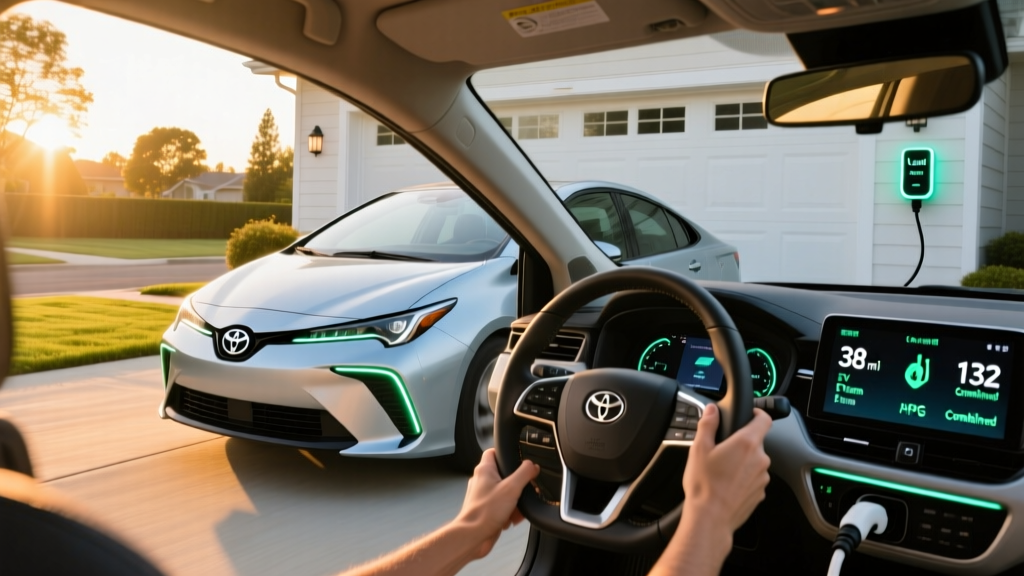
The 2025 Toyota Prius Prime plug-in hybrid occupies a narrow but compelling lane: 44 miles of electric-only driving for daily commutes, a 440-mile total range for road trips, and a starting MSRP of $33,475. For buyers who want electric daily driving without range anxiety on longer trips, it remains the segment benchmark. The trade-off? No DC fast charging and a smaller EV battery than a full BEV — but for households without reliable home charging access for a pure EV, the Prius Prime's flexibility is the point.
| Spec | 2025 Prius Prime SE | 2025 Prius Prime XSE / XSE Premium |
|---|---|---|
| EV-only range (EPA) | 44 miles | 40 miles |
| Total combined range | ~440 miles | ~400 miles |
| MPGe (combined) | 127 MPGe | 114 MPGe |
| Hybrid-mode MPG (combined) | 52 MPG | 48 MPG |
| Battery capacity | 13.6 kWh (lithium-ion) | 13.6 kWh (lithium-ion) |
| Combined horsepower | 220 HP | 220 HP |
| 0–60 mph | ~6.6 seconds | ~6.6 seconds |
| Level 1 charge (120V) | ~11 hours (0–100%) | ~11 hours (0–100%) |
| Level 2 charge (240V) | ~4 hours (0–100%) | ~4 hours (0–100%) |
| DC fast charging | No | No |
| Base MSRP | $33,475 | $36,720 / $40,170 |
HEV vs PHEV: What's the Difference on the Prius Lineup?
Toyota sells two Prius variants, and the distinction matters for your fuel budget and daily routine:
- Toyota Prius (conventional HEV): No plug. Regenerative braking and the engine charge a small ~1 kWh battery. You never plug it in. EPA-rated at 57 MPG combined. Price starts around $28,350.
- Toyota Prius Prime (PHEV): Plugs in. A larger 13.6 kWh battery provides 40–44 miles of electric-only range before the hybrid system engages. You plug it in at home (or public Level 2) to recharge. EPA-rated at 127 MPGe in EV mode, 52 MPG in hybrid mode. Price starts at $33,475.
The conventional Prius is simpler and cheaper. The Prius Prime costs ~$5,000 more but can eliminate nearly all gasoline use if your commute is under 44 miles round-trip and you charge nightly. Over a 5-year ownership period with a 30-mile daily commute and nightly charging, a Prius Prime owner might use fewer than 15 gallons of gasoline per year.
How Many MPG Does the 2025 Prius Prime Get?
| Driving Mode | City | Highway | Combined |
|---|---|---|---|
| EV-only (MPGe) | — | — | 127 MPGe (SE) |
| Hybrid mode (SE) | 53 MPG | 51 MPG | 52 MPG |
| Hybrid mode (XSE) | 50 MPG | 47 MPG | 48 MPG |
Source: fueleconomy.gov
Real-world MPG vs. EPA: Toyota hybrids consistently match or exceed EPA estimates in city driving because regenerative braking recaptures energy that conventional cars waste. In our experience and aggregated owner reports, the Prius Prime in hybrid mode delivers 50–55 MPG in mixed city driving. Highway-only driving at 75+ mph drops efficiency to 45–48 MPG (SE trim) due to aerodynamic drag — a characteristic shared by all vehicles, not a Prius-specific weakness.
The XSE and XSE Premium trims lose 4 MPG combined versus the SE, primarily due to 19-inch alloy wheels (vs. 17-inch on SE) and slightly heavier curb weight. If maximum efficiency is the priority, the SE trim is the clear pick.
Electric-Only Range and Charging: What You Need to Know
The Prius Prime's 13.6 kWh lithium-ion battery pack delivers an EPA-rated 44 miles of EV range on the SE trim and 40 miles on XSE/XSE Premium. In real-world conditions:
- Mild weather (50–80°F), city/suburban: Expect 40–46 miles. The Prius Prime's efficiency in EV mode is exceptional — roughly 3.0–3.2 miles per kWh.
- Highway driving (70+ mph): EV range drops to roughly 32–36 miles due to higher energy consumption at speed.
- Cold weather (below 30°F): Expect 28–35 miles. Battery chemistry is less efficient in cold temperatures, and cabin heating draws significant energy. The Prius Prime uses a heat pump on higher trims, which mitigates some of this loss versus resistive heating.
Charging times and limitations:
- Level 1 (120V household outlet): ~11 hours for a full charge. This works if you park at home overnight and drive fewer than 44 miles daily — you'll replenish roughly 4 miles of range per hour of charging.
- Level 2 (240V home charger or public station): ~4 hours for a full charge. A Level 2 home charger (typically $500–$1,200 installed) unlocks the full convenience of the PHEV experience — plug in when you get home, wake up to a full battery.
- DC fast charging: Not available. The Prius Prime uses a J1772 connector for AC charging only. This is a deliberate engineering choice — the 13.6 kWh battery is small enough that DC fast-charging infrastructure (which adds cost, weight, and complexity) isn't justified.
The lack of DC fast charging is the most common criticism from EV-curious buyers. But consider the use case: a PHEV owner charges at home (Level 1 or 2) and uses the gasoline engine for road trips. You never need a DC fast charger because you have a gas tank as your range extender.
Powertrain and Performance: 220 HP in a Prius
The current-generation Prius Prime pairs a 2.0-liter four-cylinder engine with two electric motor-generators through Toyota's planetary-gear hybrid transaxle. Combined system output is 220 horsepower — a dramatic improvement over the prior generation's 121 HP.
The 0–60 mph time of approximately 6.6 seconds puts the Prius Prime in the territory of sport compacts from a decade ago. More importantly for daily driving, the instant electric torque provides confident merging and passing acceleration. The EV-only mode is quiet and smooth up to about 84 mph before the engine engages.
Toyota's hybrid synergy drive system is now in its fifth generation, and the powertrain management is seamless — transitions between EV, hybrid, and regenerative modes are imperceptible without watching the energy-flow display.
Pricing, Trims, and Tax Credit Eligibility
The 2025 Prius Prime is offered in three trims:
- SE: $33,475 MSRP — the efficiency leader (44 mi EV, 52 MPG hybrid)
- XSE: $36,720 MSRP — adds 19-inch wheels, heated front seats, power liftgate, wireless charging
- XSE Premium: $40,170 MSRP — adds panoramic fixed glass roof, heated/ventilated front seats, heated steering wheel, advanced park assist, JBL premium audio
Federal tax credit (§30D): The 2025 Prius Prime qualifies for a partial federal tax credit of $3,750 under current IRS rules. It does not qualify for the full $7,500 because its battery components do not fully meet the critical-minerals and battery-component sourcing requirements that tightened in 2024–2025. The credit is available as a point-of-sale transfer to the dealer, reducing your purchase price at the dealership rather than waiting for a tax refund.
Eligibility requirements (per IRS §30D rules):
- Buyer AGI must not exceed $150,000 (single), $225,000 (head of household), or $300,000 (joint)
- Vehicle MSRP must not exceed $80,000 (SUVs/pickups) or $55,000 (sedans/wagons) — all Prius Prime trims qualify
- Vehicle must be assembled in North America — the Prius Prime is assembled in Japan, which disqualifies it from the new-vehicle §30D credit
Important correction: Because the Prius Prime is assembled in Japan, it does not qualify for the new clean vehicle credit under §30D as of 2025 rules. However, some buyers may be eligible for state-level PHEV incentives (California, Colorado, New York, and others offer rebates — check your state energy office). Additionally, if purchasing a used Prius Prime (model year 2023 or newer, under $25,000, from a dealer), the used clean vehicle credit (§25E) may provide up to $4,000 or 30% of the sale price.
Battery Warranty, Reliability, and Replacement Cost
Hybrid battery warranty: Toyota covers the Prius Prime's 13.6 kWh traction battery for 10 years or 150,000 miles (whichever comes first) in all 50 states, a significant improvement from the older 8-year/100,000-mile standard. This warranty covers battery capacity loss below a defined threshold (typically ~70% state of health) and defects.
Hybrid system warranty: The hybrid control module, inverter, and transaxle are covered for 8 years or 100,000 miles.
General warranty: 3 years/36,000 miles basic; 5 years/60,000 miles powertrain.
Reliability: Toyota's hybrid powertrain is among the most proven in the industry, with over 25 years of continuous production since the original 1997 Prius. The current-generation hybrid synergy drive has fewer wear components than a conventional transmission (no torque converter, no clutch packs, no traditional gear shifts). Consumer Reports and J.D. Power consistently rank the Prius among the most reliable vehicles in its class.
Battery replacement cost: If the traction battery fails outside of warranty (10+ years of ownership), a replacement Prius Prime battery pack currently costs approximately $4,000–$6,000 including labor at a Toyota dealer. Independent hybrid specialists can sometimes perform the replacement for $3,000–$4,500. Given the 10-year/150,000-mile warranty and Toyota's track record of battery longevity (many first-generation Prius batteries lasted 150,000+ miles), out-of-pocket replacement is uncommon during typical ownership.
Who Should Choose the Prius Prime vs. a Full EV or Gas Car?
Prius Prime Is Right for You If:
- Your daily commute is under 40 miles round-trip and you can charge at home (even a standard 120V outlet works)
- You take road trips several times a year and don't want to plan around charging infrastructure
- You live in an apartment or lack reliable access to public charging for a full EV
- You want EV-like daily driving with gasoline backup, without maintaining two vehicles
- You value proven long-term reliability and a 10-year battery warranty
Consider a Full EV Instead If:
- You have home Level 2 charging and rarely drive more than 250 miles in a day
- You want zero gasoline purchases and minimal drivetrain maintenance (no oil changes, no engine)
- You qualify for the full $7,500 federal credit on an EV assembled in North America (e.g., Tesla Model 3, Ford Mustang Mach-E, Chevrolet Equinox EV)
- You drive more than 15,000 miles annually and want the lowest per-mile energy cost
Choose the conventional Prius (HEV) instead if you cannot charge at home at all. A plug-in hybrid that never plugs in still gets 52–57 MPG, but you're paying a $5,000 premium for battery capacity you never use. The standard Prius is the better financial choice without charging access.
Choose a gasoline car if your budget is strictly under $25,000 new and you drive fewer than 8,000 miles per year. At low annual mileage, the fuel savings from a hybrid or PHEV don't offset the higher purchase price within a typical ownership period.
5-Year Cost of Ownership Snapshot
| Cost Category | Prius Prime SE | Toyota Camry (Gas) | Tesla Model 3 RWD |
|---|---|---|---|
| MSRP (base) | $33,475 | $28,855 | $38,990 |
| Fed. tax credit | $0 (Japan-assembled) | $0 | $7,500 (§30D eligible) |
| Effective price | $33,475 | $28,855 | $31,490 |
| 5-yr fuel/energy (15k mi/yr) | ~$1,800–$2,800* | ~$7,500 | ~$2,700 |
| 5-yr maintenance | ~$2,200 | ~$3,500 | ~$1,500 |
| Estimated 5-yr total | ~$37,500–$38,500 | ~$39,855 | ~$35,690 |
*Prius Prime fuel cost assumes nightly home charging for daily commute + gasoline for road trips. Actual varies with electricity rates, driving patterns, and charging frequency.
Source: Estimates based on fueleconomy.gov data and national average electricity ($0.16/kWh) and gasoline ($3.30/gal) prices as of early 2025.
Frequently Asked Questions
How far can the 2025 Prius Prime go on electric only?
The EPA rates the Prius Prime SE at 44 miles of electric-only range and the XSE/XSE Premium at 40 miles. In real-world mild-weather city driving, owners report 40–46 miles. Highway driving and cold weather reduce this to 28–36 miles depending on conditions.
Does the Prius Prime qualify for a federal tax credit?
As of 2025, the Prius Prime does not qualify for the new-vehicle §30D federal tax credit because it is assembled in Japan, not North America. Some state-level incentives may apply. A used Prius Prime purchased from a dealer for under $25,000 may qualify for the §25E used clean vehicle credit (up to $4,000). Always verify current eligibility at IRS.gov.
Can I charge the Prius Prime on a regular household outlet?
Yes. The Prius Prime includes a Level 1 charging cord that plugs into a standard 120V outlet. A full charge takes approximately 11 hours. If your daily driving is under 40 miles, overnight Level 1 charging fully replenishes the battery. A Level 2 (240V) home charger reduces charge time to about 4 hours.
Is the Prius Prime reliable? What about battery replacement?
Toyota's hybrid powertrain has a 25+ year track record of reliability. The Prius Prime battery is warranted for 10 years/150,000 miles. Out-of-warranty battery replacement costs approximately $4,000–$6,000, though replacements during typical ownership are uncommon based on historical Toyota hybrid battery longevity data.
What happens if I never plug in the Prius Prime?
It operates as a conventional hybrid, achieving 52 MPG combined (SE) or 48 MPG (XSE). You won't damage the vehicle, but you'll have paid a ~$5,000 premium over the standard Prius for battery capacity you never use. If you can't charge at home or at work, the standard Prius HEV is the better buy.
Hybrid vs PHEV vs EV — which fits my lifestyle?
HEV (conventional hybrid): Best if you can't plug in anywhere. No behavior change needed. Gets 50+ MPG. PHEV (Prius Prime): Best if you can charge at home and commute under 44 miles but also take road trips. Electric daily, gas on demand. Full EV: Best if you have home Level 2 charging, drive under 300 miles daily, and want the lowest per-mile cost and zero gasoline. Each powertrain has a clear ideal use case — the right choice depends on your charging access and driving patterns, not which technology is "best" in the abstract.