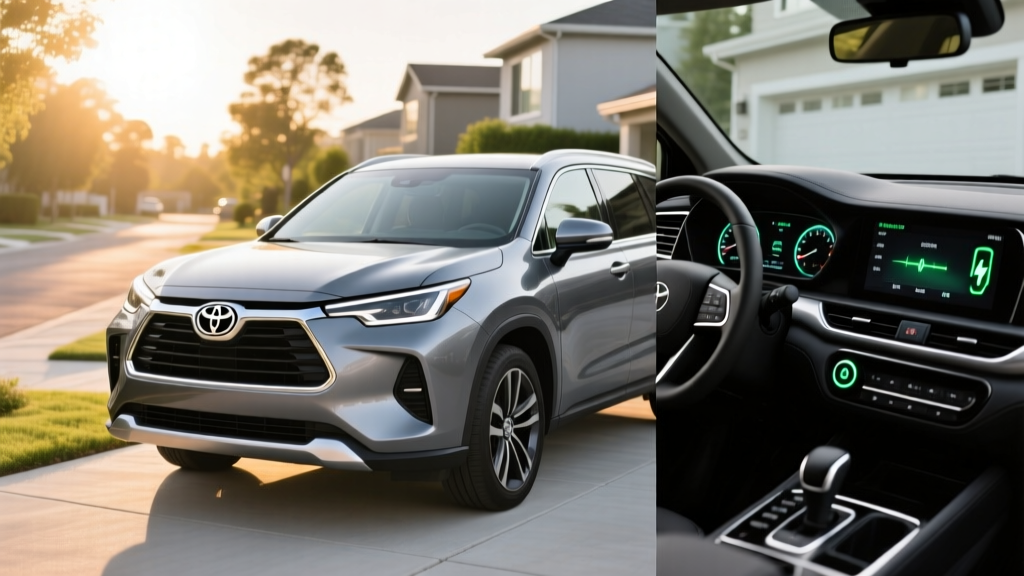
The three-row midsize SUV segment has no shortage of options, but the 2025 Toyota Hybrid Highlander occupies a specific niche: a family hauler that sips fuel without requiring you to plug in, change your habits, or worry about charging infrastructure. With an EPA-estimated 35 MPG combined and seating for up to seven, it remains one of the most practical hybrid SUVs on the market. This guide covers everything a buyer needs to know — from real-world fuel economy to battery longevity and tax-credit eligibility.
2025 Toyota Hybrid Highlander at a Glance
| Specification | Value |
|---|---|
| Powertrain | 2.5L 4-cylinder + 2 electric motors (AWD: 3 motors) |
| Combined Horsepower | 243 hp |
| Drivetrain | FWD or Electronic On-Demand AWD |
| EPA MPG (FWD) | 36 city / 35 highway / 36 combined |
| EPA MPG (AWD) | 35 city / 34 highway / 35 combined |
| Battery Type | Nickel-Metal Hydride (NiMH), sealed |
| Seating | 7 passengers (standard) |
| Cargo Volume (behind 3rd row) | 16.1 cu ft |
| Max Cargo (all seats folded) | 84.3 cu ft |
| Towing Capacity | 3,500 lbs |
| 0–60 mph | ~7.8 seconds (est.) |
| Starting MSRP (LE FWD) | $41,620 |
| Top Trim MSRP (Platinum AWD) | ~$53,070 |
| Hybrid Battery Warranty | 10 years / 150,000 miles |
Fuel Economy: EPA Numbers vs. Real-World MPG
The 2025 Toyota Hybrid Highlander's fuel economy is its headline feature. According to fueleconomy.gov, the front-wheel-drive model achieves 36 MPG city, 35 highway, and 36 combined. The AWD variant drops slightly to 35/34/35.
| Configuration | City | Highway | Combined |
|---|---|---|---|
| FWD (LE, XLE, Limited) | 36 MPG | 35 MPG | 36 MPG |
| AWD (all trims) | 35 MPG | 34 MPG | 35 MPG |
Toyota's hybrid system excels in stop-and-go city driving, where regenerative braking and electric-motor assist do the heavy lifting. Many owners report exceeding the EPA city figure in urban commutes — 37–40 MPG is achievable in warm weather with moderate acceleration. Highway driving at sustained 75+ MPH typically yields 30–33 MPG, as the gasoline engine carries more of the load and aerodynamic drag increases. In cold weather (below 30°F), expect a 5–10% reduction across the board as the engine runs more frequently for cabin heat and battery conditioning.
For context, the non-hybrid 2025 Highlander (turbocharged 2.4L, 265 hp) returns 22 city / 29 highway / 25 combined with AWD. The hybrid saves roughly 10 MPG combined — translating to approximately 120 fewer gallons per year for a driver covering 15,000 miles annually, or about $400–$500 in annual fuel savings at $3.50/gallon.
Hybrid vs. PHEV vs. EV: Which Highlander Fits You?
Toyota discontinued the Highlander Hybrid's plug-in variant (previously sold in limited markets) and does not offer a fully electric Highlander for 2025. However, Toyota does sell the Grand Highlander Hybrid (a larger variant with similar powertrain) and the battery-electric bZ4X crossover for those considering a BEV. Here's how the conventional hybrid Highlander compares to the alternatives:
| Factor | Highlander Hybrid (HEV) | Typical PHEV SUV | Typical 3-Row BEV |
|---|---|---|---|
| Plug-in Required? | No — self-charging | Yes — for EV range | Yes — always |
| Electric-Only Range | N/A (EV assist only) | 25–40 miles typical | 250–350 miles |
| Total Range | ~600+ miles | ~450–550 miles | 250–350 miles |
| Fuel Cost (per mile) | ~$0.10 | ~$0.04 (EV) / $0.10 (gas) | ~$0.04 |
| Federal Tax Credit | Not eligible | Up to $7,500 (if eligible) | Up to $7,500 (if eligible) |
| Home Charging Needed? | No | Recommended (Level 2) | Essential (Level 2) |
| Upfront Price Premium | ~$1,600 over gas model | ~$5,000–$8,000 over gas | ~$10,000–$15,000 over gas |
- Choose the Highlander Hybrid (HEV) if: You want maximum range without plug-in hassle, lack home charging access, frequently take long road trips, or want the lowest upfront cost among electrified three-row SUVs.
- Choose a PHEV three-row SUV if: You have home Level 2 charging, your daily commute is under 30 miles round-trip, and you want EV-like operating costs for errands while retaining gas flexibility for road trips.
- Choose a BEV three-row SUV if: You have reliable home charging, rarely drive more than 250 miles in a day, want the lowest per-mile operating cost, and are comfortable planning DC fast-charging stops on longer trips.
Powertrain Deep Dive: How the Hybrid System Works
The 2025 Highlander Hybrid uses Toyota's fourth-generation hybrid system paired with a 2.5-liter Dynamic Force inline-four engine. The engine itself produces 186 hp and 186 lb-ft of torque, but the hybrid system's electric motors bring the combined output to 243 hp.
In the FWD configuration, a single front-mounted electric motor assists the engine and handles low-speed propulsion. The AWD variant adds a second, independent rear electric motor (40 hp) that provides electronic on-demand all-wheel drive without a mechanical driveshaft — reducing weight and parasitic loss. This rear motor engages automatically during acceleration, slippery conditions, or when the system detects front-wheel slip.
The hybrid battery pack is a sealed nickel-metal hydride (NiMH) unit. Toyota has used NiMH chemistry in its mainstream hybrids for decades due to its proven durability, wide operating temperature range, and lower cost compared to lithium-ion. While NiMH has lower energy density than NMC lithium-ion, a conventional hybrid doesn't need large energy storage — the battery's job is to buffer energy from regenerative braking and provide short bursts of electric assist, not to power the vehicle for extended distances.
The transmission is Toyota's eCVT (electronically controlled continuously variable transmission), which uses a planetary gearset rather than a belt-and-pulley system. This design is mechanically simpler than traditional CVTs and has proven highly reliable over millions of Toyota hybrid vehicles.
Pricing, Trims, and Tax Credit Eligibility
The 2025 Toyota Hybrid Highlander is offered in five trims, all available with FWD or AWD (AWD adds $1,600):
- LE: $41,620 — 8-inch touchscreen, Toyota Safety Sense 2.5+, tri-zone climate
- XLE: $44,620 — SofTex seats, heated front seats, power liftgate, 7-inch TFT cluster
- XSE: $46,420 — Sport-tuned suspension, 20-inch wheels, black exterior accents
- Limited: $49,420 — Leather, 12.3-inch touchscreen, panoramic roof, JBL audio
- Platinum: $53,070 — Head-up display, 360° camera, ventilated front seats, heated second row
The 2025 Toyota Hybrid Highlander is a conventional hybrid (HEV), not a plug-in vehicle. Under IRS §30D rules, only battery-electric vehicles (BEVs) and plug-in hybrids (PHEVs) with sufficient battery capacity qualify for the federal clean vehicle credit. The Highlander Hybrid does not qualify for the $7,500 federal tax credit, nor does it qualify for the up-to-$4,000 used clean vehicle credit. Some states may offer minor incentives for high-efficiency vehicles — check your state's energy office or DMV for current programs.
Despite the lack of a federal credit, the hybrid's modest price premium over the gas-only Highlander (~$1,600 on comparable trims) typically pays for itself in fuel savings within 3–4 years for an average driver, based on 15,000 miles annually and $3.50/gallon fuel.
Battery Longevity, Warranty, and Replacement Cost
Hybrid battery durability is consistently the top concern among first-time hybrid buyers. Toyota addresses this with a robust warranty and a long track record of NiMH battery reliability.
| Component | Coverage |
|---|---|
| Hybrid Battery | 10 years / 150,000 miles (whichever comes first) |
| Hybrid System Components (inverter, motors, eCVT) | 8 years / 100,000 miles |
| Powertrain (engine, transmission) | 5 years / 60,000 miles |
| Basic Bumper-to-Bumper | 3 years / 36,000 miles |
Toyota's NiMH hybrid batteries have demonstrated exceptional longevity in real-world use. Data from fleets and long-term owners shows that many Toyota hybrid batteries retain 85–90%+ of their original capacity after 150,000 miles. Complete failures within the warranty period are uncommon — estimated at under 5% across the Toyota hybrid fleet based on industry service data.
If replacement is needed outside warranty, a new OEM hybrid battery for the Highlander Hybrid costs approximately $3,000–$4,500 including parts and labor at a Toyota dealership. Independent hybrid specialists and refurbished battery options can reduce this to $1,500–$2,500. For comparison, a transmission replacement on a conventional gas SUV can cost $3,000–$5,000.
The eCVT design further reduces long-term risk: unlike belt-driven CVTs found in some competitors, Toyota's planetary-gear eCVT has no belts, chains, or friction surfaces that wear in the traditional sense. Failures are exceedingly rare.
Real-World Ownership: What to Expect
Beyond fuel economy, several ownership characteristics distinguish the 2025 Highlander Hybrid from both its gas-only sibling and electrified competitors:
No plug-in required. The hybrid system charges its own battery through regenerative braking and engine-generated electricity. You fuel it exactly like a conventional gas vehicle — no charging cables, no home electrical upgrades, no public charging apps.
Regenerative braking feel. The Highlander Hybrid's regen is moderate compared to full EVs. Toyota offers a sequential shift mode that increases regen intensity, but true one-pedal driving (as in a BEV) is not available. Brake pad wear is significantly reduced — many owners report 80,000+ miles on original pads.
Acceleration. The 243 hp combined output moves the ~4,500-lb SUV adequately but not briskly. Expect 0–60 MPH in roughly 7.8 seconds. The electric motors provide instant torque off the line, making city merging confident, but highway passing at speed requires a downshift and higher RPMs. This is a comfort-oriented cruiser, not a performance SUV.
Cargo and practicality. The hybrid battery is packaged under the second-row seat, so cargo volume is identical to the gas model: 16.1 cu ft behind the third row, expanding to 84.3 cu ft with both rear rows folded. The third row accommodates children comfortably but is tight for adults on longer trips.
Towing. The hybrid is rated for 3,500 lbs — sufficient for a small boat, utility trailer, or pop-up camper, but less than some V6 competitors. If you tow frequently above 3,000 lbs, factor in a 15–25% fuel economy reduction.
Pros and Cons
- 35–36 MPG combined — best in its three-row segment
- No plug-in charging required; zero lifestyle change from gas
- 10-year/150,000-mile hybrid battery warranty
- Proven Toyota reliability and strong resale value
- Standard AWD availability with electronic on-demand system
- Toyota Safety Sense 2.5+ standard on all trims
- Low long-term maintenance (reduced brake wear, no plug-in components)
- No federal tax credit eligibility (HEV, not PHEV/BEV)
- Modest 243 hp — acceleration is adequate, not quick
- 3,500-lb towing capacity trails some V6 rivals
- Third row is tight for adults
- Infotainment system lags behind competitors in responsiveness
- Platinum trim pushes past $53,000 without luxury badge prestige
- No EV-only driving mode for short trips (unlike PHEV)
Frequently Asked Questions
How many MPG does the 2025 Toyota Hybrid Highlander get?
The FWD model achieves an EPA-estimated 36 city / 35 highway / 36 combined. The AWD version rates at 35/34/35. In real-world driving, city MPG often exceeds the EPA estimate (37–40 MPG in warm weather), while sustained highway driving at 75+ MPH typically returns 30–33 MPG.
Does the Highlander Hybrid need to be plugged in?
No. The 2025 Highlander Hybrid is a conventional hybrid (HEV), not a plug-in hybrid (PHEV). The battery charges itself through regenerative braking and the gasoline engine. You never need to plug it in — just fill up with gas as you would any conventional vehicle.
Is there a plug-in hybrid (PHEV) version of the 2025 Highlander?
Toyota does not offer a PHEV variant of the Highlander for the 2025 model year. If you want a Toyota PHEV with three rows, the Rav4 Prime (compact, 5 passengers) offers 42 miles of electric-only range but lacks a third row. For a three-row Toyota PHEV, you'd need to look at the Grand Highlander Hybrid (HEV only) or consider competitors like the Jeep Grand Cherokee 4xe or Mazda CX-90 PHEV.
Does the 2025 Highlander Hybrid qualify for any tax credit?
No. Under current IRS §30D rules, only plug-in electric vehicles (BEVs and PHEVs) with qualifying battery sourcing and MSRP/income thresholds are eligible for the federal clean vehicle credit. Conventional hybrids like the Highlander Hybrid are excluded. Check your state's energy office for any local efficiency incentives.
How long will the hybrid battery last, and what does replacement cost?
Toyota warranties the hybrid battery for 10 years or 150,000 miles. Real-world data from Toyota's hybrid fleet shows most batteries retain strong capacity well beyond 150,000 miles, with complete failures being uncommon (under 5%). If replacement is needed out of warranty, expect $3,000–$4,500 at a dealer, or $1,500–$2,500 through an independent hybrid specialist using refurbished cells.
How does the Highlander Hybrid compare to a full EV like the Kia EV9?
The EV9 offers 270–304 miles of EPA range, 0–60 in 5.0–8.2 seconds (depending on trim), and significantly lower per-mile fuel costs (~$0.04/mile vs. ~$0.10/mile for the hybrid). However, the EV9 starts around $56,000, requires home Level 2 charging for daily convenience, and needs DC fast-charging planning for road trips over 250 miles. The Highlander Hybrid costs less upfront, needs no charging infrastructure, and offers 600+ miles of total range — making it better suited for buyers without home charging or frequent long-distance drivers.
Is the Highlander Hybrid reliable?
Toyota's hybrid powertrain is among the most proven in the automotive industry, with over 25 years of continuous refinement since the original Prius. IIHS has historically rated the Highlander highly for safety. The NiMH battery, planetary eCVT, and mature hybrid control software contribute to a powertrain with fewer failure points than many conventional gas-only drivetrains. Toyota's 10-year/150,000-mile hybrid battery warranty further reduces long-term risk.
Is AWD worth it on the Highlander Hybrid?
The electronic on-demand AWD system costs $1,600 extra and reduces combined MPG by just 1 MPG (35 vs. 36). If you live in a region with snow, rain, or unpaved roads, the AWD system provides meaningful traction benefits with negligible fuel economy penalty. For warm-climate, pavement-only drivers, FWD is the efficiency and value pick.
Final Verdict: Who Should Buy the 2025 Toyota Hybrid Highlander?
The 2025 Toyota Hybrid Highlander is the right choice for families who want three-row practicality, proven reliability, and best-in-segment fuel economy — without taking the plunge into plug-in ownership. It's ideal for buyers who lack home charging access, frequently drive beyond 300 miles, live in areas with sparse public charging, or simply want an SUV that works exactly like a gas vehicle but uses 30% less fuel.
It's not the right pick if you want EV-only commuting (look at a PHEV), need maximum towing capacity (consider a body-on-frame SUV), or prioritize acceleration and driving dynamics over efficiency. And if you already have home Level 2 charging and your daily driving stays under 250 miles, a three-row BEV like the Kia EV9 or Rivian R1S will deliver lower operating costs and available federal tax credits.
For its intended audience — efficiency-minded families who want simplicity and reliability — the 2025 Highlander Hybrid remains the benchmark in its class.