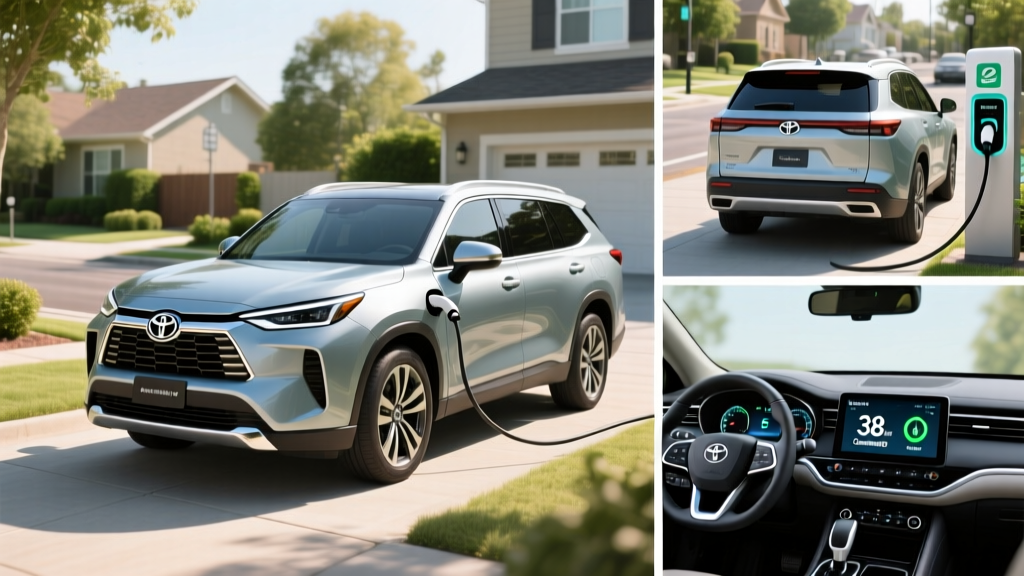
The three-row hybrid SUV segment has a clear heavyweight, and the 2025 Toyota Grand Highlander Hybrid XLE sits right in the sweet spot of the lineup. It pairs Toyota's proven hybrid synergy drive with enough interior volume to actually fit adults in the third row — something the standard Highlander has struggled with for years. For families weighing a hybrid against a plug-in hybrid or a full battery-electric vehicle, the Grand Highlander Hybrid XLE demands a close look.
This guide covers everything a research-driven buyer needs: exact EPA fuel economy, the powertrain breakdown, real-world MPG expectations, battery longevity, pricing, and a clear decision framework for choosing this HEV over a PHEV or BEV. No fluff — just the numbers and ownership realities that matter.
HEV vs. PHEV: What the Grand Highlander Hybrid Actually Is
Before evaluating the specs, it is critical to understand what you are buying. The 2025 Toyota Grand Highlander Hybrid XLE is a conventional hybrid electric vehicle (HEV), not a plug-in hybrid (PHEV). This distinction changes everything about how you use and fuel the vehicle.
HEV vs. PHEV — Key Differences
| Feature | HEV (Grand Highlander Hybrid) | PHEV (e.g., RAV4 Prime) |
|---|---|---|
| Plugs in to charge? | No — charges via engine & regen | Yes — Level 1/Level 2 |
| Electric-only range | ~1 mile at low speed | 25-42 miles typical |
| Battery size | ~1.4 kWh (small buffer) | 18-22 kWh usable |
| Home charger needed? | No | Recommended (Level 2) |
| Federal tax credit (§30D)? | No | Up to $7,500 (if eligible) |
| Best for | No home charging access; long trips | Home charging + short commutes |
The Grand Highlander Hybrid generates all its electricity onboard through the gasoline engine and regenerative braking. You never plug it in. You fuel it at a gas station like any other vehicle — it simply uses far less fuel.
Fuel Economy: EPA MPG and Real-World Expectations
The headline number for the 2025 Grand Highlander Hybrid is its EPA-estimated fuel economy. Toyota offers two hybrid powertrains, and the XLE trim is available with the standard hybrid system (not the Hybrid MAX). Here is how the numbers break down:
| Powertrain | City MPG | Highway MPG | Combined MPG |
|---|---|---|---|
| Standard Hybrid (FWD) | 36 | 32 | 34 |
| Standard Hybrid (AWD) | 35 | 33 | 34 |
| Hybrid MAX (AWD, higher trims) | 26 | 27 | 27 |
Source: fueleconomy.gov — EPA estimates. Your mileage will vary.
📊 Real-World MPG: What to Actually Expect
Toyota hybrids have a well-documented tendency to exceed EPA estimates in city driving thanks to frequent regenerative braking opportunities. In mixed suburban and city driving, owners commonly report 35-38 MPG with the standard hybrid AWD.
However, highway-heavy driving at 75-80 mph will pull numbers down to 29-31 MPG. Cold weather (below freezing) typically reduces hybrid fuel economy by 5-10% due to increased engine idling for cabin heat and reduced battery efficiency.
On a 600-mile road trip with mixed conditions, expect to use approximately 17-19 gallons — roughly one fewer fill-up than a comparable gas-only three-row SUV getting 22-24 MPG combined.
Powertrain Specs: 245 HP Hybrid Synergy Drive
The XLE trim uses Toyota's standard hybrid powertrain — a 2.5-liter four-cylinder engine paired with two electric motors (front and rear for AWD models). This is not the Hybrid MAX system, which is reserved for the Limited and Platinum trims and trades efficiency for performance.
| Specification | 2025 Grand Highlander Hybrid XLE (AWD) |
|---|---|
| Engine | 2.5L DOHC 4-cylinder + 2 electric motors (AWD e-CVT) |
| Combined horsepower | 245 hp |
| Transmission | Electronically controlled CVT (e-CVT) |
| Drivetrain | AWD (electronic rear motor) |
| 0-60 mph | ~7.5 seconds (est.) |
| Hybrid battery | ~1.4 kWh lithium-ion (sealed, self-charging) |
| Towing capacity | 3,500 lbs (standard hybrid) |
| Fuel tank | 17.1 gallons |
| Total range (est.) | ~580 miles per tank |
| Seating | 7 or 8 passengers |
| Cargo (behind 3rd row) | 20.6 cu ft |
The e-CVT is not a traditional belt-driven CVT — it uses a planetary gearset to blend engine and motor power seamlessly. There are no fixed gear ratios, which eliminates shift shock but produces a characteristic engine drone under hard acceleration. For highway merging and passing, the 245 hp combined output is adequate for a vehicle this size, though the Hybrid MAX's 362 hp is noticeably quicker if you are willing to sacrifice 7 MPG.
Battery Longevity, Warranty, and Replacement Cost
Hybrid battery anxiety is the number-one concern we hear from first-time hybrid buyers. Here is the data-backed reality for the Grand Highlander Hybrid.
🔋 Toyota Hybrid Battery Warranty
- Coverage: 10 years / 150,000 miles (whichever comes first)
- Applies to: Hybrid battery pack, hybrid control module, and related components
- Transferable: Yes — transfers to subsequent owners automatically
- Capacity threshold: Toyota covers defects and premature failure; there is no published minimum capacity retention percentage (unlike BEV warranties)
Source: Toyota Warranty Guide
Real-World Hybrid Battery Lifespan
Toyota's hybrid battery track record is among the best in the industry. The Prius, now in its fifth generation, has demonstrated that Toyota hybrid batteries routinely last 150,000-200,000+ miles before needing replacement. The Grand Highlander uses a newer lithium-ion pack (earlier Toyotas used NiMH), which offers better energy density and thermal stability.
Replacement cost if out of warranty: A Toyota hybrid battery replacement currently runs between $3,000 and $5,000 depending on the source (dealer vs. independent shop, new vs. remanufactured). Third-party hybrid battery specialists like Green Bean Battery offer remanufactured units with their own warranties at the lower end of that range.
The small 1.4 kWh battery in the standard hybrid undergoes shallow charge-discharge cycles (typically operating between 40-80% state of charge), which dramatically reduces degradation compared to a full BEV battery that regularly cycles from 10-90%. This shallow-cycling design is why Toyota hybrid batteries last so long.
Pricing, Trims, and Tax Credit Eligibility
The 2025 Toyota Grand Highlander Hybrid XLE AWD carries an MSRP of approximately $46,510 (including destination). Here is how the hybrid lineup is priced:
| Trim | Powertrain | MSRP (AWD) |
|---|---|---|
| XLE | Standard Hybrid (245 hp) | ~$46,510 |
| Limited | Standard Hybrid or Hybrid MAX | ~$51,000-$54,500 |
| Platinum | Hybrid MAX (362 hp) | ~$58,000+ |
⚠️ Federal Tax Credit: Not Eligible
The Grand Highlander Hybrid is a conventional HEV, not a plug-in vehicle. Under current IRS §30D rules, the federal clean vehicle credit (up to $7,500) applies only to battery electric vehicles (BEVs) and plug-in hybrids (PHEVs) that meet battery sourcing, MSRP, and buyer income requirements. Conventional hybrids do not qualify for the federal EV tax credit. Some states offer separate hybrid incentives — check your state's energy office for current programs.
Hybrid vs. PHEV vs. EV: Which Three-Row SUV Fits You?
Choosing between a conventional hybrid, a plug-in hybrid, and a full electric three-row SUV depends on your charging access, driving patterns, and budget. Here is a practical decision framework:
Choose the Grand Highlander Hybrid (HEV) if:
- You cannot install a home charger (apartment, street parking, no garage)
- You take frequent long road trips (400+ miles) and want zero charging planning
- You want maximum fuel efficiency without changing your fueling habits
- Your budget is under $50,000 for a three-row hybrid
- You want Toyota's long-proven hybrid reliability track record
Choose a PHEV (e.g., Mazda CX-90 PHEV, Chrysler Pacifica PHEV) if:
- You have home Level 2 charging and a commute under 30 miles
- You want 25-35 miles of electric-only driving for daily errands
- You want federal tax credit eligibility (up to $7,500 if income/sourcing rules met)
- You still want a gas engine for long road trips
Choose a full BEV (e.g., Kia EV9, Tesla Model X) if:
- You have reliable home charging and access to DC fast charging for road trips
- You want zero tailpipe emissions and the lowest per-mile fuel cost
- You are comfortable planning charging stops on trips over 250 miles
- You want the strongest federal and state incentive eligibility
What the XLE Trim Gets You (and What It Doesn't)
The XLE is the volume trim for the Grand Highlander Hybrid, and Toyota equips it well for the price. Standard features include SofTex-trimmed heated front seats, a 12.3-inch touchscreen with wireless Apple CarPlay and Android Auto, a power liftgate, tri-zone automatic climate control, and Toyota Safety Sense 3.0 (adaptive cruise, lane-keeping, automatic emergency braking, blind-spot monitoring).
What you give up versus the Limited: no ventilated seats, no panoramic roof, no premium JBL audio, no heads-up display, and no Hybrid MAX powertrain option. For most families, the XLE's equipment list covers the essentials without the $5,000+ step up to Limited.
Pros and Cons at a Glance
✅ Pros
- 34 MPG combined in a 3-row, 7/8-passenger SUV
- Genuine adult-sized third row (unlike standard Highlander)
- 10-year/150,000-mile hybrid battery warranty
- No charging infrastructure required
- ~580-mile total range per tank
- Strong resale value (Toyota brand)
- TSS 3.0 safety suite standard
❌ Cons
- No federal tax credit (HEV, not PHEV/BEV)
- CVT drone under hard acceleration
- 20.6 cu ft cargo behind 3rd row — tight for a "Grand" SUV
- Only 3,500-lb towing (Hybrid MAX tows 5,000 lbs)
- No electric-only driving beyond parking-lot speeds
- XLE lacks ventilated seats and premium audio
Frequently Asked Questions
How many MPG does the 2025 Toyota Grand Highlander Hybrid XLE get?
The EPA rates the Grand Highlander Hybrid AWD at 35 city / 33 highway / 34 combined MPG. In real-world mixed driving, expect 32-37 MPG depending on conditions. City-heavy driving favors the hybrid system; sustained highway speeds above 70 mph reduce efficiency.
Does the Grand Highlander Hybrid need to be plugged in?
No. The Grand Highlander Hybrid is a conventional HEV. It charges its small hybrid battery through the gasoline engine and regenerative braking. You never plug it in — you simply refuel at a gas station.
Is there a plug-in hybrid (PHEV) version of the Grand Highlander?
As of the 2025 model year, Toyota does not offer a PHEV version of the Grand Highlander. If you want a Toyota PHEV with three rows, you would need to look at the Sienna (which is a hybrid-only minivan, not a PHEV) or consider competitors like the Mazda CX-90 PHEV.
Is the Grand Highlander Hybrid reliable, and what does battery replacement cost?
Toyota's hybrid powertrains have a two-decade reliability track record, and the hybrid battery is warranted for 10 years / 150,000 miles. If replacement is needed out of warranty, expect to pay $3,000-$5,000. The shallow-cycling battery design means most units last well beyond 150,000 miles.
Does the 2025 Grand Highlander Hybrid qualify for any tax credit?
No. The federal §30D clean vehicle credit applies only to plug-in vehicles (BEVs and PHEVs). The Grand Highlander Hybrid is a conventional HEV and does not qualify. Check your state's energy office for any local hybrid incentives, which vary by jurisdiction.
How does the Grand Highlander Hybrid compare to the Kia Sorento Hybrid?
The Sorento Hybrid is smaller (midsize vs. large), seats 6 instead of 7-8, and offers less third-row and cargo space. It gets a similar 34-36 MPG combined but at a lower starting price (~$40,000). If you need genuine three-row comfort, the Grand Highlander is the better fit; if two occasional jump seats suffice, the Sorento saves money.
What is the difference between the standard hybrid and Hybrid MAX?
The standard hybrid (245 hp, 34 MPG combined) prioritizes fuel efficiency. The Hybrid MAX (362 hp, 27 MPG combined, available on Limited and Platinum trims) uses a turbocharged 2.4L engine with a more powerful electric system for faster acceleration and 5,000-lb towing — at the cost of 7 MPG and a higher price.