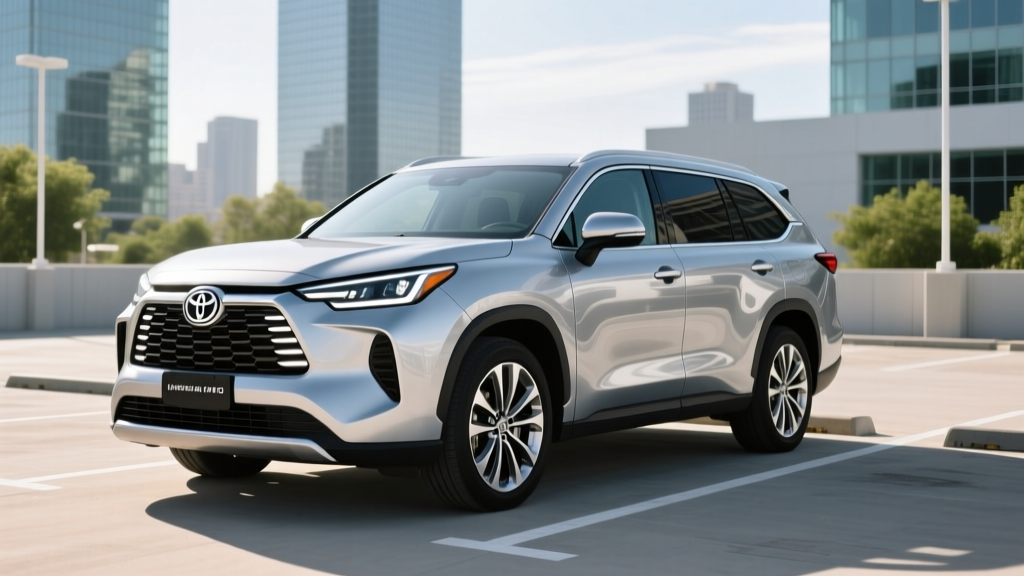
Three-row SUV buyers who want serious fuel savings without plugging in keep circling back to one nameplate. The Grand Highlander Hybrid pairs Toyota's proven series-parallel hybrid system with the cargo room and third-row space that midsize crossovers often fake. This guide breaks down the 2025 Toyota Grand Highlander Hybrid MSRP by trim, its EPA fuel economy, real-world efficiency expectations, and whether this HEV makes more sense than a PHEV or full EV for your family.
2025 Toyota Grand Highlander Hybrid MSRP by Trim
Toyota offers the Grand Highlander Hybrid in several trims, all built around the same 2.5-liter four-cylinder hybrid powertrain. Pricing has climbed modestly from the launch year, but the Grand Highlander Hybrid remains one of the most affordable three-row hybrids on the market. Below are the starting MSRPs (destination charge included) as published by Toyota for the 2025 model year.
| Trim | Drivetrain | MSRP |
|---|---|---|
| LE | FWD | $45,020 |
| LE | AWD | $46,620 |
| XLE | AWD | $49,405 |
| Limited | AWD | $54,505 |
| Platinum | AWD | $58,175 |
Add-ons like panoramic roof, captain's chairs, and premium audio packages can push a Limited or Platinum past $62,000. For comparison, the non-hybrid turbo-four Grand Highlander starts around $43,070, making the hybrid premium roughly $2,000 at the LE trim — a gap most buyers recoup in fuel savings within three to four years of average driving.
EPA Fuel Economy and Real-World MPG
The Grand Highlander Hybrid uses Toyota's fifth-generation hybrid system with a 2.5-liter inline-four paired with front and (on AWD models) rear electric motors. The EPA rates the AWD hybrid at 35 MPG combined, which is exceptional for a vehicle with over 97 cubic feet of cargo space behind the front row.
| Drivetrain | City | Highway | Combined |
|---|---|---|---|
| FWD | 37 MPG | 34 MPG | 36 MPG |
| AWD (Hybrid) | 36 MPG | 32 MPG | 35 MPG |
| AWD (Hybrid MAX — performance turbo hybrid) | 27 MPG | 28 MPG | 27 MPG |
Over 15,000 miles per year at $3.40/gallon, the 35 MPG AWD hybrid costs roughly $1,457 in fuel annually. The non-hybrid turbo-four Grand Highlander (24 MPG combined) would burn through about $2,125 — a $668 annual gap that widens as gas prices rise. Source: fueleconomy.gov.
HEV vs PHEV vs EV: Which Grand Highlander Fits?
Toyota does not currently offer a plug-in hybrid (PHEV) version of the Grand Highlander. The Highlander PHEV was discontinued after the 2023 model year, so if you need plug-in capability in a Toyota three-row, your options are limited. Here's how the three electrified paths compare for a family-SUV buyer:
Conventional Hybrid (HEV)
Grand Highlander Hybrid. No plug needed. 35 MPG combined. Self-charging via regenerative braking and the gas engine. Best for buyers without home charging access or who drive 400+ mile road trips regularly.
Plug-In Hybrid (PHEV)
Not available in Grand Highlander. A PHEV would offer 30–40 miles of electric-only range before the gas engine engages. Requires Level 2 home charging for best value. Closest Toyota equivalent: the RAV4 Prime (42 mi EV range) — but it's a two-row compact.
Full EV (BEV)
Kia EV9, Tesla Model X. 300+ mile range, zero tailpipe emissions, lowest per-mile fuel cost. Requires reliable home or workplace charging. Higher upfront cost but lower operating cost over 5 years.
If you can charge at home and your daily driving stays under 40 miles, a PHEV or BEV cuts fuel costs further. But for families who regularly tow (the Grand Highlander Hybrid tows up to 3,500 lbs), take long road trips, or lack charging access, the conventional hybrid is the pragmatic pick.
Powertrain Specs: What's Under the Hood
| Specification | Hybrid AWD | Hybrid MAX AWD |
|---|---|---|
| Engine | 2.5L inline-4 + 2 electric motors | 2.4L turbo inline-4 + electric motor |
| Combined Horsepower | 245 HP | 362 HP |
| Combined Torque | 173 lb-ft (engine) + electric torque | 400 lb-ft |
| Transmission | eCVT (planetary gearset) | 6-speed automatic |
| 0–60 MPH | ~7.8 sec | ~6.3 sec |
| Towing Capacity | 3,500 lbs | 5,000 lbs |
| Battery Type | Nickel-Metal Hydride (NiMH), ~1.6 kWh | NiMH, ~1.6 kWh |
The standard hybrid uses Toyota's eCVT — not a belt-and-cone CVT, but a planetary gearset that blends engine and motor power seamlessly. It's the same architecture proven over 25+ years in the Prius, Camry Hybrid, and Highlander Hybrid. The Hybrid MAX swaps refinement and efficiency for a turbocharged punch and a conventional geared automatic, aimed at buyers who want near-V6 acceleration.
Battery Warranty, Lifespan, and Replacement Cost
Toyota's hybrid battery track record is among the best. The NiMH packs used in the Grand Highlander Hybrid are conservatively sized (~1.6 kWh usable) and never fully charged or fully depleted — the system keeps the battery in a 40–80% state-of-charge window, which dramatically reduces degradation. Data from millions of Prius and Highlander Hybrid vehicles on the road shows that most Toyota hybrid batteries last 150,000–200,000+ miles without needing replacement.
If a replacement is needed out of warranty, a new OEM Toyota hybrid battery for the Highlander/Grand Highlander platform typically costs between $3,000 and $5,000 including labor at a dealership. Independent hybrid specialists often offer refurbished or reconditioned packs for $1,500–$2,500. Given the 10-year/150,000-mile warranty and the proven longevity of Toyota's NiMH packs, battery replacement is a low-probability event for most original owners.
Tax Credits and Incentives: Does It Qualify?
This is where hybrid buyers often encounter confusion. The 2025 Toyota Grand Highlander Hybrid is a conventional hybrid (HEV), not a plug-in vehicle. Under the federal IRS §30D Clean Vehicle Credit, only battery-electric vehicles (BEVs) and plug-in hybrids (PHEVs) with sufficient battery capacity qualify. The Grand Highlander Hybrid does NOT qualify for the $7,500 federal EV tax credit.
However, there are other savings to consider:
- State hybrid incentives: A handful of states offer rebates or HOV-lane access for conventional hybrids, though these are increasingly rare as states shift incentives toward BEVs and PHEVs.
- Lower total cost of ownership: The $668/year fuel savings over the non-hybrid turbo-four adds up to $3,340 over five years — often exceeding what a state hybrid rebate would provide.
- No §30D income or MSRP caps to worry about: Since the credit doesn't apply, you aren't constrained by the $80,000 SUV MSRP cap or the $300,000/$150,000 adjusted gross income limits that affect EV credit eligibility.
For buyers specifically chasing the $7,500 federal credit, the closest three-row options are the Kia EV9 (BEV, partial credit eligibility depending on sourcing rules) or waiting for a future PHEV three-row entrant. Always verify current credit rules at irs.gov, as battery-sourcing and critical-mineral requirements change annually.
Pros and Cons: The Honest Assessment
✓ Pros
- 35 MPG combined in a genuine three-row SUV with usable adult-sized third row
- 97.5 cu-ft cargo volume behind front row — class-leading
- 10-year / 150,000-mile hybrid battery warranty
- Proven Toyota hybrid reliability with 25+ years of iteration
- No plug-in requirement — works for apartment dwellers and road-trippers alike
- Standard Toyota Safety Sense 3.0 (adaptive cruise, lane-keep, automatic emergency braking)
✗ Cons
- No PHEV option — can't access EV-only commuting or federal tax credit
- 245 HP feels adequate, not quick, for a 4,600-lb SUV (Hybrid MAX fixes this but drops to 27 MPG)
- AWD hybrid starts at $46,620 — a significant outlay vs. non-hybrid LE at ~$44,670
- eCVT drone under hard acceleration (common to Toyota hybrids)
- 3,500-lb tow rating (Hybrid MAX tows 5,000 lbs but sacrifices fuel economy)
- Third row is tight for adults on long trips (best for kids or short drives)
Who Should Buy the Grand Highlander Hybrid?
Choose the Grand Highlander Hybrid if: You need three rows and cargo space, drive 12,000–20,000 miles per year, lack reliable home or workplace EV charging, take regular road trips over 300 miles, and want a vehicle that will reliably last 200,000+ miles with minimal powertrain risk.
Look at a full EV (Kia EV9, Tesla Model X) if: You have Level 2 home charging, your daily commute is under 60 miles, you want to eliminate gas entirely, and you qualify for the $7,500 federal tax credit (income and sourcing rules permitting).
Consider the non-hybrid Grand Highlander turbo-four if: Your annual mileage is under 8,000 miles, making the $2,000 hybrid premium hard to recoup within your ownership timeframe.
Frequently Asked Questions
How many MPG does the 2025 Grand Highlander Hybrid get?
The AWD hybrid is EPA-rated at 36 city / 32 highway / 35 combined MPG. The FWD version bumps combined to 36 MPG. Real-world city driving often yields 36–39 MPG thanks to Toyota's strong regenerative braking, while sustained 75+ MPH highway driving drops to approximately 29–31 MPG.
Does the Grand Highlander Hybrid need to be plugged in?
No. The Grand Highlander Hybrid is a conventional hybrid (HEV). It charges its small battery pack through regenerative braking and the gas engine. There is no plug, no charging port, and no electric-only driving mode of meaningful distance. You simply fill it with gas and drive.
Is there a Grand Highlander PHEV or plug-in version?
Not for 2025. Toyota has not announced a plug-in hybrid Grand Highlander. The Highlander PHEV (sold in limited markets) was discontinued. If Toyota introduces a Grand Highlander PHEV in a future model year, it would likely offer 30–40 miles of electric-only range and qualify for partial federal tax credits — but as of this writing, no such model exists.
How long will the hybrid battery last?
Toyota's NiMH hybrid batteries are engineered to last the life of the vehicle. Real-world data from the Highlander Hybrid and Prius platforms shows most batteries lasting 150,000–200,000+ miles. Toyota backs the hybrid battery with a 10-year / 150,000-mile warranty. Out-of-warranty replacement runs $3,000–$5,000 at a dealer, or $1,500–$2,500 at an independent hybrid specialist.
Does the 2025 Grand Highlander Hybrid qualify for a tax credit?
No. Federal §30D Clean Vehicle Credits apply only to plug-in vehicles (BEVs and PHEVs). Since the Grand Highlander Hybrid is a conventional HEV, it does not qualify. Some states may offer minor hybrid incentives — check your state's energy office or fueleconomy.gov's incentives page for local programs.
How does the Grand Highlander Hybrid compare to the Kia Sorento Hybrid?
The Sorento Hybrid starts lower (~$38,000) and returns 35 MPG combined, but it's smaller inside — its third row is best suited for children, and cargo space behind the third row is significantly less. The Grand Highlander Hybrid offers genuinely usable adult third-row seating and 97.5 cu-ft of total cargo volume, justifying its higher MSRP for larger families.
Is the Hybrid MAX worth the premium?
The Hybrid MAX delivers 362 HP and a 5,000-lb tow rating, but fuel economy drops to 27 MPG combined and it's only available on the Limited and Platinum trims (starting above $54,505). If towing and acceleration are priorities, it's a compelling upgrade. If fuel savings are the main goal, the standard 245 HP hybrid at 35 MPG is the smarter buy.