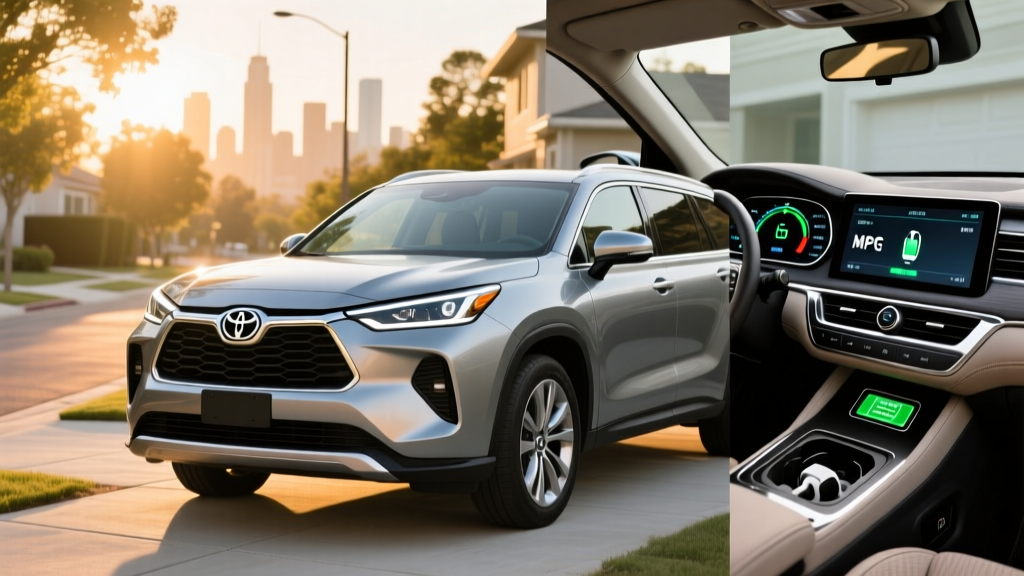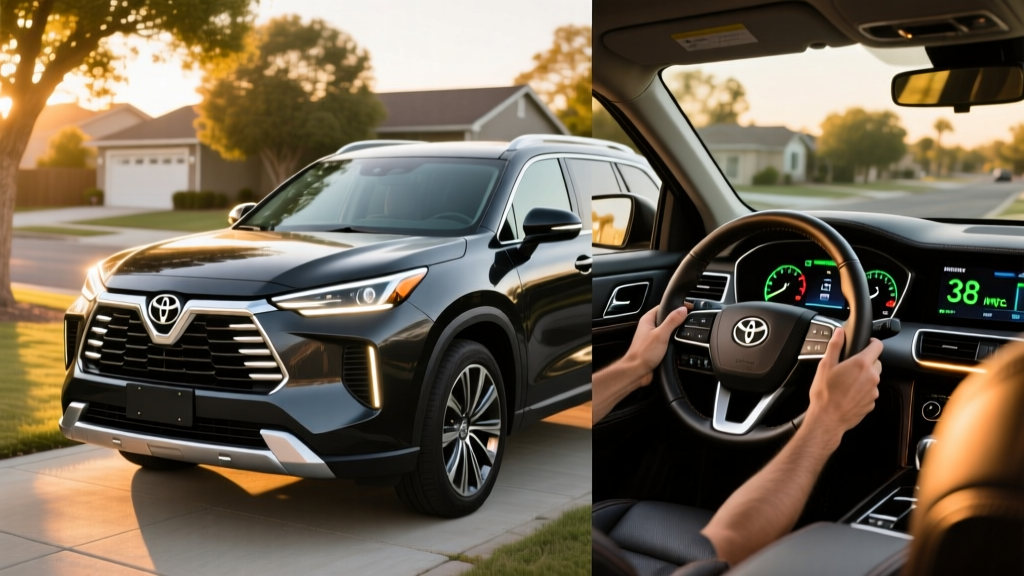
Quick Verdict: The Family Hauler That Sips Fuel Like a Sedan
The 2025 Toyota Grand Highlander Hybrid Limited sits at the intersection of three-row practicality and genuine fuel efficiency. With an EPA-estimated 36 MPG combined, this midsize SUV delivers the kind of efficiency most compact sedans can't match — while carrying seven or eight passengers and their cargo. For families who aren't ready to commit to a full battery-electric vehicle but want to meaningfully cut fuel costs, the Grand Highlander Hybrid Limited is one of the most compelling options on the market.
This is a conventional hybrid (HEV), not a plug-in. You never plug it in. The hybrid system recovers energy through regenerative braking and optimizes the gas engine's operation to maximize efficiency. If you're looking for electric-only driving, Toyota offers the RAV4 Prime and Prius Prime as PHEVs, but the Grand Highlander lineup is currently HEV-only (alongside the non-hybrid turbo four-cylinder and the Hybrid MAX powertrain).
A conventional hybrid (HEV) like the Grand Highlander Hybrid uses a small battery (typically 1-2 kWh) charged entirely by the engine and regenerative braking. You fuel it with gas and never plug in. A plug-in hybrid (PHEV) has a larger battery (10-20+ kWh) that you charge from a wall outlet or charger, giving 20-40 miles of electric-only range before the gas engine kicks in. The Grand Highlander is an HEV — no plug, no electric-only range, but also no charging hassle.
Fuel Economy: EPA Ratings and Real-World MPG
The headline number for the 2025 Grand Highlander Hybrid Limited is its efficiency. Here's the EPA breakdown:
| Metric | FWD | AWD (AWD-i) |
|---|---|---|
| City MPG | 37 | 36 |
| Highway MPG | 34 | 32 |
| Combined MPG | 36 | 35 |
Source: fueleconomy.gov
Toyota's hybrid system excels in city driving, where regenerative braking and electric-motor assist do the heavy lifting. Owners consistently report matching or slightly exceeding the EPA city estimate of 36-37 MPG in stop-and-go traffic. Highway cruising at 75+ MPH tends to return 30-33 MPG — slightly below the sticker — because the 2.5-liter four-cylinder engine works harder to move the Grand Highlander's ~4,600-lb curb weight at sustained speed. Expect a realistic combined average of 33-36 MPG in mixed driving, which is outstanding for a three-row SUV.
Powertrain: 245 HP Hybrid System
The Grand Highlander Hybrid pairs a 2.5-liter inline-four engine with Toyota's fourth-generation hybrid system. Here's the breakdown:
| Specification | Value |
|---|---|
| Engine | 2.5L DOHC 4-cylinder (Dynamic Force) |
| Engine Output | 186 HP / 186 lb-ft torque |
| Front Electric Motor | 134 HP / 199 lb-ft |
| Rear Electric Motor (AWD-i) | 54 HP / 89 lb-ft |
| Net Combined Horsepower | 245 HP |
| Transmission | eCVT (electronically controlled) |
| 0-60 MPH (est.) | ~7.5 seconds |
| Towing Capacity | 3,500 lbs (hybrid) |
| Drivetrain (Limited) | AWD-i standard on Limited trim |
The eCVT isn't a traditional belt-driven CVT — it uses a planetary gearset to blend engine and motor power seamlessly. There are no rubber-band rev sensations. Acceleration is linear and adequate for merging and passing, though the Hybrid MAX powertrain (362 HP, available on other trims) is the choice if you prioritize performance over maximum efficiency.
Pricing: What the Limited Trim Costs in 2025
The 2025 Toyota Grand Highlander Hybrid Limited is positioned as the premium trim in the hybrid lineup:
| Trim | MSRP (incl. destination) |
|---|---|
| Hybrid XLE (AWD-i) | ~$47,170 |
| Hybrid Limited (AWD-i) | ~$51,405 |
| Hybrid MAX Limited (AWD) | ~$55,160 |
Pricing per Toyota's official configurator. Verify with your dealer for current pricing and availability.
The Limited trim adds ventilated front seats, a panoramic moonroof, leather-trimmed seating, a 12.3-inch digital instrument cluster, a 360-degree camera system, and a premium JBL audio system over the XLE. It's well-equipped, though options like captain's chairs (reducing seating to seven) and special paint colors can push the price above $53,000.
Tax Credit Eligibility: Does the Grand Highlander Hybrid Qualify?
This is where hybrid buyers need clarity. Under the current IRS §30D rules for new clean vehicles:
The 2025 Toyota Grand Highlander Hybrid does NOT qualify for the federal §30D clean vehicle tax credit (up to $7,500). The §30D credit applies only to plug-in electric vehicles (BEVs and PHEVs) with a minimum battery capacity of 7 kWh. Conventional hybrids (HEVs) like the Grand Highlander Hybrid are ineligible. The Grand Highlander is not offered as a PHEV.
State incentives: Some states offer rebates for conventional hybrids, but these vary widely. Check your state's energy or environmental agency for current programs. A tax professional can advise on any applicable local benefits.
Source: IRS §30D Clean Vehicle Credits
Battery Warranty, Reliability, and Replacement Costs
Toyota's hybrid battery warranty is one of the strongest in the industry and a major reason hybrid buyers lean Toyota:
Hybrid Battery: 10 years / 150,000 miles (whichever comes first)
Hybrid System Components: 8 years / 100,000 miles
Limited Vehicle Warranty: 3 years / 36,000 miles bumper-to-bumper; 5 years / 60,000 miles powertrain
The warranty covers the hybrid battery if it drops below a specified capacity threshold or fails outright. In practice, Toyota's nickel-metal hydride (NiMH) and lithium-ion hybrid batteries routinely last well beyond 150,000 miles with minimal degradation. The hybrid battery in the Grand Highlander is a small-capacity pack (~1.6-2 kWh) designed for frequent shallow cycling, which is far less stressful than the deep cycling in a full EV.
Replacement cost: If the hybrid battery does need replacement outside warranty, expect to pay between $3,000 and $5,000 for a new OEM battery pack, including labor. Third-party refurbished options can reduce this to $1,500-$2,500. However, given Toyota's track record — the Prius has been running hybrid batteries past 200,000 miles since the early 2000s — out-of-warranty failure is rare.
Reliability outlook: Toyota's hybrid powertrains are among the most proven in the automotive industry. The 2.5L Dynamic Force engine and eCVT have no timing belt (chain-driven), no traditional starter motor (the hybrid motor handles starts), and no alternator — reducing failure points. The Grand Highlander is newer to the lineup, but the underlying powertrain architecture has been refined across the Camry, RAV4, and Highlander Hybrid for years.
Hybrid vs. PHEV vs. Full EV: Which Is Right for You?
| Factor | HEV (Grand Highlander Hybrid) | PHEV (e.g., Chrysler Pacifica Hybrid) | Full EV (e.g., Kia EV9) |
|---|---|---|---|
| Plug-in Required? | No | Yes (for EV range) | Yes (always) |
| Electric-Only Range | 0 miles | ~32 miles | 230-300+ miles |
| Fuel Cost (annual, 15K mi) | ~$1,600 (gas) | ~$1,000-$1,400 | ~$500-$800 (electric) |
| Federal Tax Credit | None | Up to $7,500* | Up to $7,500* |
| Home Charging Needed? | No | Recommended | Essential |
| Three-Row Seating | Yes (7-8) | Yes (7, minivan) | Yes (6-7) |
| Best For | No plug access, road trips | Short commutes + home plug | Home charging, low mi cost |
* §30D credit subject to MSRP caps, income limits, and battery sourcing requirements. Verify at IRS.gov.
- You don't have access to home or workplace charging
- You take frequent long road trips and don't want to plan around chargers
- You want maximum fuel efficiency without any behavioral change
- You value Toyota's hybrid reliability track record
- You need three rows and cargo space in a single package
- You can install a Level 2 charger at home
- Your daily commute is under 30 miles (PHEV covers it on electricity)
- You want to qualify for the $7,500 federal tax credit
- You want to minimize per-mile fuel cost (electricity is cheaper than gas)
Pros and Cons: The Honest Assessment
✓ Pros
- 36 MPG combined in a 4,600-lb three-row SUV — class-leading
- No plug-in required; zero lifestyle change from a gas car
- 10-year / 150,000-mile hybrid battery warranty
- AWD-i standard on Limited trim for all-weather confidence
- Generous third-row space (vs. standard Highlander)
- Toyota Safety Sense 3.0 standard (adaptive cruise, lane-keep, auto emergency braking)
- Proven hybrid powertrain with minimal maintenance needs
✗ Cons
- No federal tax credit — HEVs are ineligible under §30D
- Limited trim starts above $51K; well-optioned pushes $54K+
- Highway MPG drops to ~30-33 at 75+ MPH (aerodynamics + weight)
- Not a PHEV — no electric-only driving for short commutes
- eCVT can drone under hard acceleration (common to Toyota hybrids)
- 3,500-lb towing is adequate but trails body-on-frame SUVs
- Hybrid MAX (more power) sacrifices ~8 MPG for the upgrade
Frequently Asked Questions
How many MPG does the 2025 Grand Highlander Hybrid Limited get?
The AWD-i Limited is EPA-rated at 36 city / 32 highway / 35 combined MPG. The FWD version (available on lower trims) bumps that to 37/34/36. In real-world driving, expect 33-36 MPG combined, with city driving often matching or exceeding the EPA estimate and highway driving returning slightly less at high speeds.
Does the Grand Highlander come as a plug-in hybrid (PHEV)?
No. Toyota does not offer the Grand Highlander as a PHEV. It's available as a conventional hybrid (HEV), a turbocharged gas model, or the Hybrid MAX (a performance-oriented HEV). If you need a Toyota PHEV with three rows, you'd need to look at the Sienna (minivan, 36 MPG combined, no EV-only mode but hybrid standard) or wait for potential future PHEV variants.
How far can the Grand Highlander Hybrid go on electric only?
Zero miles on electric only. As a conventional hybrid, the Grand Highlander uses its electric motor to assist the gas engine, enable brief low-speed electric-only creeping (typically under 1 mile at low speeds in parking lots), and recover energy during braking. It cannot sustain electric-only driving like a PHEV or BEV. The small hybrid battery (~1.6-2 kWh) is not designed for it.
Is the hybrid battery reliable, and what does replacement cost?
Toyota's hybrid batteries are among the most reliable in the industry. The Grand Highlander's hybrid battery is covered for 10 years / 150,000 miles. Replacement outside warranty costs $3,000-$5,000 for an OEM pack, though third-party options exist for less. In practice, Toyota hybrid batteries routinely last 150,000-200,000+ miles. The Prius has demonstrated this over two decades of real-world use.
Does the Grand Highlander Hybrid qualify for any tax credit?
Not the federal §30D clean vehicle credit — that applies only to plug-in vehicles (BEVs and PHEVs). Some states may offer small incentives for high-efficiency hybrids, but these vary by jurisdiction and change frequently. Consult your state's energy office or a tax professional for current local programs.
How does the Grand Highlander Hybrid compare to the regular Highlander Hybrid?
The Grand Highlander is roughly 6.5 inches longer, providing significantly more third-row legroom and cargo space behind the third row (about 20.6 cu ft vs. 16.1 cu ft in the standard Highlander Hybrid). Both use the same 245 HP hybrid powertrain and achieve similar MPG. The Grand Highlander starts at a higher price but solves the standard Highlander's cramped third row.
Is the Hybrid MAX worth the upgrade over the standard hybrid?
The Hybrid MAX delivers 362 HP and a 6.0-second 0-60 time (vs. ~7.5 seconds for the standard hybrid), but it drops to 27 MPG combined and costs roughly $3,500 more. If you prioritize acceleration and towing (5,000 lbs with Hybrid MAX), it's compelling. If fuel savings are the priority, the standard hybrid's 35-36 MPG combined saves approximately $400-$600 per year in fuel over the Hybrid MAX at 15,000 miles annually.