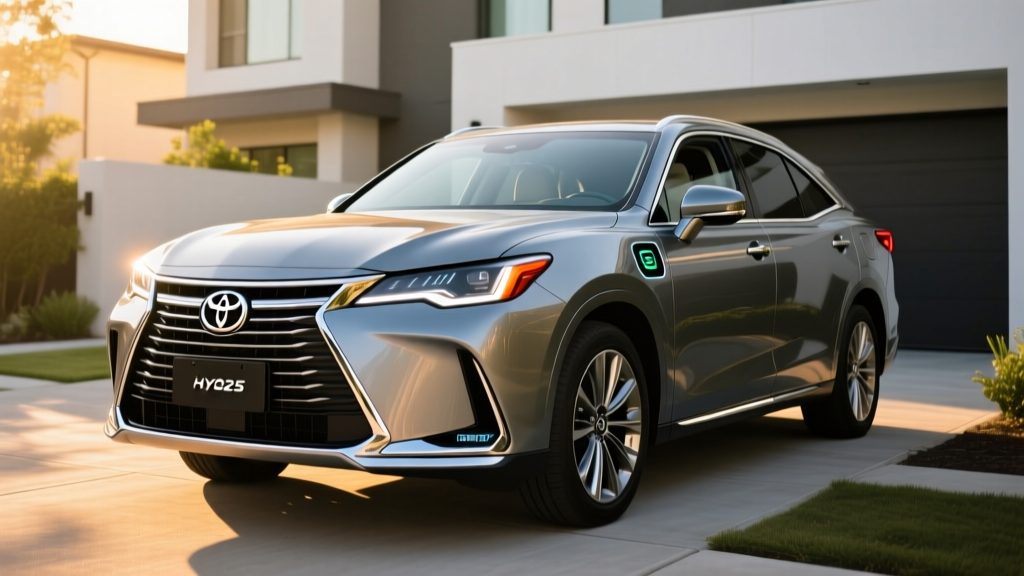
The 2025 Toyota Crown Signia slots into a narrow but growing segment: a midsize hybrid-only crossover that prioritizes fuel efficiency and refinement over raw performance. Replacing the discontinued Toyota Venza, the Crown Signia arrives exclusively as a conventional hybrid (HEV) — no plug required — with standard all-wheel drive and a premium interior that punches above its price class. For buyers weighing a hybrid against a plug-in hybrid (PHEV) or a full battery-electric vehicle (BEV), the Crown Signia makes a compelling case for simplicity.
This guide breaks down every number that matters: EPA and real-world MPG, the hybrid powertrain, battery longevity, pricing by trim, tax-credit eligibility, and who should — and shouldn't — put this on their shortlist.
HEV vs PHEV vs EV: Where the Crown Signia Fits
Before diving into specs, it's essential to clarify what the Crown Signia is and isn't. Toyota offers it only as a conventional hybrid (HEV). There is no plug-in hybrid variant and no all-electric version. Here's how that distinction shapes ownership:
| Feature | HEV (Crown Signia) | PHEV (e.g., RAV4 Prime) | BEV (e.g., Tesla Model Y) |
|---|---|---|---|
| Plug-in charging needed? | No — self-charging via regen + engine | Yes — plug in for electric-only miles | Yes — sole energy source |
| Electric-only range | ~1 mile at low speed | 35–42 miles typical | 250–330 miles EPA |
| Fuel/energy source | Gasoline only | Gasoline + grid electricity | Grid electricity only |
| Home charging install | None required | Level 2 recommended (240V) | Level 2 essential (240V) |
| Federal tax credit (§30D) | Not eligible | Up to $7,500 if eligible | Up to $7,500 if eligible |
| Best for | No home charging access; simplicity | Home chargers with short commutes | Home chargers; low-cost miles |
The Crown Signia's hybrid system recovers energy during braking and deceleration to recharge its small battery pack, meaning you never need to think about charging infrastructure. You fuel it like a conventional car and let the powertrain manage the rest.
Powertrain Specs: 240 HP With Standard AWD
Every 2025 Crown Signia uses Toyota's fourth-generation hybrid system pairing a 2.5-liter inline-four engine with three electric motors — two on the front axle and one on the rear — delivering standard electronic all-wheel drive.
| Specification | Detail |
|---|---|
| Engine | 2.5L DOHC 4-cylinder + 3 electric motors |
| Combined net horsepower | 240 hp |
| Drivetrain | Electronic AWD (eAWD), standard all trims |
| Transmission | Electronically controlled CVT (eCVT) |
| Hybrid battery | Lithium-ion, ~1.6 kWh (HEV buffer pack) |
| 0–60 mph | ~7.1 seconds (manufacturer estimate) |
| Towing capacity | 1,200 lbs (not rated for heavy towing) |
| Fuel tank | 14.5 gallons |
The 240-hp figure puts the Crown Signia ahead of the outgoing Venza (219 hp) and competitive with turbocharged midsize crossovers. The eCVT is smooth but not sporty — expect linear, quiet acceleration rather than the punchy step-off of a turbo-four with a conventional automatic. The rear motor engages automatically for traction; there is no mechanical driveshaft connecting the axles.
Fuel Economy: EPA Ratings and Real-World MPG
This is the Crown Signia's headline metric. Toyota targets buyers who want crossover practicality without the fuel cost penalty that typically comes with it.
| Trim | City (EPA) | Highway (EPA) | Combined (EPA) |
|---|---|---|---|
| XLE | 39 MPG | 37 MPG | 38 MPG |
| Limited | 37 MPG | 34 MPG | 36 MPG |
The XLE trim's 38 MPG combined is the volume pick and the more efficient choice, thanks to its lighter weight and smaller 19-inch wheels. The Limited trim's 21-inch wheels and additional equipment drop it to 36 MPG combined — still excellent for an AWD midsize crossover but worth noting if efficiency is paramount.
Real-World MPG: What to Actually Expect
Toyota hybrids historically meet or exceed their EPA city ratings in stop-and-go driving because regenerative braking recovers energy that gas-only cars waste as heat. On the highway, where the engine does more of the work alone, real-world numbers tend to settle closer to — or slightly below — the EPA figure.
- City / suburban driving: Expect 38–42 MPG on the XLE. Hybrid systems shine here.
- Highway cruising (70–75 mph): Expect 33–36 MPG. Aerodynamic drag and the engine carrying full load reduce the hybrid advantage.
- Cold weather (below 35°F): Expect a 5–10% drop (roughly 34–36 combined on the XLE). The engine runs longer to heat the cabin and bring the catalytic converter to operating temperature.
- Combined mixed driving: Most owners report 36–39 MPG in moderate climates, aligning closely with the EPA sticker.
With a 14.5-gallon tank and 38 MPG combined, the Crown Signia XLE delivers roughly 550 miles of total range between fill-ups — competitive with the best in the segment and far beyond what most BEVs offer on a single charge.
Pricing by Trim and Tax Credit Eligibility
The 2025 Crown Signia is offered in two trims. Pricing below includes the mandatory destination charge.
| Trim | MSRP (incl. destination) | Key Features |
|---|---|---|
| XLE | $41,590 | 19" alloy wheels, 12.3" touchscreen, heated front seats, wireless CarPlay/Android Auto, Toyota Safety Sense 3.0 |
| Limited | $47,590 | 21" alloy wheels, panoramic fixed glass roof, ventilated front seats, leather-trimmed seats, 11-speaker JBL audio, digital rearview mirror |
Does the Crown Signia Qualify for a Federal Tax Credit?
No. The Crown Signia is a conventional hybrid (HEV), and the IRS §30D Clean Vehicle Credit applies only to plug-in electric vehicles (PHEVs and BEVs) with a minimum battery capacity of 7 kWh. The Crown Signia's ~1.6 kWh hybrid battery does not qualify.
There is no federal tax credit for conventional hybrids in 2025. Some states and local utilities offer modest rebates for any high-efficiency vehicle, but these vary widely by jurisdiction. Check your state energy office or utility provider for current programs. A tax professional can confirm any applicable local incentives.
Battery Longevity, Warranty, and Replacement Cost
Hybrid battery anxiety is the most common concern among first-time hybrid buyers. Here's what the data shows:
| Coverage | Term |
|---|---|
| Hybrid battery warranty | 10 years / 150,000 miles (whichever comes first) |
| Hybrid system components | 8 years / 100,000 miles |
| Basic vehicle warranty | 3 years / 36,000 miles |
| Powertrain warranty | 5 years / 60,000 miles |
Toyota's fourth-generation hybrid system is among the most proven in the industry. The Prius, Camry Hybrid, and RAV4 Hybrid have accumulated billions of real-world miles, and battery failures within the warranty period are statistically rare. The lithium-ion hybrid pack in the Crown Signia is small (~1.6 kWh) and operates within a narrow state-of-charge window (roughly 40–80%), which significantly reduces degradation compared to the deeper cycles in BEVs and PHEVs.
Hybrid Battery Replacement Cost
If the hybrid battery does fail outside of warranty — uncommon but possible at high mileage — replacement costs for Toyota's 2.5L hybrid system typically range from $2,500 to $4,500 including parts and labor at a dealership. Independent hybrid specialists often offer refurbished packs for $1,500–$2,500. For context, most Toyota hybrid batteries last well beyond 150,000 miles with minimal capacity loss.
Who Should Buy the Crown Signia — and Who Shouldn't
Pros
- 38 MPG combined (XLE) with AWD — exceptional for a midsize crossover
- No charging infrastructure needed — ideal for apartment dwellers or those without a garage
- Premium interior materials and quiet cabin at a mainstream price point
- Standard Toyota Safety Sense 3.0 (adaptive cruise, lane tracing, auto emergency braking)
- 10-year / 150,000-mile hybrid battery warranty
- 550+ miles of total range per tank
Cons
- No federal tax credit eligibility (HEV, not PHEV/BEV)
- Only two trims — limited configurability (no standalone options packages)
- 1,200-lb towing capacity — not suitable for trailers or boats
- eCVT feels unengaging for spirited driving
- Limited trim's 21" wheels sacrifice 2 MPG and ride comfort
- No plug-in hybrid variant available
The Decision Framework
Choose the Crown Signia if: You want a fuel-efficient AWD crossover without the complexity, cost, or infrastructure demands of a PHEV or EV. You don't have reliable home or workplace charging. You value a premium cabin and Toyota's reliability reputation. You drive 12,000–15,000 miles per year and want low fuel costs without changing your refueling habits.
Look at a PHEV (e.g., Toyota RAV4 Prime) if: You have home Level 2 charging and a commute under 40 miles. You want electric-only daily driving with gas-engine flexibility for road trips. You may qualify for the $7,500 federal credit, which can offset the PHEV price premium.
Look at a BEV (e.g., Hyundai Ioniq 5, Tesla Model Y) if: You have reliable home charging, want the lowest per-mile energy cost (electricity at $0.13/kWh ≈ $0.04/mile vs. gas at $3.50/gal ≈ $0.12/mile at 30 MPG), and are ready to plan around DC fast charging on road trips.
Ownership Costs: Fuel Savings vs. a Gas-Only Crossover
To put the Crown Signia's efficiency in financial context, here's a 5-year fuel cost comparison against a typical gas-only AWD midsize crossover averaging 25 MPG combined, assuming 15,000 miles/year and $3.50/gallon regular unleaded:
| Vehicle | MPG Combined | Gallons/Year | Annual Fuel Cost | 5-Year Fuel Cost |
|---|---|---|---|---|
| Crown Signia XLE | 38 | 395 | $1,382 | $6,909 |
| Gas AWD crossover (25 MPG) | 25 | 600 | $2,100 | $10,500 |
| 5-year savings with Crown Signia | ~$3,591 | |||
That roughly $3,600 fuel savings over five years partially offsets the Crown Signia's higher starting price versus non-hybrid competitors. Factor in Toyota's strong resale values — hybrids consistently retain value better than gas-only counterparts — and the total cost of ownership picture strengthens further.
Safety and Driver Assistance
Every 2025 Crown Signia includes Toyota Safety Sense 3.0, which bundles:
- Pre-Collision System with Pedestrian Detection
- Lane Departure Alert with Steering Assist
- Lane Tracing Assist
- Dynamic Radar Cruise Control (full-speed adaptive cruise)
- Road Sign Assist
- Automatic High Beams
- Proactive Driving Assist (gentle braking/deceleration when approaching slower traffic)
This is an SAE Level 2 driver-assistance system — it can manage steering, acceleration, and braking under certain conditions, but the driver must remain fully attentive with hands on the wheel at all times. It is not a self-driving system. For hands-free highway driving, you'd need to look at GM's Super Cruise or Ford's BlueCruise, neither of which is available on the Crown Signia.
Check NHTSA and IIHS for crash-test ratings as they become available for the 2025 model year.
Frequently Asked Questions
How many MPG does the 2025 Toyota Crown Signia get?
The XLE trim achieves an EPA-estimated 39 city / 37 highway / 38 combined MPG. The Limited trim is rated at 37 city / 34 highway / 36 combined. Real-world mixed driving typically yields 36–39 MPG for the XLE in moderate climates, with city driving often exceeding the EPA figure thanks to regenerative braking.
Does the Crown Signia need to be plugged in?
No. The Crown Signia is a conventional hybrid (HEV), not a plug-in hybrid. Its small lithium-ion battery recharges through regenerative braking and the gasoline engine. You simply fill it with gasoline like any other car.
Is there a plug-in hybrid (PHEV) version of the Crown Signia?
Not for the 2025 model year. Toyota offers the Crown Signia exclusively as a conventional hybrid. If you want a Toyota PHEV crossover with electric-only range, the RAV4 Prime (42 miles electric-only, when available) is the closest alternative in Toyota's lineup.
Does the Crown Signia qualify for any federal tax credit?
No. The federal §30D Clean Vehicle Credit requires a plug-in vehicle with at least 7 kWh of battery capacity. The Crown Signia's ~1.6 kWh hybrid battery does not meet this threshold. No federal tax credit exists for conventional hybrids in 2025.
How reliable is the Crown Signia's hybrid system?
Toyota's hybrid systems are among the most proven in the automotive industry, with decades of real-world data from millions of Prius, Camry Hybrid, and RAV4 Hybrid vehicles. The hybrid battery is warranted for 10 years / 150,000 miles, and failures within that window are rare. The system has far fewer wear components than a conventional powertrain — no traditional starter, alternator, or accessory belt.
What does a Crown Signia hybrid battery replacement cost?
Outside of warranty, a replacement hybrid battery for Toyota's 2.5L hybrid system typically costs $2,500–$4,500 at a dealership (parts and labor). Refurbished packs from independent hybrid specialists run $1,500–$2,500. In practice, most Toyota hybrid batteries last well past 150,000 miles.
How does the Crown Signia compare to the Toyota RAV4 Hybrid?
The RAV4 Hybrid offers more cargo space (37.6 cu ft vs. ~25.8 cu ft behind the second row), a lower starting price (~$34,000), and slightly lower combined MPG (39–40 depending on trim). The Crown Signia trades some utility for a more premium interior, quieter ride, and a wagon-like profile. Think of it as Toyota's upscale hybrid wagon-crossover versus the RAV4's practical family hauler.
Can the Crown Signia tow a trailer?
The Crown Signia is rated for 1,200 lbs of towing capacity — enough for a small utility trailer or a couple of dirt bikes, but not suitable for boat trailers, campers, or horse trailers. If towing is a priority, look at the Toyota Grand Highlander Hybrid (5,000 lbs) or a body-on-frame SUV.