Quick Verdict: The Efficiency Benchmark at $23,500
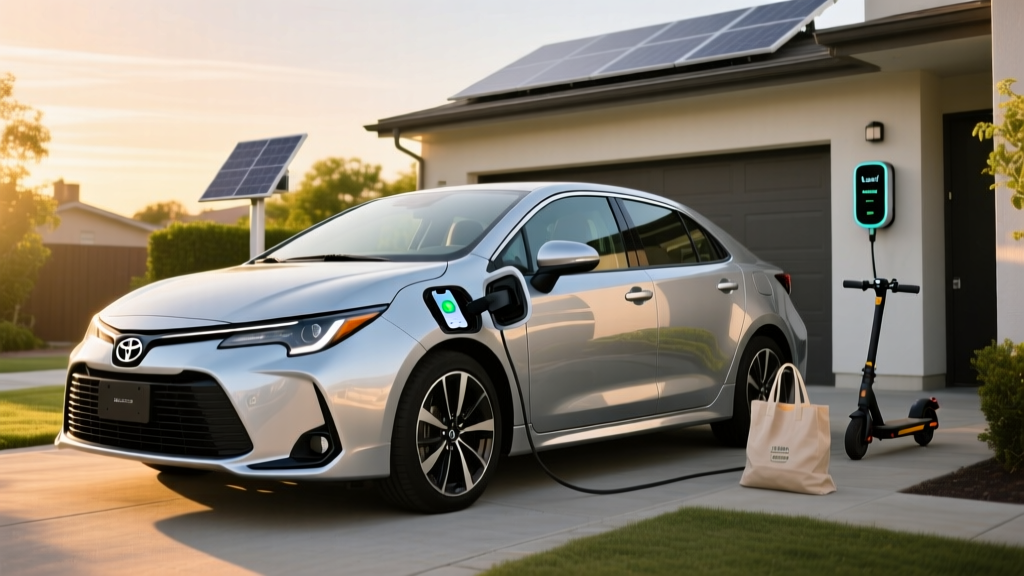
The 2025 Toyota Corolla Hybrid remains one of the most compelling arguments for electrification without lifestyle compromise. It delivers an EPA-estimated 50 MPG combined without a plug, without range anxiety, and without a price premium that breaks the budget. Starting at $23,500 for the LE trim, it undercuts most competitors while offering standard all-wheel drive — a rarity in the hybrid compact segment. For buyers who want electrified efficiency but lack home charging access or the budget for a full EV, this is the benchmark.
| Spec | Value |
|---|---|
| Powertrain | 1.8L 4-cyl + 2 electric motors (AWD: 3 motors) |
| Combined Horsepower | 138 hp |
| Transmission | eCVT (planetary gearset) |
| EPA MPG (LE FWD) | 53 city / 46 hwy / 50 combined |
| EPA MPG (AWD trims) | 51 city / 44 hwy / 48 combined |
| Hybrid Battery | ~1.0 kWh lithium-ion (sealed, self-charging) |
| Plug-In Required? | No — regenerative braking + engine charges battery |
| 0-60 mph | ~9.2 seconds (est.) |
| Cargo Volume | 13.1 cu ft (trunk) |
| Base MSRP (LE) | $23,500 |
| Hybrid Battery Warranty | 10 years / 150,000 miles |
| Federal Tax Credit | Not eligible (§30D requires plug-in capability) |
HEV vs PHEV: What the Corolla Hybrid Actually Is
This is a critical distinction that trips up many first-time hybrid shoppers. The 2025 Toyota Corolla Hybrid is a conventional hybrid (HEV), not a plug-in hybrid (PHEV). Here is what that means in practice:
| Feature | Corolla Hybrid (HEV) | Typical PHEV (e.g., Prius Prime) |
|---|---|---|
| Plug-in charging | No — charges via regen + engine | Yes — Level 1/Level 2 AC |
| Electric-only range | None (motor assists engine) | 25-44 miles typically |
| Battery size | ~1.0 kWh | 13-18 kWh |
| Federal tax credit | Not eligible | Up to $7,500 (if eligible) |
| Home charger needed | No | Recommended for full benefit |
| Complexity | Lower — no charging logistics | Higher — requires charging routine |
The Corolla Hybrid's small lithium-ion battery sits under the rear seat and charges itself through regenerative braking and the gasoline engine. You never plug it in. The electric motors assist the 1.8-liter engine during acceleration, enable brief low-speed electric-only movement (typically under 1 mile at parking-lot speeds), and recapture energy during deceleration. The result: dramatically better fuel economy than a gas-only Corolla (which returns roughly 34 MPG combined) with zero change to your daily routine.
Fuel Economy: EPA Numbers and Real-World MPG
The headline number is 50 MPG combined for the LE trim with front-wheel drive, according to fueleconomy.gov. But the city/highway split tells a more useful story for your specific commute:
| Trim / Drivetrain | City MPG | Highway MPG | Combined MPG |
|---|---|---|---|
| LE (FWD) | 53 | 46 | 50 |
| SE (AWD) | 51 | 44 | 48 |
| XLE (AWD) | 51 | 44 | 48 |
Real-world expectation: Toyota's hybrid system excels in stop-and-go city driving, where regenerative braking and electric-motor assist do the most work. Many owners report exceeding the EPA city estimate in moderate-temperature urban driving — 55-58 MPG is achievable on flat city routes at 25-40 mph averages. Highway fuel economy is the weaker point; sustained 70-80 mph cruising relies more heavily on the gasoline engine, and real-world highway trips typically return 42-45 MPG. In cold weather (below freezing), expect a 5-10% reduction across the board as the engine runs more frequently to maintain cabin heat and battery temperature.
For context, a driver covering 15,000 miles annually at 48 MPG combined would consume roughly 312 gallons per year. At $3.40/gallon (national average), that is approximately $1,060 in annual fuel cost — versus roughly $1,590 for a gas-only Corolla at 34 MPG. The hybrid premium pays for itself in fuel savings within roughly 3-4 years for typical drivers, before considering any state incentives.
Powertrain Deep Dive: How 138 HP Delivers 50 MPG
The 2025 Corolla Hybrid pairs a 1.8-liter Atkinson-cycle four-cylinder engine with Toyota's fifth-generation hybrid transaxle. The gasoline engine produces roughly 96 hp on its own, while two front-mounted motor-generators add electric torque. Combined system output is 138 horsepower.
AWD trims (SE, XLE) add a third electric motor on the rear axle, providing up to 41 hp to the rear wheels when traction is needed. This is an on-demand system — the rear motor engages during acceleration from a stop, on slippery surfaces, or when the front wheels lose grip. There is no mechanical driveshaft connecting front and rear axles, which reduces weight and parasitic loss.
The eCVT is not a traditional belt-and-cone CVT. It uses a planetary gearset that seamlessly blends engine and motor power without fixed gear ratios. This eliminates shift shock and keeps the engine in its most efficient RPM range. The trade-off is the characteristic "drone" under hard acceleration, where engine RPM holds steady while vehicle speed climbs. For daily commuting, this is largely imperceptible; for highway merging, the 9.2-second 0-60 time feels adequate but unhurried.
Pricing, Trims, and Tax Credit Reality
The 2025 Corolla Hybrid is offered in three trims:
- LE: $23,500 — FWD standard, 8-inch touchscreen, wireless Apple CarPlay/Android Auto, Toyota Safety Sense 3.0
- SE: $25,500 — AWD standard, sport-tuned suspension, 18-inch alloy wheels, Smart Key system
- XLE: $27,500 — AWD standard, SofTex heated seats, 10.5-inch display, wireless charging pad
Federal Tax Credit: Not Eligible
The Corolla Hybrid does not qualify for the federal §30D Clean Vehicle Credit. Per IRS rules, the §30D credit applies only to plug-in electric vehicles (BEVs and PHEVs) with a battery capacity of at least 7 kWh. The Corolla Hybrid's ~1.0 kWh battery and lack of plug-in capability place it outside the credit's scope. This is true of all conventional hybrids — no HEV on the market currently qualifies for the federal EV tax credit.
Some states offer separate incentives for hybrid purchases (e.g., Colorado, Maryland). Check your state's energy office or department of revenue for current programs, as these vary widely and change frequently.
Battery Longevity, Warranty, and Replacement Cost
Hybrid battery anxiety is the single most common concern among first-time hybrid buyers. Here are the facts for the 2025 Corolla Hybrid:
Toyota Hybrid Battery Warranty
Coverage: 10 years or 150,000 miles (whichever comes first), transferable to subsequent owners.
What's covered: Defects in materials or workmanship, and capacity loss below a functional threshold that impairs hybrid system operation.
Source: Toyota's official warranty guide
Toyota's hybrid battery packs have proven remarkably durable in real-world use. The Prius, which shares similar hybrid architecture, has demonstrated battery lifespans exceeding 200,000 miles in taxi and rideshare service. The Corolla Hybrid's lithium-ion pack is smaller and less stressed than a PHEV or BEV battery because it operates within a narrow state-of-charge window (roughly 40-80% SoC), never fully charging or fully depleting. This shallow-cycling strategy dramatically extends cell life.
Replacement cost if out of warranty: A new OEM hybrid battery pack for the Corolla Hybrid runs approximately $2,000-$3,000 installed at a Toyota dealer. Third-party refurbished packs are available for $1,000-$1,800 installed. For context, this is a fraction of a BEV traction battery replacement ($8,000-$20,000+) because the hybrid pack is roughly 1/50th the size.
The hybrid system also includes two motor-generators and a power control unit (inverter). These components share the 10-year/150,000-mile hybrid system warranty and have similarly strong reliability records. The 12-volt auxiliary battery is a separate item with a typical 3-5 year lifespan and standard replacement cost (~$150-$250).
Who Should Buy the Corolla Hybrid — And Who Shouldn't
Pros
- 50 MPG combined — among the highest of any non-plug-in vehicle
- Standard AWD on SE/XLE trims at a compact-car price
- No plug-in required — zero charging logistics
- 10-year/150,000-mile hybrid battery warranty
- Low starting price ($23,500) with strong resale value
- Toyota Safety Sense 3.0 standard (adaptive cruise, lane-keeping, AEB)
Cons
- Modest 138 hp — not a performance car; highway merging requires planning
- Trunk space limited to 13.1 cu ft (no folding rear seat pass-through on some trims)
- No federal tax credit eligibility
- Rear-seat legroom is tight for taller passengers
- Infotainment is functional but not class-leading
- AWD trims drop to 48 MPG combined
Decision Framework: Is the Corolla Hybrid Right for You?
Choose the Corolla Hybrid if:
- You want maximum MPG without plugging in or changing your routine
- You lack access to home or workplace charging (apartment, street parking)
- Your budget is under $28,000 and you want proven reliability
- Your commute is city-heavy, where hybrid efficiency peaks
- You need AWD for snow/rain but don't want an SUV's fuel penalty
Consider a PHEV (like the Prius Prime) if:
- You have home charging and a commute under 40 miles round-trip
- You want electric-only daily driving with gas-engine backup for road trips
- You may qualify for the $7,500 federal tax credit on a PHEV
Consider a full BEV if:
- You have reliable Level 2 home charging
- Your daily driving is under 200 miles and you rarely road-trip beyond charger coverage
- You want to eliminate gasoline entirely and reduce maintenance (no oil changes, fewer brake replacements)
- You qualify for federal and state EV incentives that narrow the price gap
Corolla Hybrid vs the Competition
The Corolla Hybrid's closest rival is the Toyota Prius (redesigned for 2023, continuing into 2025). The Prius offers slightly higher combined MPG (up to 57 on the LE trim), more cargo versatility (hatchback), and a more powerful 194-hp powertrain — but starts roughly $4,000 higher at $27,950. If budget is the primary driver, the Corolla Hybrid wins on value. If you want more power, cargo flexibility, and the latest hybrid tech, the Prius is the upgrade pick.
The Honda Civic Hybrid (returning for 2025) targets a similar buyer with a two-motor hybrid system rated at approximately 200 hp and an EPA estimate near 49 MPG combined. It offers a more engaging driving experience but typically at a higher price point.
The Hyundai Elantra Hybrid delivers an EPA-estimated 54 MPG combined (Blue trim) with a 139-hp powertrain, starting around $25,000. Its 6-speed automatic avoids the eCVT drone, and it offers a longer powertrain warranty (10yr/100k), though its hybrid battery warranty is shorter than Toyota's at 10yr/100k miles.
Frequently Asked Questions
How many MPG does the 2025 Toyota Corolla Hybrid actually get?
The EPA rates the LE (FWD) trim at 53 city / 46 highway / 50 combined MPG. AWD trims (SE, XLE) are rated at 51 city / 44 highway / 48 combined. In real-world driving, city MPG often exceeds the EPA estimate in moderate temperatures, while sustained highway driving above 70 mph typically returns 42-45 MPG. Cold weather reduces efficiency by roughly 5-10%.
Does the Corolla Hybrid need to be plugged in?
No. The Corolla Hybrid is a conventional hybrid (HEV). Its small battery charges itself through regenerative braking and the gasoline engine. You fuel it like any other car — with gasoline at any station. There is no plug, no charging cable, and no need for a home charger.
Does the 2025 Corolla Hybrid qualify for any tax credit?
It does not qualify for the federal §30D Clean Vehicle Credit, which requires plug-in capability and a minimum 7 kWh battery. Some states offer separate hybrid incentives — check your state's energy office for current programs. The Corolla Hybrid's lower purchase price partially offsets the lack of a federal credit compared to more expensive PHEVs and BEVs.
How long will the hybrid battery last, and what does replacement cost?
Toyota warranties the hybrid battery for 10 years or 150,000 miles. Real-world data from Toyota's hybrid fleet (Prius, Camry Hybrid) shows many packs lasting 200,000+ miles with proper maintenance. If replacement is needed out of warranty, expect $2,000-$3,000 for a new OEM pack installed, or $1,000-$1,800 for a refurbished unit. The shallow charge-discharge cycles in Toyota's hybrid system are a primary reason for this longevity.
Is the Corolla Hybrid slower than the gas-only Corolla?
The hybrid produces 138 combined horsepower versus 169 hp for the gas-only Corolla's 2.0L engine. The hybrid's 0-60 time of roughly 9.2 seconds is about 1.5 seconds slower. However, the electric motors provide instant torque from a stop, making the hybrid feel responsive in city driving. The gap is most noticeable during highway passing maneuvers, where the hybrid requires more planning.
Hybrid vs PHEV vs EV — which powertrain fits me?
Hybrid (HEV): Best if you lack charging access, want zero routine change, and prioritize low purchase price. The Corolla Hybrid fits here.
Plug-in hybrid (PHEV): Best if you have home charging, a short commute (under 40 miles), and want electric-only daily driving with gas backup. Consider the Prius Prime.
Battery electric (BEV): Best if you have reliable Level 2 home charging, drive under 200 miles daily, and want to eliminate gasoline and reduce maintenance. Consider the Tesla Model 3, Chevrolet Equinox EV, or Hyundai Ioniq 6.
Does the Corolla Hybrid have AWD?
Yes, but only on SE and XLE trims. The AWD system uses a dedicated rear-axle electric motor (no mechanical driveshaft) that engages on demand for improved traction. The LE trim is front-wheel drive only and achieves the highest MPG rating (50 combined).