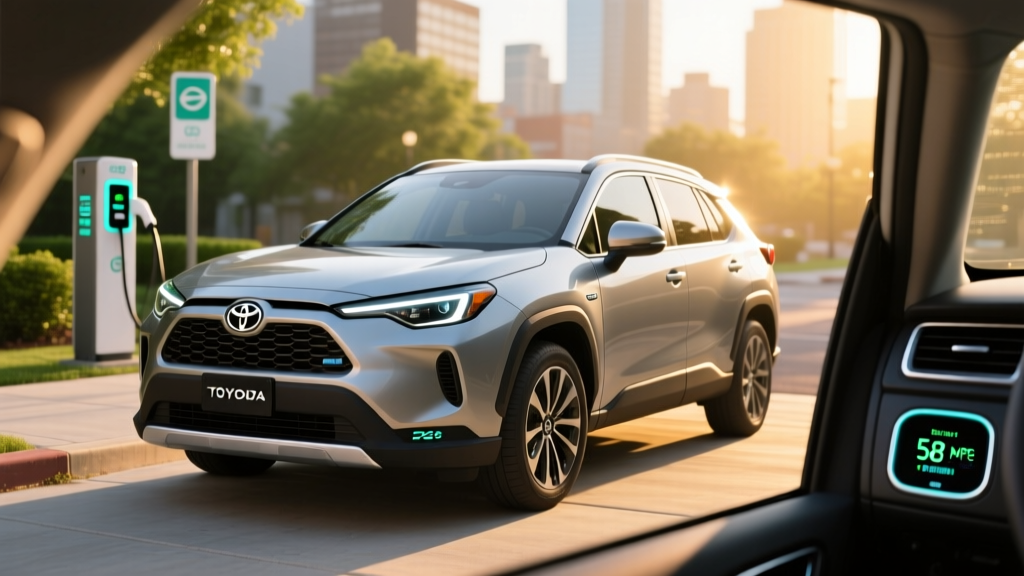
The 2025 Toyota Corolla Cross Hybrid SUV occupies a specific niche: subcompact crossover efficiency without the range anxiety, charging logistics, or price premium of a full battery-electric vehicle. With an EPA-estimated 42 MPG combined and standard all-wheel drive, it targets buyers who want electrified efficiency but lack home charging access or simply prefer the fill-up-and-go simplicity of a conventional hybrid. This guide covers the exact numbers, real-world expectations, and ownership economics you need before signing the paperwork.
HEV vs PHEV: What the Corolla Cross Hybrid Actually Is
Conventional Hybrid (HEV): The 2025 Corolla Cross Hybrid is a self-charging hybrid. It has a small battery (approximately 1.3 kWh) that recharges through regenerative braking and the gasoline engine. You never plug it in. It cannot drive on electric power alone for meaningful distances.
Plug-in Hybrid (PHEV): A PHEV like the Toyota RAV4 Prime carries a much larger battery (~18.1 kWh), offers 30–40 miles of electric-only range, and requires plugging in to realize its efficiency advantage. Toyota does not currently offer the Corolla Cross as a PHEV.
Full EV (BEV): A battery-electric vehicle like the Hyundai Kona Electric has no gasoline engine and relies entirely on grid charging for 200–300 miles of range.
If you were searching for a plug-in Corolla Cross, it doesn't exist for the 2025 model year. The Corolla Cross Hybrid is strictly an HEV — a highly efficient one, but one that runs on gasoline at all times with electric motor assist.
Fuel Economy: EPA Ratings vs Real-World MPG
| Metric | EPA Estimate | Real-World Expectation |
|---|---|---|
| City MPG | 45 MPG | 43–48 MPG (hybrids excel in stop-and-go) |
| Highway MPG | 38 MPG | 35–38 MPG (less regen benefit at steady speed) |
| Combined MPG | 42 MPG | 39–44 MPG (depends on driving mix) |
According to fueleconomy.gov, the 2025 Corolla Cross Hybrid AWD achieves 45 city / 38 highway / 42 combined. These numbers apply across all trims (S, SE, XSE) because the powertrain is identical.
Real-world context: Toyota's hybrid system recovers significant energy during braking and low-speed driving, which is why the city number exceeds the highway number — the opposite of a conventional gas car. In our experience and consistent owner reporting, city-heavy commuters regularly see 44–48 MPG. Highway-dominant drivers at 75+ MPH should expect closer to 35–37 MPG, as aerodynamic drag and reduced regenerative opportunities lower efficiency. Cold weather (below freezing) typically drops MPG by 5–10% due to cabin heating demands and reduced battery efficiency.
For comparison, the non-hybrid 2025 Corolla Cross AWD is rated at 29 city / 32 highway / 30 combined — a 12 MPG gap that translates into roughly $400–$550 in annual fuel savings for the hybrid at 15,000 miles/year and $3.50/gallon regular unleaded.
Powertrain Specs: Engine, Motors, and Horsepower
| Specification | Detail |
|---|---|
| Engine | 2.0L 4-cylinder Atkinson-cycle |
| Engine Output | 150 hp / 139 lb-ft torque |
| Electric Motors | Front motor + rear motor (AWD) |
| Net Combined Horsepower | 196 hp |
| Transmission | Electronic Continuously Variable (eCVT) |
| Drivetrain | Electronic On-Demand AWD (standard) |
| 0–60 MPH | ~7.5 seconds (est.) |
| Battery Capacity | ~1.3 kWh (nickel-metal hydride) |
| Fuel Tank | 10.6 gallons |
| Total Driving Range | ~445 miles (EPA combined) |
The 2025 Corolla Cross Hybrid pairs Toyota's fifth-generation hybrid system with a 2.0-liter Dynamic Force engine. The rear-mounted electric motor provides all-wheel drive without a mechanical driveshaft — it engages automatically when the system detects front-wheel slip or during hard acceleration. Total system output of 196 hp makes it notably quicker than the 169-hp non-hybrid Corolla Cross, and the electric motor's instant torque gives it responsive off-the-line feel in city driving.
Because this is an HEV with a ~1.3 kWh battery, there is no meaningful electric-only driving range. The electric motors assist the gasoline engine and can propel the car at very low speeds for brief distances (under 1 mile, typically in parking lots), but the engine is always running or ready to engage. There is no plug, no charging port, and no DC fast-charge capability.
Pricing, Trims, and Tax Credit Eligibility
The 2025 Toyota Corolla Cross Hybrid starts at approximately $29,345 (including destination) for the base S trim and tops out around $33,500 for a loaded XSE with Premium package.
| Trim | MSRP (approx.) | Key Features |
|---|---|---|
| S Hybrid | $29,345 | AWD, Toyota Safety Sense 3.0, 8" touchscreen |
| SE Hybrid | $30,790 | Sport-tuned suspension, 18" alloy wheels, roof rails |
| XSE Hybrid | $32,350 | SofTex seats, heated front seats, power liftgate |
Does the Corolla Cross Hybrid Qualify for a Federal Tax Credit?
No. Under current IRS §30D Clean Vehicle Credit rules, only plug-in electric vehicles (BEVs and PHEVs) with a minimum battery capacity of 7 kWh qualify for the federal tax credit. The Corolla Cross Hybrid's ~1.3 kWh battery is far below that threshold. There is no federal purchase incentive for conventional HEVs.
Some states and utilities offer rebates or HOV-lane access for hybrids, but these vary widely by jurisdiction. Check your state energy office or local utility for current programs. The Alternative Fuels Data Center maintains a searchable database of state and local incentives.
Reliability, Battery Warranty, and Replacement Cost
Hybrid Battery Warranty: Toyota covers the hybrid battery and hybrid system components for 10 years / 150,000 miles (whichever comes first) on 2025 models — an increase from the previous 8-year/100,000-mile coverage that applied to older models.
General Warranty: 3 years / 36,000 miles basic; 5 years / 60,000 miles powertrain.
Toyota's hybrid powertrains have an exceptional reliability track record spanning over 25 years since the original Prius. The Corolla Cross Hybrid uses Toyota's latest-generation hybrid transaxle and a nickel-metal hydride (NiMH) battery pack — a chemistry Toyota has favored for its durability and thermal stability in non-plug-in applications.
Battery replacement cost: If the hybrid battery fails outside warranty, a replacement typically costs between $2,000 and $3,500 including labor at a Toyota dealer. Independent hybrid specialists may offer refurbished packs for $1,200–$2,000. However, widespread failures are rare — many Toyota hybrid batteries last 150,000–200,000+ miles before significant capacity loss.
The broader powertrain (engine, eCVT transaxle, electric motors) is well-proven. The eCVT has no traditional belts, bands, or clutches to wear out — it's a planetary gearset that Toyota has refined across millions of vehicles. According to NHTSA, the Corolla Cross has not been subject to major powertrain recalls specific to the hybrid system.
Who Should Choose the Corolla Cross Hybrid vs a Full EV or Gas Car
Pros
- 42 MPG combined — 40%+ better than the gas-only Corolla Cross
- Standard AWD across all hybrid trims
- 196 hp — significantly quicker than the non-hybrid (169 hp)
- No plug-in required — works with existing fueling habits
- 10-year/150,000-mile hybrid battery warranty
- Proven Toyota hybrid reliability
- ~445-mile total range between fill-ups
Cons
- No electric-only driving range (HEV, not PHEV)
- No federal tax credit eligibility
- Cargo space slightly reduced vs non-hybrid (~25 cu ft behind rear seats)
- Base price ~$2,500 higher than equivalent gas AWD trim
- Rear seat legroom is tight for taller passengers
- No spare tire (tire repair kit standard)
Choose the Corolla Cross Hybrid if:
- You want maximum MPG without changing your fueling routine
- You lack access to home or workplace charging (apartment, street parking)
- You drive a city-heavy commute where hybrid efficiency shines (45 MPG city)
- You want AWD for snow/rain without the fuel penalty of a conventional AWD SUV
- You plan to own the vehicle 8+ years and value long-term reliability
Choose a PHEV (like the RAV4 Prime) if:
- You have home Level 2 charging and a commute under 40 miles
- You want electric-only daily driving with gas backup for road trips
- You want to qualify for the federal tax credit (up to $7,500)
Choose a full EV (like the Hyundai Kona Electric) if:
- You have reliable home charging and want zero tailpipe emissions
- You want the lowest per-mile fuel cost (~$0.04–$0.06/mi on home electricity vs ~$0.12/mi for this hybrid)
- Your daily driving is under 250 miles and you road-trip infrequently
Real-World Ownership Economics
| Cost Factor | Corolla Cross Hybrid | Corolla Cross Gas AWD |
|---|---|---|
| MSRP (base) | ~$29,345 | ~$26,845 |
| Annual Fuel Cost (15K mi/yr) | ~$1,250 | ~$1,750 |
| 5-Year Fuel Cost | ~$6,250 | ~$8,750 |
| Federal Tax Credit | $0 | $0 |
| Estimated 5-Year Total (purchase + fuel) | ~$35,595 | ~$35,595 |
The hybrid's ~$2,500 price premium over the gas AWD model is typically recouped through fuel savings within 4–5 years at current gas prices. If you drive more than 15,000 miles annually or live in a state with higher fuel costs (California, New York, Hawaii), payback accelerates to 3 years or less. Factor in potentially higher resale value — Toyota hybrids historically retain value well — and the total-cost-of-ownership case strengthens further.
Frequently Asked Questions
How many MPG does the 2025 Toyota Corolla Cross Hybrid get?
The EPA rates it at 45 city / 38 highway / 42 combined MPG. In real-world driving, city-heavy commuters often see 44–48 MPG, while highway-dominant driving at higher speeds yields 35–38 MPG. Cold weather reduces these figures by roughly 5–10%.
Does the Corolla Cross Hybrid need to be plugged in?
No. It is a conventional hybrid (HEV), not a plug-in hybrid. The battery recharges through regenerative braking and the gasoline engine. There is no charging port on the vehicle.
How far can it drive on electric power alone?
Effectively zero miles at meaningful speeds. The electric motors assist the gas engine and can move the car at very low speeds (parking lot crawling) for short distances, but the gasoline engine is the primary power source at all times. If you want electric-only range, you need a PHEV or BEV.
Is the hybrid battery reliable, and what does replacement cost?
Toyota's hybrid batteries have an outstanding reliability record. The 2025 model carries a 10-year/150,000-mile hybrid battery warranty. Out-of-warranty replacement typically runs $2,000–$3,500 at a dealer, but most batteries last well beyond 150,000 miles without significant issues.
Does the 2025 Corolla Cross Hybrid qualify for any tax credit?
Not the federal §30D Clean Vehicle Credit — that requires a plug-in vehicle with at least 7 kWh of battery capacity. Some state or utility incentives may apply to hybrids; check the Alternative Fuels Data Center for your area. There is no federal purchase incentive for conventional HEVs.
How does the Corolla Cross Hybrid compare to the RAV4 Hybrid?
The RAV4 Hybrid is larger (midsize vs subcompact), more powerful (219 hp), offers more cargo room (~37 cu ft), and gets 39 MPG combined — slightly less than the Corolla Cross Hybrid's 42 MPG due to its greater weight. The RAV4 Hybrid also starts about $3,000 higher. If you need rear-seat space and cargo capacity, the RAV4 is the better pick. If efficiency and a lower price are priorities, the Corolla Cross Hybrid wins.
Is AWD standard on all Corolla Cross Hybrid trims?
Yes. Every 2025 Corolla Cross Hybrid trim (S, SE, XSE) comes with electronic on-demand AWD as standard equipment. The rear electric motor engages automatically when needed — there is no FWD-only hybrid variant.