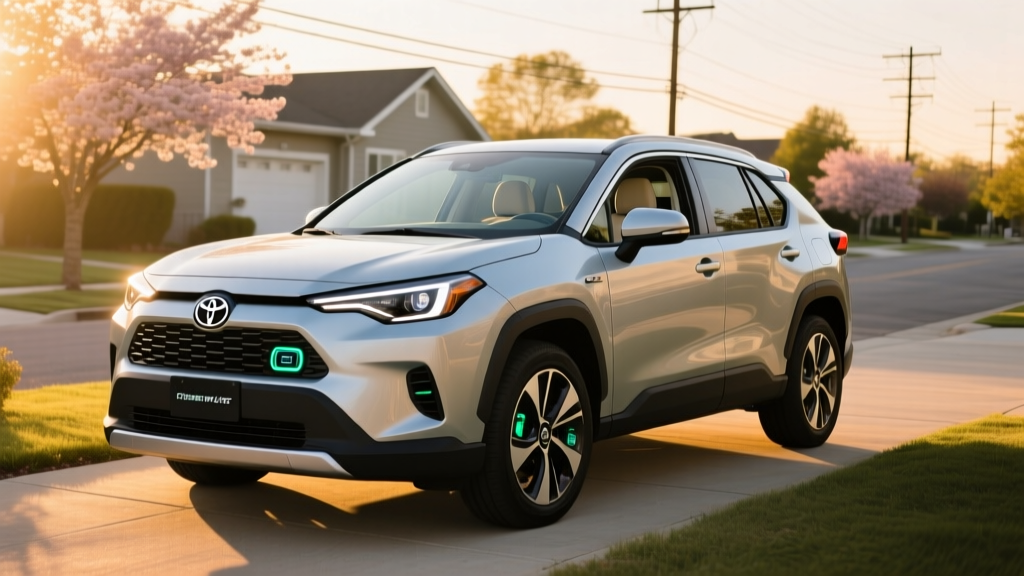
The 2025 Toyota Corolla Cross Hybrid SE occupies a specific niche that a growing number of buyers are hunting for: a compact crossover that sips fuel without requiring you to change how you drive. No plugs, no range apps, no charging-curve math. You fill it with gas and go — but you'll visit the pump far less often than you would in a conventional gas-only compact SUV.
As the sport-tuned trim in Toyota's Corolla Cross Hybrid lineup, the SE adds visual and handling upgrades over the base S and mid-grade SE Nightshade trims while keeping the same proven fifth-generation Toyota Hybrid System (THS). Below, we break down every number that matters — from EPA fuel economy to real-world MPG, battery warranty specifics, and how this hybrid stacks up against both plug-in hybrids and full EVs for your next purchase.
HEV vs PHEV: What the Corolla Cross Hybrid Actually Is
Before diving into specs, it's critical to establish what the Corolla Cross Hybrid is not: it is not a plug-in hybrid (PHEV). This distinction trips up many first-time hybrid shoppers.
Conventional Hybrid (HEV) vs Plug-In Hybrid (PHEV)
| Feature | HEV (Corolla Cross Hybrid) | PHEV (e.g., Toyota RAV4 Prime) |
|---|---|---|
| Plug-in charging required? | No — gas only | Yes — 120V or 240V outlet |
| Electric-only range | ~1 mi at very low speeds | 25–42 mi typical |
| Battery size | ~1.3 kWh (small buffer) | 13–18 kWh usable |
| DC fast charging | N/A | Rare (RAV4 Prime: no DCFC) |
| Federal tax credit (§30D) | Not eligible | Up to $7,500 if eligible |
| Best for | Apartment dwellers, no home charging | Home chargers, short commutes |
The Corolla Cross Hybrid recharges its small battery exclusively through regenerative braking and the gasoline engine. You never plug it in.
Toyota does not currently offer a Corolla Cross PHEV in the US market. If you need electric-only commuting range with a plug, you'd need to look at the larger RAV4 Prime (if you can find one) or a competitor PHEV like the Hyundai Tucson Plug-In Hybrid.
Fuel Economy: EPA Ratings and Real-World MPG
The headline number for the 2025 Corolla Cross Hybrid — across all trims including the SE — is 42 MPG combined per the EPA. Here's the full breakdown from fueleconomy.gov:
| Driving Cycle | EPA MPG | Real-World Expectation |
|---|---|---|
| City | 45 MPG | 44–50 MPG (hybrids excel in stop-and-go) |
| Highway | 38 MPG | 34–38 MPG (sustained 70+ mph reduces regen benefit) |
| Combined | 42 MPG | 38–46 MPG depending on driving mix |
For comparison, the gas-only 2025 Corolla Cross (2.0L, AWD) rates at 29 MPG combined — making the hybrid a 45% improvement in fuel efficiency for roughly $2,500 more in MSRP. That premium pays for itself in fuel savings within 2–3 years for an average driver covering 12,000 miles annually at $3.40/gallon.
Powertrain Specs: 196 HP with Standard AWD
The Corolla Cross Hybrid uses Toyota's fifth-generation hybrid system, pairing a 2.0-liter four-cylinder Atkinson-cycle engine with two electric motor-generators and an electronically controlled continuously variable transmission (eCVT). A rear-mounted electric motor provides standard electronic all-wheel drive (AWD) — there is no mechanical driveshaft to the rear wheels.
| Specification | 2025 Corolla Cross Hybrid SE |
|---|---|
| Combined Net Horsepower | 196 HP |
| Gasoline Engine | 2.0L 4-cyl Atkinson-cycle, 150 HP / 139 lb-ft |
| Front Electric Motor | 83 kW (111 HP) |
| Rear Electric Motor (AWD) | 30 kW (41 HP) |
| Hybrid Battery | ~1.3 kWh, Lithium-ion (sealed NiMH on early builds) |
| Transmission | eCVT (planetary gearset, not a belt CVT) |
| Drivetrain | Electronic AWD (standard on all Hybrid trims) |
| 0–60 MPH | ~7.5 seconds (est.) |
| Towing Capacity | 1,500 lbs |
| Curb Weight | ~3,355 lbs |
The SE trim specifically adds sport-tuned suspension tuning, 18-inch alloy wheels, paddle shifters (which simulate stepped gear ratios in the eCVT), and a slightly more aggressive exterior treatment. The powertrain is identical across all Corolla Cross Hybrid trims (S, SE, SE Nightshade, XSE, XSE Nightshade) — you're paying for aesthetics and chassis feel, not more power.
At 196 HP, the Corolla Cross Hybrid is one of the quicker vehicles in the subcompact hybrid crossover segment. The 0–60 time of approximately 7.5 seconds beats the gas-only Corolla Cross (9.2 seconds) and outpaces competitors like the Honda HR-V hybrid (not sold in the US) and the Kia Niro Hybrid (~8.0 seconds). The instant torque from the front electric motor makes it feel even punchier in city driving than the 0–60 number suggests.
Pricing, Trims, and Tax Credit Eligibility
The 2025 Toyota Corolla Cross Hybrid SE carries a starting MSRP of approximately $31,090 (including destination charge). Here's how the hybrid trims stack up:
| Trim | MSRP (incl. destination) | Key Additions |
|---|---|---|
| Hybrid S | $29,590 | Base hybrid, 17" wheels, TSS 3.0 |
| Hybrid SE | $31,090 | 18" alloys, sport suspension, paddle shifters, SofTex seats |
| Hybrid XSE | $33,340 | Wireless CarPlay/Android Auto, heated seats, power liftgate |
While the lack of a federal tax credit stings compared to a PHEV or EV, the Corolla Cross Hybrid's lower purchase price (compared to most PHEVs starting in the $37K–$45K range) often offsets the credit advantage. A RAV4 Prime starts near $44,000 and requires home charging infrastructure to realize its benefits — the Corolla Cross Hybrid asks for none of that.
Battery Warranty, Reliability, and Replacement Cost
Hybrid battery longevity remains the top concern for first-time hybrid buyers, and it's where Toyota's track record is strongest in the industry. The company has been mass-producing hybrids since the 1997 Prius and has deployed over 25 million hybrid systems globally.
Toyota Hybrid Battery Warranty
- Coverage: 10 years / 150,000 miles (whichever comes first)
- What's covered: Hybrid battery pack, hybrid control module, inverter, and related hybrid system components
- Capacity threshold: Toyota warrants against defects and abnormal loss of capacity — there is no published minimum State of Health (SoH) percentage, but the warranty covers failure and significant degradation
- Transferability: Fully transferable to subsequent owners at no cost
- Additional powertrain warranty: 5 years / 60,000 miles on the gasoline engine and transaxle
Real-world data from Toyota hybrid owners consistently shows the 1.3 kWh hybrid battery lasting well beyond 150,000 miles with minimal degradation. Unlike a full EV's 60–100 kWh pack that cycles deeply every day, the Corolla Cross Hybrid's small battery operates in a narrow State of Charge window (roughly 40%–80% SoC). The hybrid control system never fully charges or fully depletes the pack, which dramatically extends cell life. This shallow-cycling strategy is why 20-year-old Prius batteries are still functioning in many vehicles.
Replacement cost if out of warranty: A new OEM hybrid battery pack for the Corolla Cross Hybrid runs approximately $2,500–$4,000 installed at a Toyota dealer. Third-party refurbished packs are available for $1,500–$2,500. This is a fraction of EV battery replacement costs ($8,000–$20,000+) because the hybrid pack is small and simpler. Given Toyota's 10-year/150,000-mile warranty and the typical ownership cycle, most original owners will never face this cost.
Reliability data from Consumer Reports and J.D. Power consistently ranks the Toyota Corolla Cross above average in its segment, and the hybrid powertrain specifically carries one of the lowest predicted failure rates of any electrified system on the market. The eCVT (a planetary gearset, not a belt-and-pulley CVT) has no clutch packs, bands, or friction materials to wear out — it is mechanically one of the simplest transmissions ever put in a passenger vehicle.
Corolla Cross Hybrid SE vs Full EV vs Gas: Which Fits You?
The decision between a conventional hybrid, a plug-in hybrid, a full battery electric vehicle, and a gas-only car comes down to three variables: your daily mileage, your access to charging, and your budget.
Choose the Corolla Cross Hybrid if:
- You live in an apartment or lack home charging access
- Your daily commute is 20–80 miles (mixed city/highway)
- You want maximum fuel savings with zero lifestyle change
- You take road trips of 300+ miles regularly
- Your budget is under $35,000
- You live in a region with extreme cold (hybrids lose less range than EVs in winter)
Choose a full EV (e.g., Tesla Model Y, Hyundai Ioniq 5) if:
- You can install a Level 2 home charger (240V)
- Your daily driving is under 200 miles
- You want the lowest per-mile fuel cost (~$0.04–$0.08/mi vs $0.09–$0.12/mi for this hybrid)
- You qualify for the $7,500 federal tax credit (offsets higher EV purchase price)
- You want near-zero routine maintenance (no oil changes, fewer brake replacements)
The Corolla Cross Hybrid's total cost of ownership over 5 years is compelling: at 12,000 miles/year and $3.40/gallon, you'll spend roughly $970/year on fuel. A comparable gas-only Corolla Cross (29 MPG combined) would cost about $1,407/year. That's $2,185 in fuel savings over 5 years — nearly recovering the hybrid's price premium. Add in Toyota's strong resale values (the Corolla Cross Hybrid retains approximately 55–60% of its value after 5 years per Kelley Blue Book data) and the ownership math works well even without a tax credit.
What the SE Trim Gets You (and What You're Missing)
The SE sits in the middle of the Corolla Cross Hybrid range, and it's arguably the sweet spot for value. Here's what distinguishes it:
SE highlights:
- Sport-tuned suspension (firmer damping, slightly quicker steering ratio)
- 18-inch machined-finish alloy wheels (vs 17-inch on the S trim)
- Paddle shifters with 6 simulated gear ratios
- SofTex synthetic leather-trimmed seats
- Leather-trimmed steering wheel and shift knob
- Dual-zone automatic climate control
- 8-inch touchscreen with wireless Apple CarPlay and Android Auto
- Toyota Safety Sense 3.0 (pre-collision, lane departure, adaptive cruise, lane tracing, road sign assist, automatic high beams)
What you give up vs the XSE: The top-trim XSE adds a power liftgate, heated front seats, a 10.5-inch touchscreen upgrade, and a JBL premium audio system. If you're in a cold climate, the heated seats on the XSE are worth considering — the SE does not offer a cold-weather package.
✓ Pros
- 42 MPG combined — best-in-class for AWD compact crossovers
- Standard AWD with no fuel-economy penalty vs FWD
- 196 HP makes it genuinely quick for the segment
- 10-year/150,000-mile hybrid battery warranty
- No plug-in required — zero infrastructure investment
- Toyota Safety Sense 3.0 standard on every trim
- Strong projected resale value
✗ Cons
- No federal tax credit eligibility
- Highway MPG drops to upper 30s at 75+ mph
- Cargo space (25.5 cu ft behind rear seats) trails some rivals
- No heated seats available on SE trim
- Engine noise under hard acceleration (eCVT drone)
- 1,500-lb towing capacity limits utility
- No PHEV variant available in the US
Frequently Asked Questions
How many MPG does the 2025 Corolla Cross Hybrid SE get?
The EPA rates all Corolla Cross Hybrid trims at 45 city / 38 highway / 42 combined MPG. Real-world results vary: city-heavy drivers often see 44–50 MPG, while sustained highway driving at 75+ mph yields 34–38 MPG. Cold weather (below 35°F) typically reduces efficiency by 3–5 MPG due to increased engine run time for cabin heating.
Does the Corolla Cross Hybrid need to be plugged in?
No. The Corolla Cross Hybrid is a conventional hybrid (HEV), not a plug-in hybrid (PHEV). Its small battery recharges through regenerative braking and the gasoline engine. You fuel it exclusively at a gas station. There is no plug, no charging port, and no electric-only driving range to manage.
Does the 2025 Corolla Cross Hybrid qualify for any tax credit?
It does not qualify for the federal §30D Clean Vehicle Credit, which is limited to plug-in vehicles (BEVs and PHEVs) with eligible battery sourcing. Some states and utilities offer small rebates for hybrid purchases — check the Alternative Fuels Data Center for programs in your state. Always consult a tax professional for personal eligibility.
How long will the hybrid battery last and what does replacement cost?
Toyota warranties the hybrid battery for 10 years / 150,000 miles. Real-world data from millions of Toyota hybrids shows the pack regularly lasting 200,000+ miles with minimal degradation, thanks to shallow-cycling charge management. Out-of-warranty replacement costs approximately $2,500–$4,000 at a dealer, or $1,500–$2,500 for an aftermarket refurbished unit — far less than EV battery replacement.
Is the Corolla Cross Hybrid SE good in snow?
The standard electronic AWD system sends up to 50% of torque to the rear wheels via an independent rear electric motor. Combined with the hybrid system's smooth torque delivery and standard Toyota Safety Sense 3.0 (which includes traction and stability control), the Corolla Cross Hybrid performs well in light-to-moderate snow. For severe winter conditions, dedicated winter tires make a bigger difference than any AWD system.
How does the SE trim's sport suspension affect ride quality?
The SE's sport-tuned damping is firmer than the base S trim, which improves cornering composure and reduces body roll. You'll notice slightly more impact harshness over broken pavement and expansion joints. For most buyers, the trade-off is worthwhile — the Corolla Cross was never a luxury-ride vehicle, and the SE's tuning makes it feel more planted without being uncomfortable.
Corolla Cross Hybrid vs RAV4 Hybrid — which is the better buy?
The RAV4 Hybrid offers more interior space (37.6 cu ft cargo vs 25.5), more power (219 HP), and higher towing capacity (1,750 lbs). But it starts around $34,000 and rates at 39 MPG combined — 3 MPG less than the Corolla Cross Hybrid. If cargo space and rear-seat room are priorities, the RAV4 wins. If you want the best fuel economy and lowest price in a Toyota hybrid crossover, the Corolla Cross Hybrid SE is the more efficient and affordable choice.