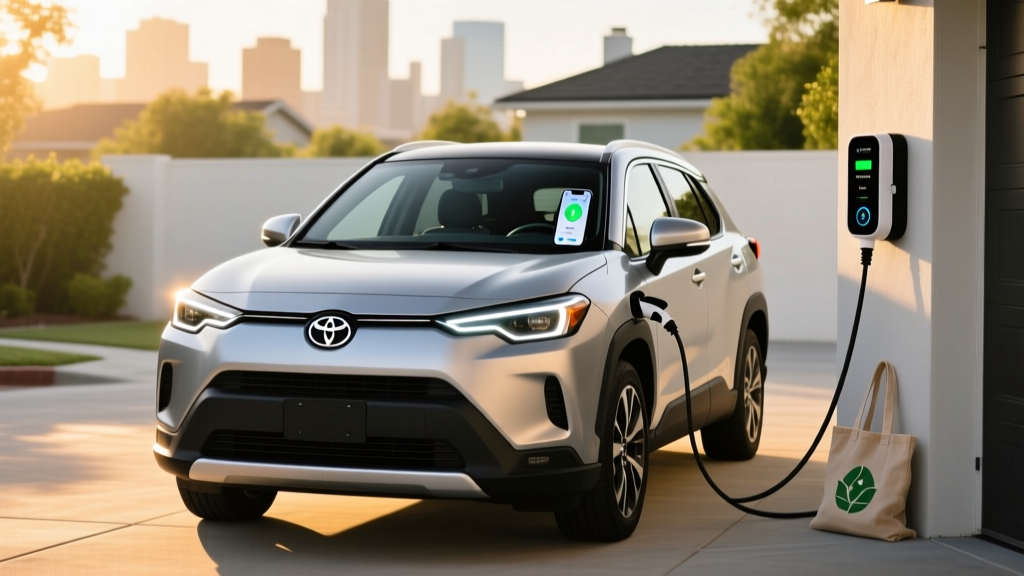
Quick Verdict: The 2025 Toyota Corolla Cross Hybrid AWD
The 2025 Toyota Corolla Cross Hybrid AWD occupies a specific and increasingly popular niche: a compact crossover that sips fuel like a Prius but offers the raised ride height and all-weather confidence that SUV buyers demand. With an EPA-rated 42 MPG combined and a starting MSRP around $30,000, it undercuts most competitors on fuel cost while delivering 196 combined horsepower — enough for confident highway merging and light trail duty.
This is a conventional hybrid electric vehicle (HEV), not a plug-in. You never plug it in. The 1.1 kWh battery recharges exclusively through regenerative braking and the gasoline engine. That distinction matters enormously for buyers weighing charging logistics, tax credit eligibility, and daily driving habits.
HEV vs. PHEV: Where the Corolla Cross Hybrid Fits
Conventional Hybrid (HEV) — This vehicle:
- No plug, no charging infrastructure required
- Small battery (~1.1 kWh) charged by regen + engine
- Electric motor assists the gas engine; cannot drive on electric alone at meaningful speeds
- No federal EV tax credit eligibility under IRS §30D
- Lower purchase price, simpler ownership
Plug-in Hybrid (PHEV) — e.g., Toyota RAV4 Prime, Hyundai Tucson PHEV:
- Requires plug-in charging (Level 1 or Level 2)
- Larger battery (13-18 kWh typical) enabling 25-42 miles of electric-only driving
- Can operate as a full EV for daily commutes, then switches to hybrid mode
- May qualify for partial or full $7,500 federal tax credit (subject to income, MSRP, and battery sourcing rules)
- Higher purchase price, more complex ownership
The Corolla Cross Hybrid is firmly HEV. Toyota does not currently offer a Corolla Cross PHEV variant in the US market. If you need electric-only commuting capability, you'll need to look at the RAV4 Prime or a full BEV.
Fuel Economy: EPA Ratings and Real-World MPG
Hybrid fuel economy is where the Corolla Cross Hybrid earns its keep. The fifth-generation Toyota Hybrid System pairs a 2.0-liter four-cylinder engine with front and rear electric motors for all-wheel drive, yielding class-leading efficiency for an AWD crossover.
| Driving Condition | EPA Rating | Real-World Expectation |
|---|---|---|
| City | 45 MPG | 43-48 MPG (hybrids excel in stop-and-go) |
| Highway | 38 MPG | 35-40 MPG (sustained speeds reduce regen benefit) |
| Combined | 42 MPG | 39-44 MPG |
Real-world context: Toyota hybrids historically meet or slightly exceed their EPA city estimates because regenerative braking recovers energy that conventional cars waste as heat. In mixed suburban driving with frequent stops, owners commonly report 43-46 MPG. Highway-only trips at 75+ mph will drop toward 35-37 MPG, as aerodynamic drag dominates and the engine runs more frequently. Cold weather (below freezing) reduces efficiency by roughly 5-10% due to increased engine warm-up time and cabin heating demands.
For comparison, the gas-only Corolla Cross AWD achieves 29 MPG combined — a 45% improvement for the hybrid. Against the Honda CR-V Hybrid AWD (40 MPG combined) and the Hyundai Tucson Hybrid AWD (38 MPG combined), the Corolla Cross Hybrid leads the compact AWD hybrid segment.
Source: EPA Fuel Economy Guide
Powertrain and Performance Specs
| Specification | 2025 Corolla Cross Hybrid AWD |
|---|---|
| Engine | 2.0L 4-cylinder DOHC 16-valve |
| Engine Power | 150 hp @ 6,000 rpm / 139 lb-ft @ 4,400 rpm |
| Front Electric Motor | 83 kW (111 hp) |
| Rear Electric Motor | 30 kW (40 hp) — AWD only |
| Combined Net System Power | 196 hp |
| Hybrid Battery | ~1.1 kWh, Lithium-ion (not user-serviceable) |
| Transmission | Electronic Continuously Variable (eCVT) |
| Drivetrain | Electronic On-Demand AWD |
| 0-60 mph | ~7.5 seconds (est.) |
| Towing Capacity | Not rated for towing |
| Cargo Volume | 25.0 cu ft (rear seats up) |
The 196 combined horsepower is a meaningful step up from the gas-only Corolla Cross (169 hp) and translates to noticeably better acceleration, especially when merging onto highways or climbing grades. The rear electric motor provides AWD traction without a mechanical driveshaft — it engages only when slip is detected or during hard acceleration, minimizing parasitic loss.
The eCVT is a Toyota hallmark: smooth, gearless, and optimized for efficiency rather than sporty shifts. Drivers accustomed to traditional automatics may notice the characteristic "motorboat" engine drone under hard acceleration, but in normal driving, the powertrain is remarkably quiet.
Pricing, Trims, and Tax Credit Eligibility
The 2025 Corolla Cross Hybrid is offered in three trims, all with standard AWD:
- S Hybrid: ~$30,095 MSRP (base, well-equipped with TSS 3.0)
- SE Hybrid: ~$31,595 MSRP (sport-tuned suspension, SofTex seats)
- XSE Hybrid: ~$33,595 MSRP (premium audio, heated seats, power liftgate)
All prices include destination. The hybrid premium over the gas-only equivalent trim is approximately $1,500-$2,000, which most buyers will recoup in fuel savings within 2-3 years at current gas prices.
Federal Tax Credit Status: NOT ELIGIBLE
The Corolla Cross Hybrid is a conventional HEV, not a plug-in vehicle. Under current IRS §30D rules, only battery electric vehicles (BEVs) and plug-in hybrid electric vehicles (PHEVs) with sufficient battery capacity qualify for the Clean Vehicle Credit. Conventional hybrids do not qualify for any federal purchase incentive.
Some states may offer minor hybrid incentives or HOV lane access — check your state's energy office for current programs.
Real-World Ownership: 5-Year Cost Snapshot
Fuel savings are the primary financial argument for the Corolla Cross Hybrid. Here's how the math works over five years and 75,000 miles:
| Cost Factor | Corolla Cross Hybrid AWD | Corolla Cross Gas AWD |
|---|---|---|
| Estimated Fuel Cost (5 yr / 75k mi) | ~$5,360 (42 MPG, $3.00/gal) | ~$7,760 (29 MPG, $3.00/gal) |
| Fuel Savings vs. Gas | ~$2,400 saved over 5 years | |
| Estimated Insurance (annual avg) | ~$1,600 | ~$1,500 |
| Maintenance (5 yr) | ~$2,200 | ~$2,400 |
| Purchase Premium for Hybrid | ~$1,500-$2,000 | |
The hybrid pays for its purchase premium in roughly 3-4 years through fuel savings alone, and continues saving money for the life of the vehicle. Maintenance costs are comparable or slightly lower than the gas model — the hybrid system eliminates the traditional starter motor and alternator, and regenerative braking extends brake pad life significantly.
Battery Warranty, Reliability, and Replacement Cost
Toyota Hybrid Battery Warranty: 10 years / 150,000 miles (whichever comes first) for 2020 and newer models. This covers the hybrid battery pack against defects and capacity loss below a defined threshold.
Hybrid System Components Warranty: 8 years / 100,000 miles for the inverter, electric motors, and related control systems.
Toyota's hybrid battery longevity record is among the best in the industry. The original Prius, introduced in the US in 2000, demonstrated that nickel-metal hydride and later lithium-ion hybrid batteries routinely last 150,000-200,000+ miles with minimal degradation. The Corolla Cross Hybrid's lithium-ion pack is smaller and less stressed than a full EV battery, operating in a narrow state-of-charge window (roughly 40-80%) managed by the vehicle's computer — this significantly extends cycle life.
Battery replacement cost: If the hybrid battery fails outside warranty, replacement runs approximately $2,500-$4,000 including labor, depending on whether you choose a new OEM pack, a refurbished unit, or an independent hybrid specialist. This is dramatically less than a full EV battery replacement ($10,000-$20,000+) because the pack is small (~1.1 kWh vs. 60-100 kWh in a BEV).
Reliability outlook: Toyota consistently ranks at or near the top of J.D. Power and Consumer Reports reliability surveys, and the fifth-generation hybrid system is a mature, well-proven technology. The 2.0L Dynamic Force engine has been in production since 2018 with no widespread failure patterns.
Who Should Choose the Corolla Cross Hybrid?
Choose the Corolla Cross Hybrid if:
- You want AWD capability and SUV ride height without a fuel-economy penalty
- You cannot charge at home (apartment, street parking, no garage) — HEVs need no charging infrastructure
- Your daily commute is under 50 miles with stop-and-go traffic (where hybrids shine)
- You want to minimize upfront cost and avoid the complexity of EV ownership
- You plan to keep the vehicle 8+ years (the hybrid premium pays for itself in fuel savings)
Consider a full EV instead if:
- You have reliable home Level 2 charging and want zero tailpipe emissions
- You want access to the $7,500 federal tax credit (check current eligibility)
- Your daily commute is under 40 miles round-trip (most modern EVs handle this easily)
- You want to eliminate oil changes, spark plugs, and engine maintenance entirely
Consider a PHEV instead if:
- You want electric-only commuting (25-42 mi) but also need long road-trip range
- You have home charging access and want partial federal tax credit eligibility
- You're willing to pay a higher purchase premium ($38,000-$45,000 for a RAV4 Prime)
Pros
- 42 MPG combined — best-in-class for AWD compact crossover
- 196 hp provides confident acceleration vs. gas model
- No charging infrastructure required
- 10-year / 150,000-mile hybrid battery warranty
- Standard Toyota Safety Sense 3.0 (ADAS suite)
- Strong reliability track record
- Low purchase premium over gas model ($1,500-$2,000)
Cons
- No plug-in option — cannot drive on electric only
- No federal tax credit eligibility
- Cargo space is modest (25.0 cu ft) vs. RAV4 or CR-V
- Not rated for towing
- Highway MPG drops to ~35-37 at sustained 75+ mph
- eCVT drone under hard acceleration
- Rear seat legroom is tight for taller passengers
Frequently Asked Questions
How many MPG does the 2025 Toyota Corolla Cross Hybrid AWD get?
The EPA rates it at 45 city / 38 highway / 42 combined MPG. In real-world suburban driving with mixed stop-and-go and highway use, expect 39-44 MPG. City-heavy driving often yields 43-48 MPG because regenerative braking recovers energy at low speeds.
Does the Corolla Cross Hybrid need to be plugged in?
No. This is a conventional hybrid (HEV), not a plug-in hybrid (PHEV). The small lithium-ion battery charges automatically through regenerative braking and the gasoline engine. You simply fill it with gas and drive.
How far can it go on electric only?
It cannot. Unlike a PHEV or full EV, the Corolla Cross Hybrid cannot drive on electric power alone at any meaningful speed or distance. The electric motors assist the gas engine but do not operate independently for propulsion. If electric-only driving is a priority, consider a PHEV like the RAV4 Prime (42 miles electric) or a full BEV.
Is the Corolla Cross Hybrid reliable?
Toyota's hybrid systems are among the most proven in the industry, with over 25 years of continuous production since the original Prius. The fifth-generation hybrid system in the Corolla Cross uses mature, well-tested components. Toyota backs it with a 10-year / 150,000-mile hybrid battery warranty. J.D. Power and Consumer Reports consistently rank Toyota at or near the top for long-term reliability.
What does a hybrid battery replacement cost?
Outside of warranty, a Corolla Cross Hybrid battery replacement costs approximately $2,500-$4,000 including labor. This is far less than a full EV battery replacement because the pack is small (~1.1 kWh). In practice, Toyota hybrid batteries routinely last 150,000-200,000+ miles, and the 10-year warranty provides substantial coverage.
Does the Corolla Cross Hybrid qualify for a federal tax credit?
No. Under current IRS §30D rules, only plug-in electric vehicles (BEVs and PHEVs) qualify for the federal Clean Vehicle Credit. Conventional hybrids like the Corolla Cross Hybrid are not eligible. Some states may offer minor incentives or HOV lane access for hybrids — check your state's energy office.
How does the Corolla Cross Hybrid compare to the RAV4 Hybrid?
The RAV4 Hybrid is larger, more powerful (219 hp), and offers more cargo space (37.6 cu ft), but starts around $33,000 and achieves 39 MPG combined — 3 MPG less than the Corolla Cross Hybrid. If you need maximum cargo room or tow capability (RAV4 Hybrid: 1,500 lbs), the RAV4 is the better choice. If efficiency and lower cost are priorities, the Corolla Cross Hybrid wins.
Is the AWD system always active?
No. The Corolla Cross Hybrid uses an electronic on-demand AWD system. Under normal driving conditions, the vehicle operates primarily in front-wheel drive for maximum efficiency. The rear electric motor engages automatically when the system detects wheel slip, during hard acceleration, or in low-traction conditions. This approach minimizes energy loss while providing confidence in rain, snow, and light off-road situations.