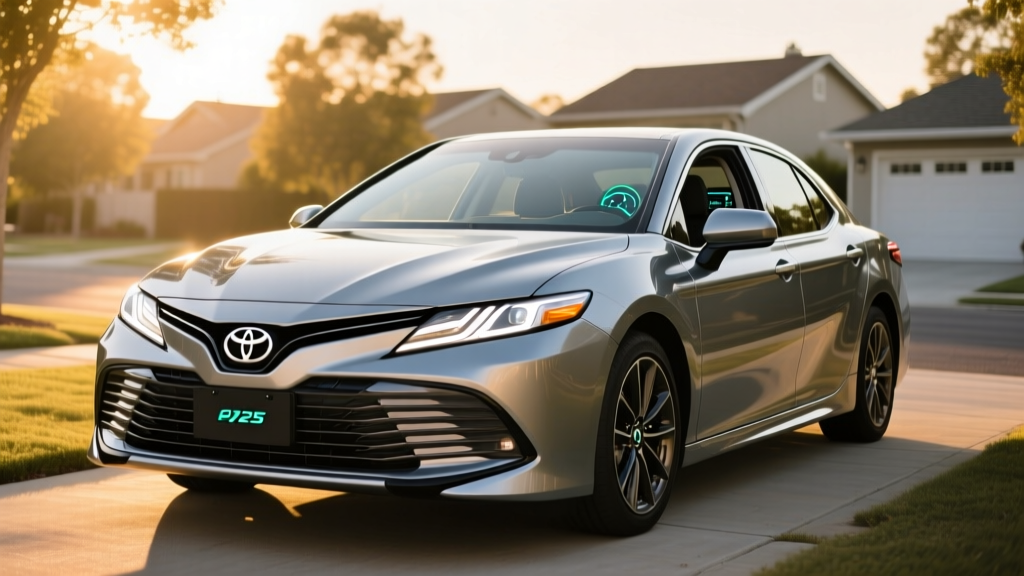
The 2025 Toyota Camry Hybrid sedan marks a pivotal shift for America's best-selling midsize sedan: for the first time, every Camry is a hybrid. Toyota eliminated the gas-only four-cylinder entirely, betting that the fifth-generation Toyota Hybrid System (THS) delivers the efficiency buyers demand without the range compromises of a full battery-electric vehicle. With an EPA-estimated 51 MPG combined on front-wheel-drive trims and a starting MSRP of $29,490, the 2025 Camry Hybrid occupies a compelling middle ground between conventional gas sedans and pricier plug-in hybrids or EVs.
This guide breaks down the exact numbers — fuel economy by trim and drivetrain, powertrain output, real-world MPG expectations, battery warranty coverage, and total cost of ownership — so you can decide whether the 2025 Camry Hybrid fits your commute, budget, and charging situation.
HEV vs. PHEV vs. EV: Where the Camry Hybrid Fits
Before diving into specs, it's critical to understand what the 2025 Camry is — and what it isn't. The Camry Hybrid is a conventional hybrid electric vehicle (HEV). It does not plug in. It has no electric-only driving range to speak of (the battery assists the gas engine at low speeds but cannot propel the car on electricity alone for meaningful distances). You refuel it at any gas station, exactly like a traditional car.
| Attribute | HEV (Camry Hybrid) | PHEV (e.g., Prius Prime) | BEV (e.g., Tesla Model 3) |
|---|---|---|---|
| Plugs in? | No | Yes | Yes |
| Electric-only range | ~0 mi | 25–44 mi | 250–360+ mi |
| Home charging needed? | No | Recommended | Required |
| Gas engine? | Yes | Yes | No |
| Federal tax credit (§30D)? | No | Up to $7,500* | Up to $7,500* |
| Typical starting MSRP | $29,490 | $33,445 | $38,990+ |
*§30D credit eligibility depends on MSRP caps, buyer income limits, battery sourcing requirements, and point-of-sale transfer rules. See IRS guidelines for current-year details.
The Camry Hybrid is the right call if you want maximum fuel efficiency with zero lifestyle changes — no home charger installation, no route planning around charging stations, no cold-weather range anxiety. If you have home charging access and a short commute, a PHEV like the Toyota Prius Prime (44 miles electric-only) may save more on fuel. If you're ready to eliminate gas entirely, a BEV is the next step. But for drivers who want simplicity, the Camry HEV is hard to beat.
Fuel Economy: EPA MPG by Trim and Drivetrain
The 2025 Camry Hybrid is offered in four trims — LE, SE, XLE, and XSE — with either front-wheel drive (FWD) or electronic all-wheel drive (AWD). The drivetrain choice affects both fuel economy and horsepower, as the AWD system adds a rear-mounted electric motor.
| Trim | Drivetrain | City MPG | Highway MPG | Combined MPG |
|---|---|---|---|---|
| LE | FWD | 53 | 50 | 51 |
| LE | AWD | 51 | 49 | 50 |
| SE | FWD | 48 | 47 | 47 |
| SE | AWD | 46 | 46 | 46 |
| XLE | FWD | 48 | 47 | 47 |
| XLE | AWD | 46 | 46 | 46 |
| XSE | FWD | 48 | 47 | 47 |
| XSE | AWD | 46 | 46 | 46 |
Source: EPA fueleconomy.gov
The LE trim's 51 MPG combined figure is the headline number, but notice the pattern: sport-tuned SE and XSE trims, along with the more feature-laden XLE, drop to 47 combined on FWD. The difference comes from larger 18- or 19-inch wheels, wider tires, and slightly different aerodynamic tuning. The AWD penalty is modest — just 1 MPG across the board — making it a practical choice for snow-belt buyers who don't want to sacrifice much at the pump.
Real-World MPG: What to Actually Expect
Toyota hybrids have a well-documented trait: they often exceed EPA estimates in city driving and fall slightly short on sustained highway runs. This is the inverse of gas-only cars. The hybrid system recaptures energy during stop-and-go braking, making city commutes its efficiency sweet spot.
Based on owner-reported data and independent testing:
- City/commute driving: Expect 52–56 MPG on LE FWD — the regenerative braking system shines here.
- Highway (70–80 mph sustained): Expect 44–48 MPG on LE FWD. Aerodynamic drag rises with the square of speed, and the 2.5L engine carries more of the load at highway speeds.
- Mixed driving: 48–52 MPG is typical for LE owners in moderate climates.
- Cold weather (below 32°F): Expect a 5–10% drop. The engine runs more often to provide cabin heat and warm the catalytic converter.
For a 15,000-mile/year driver averaging 50 MPG, annual fuel consumption is roughly 300 gallons. At $3.30/gallon (2025 national average for regular unleaded), that's approximately $990 per year in fuel — roughly $600–$800 less than a comparable turbocharged gas sedan getting 30 MPG combined.
Powertrain Specs: Fifth-Gen Hybrid System
The 2025 Camry uses Toyota's fifth-generation hybrid system built around a 2.5-liter Dynamic Force inline-four engine. Here's the complete powertrain breakdown:
| Specification | FWD Models | AWD Models |
|---|---|---|
| Engine | 2.5L 4-cylinder (184 hp, 163 lb-ft) | 2.5L 4-cylinder (184 hp, 163 lb-ft) |
| Front electric motor | 100 kW (134 hp) | 100 kW (134 hp) |
| Rear electric motor | — | 30 kW (40 hp) |
| Net combined horsepower | 225 hp | 232 hp |
| Transmission | eCVT | eCVT |
| 0–60 mph (est.) | ~7.1 sec | ~6.9 sec |
| Hybrid battery | ~1.0 kWh lithium-ion (NiMH on base) | ~1.0 kWh lithium-ion (NiMH on base) |
| Fuel tank | 13.2 gal | 13.2 gal |
| Total range (est.) | ~670 mi | ~660 mi |
The combined 225 hp (FWD) or 232 hp (AWD) output represents a meaningful step up from the previous-generation Camry Hybrid's 208 hp. Throttle response is immediate thanks to the electric motor's instant torque, and the eCVT avoids the rubber-band feeling that older continuously variable transmissions exhibited. The AWD system's rear motor engages automatically under acceleration or low-traction conditions and doesn't require a mechanical driveshaft — it's an "e-AWD" system that saves weight and packaging space.
Pricing, Trims, and Tax Credit Eligibility
The 2025 Camry Hybrid lineup spans four trims with FWD or AWD availability:
- LE FWD: $29,490 MSRP (destination included)
- LE AWD: $30,990
- SE FWD: $31,090
- SE AWD: $32,590
- XLE FWD: $33,490
- XLE AWD: $34,990
- XSE FWD: $34,090
- XSE AWD: $35,590
Federal Tax Credit: Does the Camry Hybrid Qualify?
No. The 2025 Toyota Camry Hybrid is a conventional HEV and does not qualify for the IRS §30D Clean Vehicle Credit. That credit — up to $7,500 — is reserved for plug-in electric vehicles (BEVs and PHEVs) that meet battery sourcing, critical mineral, MSRP, and buyer income requirements.
However, some states and utilities offer rebates for conventional hybrids. Check your state energy office or local utility for current programs. Toyota also occasionally offers manufacturer loyalty cash or lease incentives that can reduce out-of-pocket cost — check Toyota's current offers page for regional deals.
Hybrid Battery Warranty Coverage
Toyota covers the Camry Hybrid's battery pack with a 10-year / 150,000-mile warranty (whichever comes first) in all 50 states. This replaced the earlier 8-year/100,000-mile coverage starting with the 2020 model year. The warranty covers battery capacity loss below a specified threshold and defects. Additionally, Toyota's Hybrid System Warranty covers the inverter, transaxle, and control modules for the same 10-year/150,000-mile period.
Reliability and Battery Replacement Cost
Toyota's hybrid powertrains have accumulated over 25 years of real-world data since the original Prius launched in Japan in 1997. The Camry Hybrid consistently earns top reliability marks from Consumer Reports and J.D. Power, and the fifth-generation THS benefits from decades of iterative refinement.
How Long Will the Hybrid Battery Last?
Based on fleet data and owner reports, Toyota hybrid batteries typically last 150,000–200,000+ miles before significant degradation. Many first-generation Prius batteries exceeded 200,000 miles. The lithium-ion packs in the 2025 Camry are more durable than the nickel-metal hydride packs of earlier generations, and Toyota's battery management system keeps the state of charge in a conservative 40–80% window to minimize stress on the cells.
Battery Replacement Cost
If the hybrid battery does fail outside of warranty, replacement costs break down as follows:
- OEM new battery from Toyota: $2,500–$4,000 (parts) + $500–$1,000 (labor) = approximately $3,000–$5,000 total
- Refurbished/remanufactured battery: $1,500–$2,500 installed
- Individual module replacement: Some independent hybrid specialists can replace only the failed modules within the pack for $800–$1,500
For context, a conventional gas sedan's transmission replacement often costs $3,000–$5,000 — and the hybrid battery is no more likely to fail than a transmission. The 10-year/150,000-mile warranty provides a substantial safety net for the vast majority of ownership periods.
Pros and Cons: The Honest Assessment
Pros
- Class-leading 51 MPG combined (LE FWD) with real-world potential to exceed it in city driving
- No plug-in charging required — zero infrastructure changes needed
- 225–232 hp provides confident acceleration, a notable upgrade from prior generations
- Standard Toyota Safety Sense 3.0 (pre-collision, lane departure, adaptive cruise, road sign assist)
- 10-year/150,000-mile hybrid battery warranty across all states
- AWD available on every trim for just $1,500 more and only 1 MPG penalty
- Strong resale value — Camry Hybrids hold value well in the used market
Cons
- No federal tax credit eligibility (HEV, not PHEV or BEV)
- Sport trims (SE/XSE) lose 4–5 MPG vs. LE due to wheel/tire choices
- eCVT still lacks the engagement of a geared automatic for enthusiast drivers
- Rear seat doesn't fold completely flat in some trims due to battery placement
- No DC fast charging capability (not applicable to HEVs, but worth noting vs. PHEVs)
- Base LE interior materials feel budget-conscious at the $29,490 price point
Who Should Buy the 2025 Camry Hybrid?
Choose the Camry Hybrid if:
- You want maximum MPG with zero charging hassle or home electrical upgrades
- Your commute involves heavy stop-and-go traffic where hybrid efficiency peaks
- You drive 12,000–20,000 miles/year and want to minimize annual fuel spend (~$990/yr at 50 MPG)
- You need AWD for winter driving but don't want an SUV's fuel penalty
- You plan to keep the car 8–10 years and value Toyota's reliability track record
Consider a PHEV (Prius Prime) instead if:
- You have home Level 2 charging and a commute under 40 miles round-trip
- You want to drive mostly on electricity and qualify for the §30D tax credit
Consider a BEV (Model 3, Ioniq 6) instead if:
- You have reliable home charging and want to eliminate gas and oil changes entirely
- Your daily driving is under 250 miles and you take occasional road trips with planned charging stops
Frequently Asked Questions
How many MPG does the 2025 Toyota Camry Hybrid get?
The LE FWD trim achieves an EPA-estimated 53 city / 50 highway / 51 combined MPG. Sport and luxury trims (SE, XLE, XSE) get 47 combined on FWD and 46 combined with AWD. Real-world city driving often exceeds EPA estimates by 2–5 MPG, while sustained highway driving at 75+ mph may fall 3–5 MPG below the sticker.
Does the 2025 Camry Hybrid need to be plugged in?
No. The Camry Hybrid is a conventional HEV. It charges its small battery pack through regenerative braking and the gas engine. You never plug it in — just fill up at any gas station with regular unleaded (87 octane).
Does the Camry Hybrid qualify for a federal tax credit?
No. The IRS §30D Clean Vehicle Credit applies only to plug-in vehicles (BEVs and PHEVs) that meet specific battery sourcing and MSRP requirements. The Camry Hybrid, as an HEV, is not eligible. Some state or utility programs may offer hybrid incentives — check local resources.
How long will the Camry Hybrid battery last?
Toyota's hybrid batteries are designed to last 150,000–200,000+ miles based on historical data. The battery is warranted for 10 years or 150,000 miles. Toyota's battery management system avoids deep discharge and full-charge states, which significantly extends cell life compared to full EVs that routinely cycle from 10% to 90%.
What does it cost to replace the hybrid battery?
An OEM replacement runs approximately $3,000–$5,000 installed at a Toyota dealer. Refurbished batteries or independent module-level repairs can reduce this to $800–$2,500. Given the 10-year/150,000-mile warranty and the battery's proven longevity, most owners will never face this cost.
Is the AWD system worth the MPG trade-off?
AWD costs only 1 MPG combined (e.g., 50 vs. 51 on the LE) and adds $1,500 to the MSRP. The rear electric motor provides genuine traction benefits in rain, snow, and light off-pavement situations without the weight and complexity of a mechanical AWD system. For buyers in northern climates, the trade-off is minimal and worthwhile.
How does the Camry Hybrid compare to the Honda Accord Hybrid?
The 2025 Accord Hybrid achieves an EPA-estimated 48 combined MPG on its base trim, trailing the Camry Hybrid LE's 51 combined. The Camry also offers AWD across all trims (the Accord Hybrid does not). However, the Accord Hybrid's two-motor system delivers slightly more natural-feeling acceleration and a more refined highway ride. Both carry excellent reliability records and similar battery warranties.