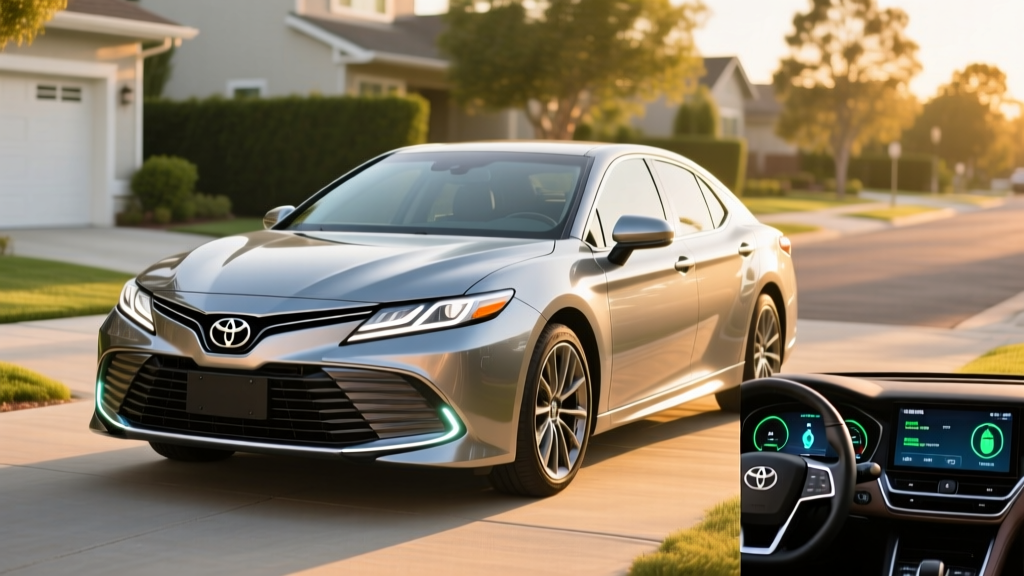
The 2025 Toyota Camry arrived with a powertrain overhaul that made headlines: every single Camry sold in the United States is now a hybrid. Toyota dropped the purely gas-powered four-cylinder entirely, betting that its fifth-generation hybrid system could satisfy both efficiency seekers and drivers who care about passing power. The result is a midsize sedan that posts up to 51 MPG combined while delivering a genuinely useful 225 horsepower on front-wheel-drive trims — and 232 hp when you opt for all-wheel drive.
If you've been searching for 2025 Toyota Camry hybrid horsepower figures, you've likely noticed the numbers vary depending on drivetrain and trim. This guide breaks down exactly what Toyota's hybrid system produces, how that translates to real-world driving, what you'll pay at the pump and the dealer, and whether this HEV (conventional hybrid) is the right electrified choice for your situation — or whether a PHEV or full BEV might serve you better.
2025 Camry Hybrid Powertrain: Where the Horsepower Comes From
The 2025 Camry uses Toyota's fifth-generation hybrid powertrain, a series-parallel system that pairs a 2.5-liter four-cylinder engine with one or two electric motors depending on drivetrain configuration. Here's the critical distinction: horsepower in this system isn't simply additive. You can't just add the gas engine's output to the electric motor's output because they don't peak at the same RPM. Toyota rates combined system output, which is the number that matters.
| Specification | FWD Models | AWD Models |
|---|---|---|
| Combined System Horsepower | 225 hp | 232 hp |
| Gas Engine | 2.5L 4-cyl, 184 hp / 163 lb-ft | 2.5L 4-cyl, 184 hp / 163 lb-ft |
| Front Electric Motor | 100 kW (134 hp) | 100 kW (134 hp) |
| Rear Electric Motor (AWD only) | — | 30 kW (40 hp) |
| 0–60 mph (est.) | ~7.1 seconds | ~6.9 seconds |
| Transmission | eCVT | eCVT |
| Drivetrain | Front-wheel drive | Electronic AWD |
The AWD system is worth understanding because it's not a traditional mechanical setup. There's no driveshaft connecting front and rear axles. Instead, a dedicated 30 kW electric motor powers the rear wheels when the system detects slip or when extra traction is needed. This adds 7 net horsepower to the system total (232 vs. 225) and provides confident launches in rain or light snow without the parasitic drivetrain loss of a conventional AWD system.
Fuel Economy: EPA Ratings and Real-World MPG
The headline number for the 2025 Camry Hybrid is its EPA-estimated fuel economy, which varies by trim and wheel size. The LE trim on 16-inch wheels achieves the highest rating, while the sportier XSE on 19-inch wheels sacrifices a few MPG for aesthetics and handling.
| Trim / Drivetrain | City MPG | Highway MPG | Combined MPG |
|---|---|---|---|
| LE (FWD) | 53 | 50 | 51 |
| LE (AWD) | 51 | 49 | 50 |
| SE / XLE (FWD) | 48 | 47 | 47 |
| SE / XLE (AWD) | 46 | 46 | 46 |
| XSE (FWD) | 48 | 47 | 47 |
| XSE (AWD) | 44 | 43 | 44 |
Real-world MPG reality check: Toyota hybrids historically perform as well as — or better than — their EPA estimates in city driving, where regenerative braking and electric-only low-speed operation shine. On predominantly highway routes at 70–80 mph, expect to see numbers 2–4 MPG below the city rating. In mixed suburban-and-highway driving over a full tank, most owners of the LE FWD report landing between 47 and 52 MPG, which tracks closely with the EPA combined figure. Cold weather (below 35°F) typically drops observed economy by 5–10% due to reduced battery efficiency and increased engine idling for cabin heat.
HEV vs. PHEV vs. EV: Which Electrified Camry (or Competitor) Fits You?
The 2025 Camry is offered exclusively as a conventional hybrid (HEV). There is no plug-in hybrid Camry variant — Toyota discontinued the Camry Hybrid plug-in concept years ago, and the current generation focuses on the self-charging HEV architecture. This matters because buyers often confuse HEV and PHEV capabilities. Let's clarify:
HEV (This Camry)
- No plug-in required
- Regenerative braking charges a small (~1 kWh) battery
- Electric motor assists gas engine; brief EV-only at low speeds
- Best for: drivers without home charging access who want max MPG
PHEV (e.g., Prius Prime)
- Plugs in to charge a larger battery (13.6 kWh in Prius Prime)
- ~40 miles of true electric-only driving
- Gas engine takes over when battery depletes
- Best for: home chargers with short commutes
BEV (e.g., Tesla Model 3)
- 100% electric, no gas engine
- 250–350+ miles EPA range
- Requires home or reliable public charging
- Best for: home chargers, lower fuel cost, zero tailpipe emissions
The Camry Hybrid is the right call if you want dramatic fuel savings without changing your refueling behavior at all. You fill up at a gas station exactly as you always have — you just visit far less often. If you have a garage and can install a Level 2 charger, and your daily commute is under 40 miles round-trip, a PHEV like the Toyota Prius Prime (44 miles electric-only, 52 MPG combined after battery depletion) could eliminate most of your gasoline use. If your commute is longer and you want zero tailpipe emissions with the lowest per-mile energy cost, a BEV enters the conversation — but requires charging infrastructure planning.
Pricing, Trims, and Tax Credit Eligibility
The 2025 Camry Hybrid starts at a competitive MSRP, with the lineup spanning from well-equipped to near-luxury. Here's what you're looking at across the range:
| Trim | Drivetrain | MSRP (approx.) |
|---|---|---|
| LE | FWD | $29,495 |
| LE | AWD | $30,995 |
| SE | FWD | $31,795 |
| SE | AWD | $33,295 |
| XLE | FWD | $34,495 |
| XLE | AWD | $35,995 |
| XSE | FWD | $36,495 |
| XSE | AWD | $37,995 |
Federal tax credit status: The 2025 Camry Hybrid does not qualify for the federal §30D clean vehicle tax credit of up to $7,500. Under current IRS rules, the §30D credit applies only to plug-in electric vehicles (BEVs and PHEVs) with sufficient battery capacity. Conventional hybrids like the Camry HEV are excluded regardless of their efficiency. Some states and municipalities offer their own incentives for high-efficiency vehicles, so check your local DMV or energy office — but at the federal level, the tax-credit advantage belongs to plug-in vehicles.
- ☐ Vehicle must be a plug-in EV (BEV or PHEV) — HEVs excluded
- ☐ Battery capacity ≥ 7 kWh (for PHEV/BEV)
- ☐ MSRP cap: $55,000 (sedans) / $80,000 (SUVs, trucks, vans)
- ☐ Buyer income cap: $150K single / $300K joint (modified AGI)
- ☐ Battery components and critical minerals must meet North American sourcing thresholds
- ☒ 2025 Camry Hybrid: Does NOT qualify (conventional HEV, no plug)
Battery Longevity, Warranty, and Replacement Cost
The most common concern among hybrid buyers — and the question we hear most often — is battery lifespan. The 2025 Camry uses a lithium-ion hybrid battery pack (approximately 1.0 kWh usable capacity) that is fundamentally different from the large traction batteries in BEVs. This battery doesn't need to store massive energy; it buffers regenerative braking energy and provides electric motor assist. As a result, it cycles far less deeply and degrades much more slowly.
Replacement cost: If the hybrid battery does fail outside warranty, replacement typically runs between $2,000 and $4,000 at a Toyota dealer, including labor. Third-party and refurbished battery options exist for $1,000–$2,000. However, real-world data from Toyota's decades of hybrid production (the Prius launched in 1997) shows that modern lithium-ion hybrid batteries routinely last 150,000–200,000+ miles with minimal capacity loss. The shallow charge-discharge cycles and robust thermal management make catastrophic hybrid battery failure uncommon.
For context, this is a fundamentally different risk profile than a BEV battery replacement, which can cost $8,000–$20,000+ depending on pack size. The Camry Hybrid's small battery is one of the lowest-stress electrified components on the road.
Driving Impressions: What 225 Horsepower Feels Like
Numbers tell part of the story, but the character of Toyota's hybrid system matters too. The 2025 Camry's eCVT (electronically controlled continuously variable transmission) doesn't have fixed gear ratios — it uses a planetary gearset to blend engine and motor power seamlessly. The result is smooth, linear acceleration without the rubber-band effect that plagued earlier CVTs.
At low speeds (0–30 mph), the electric motor dominates, providing instant torque and quiet operation. The gas engine engages progressively as you demand more power, and at full throttle, both the engine and front motor deliver combined peak output. The 225 hp FWD Camry hits 60 mph in roughly 7.1 seconds — not sports-sedan quick, but entirely adequate for highway merging and passing. The AWD version shaves about 0.2 seconds off that time thanks to the rear motor's additional grip and power.
Compared to the previous-generation Camry Hybrid (208 hp combined), the 2025 model's 225 hp output represents a meaningful improvement. Where the old car felt merely adequate, the new one feels genuinely willing. The steering is heavier and more precise than past Camrys, and the chassis tuning on SE and XSE trims adds a layer of composure that makes this a more engaging sedan than its reputation suggests.
Ownership Costs: 5-Year Fuel Savings vs. Gas-Only Sedans
The 2025 Camry Hybrid's efficiency translates directly into ownership savings. Here's how the math works for a typical driver covering 15,000 miles per year:
| Vehicle | Combined MPG | Annual Fuel Cost | 5-Year Fuel Cost |
|---|---|---|---|
| 2025 Camry Hybrid LE (FWD) | 51 | $1,029 | $5,147 |
| 2024 Camry Gas LE (prior gen) | 32 | $1,641 | $8,203 |
| Honda Accord 1.5T (gas) | 33 | $1,591 | $7,955 |
| Hyundai Sonata Hybrid | 47 | $1,117 | $5,585 |
Over five years, the Camry Hybrid saves roughly $2,800–$3,100 in fuel compared to a typical gas-only midsize sedan. That nearly offsets the modest price premium of the hybrid powertrain — and remember, every 2025 Camry is a hybrid, so there's no longer a hybrid price penalty within the Camry lineup itself. You're getting hybrid efficiency at what would have been the gas model's price point.
Insurance costs for the Camry Hybrid are generally in line with gas competitors, and Toyota's reliability record keeps long-term maintenance costs low. There are no spark plugs to change at 30,000-mile intervals (the Atkinson-cycle engine uses iridium plugs rated for 120,000 miles), and regenerative braking significantly extends brake pad life — many owners report 60,000–80,000 miles on original pads.
Pros, Cons, and Final Verdict
Pros
- Up to 51 MPG combined — class-leading efficiency
- 225 hp (232 AWD) is a genuine improvement over prior gen
- No plug-in required — zero behavior change from gas cars
- 10-year / 150,000-mile hybrid battery warranty
- ~673 miles of range per tank
- AWD available across all trims
- Strong resale value and Toyota reliability reputation
Cons
- No federal tax credit (HEV excluded from §30D)
- No plug-in hybrid (PHEV) variant available
- eCVT drone under hard acceleration (improved but present)
- XSE with 19" wheels drops to 44 MPG combined
- Infotainment still trails competitors in responsiveness
- No DC fast charging capability (not applicable to HEV)
Frequently Asked Questions
How many MPG does the 2025 Toyota Camry Hybrid get?
The 2025 Camry Hybrid LE (FWD) achieves an EPA-estimated 53 city / 50 highway / 51 combined MPG. Sportier trims with larger wheels (XSE AWD) rate as low as 44 MPG combined. Real-world mixed driving typically matches or slightly exceeds the EPA combined number, especially in city-heavy use.
How much horsepower does the 2025 Camry Hybrid have?
FWD models produce 225 combined system horsepower; AWD models produce 232 hp. This comes from a 2.5-liter four-cylinder engine (184 hp) paired with electric motors (100 kW front, plus 30 kW rear on AWD). The combined figure is what matters, and it represents a 17 hp increase over the previous-generation Camry Hybrid.
Does the 2025 Camry Hybrid qualify for a federal tax credit?
No. The federal §30D clean vehicle credit applies only to plug-in vehicles (BEVs and PHEVs). The Camry Hybrid is a conventional HEV that charges its battery through regenerative braking and the gas engine — it does not plug in. Some state-level incentives may apply, but at the federal level, no credit is available. Check IRS.gov for current rules.
Is the Camry Hybrid battery reliable, and what does replacement cost?
Toyota's hybrid batteries have an excellent longevity track record spanning over 25 years of production. The 2025 Camry's lithium-ion hybrid battery is warranted for 10 years / 150,000 miles. Out-of-warranty replacement costs approximately $2,000–$4,000 at a dealer, but most hybrid batteries last well beyond 150,000 miles without issue.
Should I buy the Camry Hybrid, a PHEV, or a full EV?
Choose the Camry Hybrid if you want maximum MPG without changing your fueling habits, don't have access to home charging, or regularly drive long distances where charging stops would be inconvenient. Choose a PHEV (like the Prius Prime) if you can charge at home and want 30–44 miles of daily electric driving with a gas backup. Choose a full EV (like the Tesla Model 3 or Hyundai Ioniq 6) if you have reliable home charging, want the lowest per-mile energy cost, and are comfortable planning around DC fast charging on road trips.
Does the 2025 Camry Hybrid need to be plugged in?
No. The Camry Hybrid is a conventional (self-charging) hybrid. Its small battery is charged entirely by the gas engine and regenerative braking. There is no plug, no charging cable, and no need for any charging infrastructure. You refuel at a gas station exactly like a conventional car.