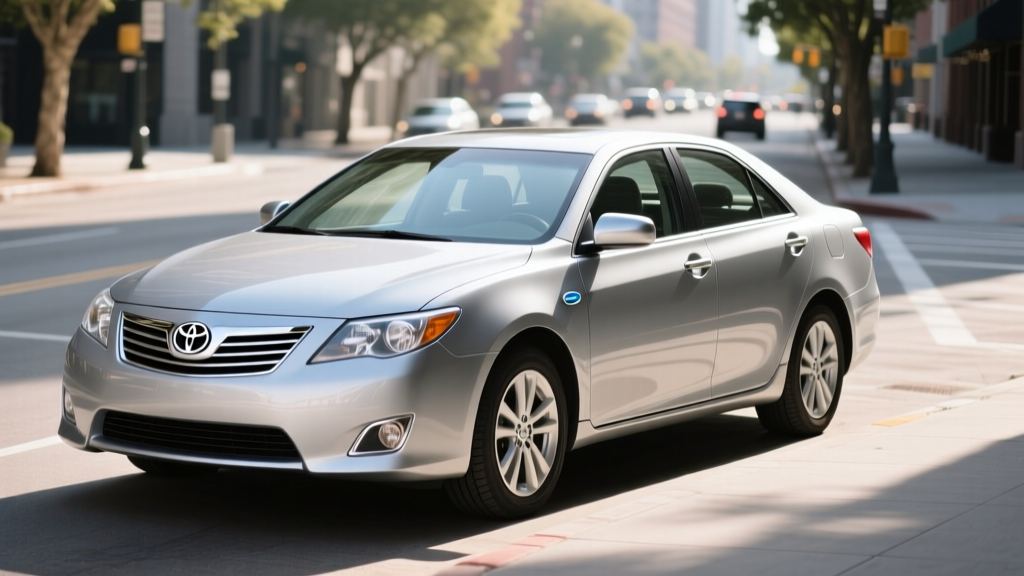
The 2025 Toyota Camry arrived with a significant powertrain shift: every model in the lineup is now a hybrid. Gone are the four-cylinder and V6 gas-only variants, replaced by Toyota's fifth-generation hybrid system across all trims. For shoppers researching the 2025 Toyota Camry Hybrid EPA MPG combined figure, the headline number is 51 MPG — but that's only part of the efficiency story. Trim level, drivetrain (FWD vs. AWD), and your driving mix all shift the real-world result.
This guide covers the exact EPA figures by configuration, how the Camry Hybrid performs beyond the sticker, what the fifth-generation hybrid powertrain actually does, and whether a conventional hybrid (HEV) like this is the right bridge for buyers not yet ready for a full EV or plug-in hybrid.
2025 Toyota Camry Hybrid MPG: EPA Estimates by Configuration
The 2025 Camry Hybrid uses a 2.5-liter four-cylinder engine paired with electric motors, but the fuel economy varies depending on whether you choose front-wheel drive or electronic all-wheel drive. Here are the official EPA numbers as published on fueleconomy.gov:
| Configuration | City MPG | Highway MPG | Combined MPG |
|---|---|---|---|
| FWD (LE, SE, XLE, XSE) | 53 | 50 | 51 |
| AWD (LE, SE, XLE, XSE) | 51 | 49 | 50 |
The FWD models achieve the highest combined figure of 51 MPG, while the AWD variants drop just 1 MPG combined to 50 MPG. This is a remarkably small penalty for all-wheel-drive traction — a testament to the efficiency of Toyota's electronic AWD system, which uses a separate rear-mounted electric motor rather than a mechanical driveshaft.
Real-World MPG: What Owners Actually See
EPA estimates for conventional hybrids tend to be more achievable than those for gas-only cars, and many Camry Hybrid owners report meeting or even exceeding the combined sticker in mixed driving. Here's why:
- City driving favors hybrids: The electric motor handles low-speed propulsion, regenerative braking recovers energy in stop-and-go traffic, and the engine shuts off at stops. Owners doing predominantly urban driving often see 52–55 MPG.
- Highway driving is the weak spot: At sustained 70–80 MPH, the hybrid advantage narrows. The engine runs more continuously, and aerodynamic drag dominates. Expect 44–48 MPG on long highway trips, slightly below the EPA highway figure.
- Cold weather impact: In freezing temperatures, hybrid battery efficiency drops and the engine runs more frequently to maintain cabin heat. Expect a 5–10% reduction in winter months — roughly 45–47 MPG combined for FWD models.
HEV vs. PHEV vs. EV: Where the Camry Hybrid Fits
The 2025 Camry is a conventional hybrid (HEV), not a plug-in hybrid (PHEV). This distinction is critical for buyers cross-shopping electrified sedans:
| Feature | HEV (Camry Hybrid) | PHEV (e.g., Prius Prime) | BEV (e.g., Tesla Model 3) |
|---|---|---|---|
| Plug-in charging? | No — self-charging via regen & engine | Yes — Level 1/2 AC charging | Yes — Level 2 AC + DC fast charging |
| Electric-only range | ~1 mile (low-speed assist only) | 25–44 miles (model dependent) | 250–400+ miles |
| Gasoline required? | Yes — always | Yes — after battery depletes | No — fully electric |
| Federal tax credit (§30D) | No | Up to $7,500 (if eligible) | Up to $7,500 (if eligible) |
| Home charging install needed | No | Recommended (Level 2) | Essential (Level 2) |
The Camry Hybrid requires zero lifestyle change from a gas car. You fuel it at any gas station, never plug it in, and benefit from hybrid efficiency automatically. If you can charge at home and want 30–40 miles of electric-only commuting, a PHEV like the Toyota Prius Prime (44 miles EV range, 52 MPG combined after depletion) may suit you better — and it qualifies for the federal tax credit. If you're ready to go fully electric and have reliable home charging, a BEV eliminates gas entirely but demands a larger upfront investment and charging infrastructure.
Powertrain: Fifth-Generation Hybrid System
The 2025 Camry Hybrid is built on Toyota's fifth-generation hybrid architecture, which delivers more power and better efficiency than the outgoing fourth-generation system. Here are the exact specifications:
| Specification | FWD | AWD |
|---|---|---|
| Engine | 2.5L 4-cylinder + 2 electric motors | 2.5L 4-cylinder + 3 electric motors (rear motor added) |
| Combined net horsepower | 225 hp | 232 hp |
| Transmission | eCVT (planetary gearset) | eCVT (planetary gearset) |
| 0–60 MPH (est.) | ~7.1 sec | ~6.9 sec |
| Hybrid battery | ~1.0 kWh lithium-ion (sealed) | ~1.0 kWh lithium-ion (sealed) |
| Fuel tank capacity | 13.2 gal | 13.2 gal |
| Total driving range | ~673 miles | ~660 miles |
The AWD model's extra 7 horsepower comes from the independent 40 kW rear electric motor, which engages automatically for traction in slippery conditions and during hard acceleration. This motor is not mechanically linked to the front axle — it's a fully electronic system with no driveshaft, center differential, or weight penalty of a traditional AWD setup.
The ~1.0 kWh lithium-ion hybrid battery is small by PHEV or BEV standards, but it's not designed for extended electric-only driving. It buffers energy captured from regenerative braking and the engine, deploying it for acceleration assist and low-speed electric motoring. This small battery also means faster replacement cost and less long-term degradation concern than a large EV pack.
Pricing, Trims, and Tax Credit Eligibility
The 2025 Camry Hybrid lineup is straightforward — four trims, each available in FWD or AWD:
| Trim | FWD MSRP | AWD MSRP |
|---|---|---|
| LE | $28,400 | $29,900 |
| SE | $29,900 | $31,400 |
| XLE | $33,400 | $34,900 |
| XSE | $34,900 | $36,400 |
Destination charge adds approximately $1,195.
Battery Warranty, Lifespan, and Replacement Cost
Hybrid battery longevity is one of the most common concerns among first-time hybrid buyers. Toyota addresses this with an industry-leading warranty:
In practice, Toyota's hybrid batteries have demonstrated exceptional longevity. Data from fleet operators and long-term owners shows that fourth-generation Camry and Prius hybrid batteries routinely exceed 150,000–200,000 miles before meaningful capacity loss. The fifth-generation system uses an updated lithium-ion pack with improved thermal management, which should further extend service life.
If replacement is eventually needed outside warranty, a new OEM hybrid battery for the Camry Hybrid typically costs between $2,000 and $4,000 installed — a fraction of the $10,000–$20,000+ that a full EV traction battery replacement can cost. Refurbished and aftermarket options can reduce this further to the $1,000–$2,000 range.
Who Should Choose the 2025 Camry Hybrid?
✓ Choose the Camry Hybrid if:
- You want 50+ MPG without changing your fueling routine
- You lack access to home or workplace EV charging
- You drive 15,000+ miles/year and want to minimize fuel cost
- You want Toyota's reliability track record and strong resale value
- You live in a cold climate where EV range loss is a concern
- You want a mid-size sedan with a comfortable ride and strong safety ratings
✗ Look elsewhere if:
- You want electric-only commuting (consider a PHEV like the Prius Prime)
- You want zero tailpipe emissions (consider a BEV)
- You want the federal $7,500 tax credit (HEVs don't qualify)
- You need more than 15.1 cu-ft of trunk space (the hybrid battery slightly reduces cargo room)
- You prefer a sporty driving experience (the eCVT prioritizes smoothness over engagement)
Annual Fuel Cost vs. Gas-Only Competitors
To put the Camry Hybrid's efficiency in financial context, here's how annual fuel costs compare against similar gas-only mid-size sedans, based on 15,000 miles/year and $3.50/gallon regular unleaded:
| Vehicle | EPA Combined MPG | Annual Fuel Cost |
|---|---|---|
| 2025 Camry Hybrid (FWD) | 51 | $1,029 |
| 2025 Honda Accord (1.5T) | 32 | $1,641 |
| 2025 Hyundai Sonata (2.5L) | 29 | $1,810 |
| 2025 Nissan Altima (2.5L) | 31 | $1,694 |
The Camry Hybrid saves roughly $600–$780 per year in fuel compared to its gas-only competitors. Over a typical 5-year ownership period, that's $3,000–$3,900 in fuel savings — a significant offset against the Camry Hybrid's slightly higher starting price.
Frequently Asked Questions
How many MPG does the 2025 Toyota Camry Hybrid get?
The FWD model achieves an EPA-estimated 53 city / 50 highway / 51 combined MPG. The AWD model achieves 51 city / 49 highway / 50 combined MPG. Real-world results typically range from 46–52 MPG combined depending on driving mix and climate.
Does the 2025 Camry Hybrid need to be plugged in?
No. The Camry Hybrid is a conventional hybrid (HEV), meaning its small battery is charged entirely by the gasoline engine and regenerative braking. You never plug it in — just fill up at any gas station as you would with a regular car.
Does the 2025 Camry Hybrid qualify for any federal tax credit?
No. Under current IRS §30D rules, only plug-in electric vehicles (PHEVs and BEVs) qualify for the federal clean vehicle credit. Conventional hybrids like the Camry Hybrid are not eligible. Check your state for any local hybrid incentives.
How long will the Camry Hybrid battery last?
Toyota warranties the hybrid battery for 10 years / 150,000 miles. Based on historical data from previous-generation Toyota hybrids, the battery commonly lasts 150,000–200,000+ miles before needing replacement. If replacement is required out of warranty, expect to pay $2,000–$4,000 for an OEM battery installed.
Is the Camry Hybrid better than a full EV for my situation?
It depends on your charging access and driving patterns. If you cannot charge at home, frequently take road trips over 300 miles, or live in an extreme cold climate, the Camry Hybrid offers excellent efficiency with zero infrastructure requirements. If you have reliable home Level 2 charging, a mostly predictable commute, and want zero tailpipe emissions, a BEV like the Tesla Model 3 or Hyundai Ioniq 6 may be a better long-term fit with lower per-mile energy costs.
What's the difference between the Camry Hybrid and the Prius?
Both use Toyota's hybrid system, but the Camry is a mid-size sedan with more interior space, a smoother ride, and higher power (225–232 hp vs. 194–196 hp for the standard Prius). The Prius achieves slightly higher MPG (up to 57 combined) due to its lighter weight and more aerodynamic shape, but the Camry offers a more refined, spacious driving experience. The Prius Prime PHEV variant adds 44 miles of electric-only range and federal tax credit eligibility that the Camry Hybrid cannot match.