2025 Subaru Hybrid Forester: The AWD Hybrid SUV That Doesn't Plug In
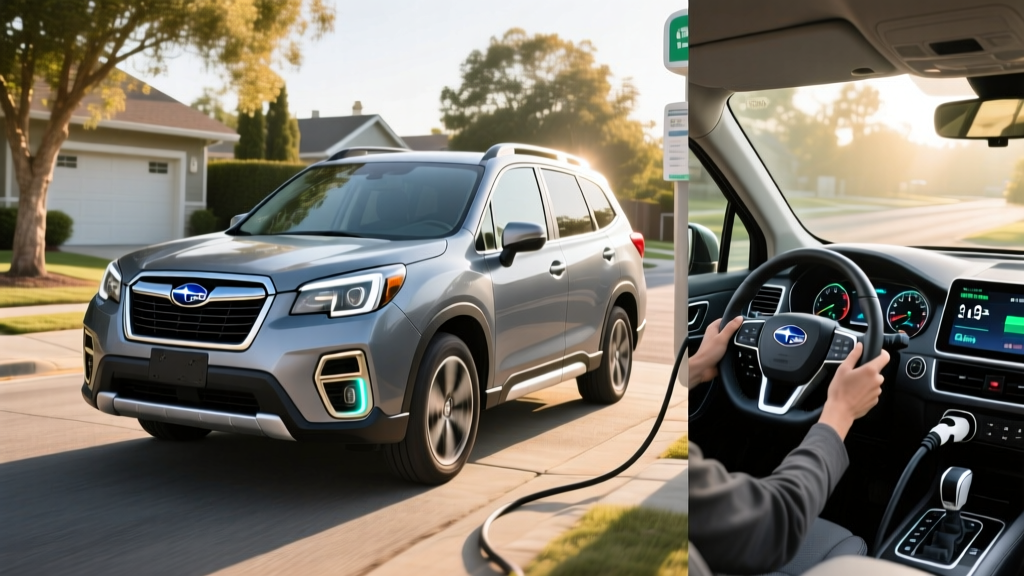
Subaru finally brought hybrid power back to the Forester lineup for 2025, answering a persistent request from buyers who want better fuel economy without sacrificing the brand's signature symmetrical all-wheel drive. The 2025 Subaru Hybrid Forester pairs a 2.5-liter boxer-four engine with an electric motor integrated into a continuously variable transmission (CVT), delivering an EPA-estimated 35 MPG combined. This is a conventional hybrid (HEV), not a plug-in — meaning no charging cables, no range anxiety, and no need to change your fueling habits.
For buyers weighing this against the standard gas Forester (29 MPG combined) or full EVs like the Hyundai Ioniq 5, the hybrid sits in a practical middle ground: meaningful fuel savings with zero infrastructure requirements. Let's break down the numbers, ownership costs, and who this vehicle actually serves best.
Fuel Economy: EPA Ratings vs Real-World MPG
The 2025 Subaru Hybrid Forester carries EPA estimates of 35 MPG city, 34 MPG highway, and 35 MPG combined. These figures represent a substantial improvement over the non-hybrid Forester's 26/33/29 MPG (city/highway/combined) rating.
| Driving Condition | EPA Estimate | Real-World Expectation |
|---|---|---|
| City | 35 MPG | 33-37 MPG |
| Highway | 34 MPG | 30-33 MPG |
| Combined | 35 MPG | 32-35 MPG |
Real-world context: Like most conventional hybrids, the Forester Hybrid tends to exceed its EPA city rating in stop-and-go traffic where regenerative braking recaptures energy frequently. Highway driving at sustained speeds above 70 mph will push fuel economy toward the low 30s, especially with roof cargo or towing. Cold weather reduces efficiency by 5-10% due to engine warm-up cycles and reduced battery performance — expect winter combined figures around 30-32 MPG in northern climates.
For comparison, the Toyota RAV4 Hybrid achieves 41 MPG combined with a more mature hybrid system, while the Honda CR-V Hybrid rates at 40 MPG combined. The Subaru's lower efficiency reflects its heavier AWD system and less aggressive regenerative tuning, but it still delivers meaningful savings over the gas-only Forester.
Hybrid vs Plug-In Hybrid: What's the Difference?
The 2025 Forester Hybrid is a conventional hybrid (HEV), not a plug-in hybrid (PHEV). This distinction matters for buyers confused by marketing terminology:
Conventional Hybrid (HEV) — 2025 Forester Hybrid
- No plug required: The battery charges through regenerative braking and the gasoline engine
- Battery size: Small (typically 1-2 kWh), used for assist and regenerative capture
- Electric-only driving: Very limited, typically under 1 mile at low speeds
- Fueling: Gasoline only, like any conventional car
- Tax credits: Generally does not qualify for federal EV tax credits
Plug-In Hybrid (PHEV) — Example: Toyota RAV4 Prime
- Plug-in charging: Can charge from a wall outlet or Level 2 charger
- Battery size: Larger (typically 10-20 kWh), enabling electric-only driving
- Electric-only range: 25-42 miles before the gas engine engages
- Fueling: Electricity for short trips, gasoline for longer drives
- Tax credits: May qualify for federal §30D credit (up to $7,500) if battery and sourcing requirements are met
The Forester Hybrid's approach prioritizes simplicity: you fill up at gas stations, the hybrid system works invisibly in the background, and you never need to think about charging infrastructure. For apartment dwellers, street parkers, or anyone without home charging access, this eliminates a major barrier that PHEVs and full EVs present.
Powertrain: Boxer Engine Meets Electric Assist
The 2025 Subaru Hybrid Forester uses a familiar powertrain architecture adapted from the Outback and Crosstrek hybrid systems:
| Component | Specification |
|---|---|
| Engine | 2.5L horizontally-opposed (boxer) 4-cylinder |
| Engine Power | 182 hp @ 5,800 rpm |
| Engine Torque | 176 lb-ft @ 4,000 rpm |
| Electric Motor | Integrated into CVT transmission |
| Combined System Output | ~194 hp (estimated) |
| Transmission | Lineartronic CVT with hybrid motor |
| Drivetrain | Symmetrical All-Wheel Drive (standard) |
| 0-60 mph | ~8.5 seconds (estimated) |
The electric motor provides low-speed torque fill and enables brief electric-only creeping in traffic, but this is not a performance hybrid. The system prioritizes fuel efficiency and smooth power delivery over acceleration. The CVT keeps the engine in its optimal efficiency range during cruising, though some drivers find the characteristic CVT drone during hard acceleration less refined than traditional geared transmissions.
Subaru's symmetrical AWD system remains fully functional in the hybrid variant, with no compromise to ground clearance (8.7 inches) or off-road capability. The X-Mode terrain management system carries over, making this one of the few hybrids in its class with genuine light off-road credentials.
Pricing, Trims, and Tax Credit Eligibility
The 2025 Subaru Hybrid Forester starts at approximately $33,000 for the base Premium trim and ranges up to $39,000 for the Touring trim. This represents a $2,000-$3,000 premium over equivalent non-hybrid Forester trims.
| Trim Level | MSRP (estimated) | Key Features |
|---|---|---|
| Premium | $33,000 | Hybrid powertrain, AWD, EyeSight safety suite, 8-inch touchscreen |
| Sport | $35,500 | Sport-tuned suspension, black exterior accents, wireless CarPlay/Android Auto |
| Limited | $37,000 | Leather upholstery, power liftgate, heated front seats, blind-spot monitoring |
| Touring | $39,000 | Nappa leather, ventilated front seats, Harman Kardon audio, reverse automatic braking |
Federal tax credit status: The 2025 Forester Hybrid does not qualify for the federal §30D clean vehicle tax credit. This credit applies only to plug-in electric vehicles (PHEVs and BEVs) with battery capacities of at least 7 kWh, and the Forester Hybrid's small battery falls far below this threshold. Additionally, the vehicle must meet critical mineral and battery component sourcing requirements under current IRS rules, which change annually.
Some states offer separate incentives for conventional hybrids, though these are increasingly rare as policy focus shifts to plug-in vehicles. Check your state's energy office or department of environmental quality for current programs — California, Colorado, and a few others have offered hybrid rebates in the past, but availability varies by year and funding.
Reliability, Battery Warranty, and Long-Term Ownership
Subaru's hybrid systems have proven reasonably reliable since their reintroduction in the Crosstrek Hybrid, though the brand's hybrid lineup is smaller and less battle-tested than Toyota's dominant hybrid portfolio. The Forester Hybrid uses a nickel-metal hydride (NiMH) or lithium-ion battery pack (chemistry varies by model year and market) mounted under the cargo floor, preserving interior space.
Hybrid Battery Warranty Coverage
Subaru provides a hybrid battery warranty of 8 years or 100,000 miles (whichever comes first) in most states. In California Air Resources Board (CARB) states — including California, New York, Massachusetts, and others adopting CARB standards — the warranty extends to 10 years or 150,000 miles.
This warranty covers battery capacity loss below a specified threshold (typically 60-70% of original capacity) and complete failure. It does not cover gradual degradation that remains above the threshold.
Battery replacement cost: If the hybrid battery fails outside warranty coverage, replacement costs typically range from $2,000 to $4,000 including parts and labor. This is significantly less than full EV battery replacements ($5,000-$15,000+) because the hybrid battery is much smaller. Third-party refurbishment shops have begun offering hybrid battery reconditioning services for $1,000-$2,000, though availability varies by region.
Long-term reliability considerations: Subaru's boxer engine architecture has a mixed reputation for long-term head gasket issues in older models, though the 2.5L FB25 engine in current Foresters has largely addressed this with improved gasket materials. The hybrid system adds complexity (electric motor, power electronics, high-voltage cabling) but eliminates the traditional starter motor and reduces brake wear through regenerative braking. Expect hybrid-specific components to last 150,000-200,000 miles with proper maintenance, based on industry averages for mature hybrid systems.
Who Should Choose the Forester Hybrid vs Alternatives?
The 2025 Subaru Hybrid Forester occupies a specific niche that won't appeal to everyone. Here's a decision framework to clarify fit:
Choose the Forester Hybrid if:
- You want AWD and better fuel economy without plugging in
- You live in an apartment or lack home charging access
- You drive 12,000-15,000 miles annually and want to reduce fuel costs by $400-$600/year vs the gas Forester
- You need 8.7 inches of ground clearance for snow, dirt roads, or light off-road use
- You prefer Subaru's EyeSight safety suite and proven AWD system
- You want a simple ownership experience with no charging infrastructure to manage
Look elsewhere if:
- You prioritize maximum fuel economy — the Toyota RAV4 Hybrid (41 MPG) and Honda CR-V Hybrid (40 MPG) deliver better efficiency
- You want electric-only driving for short commutes — consider a PHEV like the Toyota RAV4 Prime (42 miles electric-only) or Ford Escape PHEV (37 miles)
- You're ready for full electrification — the Hyundai Ioniq 5 (303 miles range, $41,000 base) offers zero tailpipe emissions and may qualify for tax credits
- You need towing capacity — the Forester Hybrid's 1,500-pound rating trails the gas Forester's 1,500-pound rating and most competitors
- You want the lowest purchase price — the non-hybrid Forester starts ~$3,000 lower
Hybrid vs PHEV vs EV decision matrix:
- Conventional hybrid (Forester Hybrid): Best for drivers without charging access, those who want simplicity, and buyers in regions with extreme cold where EV range loss is significant
- Plug-in hybrid (RAV4 Prime, Escape PHEV): Best for drivers with home charging who commute under 40 miles daily but need gas flexibility for road trips
- Full EV (Ioniq 5, Model Y, EV6): Best for drivers with reliable home/work charging, those who want minimal maintenance, and buyers who can access federal/state tax credits to offset higher upfront costs
Frequently Asked Questions
How many MPG does the 2025 Subaru Hybrid Forester get?
The EPA rates the 2025 Forester Hybrid at 35 MPG city, 34 MPG highway, and 35 MPG combined. Real-world driving typically yields 32-35 MPG combined, with city driving often exceeding the EPA estimate due to regenerative braking efficiency. Highway driving at sustained speeds above 70 mph will push fuel economy toward 30-33 MPG.
Does the Forester Hybrid need to be plugged in?
No. The 2025 Forester Hybrid is a conventional hybrid (HEV), not a plug-in hybrid. The battery charges automatically through regenerative braking and the gasoline engine. You fuel it exclusively at gas stations, just like a conventional vehicle.
Is the Forester Hybrid reliable, and what does battery replacement cost?
Subaru's hybrid systems have demonstrated reasonable reliability since their reintroduction, though the brand's hybrid portfolio is smaller than Toyota's. The hybrid battery carries an 8-year/100,000-mile warranty (10-year/150,000-mile in CARB states). Out-of-warranty battery replacement typically costs $2,000-$4,000. The boxer engine and hybrid components are expected to last 150,000-200,000 miles with proper maintenance.
Does the 2025 Forester Hybrid qualify for any tax credits?
The Forester Hybrid does not qualify for the federal §30D clean vehicle tax credit, which applies only to plug-in vehicles with battery capacities of 7 kWh or more. Some states may offer separate hybrid incentives, but these are increasingly rare. Check your state's energy office for current programs.
How does the Forester Hybrid compare to the Toyota RAV4 Hybrid?
The RAV4 Hybrid delivers superior fuel economy (41 MPG combined vs 35 MPG) and a more mature hybrid system, but the Forester Hybrid offers slightly more ground clearance (8.7 inches vs 8.1 inches) and Subaru's standard symmetrical AWD. The RAV4 Hybrid starts around $31,000, making it $2,000 less expensive. Choose the Subaru if AWD capability and Subaru's safety suite are priorities; choose the Toyota for maximum efficiency and lower cost.
Can the Forester Hybrid drive on electric power alone?
Only for very brief distances (under 1 mile) at low speeds (under 25 mph). The hybrid system uses the electric motor primarily for assist during acceleration and for regenerative braking, not for sustained electric-only driving. If you want meaningful electric-only range, consider a plug-in hybrid like the Toyota RAV4 Prime (42 miles) or a full EV.
Bottom Line: A Practical Hybrid for AWD Buyers
The 2025 Subaru Hybrid Forester delivers what its target audience wants: all-wheel drive, improved fuel economy, and zero lifestyle changes. The 35 MPG combined rating won't lead the hybrid SUV segment, but it represents a meaningful 20% improvement over the gas-only Forester while preserving the ground clearance, visibility, and safety features that define the model. For buyers who can't or won't plug in, who face harsh winters, and who value Subaru's proven AWD system, this hybrid fills a genuine gap in the market. Just understand what you're getting — and what you're giving up — compared to more efficient hybrid competitors or the rapidly maturing plug-in alternatives.