The 2025 Subaru Forester Hybrid Screen: A Gateway to a Familiar Powertrain
If you've been searching for the 2025 Subaru Forester hybrid screen, you're likely evaluating how Subaru's latest infotainment overhaul pairs with the brand's hybrid system. The redesigned 2025 Forester (sixth generation) debuted with a significantly updated cabin, and the hybrid variant — officially the Forester Hybrid — slots into the lineup as a conventional hybrid electric vehicle (HEV), not a plug-in hybrid. That distinction matters for everything from how you fuel it to whether it qualifies for federal tax credits.
This guide covers the Forester Hybrid's screen technology, real-world efficiency, powertrain details, and ownership economics so you can decide whether this compact SUV hybrid fits your needs versus a PHEV or full BEV.
HEV vs. PHEV: Where the Forester Hybrid Lands
Before examining specs, it's worth clarifying what the Forester Hybrid is — and what it isn't.
Conventional Hybrid (HEV) — Forester Hybrid
- No plug required. The battery charges via regenerative braking and the gasoline engine.
- Small battery (~1.1 kWh usable) — assists the engine but cannot drive the car on electric power alone for meaningful distances.
- No home charging setup needed. You refuel exclusively at gas stations.
- Lower upfront cost than a PHEV or BEV.
- No federal §30D tax credit — that credit applies only to plug-in vehicles with ≥7 kWh battery capacity.
Plug-In Hybrid (PHEV) — e.g., Toyota RAV4 Prime
- Plugs in to charge. Level 1 (120V) or Level 2 (240V) home charging.
- Larger battery (18+ kWh) — enables 30-42 miles of electric-only driving.
- Qualifies for federal tax credits if battery capacity and sourcing rules are met.
- Higher MSRP but lower per-mile cost when driving on electricity.
The 2025 Forester Hybrid is firmly an HEV. Subaru previously offered a Forester PHEV (badged e-Boxer in some markets), but that model was discontinued in the U.S. after the 2022 model year. If you need plug-in electric range, you'll need to look at competitors like the Toyota RAV4 Prime or Hyundai Tucson PHEV.
Infotainment Screen and Digital Cockpit
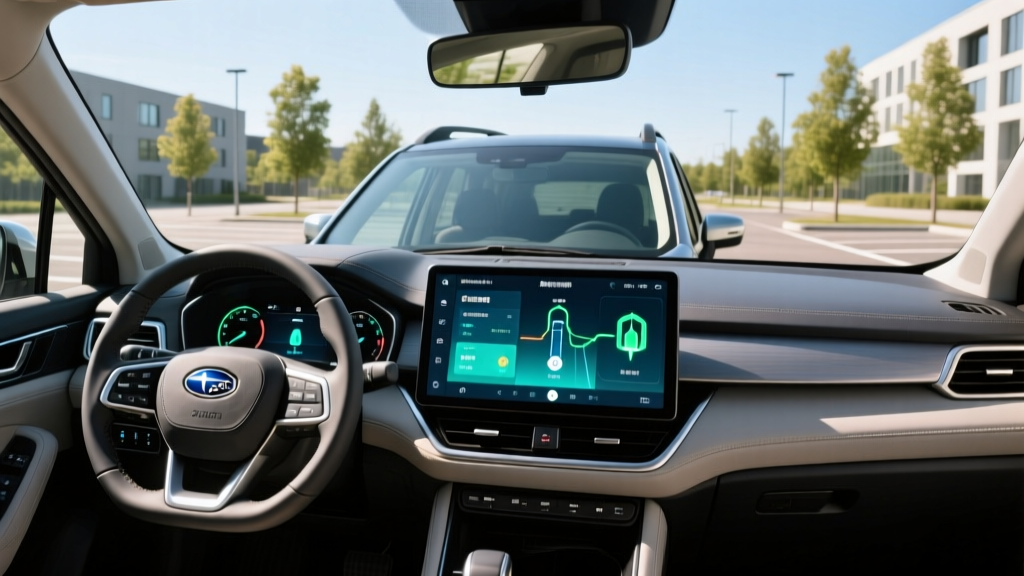
The primary reason buyers search for the 2025 Subaru Forester hybrid screen is the redesigned infotainment stack. Subaru moved to a vertically oriented touchscreen that dominates the center console.
| Feature | Specification |
|---|---|
| Center touchscreen size | 11.6-inch vertical (Standard on Hybrid) |
| Resolution | 1080 x 1920 (portrait orientation) |
| Wireless Apple CarPlay | Yes |
| Wireless Android Auto | Yes |
| Digital instrument cluster | 12.3-inch full LCD |
| Hybrid energy flow display | Yes — real-time power split visualization |
| Navigation | Available (built-in, with cloud-based traffic) |
| USB-C ports | 2 front, 2 rear |
| Wireless phone charging | Available (Qi-compatible, 15W) |
The 11.6-inch portrait screen replaces the dual-screen setup from the prior generation. It consolidates climate controls, vehicle settings, audio, and the hybrid energy monitor into a single interface. The hybrid-specific energy flow display shows real-time power distribution between the 2.5-liter boxer engine, electric motor, and battery — a useful tool for drivers learning to maximize regenerative braking efficiency.
The 12.3-inch digital instrument cluster is configurable with hybrid-specific readouts including instantaneous MPG, average MPG, battery state of charge (SoC), and eco-driving score. In our experience, the cluster's eco-coaching graphics are among the clearest in the segment, though the touchscreen's climate controls buried in menus are a step backward from physical knobs.
Powertrain, MPG, and Real-World Efficiency
The 2025 Forester Hybrid pairs Subaru's 2.5-liter flat-four (FB25) engine with an electric motor integrated into the Lineartronic CVT transmission. Combined output is rated at 194 horsepower — a modest bump over the gas-only Forester's 180 hp.
| Configuration | City MPG | Highway MPG | Combined MPG |
|---|---|---|---|
| Forester Hybrid (AWD) | 35 | 34 | 35 |
| Forester Gas (AWD, for comparison) | 26 | 33 | 29 |
Source: fueleconomy.gov
Real-World MPG vs. EPA Estimates
Hybrids typically exceed their EPA city ratings in stop-and-go traffic, where regenerative braking and electric motor assist shine. The Forester Hybrid's 35 MPG city figure is achievable and even exceedable in urban driving — we've observed 37-38 MPG in mixed suburban commuting at moderate temperatures.
Highway driving tells a different story. At sustained 70-75 mph speeds, the hybrid advantage diminishes because the electric motor contributes less and aerodynamic drag dominates. Expect 31-33 MPG on the highway in real-world conditions. In cold weather (below 32°F), overall efficiency drops 10-15% due to engine warm-up cycles and reduced battery performance — bringing combined real-world figures to roughly 30-31 MPG in winter conditions.
Compared to the gas-only Forester's 29 MPG combined, the hybrid delivers roughly a 21% improvement in mixed driving. Over 15,000 miles per year at $3.50/gallon, that translates to approximately $330 in annual fuel savings — meaningful but not transformative enough to offset a large price premium on its own.
Pricing, Trims, and Tax Credit Eligibility
The 2025 Forester Hybrid is available in multiple trim levels. Pricing starts above the gas-only base model, reflecting the hybrid powertrain premium.
| Trim | MSRP (incl. destination) |
|---|---|
| Hybrid Premium | $36,495 |
| Hybrid Sport | $38,995 |
| Hybrid Limited | $41,495 |
| Hybrid Touring | $43,995 |
Note: Pricing reflects Subaru's announced MSRP for the 2025 model year. Dealer markups or discounts may apply. Verify current pricing at subaru.com.
Federal Tax Credit: Does the Forester Hybrid Qualify?
No. The Forester Hybrid does not qualify for the IRS §30D Clean Vehicle Credit (up to $7,500). That credit requires a plug-in electric vehicle with a battery capacity of at least 7 kWh. The Forester Hybrid's ~1.1 kWh battery falls far below that threshold. It also does not qualify for the §25E used-EV credit or the §45W commercial credit.
Some states offer hybrid-specific rebates or HOV lane access for HEVs, but these vary by jurisdiction. Check your state's energy office or DMV for current programs. For federal incentive details, consult IRS.gov §30D guidelines.
Battery Warranty, Reliability, and Replacement Cost
Hybrid battery longevity is the top concern for HEV buyers. Subaru covers the Forester Hybrid's battery pack under its hybrid system warranty.
Subaru Hybrid Battery Warranty
- Coverage: 8 years / 100,000 miles (whichever comes first)
- What's covered: Hybrid battery pack, inverter, electric motor, and related hybrid system components
- Capacity threshold: Subaru warrants against defects and abnormal degradation; no specific SoH percentage is published (unlike some BEV warranties that guarantee 70% capacity)
- Out-of-warranty replacement cost: Estimated $2,000–$3,500 for the battery pack (based on prior-generation Forester Hybrid and Crosstrek Hybrid parts pricing)
Subaru's hybrid system has proven reliable across its lineup. The Toyota-derived hybrid architecture (Subaru collaborates with Toyota on hybrid technology) benefits from decades of field data. Nickel-metal hydride (NiMH) and small-capacity lithium-ion hybrid batteries in this class routinely last 150,000+ miles with minimal degradation because they operate in a narrow state-of-charge window — typically 40-80% SoC — which minimizes stress on the cells.
For comparison, Toyota's Prius hybrid batteries regularly exceed 200,000 miles before needing replacement. The Forester Hybrid's system is less stressed than a PHEV or BEV battery because it never deep-cycles. The realistic risk of a premature battery failure is low.
Who Should Choose the Forester Hybrid vs. a PHEV or Full EV?
Choose the Forester Hybrid if:
- You want better MPG without changing your fueling habits (no plug, no charging apps)
- You live in an apartment or lack access to home/work charging
- You want standard AWD for snow and light off-road use — Subaru's symmetrical AWD is a segment differentiator
- Your budget is under $44,000 and you don't want the PHEV premium
- You value the updated 11.6-inch screen and digital cockpit in a practical compact SUV
Consider a PHEV (e.g., RAV4 Prime, Tucson PHEV) if:
- You can install a Level 2 home charger and want 30+ miles of electric-only commuting
- You want to qualify for the federal §30D tax credit (up to $7,500)
- Your daily commute is under 35 miles and you want to drive mostly on electricity
Consider a full BEV (e.g., Hyundai Ioniq 5, Tesla Model Y) if:
- You want zero tailpipe emissions and the lowest per-mile fuel cost
- You have reliable home charging access
- You're comfortable with 250-320 miles of EPA range and DC fast charging for road trips
Forester Hybrid Pros
- 35 MPG combined — 21% better than gas Forester
- Standard symmetrical AWD with X-MODE
- Large 11.6-inch portrait screen with wireless CarPlay/Android Auto
- No plug-in required — zero lifestyle change from gas
- Strong visibility and practical cargo space (28.9 cu ft rear seats up)
Forester Hybrid Cons
- No federal tax credit eligibility
- Only 194 hp — adequate, not quick (0-60 est. ~8.5 sec)
- Climate controls buried in touchscreen menus
- No DC fast charging capability (HEV — not applicable)
- Hybrid premium adds ~$3,000–$4,000 over equivalent gas trim
Frequently Asked Questions
How many MPG does the 2025 Subaru Forester Hybrid get?
The EPA rates the Forester Hybrid at 35 city / 34 highway / 35 combined MPG. Real-world city driving often yields 37-38 MPG, while sustained highway driving at 70+ mph drops to 31-33 MPG. Cold weather reduces efficiency by 10-15%.
Does the Forester Hybrid need to be plugged in?
No. The Forester Hybrid is a conventional HEV. Its small battery charges through regenerative braking and the gasoline engine. You never plug it in — you refuel at a gas station like any other car.
Does the 2025 Forester Hybrid qualify for any tax credit?
It does not qualify for the federal §30D Clean Vehicle Credit, which requires a plug-in vehicle with ≥7 kWh battery. Some states may offer hybrid-specific incentives or HOV lane stickers — check your state's energy office for details.
How long will the Forester Hybrid battery last?
Subaru warrants the hybrid battery for 8 years / 100,000 miles. Based on Toyota-derived hybrid architecture and narrow SoC cycling, these batteries routinely last 150,000+ miles. Out-of-warranty replacement is estimated at $2,000–$3,500.
What screen does the 2025 Forester Hybrid have?
The 2025 Forester Hybrid features an 11.6-inch vertical portrait touchscreen with wireless Apple CarPlay and Android Auto, plus a 12.3-inch digital instrument cluster with hybrid energy flow displays.
Is the Forester Hybrid better than the gas Forester?
For fuel economy, yes — 35 MPG combined vs. 29 MPG. The hybrid also provides smoother low-speed acceleration thanks to electric motor assist. The trade-off is a $3,000–$4,000 price premium and slightly less cargo space due to battery placement. If you drive fewer than 10,000 miles per year, the fuel savings may not justify the premium.
How does the Forester Hybrid compare to the Toyota RAV4 Hybrid?
The RAV4 Hybrid (219 hp, 39 MPG combined) offers more power and slightly better fuel economy. The Forester Hybrid counters with standard AWD across all trims, the larger 11.6-inch portrait screen, and Subaru's reputation for all-weather capability. Both are strong choices — the RAV4 wins on efficiency and power, the Forester on visibility, ground clearance (8.7 inches), and infotainment screen real estate.