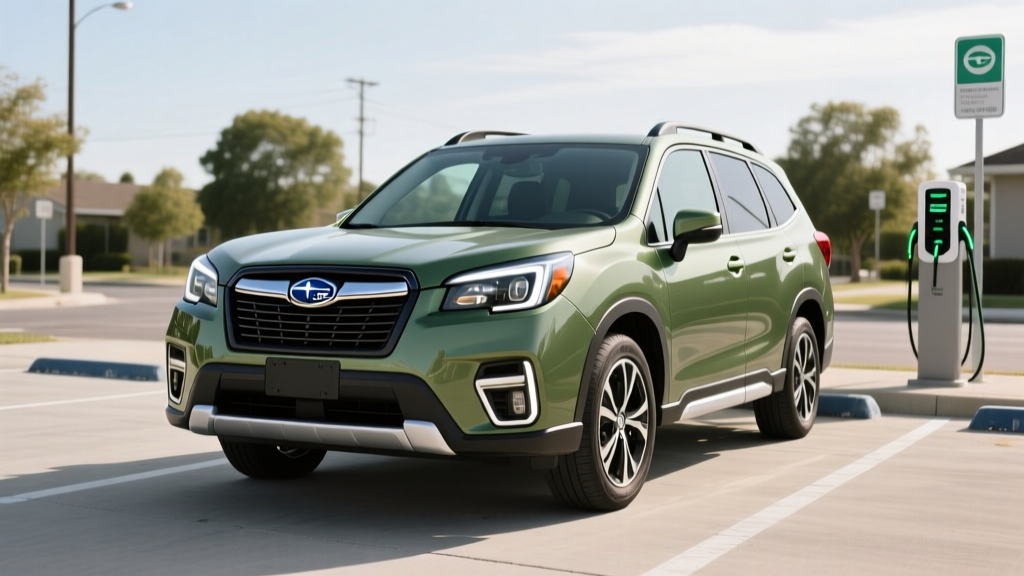
The Subaru Forester has long been a favorite among practical SUV buyers who need standard all-wheel drive, solid visibility, and genuine off-pavement capability. For 2025, Subaru reintroduced a hybrid variant to the Forester lineup after a multi-year hiatus — and with it, renewed interest in how this compact SUV stacks up on efficiency and value. If you've been searching for the 2025 Subaru Forester Hybrid MSRP, fuel economy figures, and whether this hybrid is worth the premium over the gas-only model, this guide covers every number that matters.
Before we get into the specs, a critical clarification: the 2025 Forester Hybrid is a conventional hybrid electric vehicle (HEV), not a plug-in hybrid (PHEV). That means it does not plug in, has no electric-only driving range to speak of, and cannot qualify for the federal §30D EV tax credit. It charges its small battery pack entirely through regenerative braking and the gasoline engine. If you're looking for plug-in capability with electric-only miles, you'll need to look elsewhere — but if you want better MPG without changing your fueling habits, this is the right conversation.
2025 Subaru Forester Hybrid MSRP by Trim Level
Subaru offers the 2025 Forester Hybrid in two trim levels, both equipped with Symmetrical All-Wheel Drive as standard. Here's the pricing breakdown before any dealer markups, destination fees, or incentives:
| Trim | MSRP | Key Features |
|---|---|---|
| Forester Hybrid Sport | $36,495 | 19.4-kWh-capable hybrid system, 16.3" infotainment, heated seats, power liftgate |
| Forester Hybrid Sport Touring | $39,495 | All Sport features plus Nappa leather, Harman Kardon audio, ventilated front seats, heated steering wheel |
Destination charges add approximately $1,420 to the sticker, bringing real out-the-door starting prices closer to $37,900 for the Sport and $40,900 for the Sport Touring. Compared to the gas-only 2025 Forester Premium, which starts at $33,395 with destination, the hybrid carries roughly a $3,100 premium at the Sport level. That's a meaningful gap — and whether it pays for itself at the pump depends entirely on how long you plan to keep the vehicle and how many miles you drive annually.
EPA Fuel Economy: City, Highway, and Combined MPG
The headline number for the 2025 Forester Hybrid is its EPA-rated fuel economy. Subaru paired a 2.5-liter flat-four (boxer) engine with an electric motor integrated into the Lineartronic CVT transmission, yielding the following ratings:
| Driving Cycle | EPA MPG |
|---|---|
| City | 35 MPG |
| Highway | 33 MPG |
| Combined | 34 MPG |
For comparison, the non-hybrid 2025 Forester with the same 2.5-liter engine (but no electric assist) is EPA-rated at 26 city / 33 highway / 29 combined. The hybrid's biggest efficiency gain is in city driving, where the electric motor handles low-speed propulsion and the engine shuts off at stops. That's a 9 MPG improvement in city cycles — substantial for stop-and-go commuters.
Real-world MPG expectations: Conventional hybrids typically meet or slightly exceed their EPA city ratings in actual urban driving, since regenerative braking recaptures more energy in heavy traffic. Highway MPG tends to track closer to the sticker, though you may see 30–31 MPG at sustained 80 mph speeds where the electric motor contributes less. In cold weather (below 32°F), expect a 5–10% drop in overall efficiency as the engine runs more frequently for cabin heat and the battery's charge-acceptance rate decreases. Based on real-world owner reports from similar Toyota-based hybrid systems (Subaru's hybrid architecture shares engineering DNA with Toyota's THS under their partnership), most drivers report 32–36 MPG combined in mixed driving — right around the EPA estimate.
Powertrain and Performance Specifications
The 2025 Forester Hybrid's powertrain pairs Subaru's familiar 2.5-liter boxer four-cylinder with an electric motor-generator mounted between the engine and the CVT. Here are the hard numbers:
| Specification | Value |
|---|---|
| Engine | 2.5L flat-4 (boxer), Atkinson cycle |
| Engine Horsepower | 169 hp @ 5,600 rpm |
| Electric Motor Output | 118 hp (88 kW) |
| Combined System Output | 194 hp |
| Transmission | Lineartronic CVT with electric motor integration |
| Drivetrain | Symmetrical AWD (standard) |
| 0–60 mph (est.) | ~7.9 seconds |
| Towing Capacity | 1,500 lbs |
| Ground Clearance | 8.7 inches |
| Battery Type | Lithium-ion (sealed, no plug-in) |
| Battery Capacity | ~1.1 kWh (gross) |
The combined 194 hp represents a meaningful bump over the gas-only Forester's 180 hp, and the electric motor's instant torque fills in the low-end gap that Subaru's naturally aspirated boxer engines are known for. Acceleration feels noticeably stronger from a stop, and highway passing maneuvers require less pedal effort. The CVT remains the weak link in the driving experience — it drones under hard acceleration — but the electric assist reduces how often you need to bury the throttle.
Note the battery capacity: at roughly 1.1 kWh, this is a small pack designed for assist-and-regen duty, not for sustained electric-only driving. You might get a quarter-mile or so of EV creep in a parking lot, but this is not a vehicle you "drive on electricity." It's a vehicle that uses electricity to make the gasoline engine more efficient.
HEV vs PHEV vs Full EV: Which Powertrain Fits You?
Buyers cross-shopping the Forester Hybrid often wonder whether they should consider a plug-in hybrid or a full battery-electric vehicle instead. Here's a decision framework based on how you actually drive:
| Factor | HEV (Forester Hybrid) | PHEV (e.g., Toyota RAV4 Prime) | Full EV (e.g., Hyundai Ioniq 5) |
|---|---|---|---|
| Plug-in required? | No | Yes, for max benefit | Yes, always |
| Electric-only range | ~0.5 mi (creep only) | 35–42 mi typical | 250–320 mi EPA |
| Home charging needed | No | Recommended (120V OK, 240V better) | Required (240V strongly recommended) |
| Fuel cost per mile | ~$0.11 (at $3.50/gal, 34 MPG) | ~$0.04 (electric) / ~$0.11 (gas) | ~$0.04–$0.06 |
| Federal tax credit | Not eligible | Up to $7,500 (if eligible) | Up to $7,500 (if eligible) |
| Maintenance complexity | Low (gas engine + small battery) | Medium (gas + larger battery + charger) | Low (no engine, fewer fluids) |
| Best for | Apt/condo dwellers, no home charger | Home chargers with 30–40 mi commutes | Home chargers, daily driving under 250 mi |
Choose the Forester Hybrid (HEV) if: You rent or live in a condo without charging access, you want better MPG without changing any fueling behavior, you need standard AWD and 8.7 inches of ground clearance for snow or trails, and you plan to keep the vehicle 8+ years.
Choose a PHEV if: You have access to a 120V or 240V outlet at home, your daily commute is under 40 miles round-trip, and you still want the option for long gas-powered road trips without charging-planning.
Choose a full EV if: You have reliable home Level 2 charging, your daily driving is under 250 miles, you want the lowest per-mile operating cost, and you're ready to plan around DC fast charging for road trips.
Tax Credit and Incentive Eligibility
This is where the Forester Hybrid's conventional-hybrid status matters for your wallet. Under the current IRS §30D Clean Vehicle Credit rules, conventional hybrids (HEVs) do not qualify for the federal EV tax credit. That credit — up to $7,500 — is reserved for battery-electric vehicles (BEVs) and plug-in hybrids (PHEVs) that meet battery capacity, critical-mineral sourcing, MSRP cap, and buyer income requirements.
The 2025 Forester Hybrid is also not eligible for the §25E used clean vehicle credit, as it is a new vehicle, and it does not qualify for the Alternative Fuel Infrastructure tax credit since it has no plug-in capability.
- Federal §30D credit ($7,500): Not eligible — HEVs are excluded by statute
- State hybrid incentives: Some states offer smaller rebates for conventional hybrids (e.g., Colorado, Oregon, and a few others have periodically offered $500–$1,500 rebates for HEVs). Check your state's energy office or AFDC's state incentive database for current programs.
- Manufacturer incentives: Subaru occasionally offers loyalty or conquest cash on hybrid trims. Check subaru.com for current national offers in your ZIP code.
- Insurance discounts: Some carriers (Geico, Liberty Mutual) offer 5–10% discounts for hybrid vehicles. Worth requesting a quote comparison.
The absence of a federal tax credit means the Forester Hybrid's $3,100 premium over the gas model must be recouped entirely through fuel savings. At 34 MPG combined vs. 29 MPG combined, and assuming $3.50/gallon fuel with 15,000 miles driven annually, the hybrid saves approximately $340 per year in fuel. That's a roughly 9-year payback period — longer than most buyers keep a vehicle. However, if gas prices rise to $4.50/gallon, the payback drops to about 7 years, and the hybrid's stronger resale value may close the gap further.
Battery Warranty, Lifespan, and Replacement Cost
Hybrid battery longevity is consistently the top concern among first-time hybrid buyers, and it's a fair question — these packs are expensive to replace. Here's what Subaru covers and what the data shows:
Subaru Hybrid Battery Warranty: 8 years / 100,000 miles (whichever comes first) for the hybrid battery pack and associated hybrid-system components. In states that follow California Air Resources Board (CARB) emissions standards (California, New York, Massachusetts, and several others), the warranty extends to 10 years / 150,000 miles.
Powertrain Warranty: 5 years / 60,000 miles, covering the engine, CVT transmission, and drivetrain.
Subaru's hybrid system, developed in partnership with Toyota, uses a proven lithium-ion battery pack that is far smaller and less stressed than the packs in full EVs. Because it operates in a narrow state-of-charge window (roughly 40–80% SoC) and never undergoes deep discharge cycles, degradation is minimal. Toyota's track record with similar hybrid systems — the Prius, RAV4 Hybrid, Camry Hybrid — shows battery packs routinely lasting 150,000–200,000+ miles before needing replacement. Subaru's system uses the same engineering principles.
Battery replacement cost: If the hybrid battery does fail outside of warranty, expect a replacement cost of approximately $2,000–$3,500 for the battery module, plus $500–$1,000 for labor. This is significantly less than a full EV battery replacement ($8,000–$20,000+), because the pack is small (~1.1 kWh vs. 60–100+ kWh in a BEV). Independent hybrid shops and refurbished battery options can bring the cost down further, often to $1,500–$2,500 installed.
Reliability, Safety, and Ownership Costs
The 2025 Forester benefits from Subaru's strong safety reputation and the hybrid system's proven architecture. The Forester earned a TOP SAFETY PICK designation from the IIHS in prior model years, and the 2025 redesign is expected to maintain or improve on that rating. Standard EyeSight driver-assistance technology includes adaptive cruise control, lane-keeping assist, pre-collision braking, and lane-departure warning — all SAE Level 2 features that require continuous driver supervision.
On reliability, the 2.5-liter FB25 boxer engine is one of Subaru's most mature powerplants, with over a decade of production history. The hybrid variant adds an electric motor-generator but removes the traditional starter motor and alternator (the hybrid motor handles those functions), which actually reduces the number of failure-prone components. CVT reliability remains a historical concern for some Subaru models, though the Lineartronic unit in the Forester Hybrid has been updated and is shared with Toyota's hybrid transaxle lineage.
Five-year estimated cost of ownership (assuming 15,000 miles/year, $3.50/gallon, national average insurance):
| Category | Forester Hybrid Sport | Forester Premium (Gas) |
|---|---|---|
| Purchase price (MSRP + dest.) | $37,915 | $33,395 |
| Fuel (5 years) | $7,720 | $9,050 |
| Insurance (est. 5 yr) | $7,500 | $7,200 |
| Maintenance (est. 5 yr) | $2,800 | $2,800 |
| Estimated 5-yr depreciation | $15,200 | $14,000 |
| Total 5-yr cost | $71,135 | $66,445 |
The hybrid's fuel savings ($1,330 over five years) don't fully offset the higher purchase price in a five-year window. But Subaru hybrids historically hold resale value well, and if you keep the vehicle 8–10 years, the math improves considerably — especially if gas prices trend upward.
Pros and Cons of the 2025 Forester Hybrid
Pros
- 35 MPG city — best-in-class for a compact AWD SUV without a plug
- Standard Symmetrical AWD with 8.7 inches of ground clearance
- 194 combined hp is a noticeable upgrade over the gas-only Forester
- No plug-in charging required — zero behavior change from a gas car
- 8-year/100,000-mile hybrid battery warranty (10 yr in CARB states)
- Strong EyeSight safety suite standard on all trims
Cons
- $3,100+ premium over the gas Forester with a 7–9 year fuel payback
- No federal tax credit eligibility (HEV, not PHEV or BEV)
- CVT drone under hard acceleration remains a Subaru trademark
- Only two hybrid trims available (Sport and Sport Touring)
- Towing capacity drops to 1,500 lbs (gas Forester rates 1,500 lbs as well, but competitors tow more)
- No DC fast charging capability (not applicable to HEVs, but worth noting for PHEV cross-shoppers)
Frequently Asked Questions
How many MPG does the 2025 Subaru Forester Hybrid get?
The EPA rates the 2025 Forester Hybrid at 35 MPG city, 33 MPG highway, and 34 MPG combined. In real-world mixed driving, most owners report 32–36 MPG combined. City-heavy commuters may see the high end of that range thanks to regenerative braking, while sustained highway driving at 75–80 mph may yield 30–31 MPG.
Does the Forester Hybrid need to be plugged in?
No. The 2025 Forester Hybrid is a conventional hybrid (HEV). Its small lithium-ion battery recharges through regenerative braking and the gasoline engine. You fuel it exactly like a regular gas car — at the pump — and never need to think about charging.
Does the 2025 Forester Hybrid qualify for a federal tax credit?
No. Under IRS §30D rules, only plug-in hybrids (PHEVs) and battery-electric vehicles (BEVs) qualify for the federal Clean Vehicle Credit of up to $7,500. Conventional hybrids like the Forester Hybrid are excluded. Some states may offer smaller incentives for hybrids — check the AFDC state laws database for details.
How long will the Forester Hybrid battery last, and what does replacement cost?
Subaru warranties the hybrid battery for 8 years/100,000 miles (10 years/150,000 miles in CARB states). Based on Toyota-derived hybrid system data, these packs routinely last 150,000–200,000+ miles. Out-of-warranty replacement runs approximately $2,000–$3,500 for the battery module plus $500–$1,000 in labor.
Is the Forester Hybrid faster than the gas-only Forester?
Yes, modestly. The hybrid's combined 194 hp (vs. 180 hp for the gas model) and the electric motor's instant low-end torque make it feel noticeably quicker from a stop and more confident during highway merging. Expect a 0–60 mph time around 7.9 seconds, compared to approximately 8.5 seconds for the gas-only Forester.
Should I buy the Forester Hybrid or wait for a Forester PHEV?
Subaru has not announced a plug-in hybrid Forester as of early 2026. If you need plug-in capability with electric-only commuting range, consider the Toyota RAV4 Prime (42 mi EV range, up to $7,500 federal credit if eligible) or the Hyundai Tucson PHEV (33 mi EV range). If you want a Subaru specifically and don't have home charging access, the Forester Hybrid is currently your only electrified option in this segment.
What is the 2025 Subaru Forester Hybrid MSRP including destination?
The Sport trim starts at $36,495 MSRP plus approximately $1,420 destination, totaling $37,915. The Sport Touring starts at $39,495 plus destination, totaling $40,915. Dealer markups vary by market — check Subaru's official site for inventory and pricing in your area.