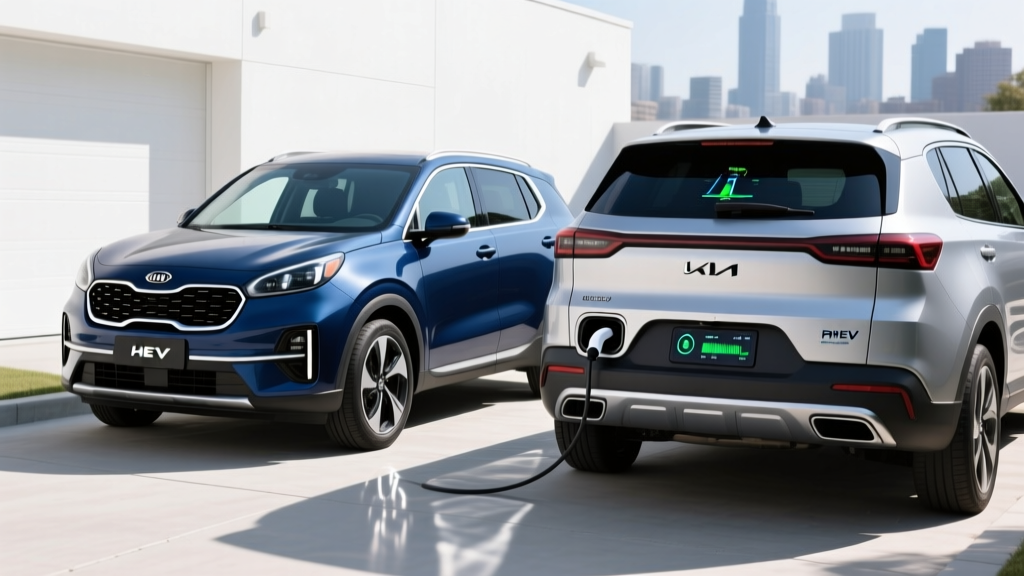
If you want an electrified compact SUV without the range anxiety or charging-plug dependency of a full EV, the 2025 Kia Sportage Hybrid lineup deserves a close look. Kia offers the Sportage in two distinct electrified flavors: a conventional hybrid (HEV) that never needs plugging in, and a plug-in hybrid (PHEV) that gives you roughly 34 miles of pure electric driving before the gas engine kicks on. Both share the same turbocharged 1.6-liter four-cylinder platform, but their efficiency profiles, pricing, and daily-driving experiences diverge significantly.
This guide breaks down every 2025 Sportage Hybrid variant with exact EPA figures, real-world expectations, powertrain specs, and tax-credit eligibility so you can match the right version to your commute and budget.
HEV vs PHEV: Which 2025 Sportage Hybrid Is Which?
Before diving into specs, the distinction matters because it affects your wallet, your garage, and your daily routine.
| Attribute | Sportage HEV (Conventional Hybrid) | Sportage PHEV (Plug-In Hybrid) |
|---|---|---|
| Plugs in? | No — self-charging via regen & engine | Yes — Level 1 or Level 2 AC charging |
| Electric-only driving | Very short distances at low speed | EPA-est. 34 miles on battery alone |
| Battery capacity | ~1.49 kWh (small buffer) | 13.7 kWh usable lithium-ion |
| DC fast charging | N/A | No — AC only (Level 1/2) |
| EPA combined MPG / MPGe | 38–43 MPG | 84 MPGe (elec+gas) / 35 MPG (gas only) |
| Drivetrain | AWD standard | AWD standard |
| Starting MSRP | ~$29,590 | ~$39,890 |
The HEV operates like a traditional gas car you never plug in. Its small battery captures energy from regenerative braking and the engine to assist acceleration and enable brief electric-only moments at low speeds. The PHEV carries a substantially larger 13.7 kWh battery that you charge at home or at public Level 2 stations, giving you a meaningful electric-only commute before the hybrid system takes over seamlessly.
Fuel Economy: EPA Numbers and Real-World MPG
Sportage HEV (Conventional Hybrid)
Kia offers the HEV with two different wheel sizes, which affects EPA ratings:
| Trim / Wheels | City MPG | Highway MPG | Combined MPG |
|---|---|---|---|
| LX / S (17"–18" wheels) | 42 | 44 | 43 |
| X-Line / SX / SX-Prestige (19" wheels) | 38 | 38 | 38 |
Source: fueleconomy.gov
Real-world MPG note: Hybrids typically exceed their EPA city rating in stop-and-go traffic because regenerative braking recovers more energy. Expect the 43-MPG combined variant to deliver 44–47 MPG in city-heavy driving. On sustained highway trips at 75+ mph, the engine does more of the work — expect 36–39 MPG. In cold weather (below 30°F), plan for a 5–10% efficiency dip as the engine runs more frequently to provide cabin heat.
Sportage PHEV (Plug-In Hybrid)
| Mode | City | Highway | Combined |
|---|---|---|---|
| Charge-depleting (electric + gas) | 84 MPGe combined | ||
| Charge-sustaining (gas only, after battery depletes) | 33 | 37 | 35 |
The 84 MPGe figure applies while the battery has charge. Once you've used the 34 miles of electric range, the PHEV operates as a conventional hybrid at roughly 35 MPG combined — still efficient, but the real savings come from maximizing electric-only miles on shorter commutes.
Electric-Only Range and Total Driving Range (PHEV)
The 2025 Sportage PHEV delivers an EPA-estimated 34 miles of electric-only range on a full charge. For commuters with round trips under 30–35 miles who can charge at home overnight, this means you could go weeks without burning a drop of gasoline on daily errands.
Total combined range (electric + full 11.1-gallon fuel tank) reaches approximately 430 miles, eliminating the range anxiety that some EV shoppers feel on road trips. When the battery depletes, the transition to hybrid mode is seamless — you won't feel a power interruption.
Real-world electric range: In mild weather (60–75°F) at city speeds, owners report squeezing 35–38 miles from a full charge. At sustained highway speeds above 70 mph or in freezing temperatures, expect 25–29 miles of electric range before the engine fires up. Preconditioning the cabin while plugged in helps preserve battery range in cold weather.
Powertrain, Performance, and Battery Specs
Both the HEV and PHEV share Kia's turbocharged 1.6-liter inline-four engine paired with an electric motor, but output differs:
| Specification | HEV | PHEV |
|---|---|---|
| Engine | 1.6L turbo I-4 | 1.6L turbo I-4 |
| Combined horsepower | 232 hp | 261 hp |
| Combined torque | 258 lb-ft | 258 lb-ft |
| Electric motor output | 47.7 kW (64 hp) | 72 kW (97 hp) |
| Transmission | 6-speed automatic | 6-speed automatic |
| Drivetrain | AWD | AWD |
| 0–60 mph (est.) | ~7.3 sec | ~6.7 sec |
| Towing capacity | 2,000 lbs | 2,000 lbs |
| Hybrid battery capacity | ~1.49 kWh | 13.7 kWh (usable) |
| Battery chemistry | Lithium-ion polymer | Lithium-ion polymer |
The PHEV's larger, more powerful electric motor gives it a meaningful acceleration advantage — 261 combined horsepower makes merging and passing feel confident. Both variants use a conventional 6-speed automatic rather than the CVTs or e-CVTs found in some competitors, which gives a more natural, stepped acceleration feel.
PHEV Charging Details
The Sportage PHEV charges via its J1772 AC port. There is no DC fast-charging capability — this is common for PHEVs, whose smaller batteries don't require high-power charging.
| Charging Method | Power | 0–100% Time |
|---|---|---|
| Level 1 (120V household outlet) | ~1.4 kW | ~10.5 hours |
| Level 2 (240V home/public station) | ~7.2 kW | ~2 hours |
Most PHEV owners charge overnight on a standard 120V outlet and wake up to a full battery every morning. If you want faster top-ups or plan to charge opportunistically during the day, a Level 2 home charger completes the job in about two hours.
Pricing, Trims, and Tax Credit Eligibility
2025 Sportage HEV Pricing
| Trim | MSRP (incl. destination) |
|---|---|
| LX | $29,590 |
| S | $31,590 |
| X-Line | $33,590 |
| SX | $35,190 |
| SX-Prestige | $37,490 |
2025 Sportage PHEV Pricing
| Trim | MSRP (incl. destination) |
|---|---|
| X-Line | $39,890 |
| X-Line Prestige | $43,090 |
Federal Tax Credit: What You Need to Know
Does the 2025 Sportage Hybrid qualify for the federal EV tax credit?
- HEV (conventional hybrid): No. The IRS §30D clean vehicle credit applies only to plug-in electric vehicles with a battery capacity of at least 7 kWh. Conventional hybrids do not qualify.
- PHEV: The 2025 Sportage PHEV has a 13.7 kWh battery, which meets the capacity threshold. However, eligibility for the full $7,500 credit depends on multiple factors under current IRS §30D rules:
- Battery components and critical minerals must meet North American sourcing thresholds (these thresholds tighten annually)
- Buyer adjusted gross income must not exceed $150,000 (single) / $300,000 (joint)
- Vehicle MSRP must not exceed $80,000 for SUVs (both Sportage PHEV trims clear this cap)
- The vehicle must undergo final assembly in North America
As of the 2025 model year, the Sportage PHEV's critical-mineral and battery-component sourcing may qualify for a partial or full credit, but this changes as sourcing requirements tighten. Consult a tax professional and verify current eligibility on fueleconomy.gov before purchasing. The credit can now be transferred to the dealer as a point-of-sale discount under current rules.
Battery Warranty, Reliability, and Replacement Cost
Battery longevity is the single biggest concern for hybrid buyers, and Kia addresses it with one of the industry's strongest warranty packages:
| Component | Coverage |
|---|---|
| Hybrid battery pack | 10 years / 100,000 miles |
| Hybrid system components (motor, inverter, etc.) | 10 years / 100,000 miles |
| Powertrain (engine, transmission) | 10 years / 100,000 miles |
| Basic bumper-to-bumper | 5 years / 60,000 miles |
The 10-year/100,000-mile hybrid battery warranty is transferable to subsequent owners in most states, which supports resale value. Kia warrants the battery to retain a minimum capacity threshold (typically 70% of original capacity) during the warranty period.
Real-world reliability: Kia's hybrid system has proven robust since its introduction across the Niro and Sorento lineups. The Sportage's turbocharged 1.6L engine is shared across Hyundai-Kia's global lineup and has accumulated millions of service miles. Hybrid batteries in modern Kia products rarely require replacement within the warranty window; degradation is gradual and typically amounts to 8–12% capacity loss over 100,000 miles.
Out-of-warranty replacement cost: If a hybrid battery does need replacement after the warranty expires, expect to pay approximately $2,500–$4,000 for the HEV pack and $5,000–$8,000 for the larger PHEV pack, including labor. These costs have been trending downward as hybrid battery production scales.
Who Should Choose the Sportage HEV, PHEV, or a Full EV?
Choose the Sportage HEV if:
- You can't charge at home (apartment, street parking, no garage access)
- You want maximum simplicity — just fill up with gas and drive
- Your budget is under $35,000 and you want strong fuel economy
- You take frequent long road trips and don't want to plan charging stops
Choose the Sportage PHEV if:
- You can install a Level 2 charger at home or have reliable workplace charging
- Your daily commute is under 35 miles round-trip (you'll rarely burn gas on weekdays)
- You want EV-like daily driving but need gas-engine flexibility for weekend road trips
- You may qualify for the federal tax credit, narrowing the price gap with the HEV
Choose a full EV (like the Kia EV6 or Hyundai Ioniq 5) if:
- You have reliable home charging and your daily driving is under 250 miles
- You want zero tailpipe emissions and minimal maintenance (no oil changes, no spark plugs)
- You're ready to use DC fast-charging networks for road trips
- You want to fully decouple from gasoline price volatility
Pros and Cons: 2025 Sportage Hybrid Lineup
Pros
- HEV achieves up to 43 MPG combined — among the best in the compact SUV segment
- PHEV's 34-mile electric range covers most daily commutes without gasoline
- 10-year/100,000-mile hybrid battery and powertrain warranty
- 261 hp in the PHEV provides confident acceleration
- Spacious interior with competitive cargo room (39.5 cu ft behind rear seats)
- Standard AWD across all hybrid trims
- Well-equipped SX-Prestige trims with premium features at reasonable prices
Cons
- PHEV has no DC fast charging — limited to ~7.2 kW Level 2 AC
- 19-inch wheels on upper HEV trims drop fuel economy from 43 to 38 MPG combined
- PHEV starting price near $40K is a significant premium over the HEV
- Turbo engine requires premium fuel recommendation for maximum output (regular accepted with slight power reduction)
- Third row not available — families needing 7 seats must look at the Sorento Hybrid
- PHEV cargo space slightly reduced vs. HEV due to larger battery placement
Frequently Asked Questions
How many MPG does the 2025 Sportage Hybrid get?
The conventional Sportage HEV achieves 42 city / 44 highway / 43 combined MPG on trims with smaller wheels, and 38/38/38 MPG on trims with 19-inch wheels. The PHEV gets 84 MPGe while running on battery charge and 35 MPG combined once the battery is depleted and it operates as a conventional hybrid.
How far can the Sportage PHEV go on electric only?
The EPA rates the 2025 Sportage PHEV at 34 miles of electric-only range. In real-world city driving at moderate temperatures, owners report 35–38 miles. Highway speeds and cold weather reduce this to approximately 25–29 miles.
Does the 2025 Sportage Hybrid qualify for a tax credit?
The conventional HEV does not qualify for any federal tax credit. The PHEV may qualify for up to $7,500 under IRS §30D, depending on battery-component and critical-mineral sourcing requirements, your income level, and the vehicle's final assembly location. Verify current eligibility at fueleconomy.gov and consult a tax professional before relying on the credit.
Is the Sportage Hybrid reliable, and what does battery replacement cost?
Kia's hybrid system has a strong reliability track record across its model range. The hybrid battery is covered by a 10-year/100,000-mile warranty. Out-of-warranty battery replacement runs approximately $2,500–$4,000 for the HEV and $5,000–$8,000 for the PHEV, though most hybrid batteries outlast their warranty periods with gradual, manageable degradation.
Do I need to plug in the Sportage HEV?
No. The conventional Sportage HEV charges its small hybrid battery entirely through regenerative braking and the gasoline engine. You simply fill it with gas like any other car. Only the PHEV variant benefits from being plugged in.
Can the Sportage PHEV DC fast charge?
No. The Sportage PHEV supports only AC charging — Level 1 (120V, ~1.4 kW) and Level 2 (240V, up to ~7.2 kW). A full Level 2 charge takes about 2 hours. This is standard for PHEVs, whose smaller batteries don't require DC fast-charging infrastructure.
How does the Sportage Hybrid compare to the Toyota RAV4 Hybrid?
The RAV4 Hybrid achieves 39–41 MPG combined and starts around $33,000, making the Sportage HEV (43 MPG, starting ~$29,590) a strong value competitor. The RAV4 Prime PHEV offers 42 miles of electric range vs. the Sportage PHEV's 34 miles, but at a significantly higher starting price (~$44,500). The Sportage hybrid lineup generally offers more aggressive pricing and a longer standard warranty.