Quick Verdict: The 2025 RAV4 Hybrid XLE Premium at a Glance
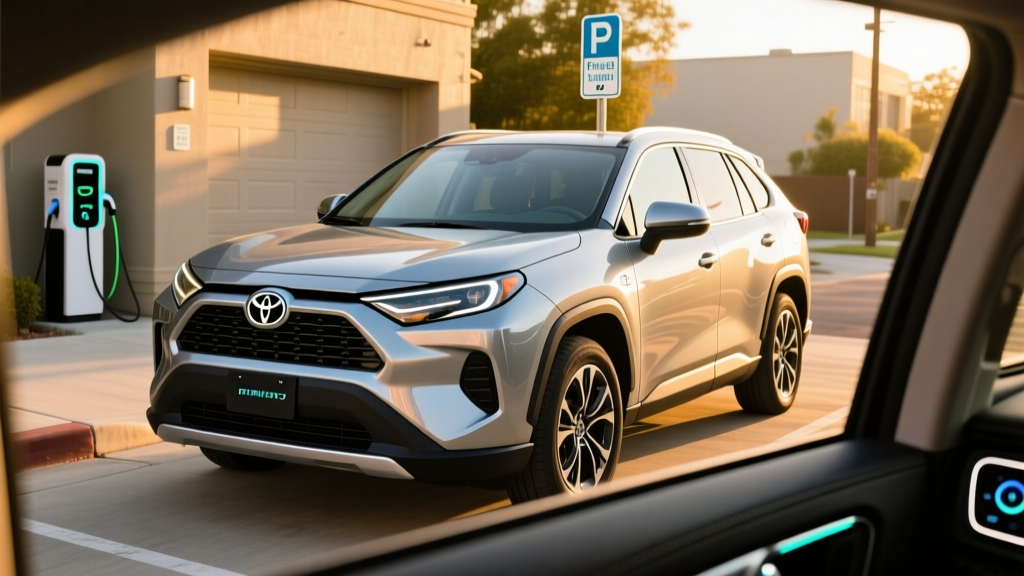
The 2025 Toyota RAV4 Hybrid XLE Premium sits in the sweet spot of Toyota's hybrid SUV lineup. It pairs the fuel-sipping efficiency of a conventional hybrid (HEV) with upgraded interior materials, a power moonroof, and Toyota's proven electronic all-wheel-drive system. For buyers who want dramatic fuel savings over a gas-only RAV4 but aren't ready to plug in or commit to a full battery-electric vehicle, this trim delivers a compelling middle ground.
As a conventional hybrid, the RAV4 Hybrid XLE Premium requires zero plug-in charging — it recovers energy through regenerative braking and its gasoline engine to keep a small battery charged. That simplicity translates to lower upfront cost, no range anxiety, and a powertrain that Toyota has refined over two decades of hybrid production.
| Spec | Value |
|---|---|
| Powertrain | 2.5L 4-cyl + 3 electric motors (AWD) |
| Combined Horsepower | 219 hp (net system) |
| EPA MPG (City / Hwy / Combined) | 41 / 38 / 39 MPG |
| Fuel Tank Capacity | 14.5 gallons |
| Total Driving Range | ~565 miles |
| 0–60 mph | ~7.4 seconds |
| Cargo Volume (behind rear seats) | 37.6 cu ft |
| MSRP (2025 XLE Premium AWD) | ~$36,795 |
| Hybrid Battery Warranty | 10 years / 150,000 miles |
EPA Fuel Economy vs. Real-World MPG: What Owners Actually See
The EPA rates the 2025 RAV4 Hybrid AWD at 41 MPG city, 38 MPG highway, and 39 MPG combined. Those numbers apply across all AWD hybrid trims, including the XLE Premium, because they share the same powertrain and weight class.
| Driving Condition | MPG |
|---|---|
| EPA City | 41 |
| EPA Highway | 38 |
| EPA Combined | 39 |
| Real-World City (owner-reported avg) | 40–43 |
| Real-World Highway (70–75 mph) | 35–37 |
| Cold-Weather Combined (sub-32°F) | 35–37 |
Compared to the gas-only 2025 RAV4 AWD (rated at 27 MPG combined by the EPA), the hybrid delivers roughly 44% better fuel economy. Over 15,000 annual miles at $3.40/gallon, that difference saves approximately $1,100 per year in fuel costs — enough to recoup the hybrid's price premium within 2–3 years depending on trim.
Powertrain Deep Dive: 219 hp with Electronic AWD
The RAV4 Hybrid uses Toyota's fifth-generation hybrid system. A 2.5-liter Dynamic Force four-cylinder engine produces 176 hp and 163 lb-ft of torque on its own. Two front-mounted electric motor-generators supplement acceleration and handle regenerative braking, while a dedicated rear-mounted electric motor (40 kW / 54 hp) powers the rear axle for all-wheel drive — with no mechanical driveshaft connecting front to rear.
This electronic AWD system (which Toyota calls AWD-i) engages the rear motor on demand: during hard acceleration, low-traction starts, and cornering. Under steady highway cruising, it disengages entirely to maximize efficiency. The result is confident traction in rain and light snow without the parasitic drivetrain losses of a traditional mechanical AWD system.
The combined net system output is 219 horsepower. That's 16 hp more than the gas-only RAV4 AWD (203 hp), and the electric motors deliver instant low-end torque that makes the hybrid feel notably quicker off the line despite a similar 0–60 mph time of approximately 7.4 seconds. The hybrid powertrain also operates more quietly at low speeds, where it can run in EV mode for short distances (typically under 1 mile at speeds below 25 mph).
HEV vs. PHEV: Understanding the RAV4 Hybrid Lineup
Toyota sells the RAV4 in two electrified forms: the conventional RAV4 Hybrid (HEV) and the RAV4 Prime (PHEV). The XLE Premium trim is available only on the conventional hybrid. Here's how they differ fundamentally:
- No plug-in charging required
- Small ~1.6 kWh battery, charged by engine + regen
- 39 MPG combined, ~565-mile total range
- Less than 1 mile of electric-only driving
- ~$33,000–$40,000 MSRP range
- No federal tax credit
- Plugs in to charge (Level 1 or Level 2)
- 18.1 kWh battery, ~42 miles electric-only range
- 94 MPGe (electric+gas), 38 MPG (gas-only after battery depletes)
- 302 hp combined — fastest RAV4 variant
- ~$44,000–$48,000 MSRP range
- May qualify for federal/state credits (subject to sourcing rules)
The RAV4 Hybrid XLE Premium is the right choice if you lack reliable home or workplace charging access. Because a conventional hybrid never needs to be plugged in, it eliminates the infrastructure dependency that comes with PHEV and full EV ownership. If you do have charging access and want electric-only commuting, the RAV4 Prime is worth the higher upfront cost — but it's sold in limited volumes and carries a significant price premium.
Pricing, Tax Credits, and Total Cost of Ownership
The 2025 RAV4 Hybrid XLE Premium AWD carries an MSRP of approximately $36,795, including destination charge. Key equipment at this trim level includes SofTex-trimmed seats, a power moonroof, a 10.5-inch touchscreen with wireless Apple CarPlay and Android Auto, heated front seats, a heated steering wheel, and the full Toyota Safety Sense 2.5+ suite (pre-collision braking, lane departure alert, adaptive cruise control, lane tracing assist).
Federal Tax Credit Eligibility
The conventional RAV4 Hybrid does not qualify for the federal §30D clean vehicle tax credit (up to $7,500). That credit is reserved for plug-in vehicles (PHEVs and BEVs) meeting specific battery sourcing, MSRP cap, and buyer income requirements under current IRS rules. The RAV4 Prime (PHEV) may be eligible depending on battery component and critical mineral sourcing, but Toyota's qualification status changes periodically — always verify current eligibility on the IRS website or with a tax professional before purchasing.
| Cost Category | RAV4 Hybrid XLE Premium | RAV4 Gas XLE AWD |
|---|---|---|
| MSRP (approx.) | $36,795 | $34,295 |
| Fuel (5 yrs @ $3.40/gal) | $6,540 | $9,445 |
| Maintenance (5 yrs est.) | $2,200 | $2,800 |
| Insurance (5 yrs avg) | $7,500 | $7,200 |
| Estimated Depreciation | $14,700 | $14,400 |
| Total (5-yr estimate) | $67,735 | $68,140 |
The hybrid's fuel savings offset its higher purchase price within roughly 2–3 years of average driving. Toyota RAV4 Hybrids also hold resale value well — Kelley Blue Book has consistently rated the RAV4 Hybrid among the top compact SUVs for 5-year cost-to-own in its segment.
Battery Warranty, Reliability, and Replacement Costs
Toyota's hybrid battery reliability record is among the best in the industry. The RAV4 Hybrid uses a nickel-metal hydride (NiMH) traction battery — a chemistry Toyota has deployed since the original Prius in 1997. While NiMH offers lower energy density than the lithium-ion packs in PHEVs and BEVs, it provides exceptional cycle-life durability and thermal stability.
Real-world data from fleet operators and long-term owners shows that Toyota hybrid batteries routinely last 150,000–200,000+ miles before any meaningful capacity degradation. Complete failures within the warranty period are rare. If a replacement is needed out of warranty, a new OEM hybrid battery for the RAV4 Hybrid typically costs between $2,000 and $3,500 installed at a dealership. Third-party refurbishment shops offer reconditioned units for $1,000–$2,000. For comparison, a full EV battery replacement can run $10,000–$20,000+.
The RAV4 Hybrid has earned strong reliability ratings from multiple sources. IIHS has historically named the RAV4 a Top Safety Pick when equipped with specific headlights, and Toyota's hybrid system has few moving parts beyond the gasoline engine — meaning fewer mechanical failure points than a conventional automatic transmission (the hybrid uses an e-CVT planetary gearset with no belts, clutches, or bands to wear out).
Who Should Choose the RAV4 Hybrid XLE Premium?
- Choose the RAV4 Hybrid if: You want maximum fuel savings with zero lifestyle change — no charging, no range planning, no plug-in infrastructure. You drive 12,000–20,000 miles per year in mixed city/highway conditions. You value Toyota's reliability reputation and strong resale value. You want AWD capability for rain and snow without a fuel-economy penalty.
- Choose the RAV4 Prime (PHEV) if: You have reliable Level 2 home or workplace charging, your daily commute is under 42 miles, and you want to drive primarily on electricity while retaining a gas engine for road trips. You're willing to pay $7,000–$10,000 more upfront for electric-only operation and 302 hp.
- Choose a full BEV (e.g., Tesla Model Y, Hyundai Ioniq 5) if: You have home charging, your daily driving is under 250 miles, you want zero tailpipe emissions, and you're ready to adopt EV charging habits. You may qualify for the $7,500 federal tax credit, which can make a BEV cost-competitive with a hybrid over 5 years.
- Stick with the gas RAV4 if: You drive under 8,000 miles per year (fuel savings won't offset the hybrid premium), you tow near the RAV4's maximum capacity frequently, or you're on the tightest possible budget and the $2,500 hybrid premium matters.
- 39 MPG combined — real-world often exceeds EPA in city
- No plug-in charging required
- 219 hp with smooth, responsive acceleration
- Electronic AWD with no fuel-economy penalty vs. FWD
- 10-year/150,000-mile hybrid battery warranty
- Strong resale value and proven long-term reliability
- XLE Premium adds luxury touches at moderate price
- No federal tax credit (conventional hybrid)
- Highway MPG drops noticeably at 75+ mph
- No DC fast charging capability (not applicable to HEV)
- Cabin noise under hard acceleration (4-cyl drone)
- Rear cargo space slightly reduced vs. gas model
- XLE Premium price approaching RAV4 Prime territory
Frequently Asked Questions
How many MPG does the 2025 RAV4 Hybrid XLE Premium get?
The EPA rates it at 41 MPG city, 38 MPG highway, and 39 MPG combined. In real-world driving, most owners report 40–43 MPG in city and suburban conditions, with highway efficiency dropping to 35–37 MPG at sustained speeds above 70 mph. Cold weather can reduce combined MPG to the mid-30s.
Does the RAV4 Hybrid need to be plugged in?
No. The RAV4 Hybrid is a conventional hybrid (HEV), not a plug-in hybrid. Its small traction battery is charged entirely by the gasoline engine and regenerative braking. You simply fill it with gasoline like any other car — there is no charging port and no plug-in requirement.
How far can the RAV4 Hybrid drive on electric power alone?
Less than 1 mile, and only at very low speeds (under 25 mph). The hybrid system uses its electric motors primarily to assist the gasoline engine and recapture braking energy, not to provide meaningful electric-only range. If you want 42 miles of electric-only driving, you need the RAV4 Prime plug-in hybrid.
Is the RAV4 Hybrid reliable, and what does battery replacement cost?
Toyota's hybrid system has an exceptionally strong reliability record spanning 25+ years of production. The hybrid battery is warranted for 10 years / 150,000 miles, and real-world data shows most batteries last well beyond that. Out-of-warranty replacement costs approximately $2,000–$3,500 for a new OEM battery, or $1,000–$2,000 for a reconditioned unit.
Does the 2025 RAV4 Hybrid qualify for any tax credit?
The conventional RAV4 Hybrid does not qualify for the federal §30D clean vehicle tax credit, which applies only to plug-in electric vehicles (PHEVs and BEVs). Some states or local utilities offer rebates for hybrid purchases, but these vary by jurisdiction — check your state energy office or utility provider for current programs.
What's the difference between the RAV4 Hybrid XLE and XLE Premium?
The XLE Premium adds SofTex synthetic leather seating, heated front seats, a heated steering wheel, a power moonroof, and a silver-finish roof rack over the standard XLE. The powertrain, fuel economy, and AWD system are identical. The Premium trim typically costs $1,500–$2,000 more than the base XLE Hybrid.
How does the RAV4 Hybrid compare to a full EV like the Tesla Model Y?
The RAV4 Hybrid costs significantly less upfront (~$37,000 vs. ~$45,000+), requires no charging infrastructure, and offers 565 miles of total range with a 2-minute gas fill-up. A Model Y offers lower per-mile "fuel" cost if you charge at home, zero tailpipe emissions, stronger acceleration, and potential federal tax credit eligibility. The right choice depends on your charging access, daily mileage, budget, and willingness to adopt EV ownership habits.