If you've searched for the 2025 RAV4 Hybrid towing capacity, you've probably seen the 1,750-pound figure tossed around on forums and spec sheets. But what does that number actually mean for a weekend camper, a boat owner, or someone who just needs to haul a utility trailer to the dump twice a year? And more importantly, how does the RAV4 Hybrid's fuel economy hold up when you're pulling weight?
We've spent time with Toyota's fifth-generation RAV4 Hybrid lineup — from the LE base trim to the adventure-oriented Woodland Edition and the plug-in RAV4 Prime — to give you a precise, numbers-driven look at what this hybrid SUV can (and can't) tow, along with the full ownership picture: real-world MPG, battery longevity, warranty coverage, and how it stacks up against both the gas RAV4 and full EVs.
2025 RAV4 Hybrid Towing Capacity by the Numbers
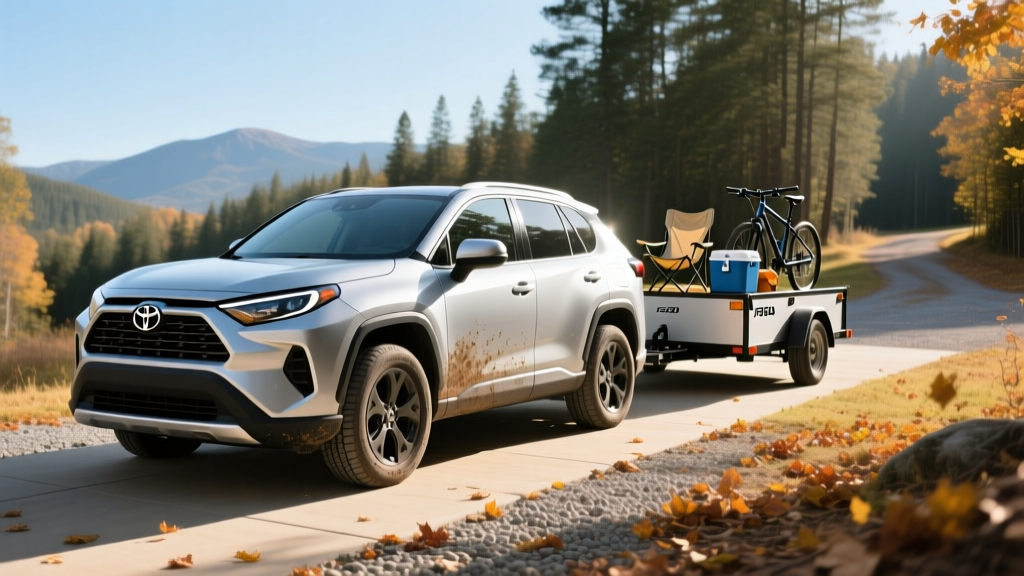
Every trim in the 2025 Toyota RAV4 Hybrid lineup — LE, XLE, XLE Premium, SE, XSE, Limited, and Woodland Edition — carries a maximum towing capacity of 1,750 pounds when properly equipped. This figure applies to the conventional hybrid (HEV) powertrain across the board.
That 1,750-lb rating covers:
- Small teardrop trailers (typically 800–1,500 lbs loaded)
- Lightweight pop-up campers
- Jet Skis on a single-axle trailer (~900–1,200 lbs)
- A 4×8 utility trailer loaded with mulch, lumber, or gear
- A small aluminum fishing boat on a trailer
What it does not cover: most hard-sided travel trailers (which typically start around 2,500 lbs dry), full-size boat trailers, or horse trailers. If your towing needs consistently exceed 1,750 lbs, you'll need to look at a body-on-frame SUV or a truck — or consider the gas-only RAV4, which Toyota rates at 1,500 lbs (actually less than the hybrid).
| Specification | Value |
|---|---|
| Towing Capacity (all trims) | 1,750 lbs |
| Combined Horsepower | 219 hp (net) |
| Engine | 2.5L 4-cyl Atkinson-cycle + electric motors |
| Drivetrain | AWD (electronic rear motor) standard |
| EPA MPG (Combined) | 39–41 MPG (varies by trim) |
| EPA City / Highway | 41 city / 38 highway (LE trim) |
| Fuel Tank | 14.5 gallons |
| Total Driving Range | ~565–595 miles |
| Hybrid Battery | 1.6 kWh (nickel-metal hydride, sealed) |
| 0–60 mph | ~7.4 seconds |
| Base MSRP (LE) | ~$33,575 |
| Hybrid Battery Warranty | 10 years / 150,000 miles |
How Many MPG Does the RAV4 Hybrid Get — Especially While Towing?
The EPA rates the 2025 RAV4 Hybrid LE at 41 city / 38 highway / 41 combined MPG. Heavier trims with larger wheels (XSE, Limited) drop slightly to around 39 combined. These figures come from fueleconomy.gov, the official DOE/EPA source.
| Trim | City MPG | Highway MPG | Combined MPG |
|---|---|---|---|
| LE | 41 | 38 | 41 |
| XLE / XLE Premium | 41 | 38 | 41 |
| Woodland Edition | 38 | 35 | 37 |
| SE / XSE | 41 | 38 | 39 |
| Limited | 41 | 38 | 39 |
Real-world MPG vs. EPA: Toyota's hybrid system excels in stop-and-go city driving, where the electric motor does heavy lifting. Many owners report exceeding the EPA city estimate by 2–4 MPG in moderate climates. However, highway-dominant commutes at 75+ mph typically yield 34–36 MPG — slightly below the sticker.
While towing: Expect fuel economy to drop significantly. Based on owner reports and hybrid towing dynamics, a RAV4 Hybrid pulling a 1,200–1,500 lb trailer typically returns 22–28 MPG depending on terrain, speed, and wind. That's still better than most gas-only compact SUVs would manage under the same load, but it's a meaningful reduction from the unloaded 39–41 MPG combined figure. Plan fuel stops accordingly on longer towing trips.
HEV vs. PHEV: RAV4 Hybrid vs. RAV4 Prime (Plug-In)
Toyota offers the RAV4 in two electrified flavors, and buyers frequently confuse them. Here's the critical distinction:
| Feature | RAV4 Hybrid (HEV) | RAV4 Prime (PHEV) |
|---|---|---|
| Plug-in Charging? | No — self-charging via regenerative braking and engine | Yes — plug in to charge the larger battery |
| Electric-Only Range | N/A (EV assist only at low speeds) | 42 miles (EPA) |
| Total Range | ~565–595 miles | ~600 miles (EV + gas) |
| Battery Size | 1.6 kWh (NiMH) | 18.1 kWh (lithium-ion) |
| Combined Horsepower | 219 hp | 302 hp |
| 0–60 mph | ~7.4 sec | ~5.7 sec |
| Towing Capacity | 1,750 lbs | 1,750 lbs |
| EPA Combined (gas mode) | 39–41 MPG | 38 MPG (gas) / 94 MPGe (EV+gas) |
| Level 2 Charge Time (0–100%) | N/A | ~2.5 hours (240V, 3.3 kW) |
| DC Fast Charging | N/A | Not supported |
| Base MSRP | ~$33,575 | ~$44,575 |
| Federal Tax Credit (§30D) | Not eligible | Not eligible (discontinued after prior credit phase-out) |
The RAV4 Hybrid (HEV) never plugs in. It captures energy through regenerative braking and the gasoline engine to charge its small 1.6 kWh battery. The electric motor assists during acceleration and can propel the vehicle at very low speeds for short distances, but it cannot sustain highway speeds on electricity alone.
The RAV4 Prime (PHEV) has a much larger 18.1 kWh lithium-ion battery that you charge by plugging in (Level 1 household outlet or Level 2 240V charger). It delivers 42 miles of EPA-rated electric-only range — enough for many daily commutes without burning a drop of gas. When the battery is depleted, it operates as a conventional hybrid. Notably, the Prime does not support DC fast charging; its onboard charger maxes out at 3.3 kW on Level 2, meaning a full charge takes about 2.5 hours.
Both versions share the same 1,750-lb towing capacity.
Powertrain Deep Dive: Why the Hybrid Tows More Than the Gas RAV4
Counterintuitively, the RAV4 Hybrid tows 250 lbs more than the gas-only RAV4 (rated at 1,500 lbs). The reason comes down to torque delivery and Toyota's AWD system.
The 2025 RAV4 Hybrid pairs a 2.5-liter Atkinson-cycle four-cylinder engine (176 hp, 163 lb-ft) with a front electric motor (118 hp, 149 lb-ft) and a rear electric motor (54 hp, 89 lb-ft). Combined net output is 219 horsepower. The electric motors deliver peak torque instantly from zero RPM, which gives the hybrid a tangible advantage when pulling away from a stop with a trailer attached — no need to wait for the engine to climb into its power band.
The electronic AWD system (Toyota calls it AWD-i) uses the independent rear motor to power the rear wheels without a mechanical driveshaft. This reduces weight and parasitic loss compared to a traditional AWD system, improving efficiency while still providing traction for slippery boat ramps or gravel campsite roads.
For towing, Toyota recommends the available towing prep package (which includes a supplemental engine oil cooler and upgraded radiator) on certain trims. Always verify your specific VIN's equipment before hitching up.
Battery Warranty, Lifespan, and Replacement Cost
Battery longevity is the top concern for hybrid buyers, and Toyota's track record here is among the best in the industry.
2025 RAV4 Hybrid Battery Warranty: Toyota covers the hybrid battery and related components for 10 years or 150,000 miles (whichever comes first) on 2025 models. This applies to the original owner and is transferable to subsequent owners for 10 years/150,000 miles from the original in-service date. This is confirmed on Toyota's official warranty page.
Real-world battery lifespan: Toyota's NiMH hybrid batteries have a proven track record spanning two decades (dating back to the original Prius). Data from fleet operators and long-term owners suggests most RAV4 Hybrid batteries last 150,000–200,000+ miles before significant degradation. The 1.6 kWh NiMH pack in the HEV operates within a narrow state-of-charge window (roughly 40–80%), which dramatically reduces stress and extends cycle life.
Battery replacement cost: If the hybrid battery does fail outside warranty, expect to pay approximately $3,000–$5,000 for a new OEM replacement including labor at a Toyota dealership. Third-party remanufactured batteries are available for roughly $1,500–$2,500 installed. For the RAV4 Prime's larger 18.1 kWh lithium-ion pack, replacement costs are higher — typically $6,000–$9,000 out of warranty.
For context, a conventional gas vehicle's transmission replacement often costs $3,000–$5,000 as well, so the hybrid battery isn't an unusual long-term maintenance expense — it's simply a different component on a similar timeline.
Pricing, Trims, and Tax Credit Eligibility
The 2025 RAV4 Hybrid lineup starts at approximately $33,575 (LE trim, including destination) and climbs to around $42,075 for the Limited. The Woodland Edition sits near $37,575. The RAV4 Prime PHEV starts significantly higher at approximately $44,575 (SE trim) and can exceed $50,000 in XSE Premium configuration.
Federal tax credit status:
- RAV4 Hybrid (HEV): Not eligible for the federal §30D Clean Vehicle Credit. Conventional hybrids do not qualify — the credit applies only to plug-in electric vehicles (BEVs and PHEVs) meeting battery capacity, sourcing, MSRP, and buyer income requirements per IRS guidelines.
- RAV4 Prime (PHEV): The RAV4 Prime previously qualified for a partial federal credit, but Toyota's credit allocation for this model has been exhausted under the manufacturer cap rules. As of the 2025 model year, the RAV4 Prime does not qualify for the §30D federal tax credit. Always verify current eligibility on the IRS website or with a tax professional before purchasing.
Some states offer additional incentives for hybrids or PHEVs — check your state's energy office or DMV for local programs, but these vary widely by jurisdiction and change frequently.
Pros
- Best-in-segment fuel economy: 39–41 MPG combined
- Standard AWD across all hybrid trims
- 1,750-lb towing beats gas RAV4 (1,500 lbs)
- 10-year/150,000-mile hybrid battery warranty
- Proven reliability with decades of Toyota hybrid data
- No plug-in charging required (HEV)
- Strong resale value
Cons
- 1,750-lb towing limit rules out most travel trailers
- No DC fast charging on RAV4 Prime
- No federal tax credit for either version
- RAV4 Prime carries an ~$11,000 premium over HEV
- Towing drops MPG to 22–28 (still decent, but noticeable)
- Woodland Edition MPG drops to 37 combined
- CVT drone under hard acceleration with a trailer
RAV4 Hybrid vs. Full EV vs. Gas: Which Is Right for You?
The decision between a hybrid, a plug-in hybrid, and a full battery-electric vehicle depends on your driving patterns, charging access, and towing needs.
Choose the RAV4 Hybrid (HEV) if: You want maximum fuel efficiency without ever plugging in, you tow occasionally under 1,750 lbs, you take long road trips where charging infrastructure is uncertain, and you want the lowest total cost of ownership in the compact SUV segment.
Choose the RAV4 Prime (PHEV) if: You have home Level 2 charging, your daily commute is under 42 miles round-trip, you want electric-only daily driving with gas-engine flexibility for longer trips, and the ~$11,000 price premium fits your budget.
Choose a full EV (e.g., Tesla Model Y, Hyundai Ioniq 5) if: You have reliable home charging, you rarely tow (most EVs are rated for 1,500–3,500 lbs but range drops sharply under load), you want to eliminate gas entirely, and you qualify for the $7,500 federal tax credit (which effectively narrows the price gap).
Choose the gas RAV4 if: Your budget is tight (base gas LE starts ~$2,000 less than the hybrid LE), you drive fewer than 8,000 miles per year (where the hybrid's fuel savings take longer to pay off), or you simply prefer a simpler powertrain.
Frequently Asked Questions
Can the 2025 RAV4 Hybrid tow a camper?
Yes, but only lightweight ones. The 1,750-lb capacity handles teardrop trailers (800–1,500 lbs), pop-up campers, and small boat trailers. Most hard-sided travel trailers exceed this limit. Always check your loaded trailer weight on a scale before hitching up — dry weight ratings from manufacturers often don't include water, propane, or cargo.
Does the RAV4 Hybrid need to be plugged in?
No. The conventional RAV4 Hybrid (HEV) is entirely self-charging. It captures energy through regenerative braking and the gasoline engine. You never plug it in. Only the RAV4 Prime (PHEV) requires plugging in to access its 42 miles of electric-only range.
How long will the RAV4 Hybrid battery last?
Toyota's hybrid batteries routinely last 150,000–200,000+ miles based on two decades of real-world data. The 2025 model is backed by a 10-year/150,000-mile hybrid battery warranty. The battery operates in a narrow charge window to minimize degradation, and replacement (if needed out of warranty) costs roughly $3,000–$5,000.
Does the RAV4 Hybrid qualify for any tax credit?
No. Neither the RAV4 Hybrid (HEV) nor the RAV4 Prime (PHEV) currently qualifies for the federal §30D Clean Vehicle Credit. The HEV doesn't meet the plug-in requirement, and the Prime has lost eligibility under IRS rules. Some state or local incentives may apply — check your jurisdiction's energy office.
What's the real-world MPG while towing?
Expect approximately 22–28 MPG when towing a 1,200–1,500 lb trailer, depending on speed, terrain, and wind. Flat highway towing at 60 mph will be at the higher end; hilly terrain or 70+ mph speeds push it lower. That still outperforms most gas-only compact SUVs under the same load.
Is the RAV4 Hybrid AWD system good for towing?
Toyota's AWD-i system provides adequate traction for towing on paved roads, gravel, and wet boat ramps. The independent rear electric motor engages automatically when slip is detected. However, it's not a heavy-duty 4WD system — it won't match the low-range capability of a body-on-frame truck for steep, muddy, or rocky trailer access roads.