The Toyota RAV4 Hybrid has held its position as one of America's best-selling electrified vehicles for good reason: it delivers genuine fuel savings without requiring a plug, a lifestyle change, or a leap into full battery-electric ownership. For the 2025 model year, Toyota continues refining the formula with updated tech, standard all-wheel drive across every trim, and fuel economy numbers that consistently beat their EPA estimates in real-world city driving.
If you're researching the 2025 RAV4 Hybrid, you likely have specific questions: What MPG will you actually see? How does it compare to the RAV4 Prime plug-in hybrid? Is the hybrid battery going to be a $5,000 liability in six years? This guide answers every one of those questions with exact numbers, not marketing fluff.
2025 RAV4 Hybrid Fuel Economy: EPA Ratings and Real-World MPG
The 2025 Toyota RAV4 Hybrid carries an EPA-estimated 41 MPG combined rating across most trims (LE, XLE, XLE Premium, Woodland Edition, SE, XSE, and Limited). The breakdown is 41 MPG city and 38 MPG highway. That city-highway inversion — where the hybrid gets better mileage in stop-and-go traffic than on the open road — is a hallmark of Toyota's hybrid synergy drive system, which recaptures energy during braking and relies heavily on the electric motor at low speeds.
| Trim | City MPG | Highway MPG | Combined MPG | Annual Fuel Cost* |
|---|---|---|---|---|
| LE | 41 | 38 | 41 | ~$1,350 |
| XLE | 41 | 38 | 41 | ~$1,350 |
| XLE Premium | 41 | 38 | 41 | ~$1,350 |
| Woodland Edition | 38 | 35 | 37 | ~$1,500 |
| SE / XSE | 41 | 38 | 41 | ~$1,350 |
| Limited | 41 | 38 | 41 | ~$1,350 |
*Based on 15,000 miles/year at $3.50/gallon regular unleaded. Source: fueleconomy.gov
In owner-reported data and independent testing, the 2025 RAV4 Hybrid routinely exceeds its EPA city estimate, with many drivers reporting 43–45 MPG in mixed suburban and urban driving. Highway fuel economy tends to land closer to the EPA figure or slightly below — expect 35–38 MPG at sustained 70–75 mph speeds. In cold weather (below 30°F), expect a 5–10% reduction as the gasoline engine runs more frequently to generate cabin heat and warm the catalytic converter. Overall, most owners average 39–43 MPG combined in year-round driving.
HEV vs. PHEV: RAV4 Hybrid vs. RAV4 Prime Explained
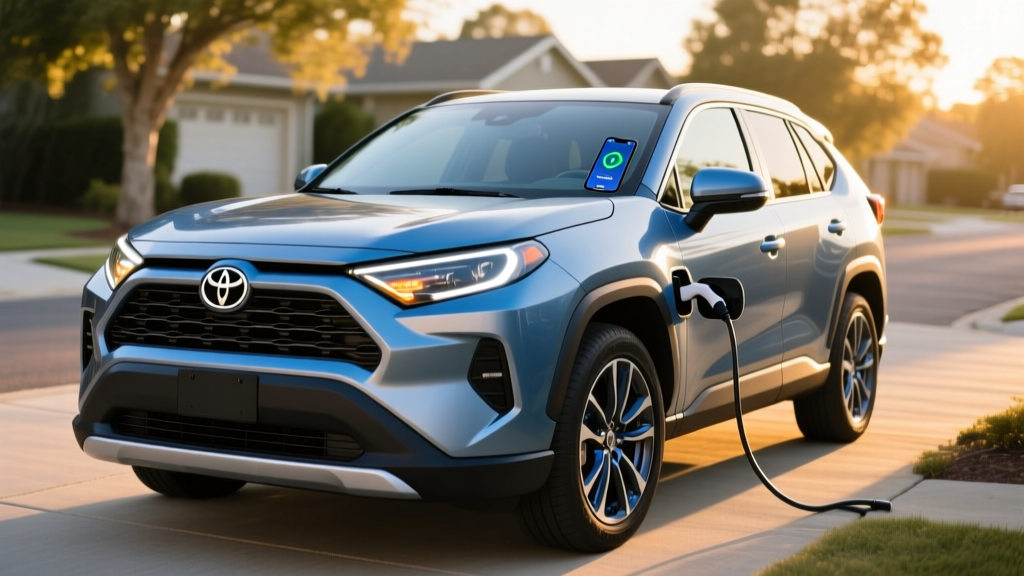
Toyota sells two electrified RAV4 variants, and the distinction matters for your wallet and your daily routine. The RAV4 Hybrid is a conventional hybrid electric vehicle (HEV) — it generates all its electricity onboard through regenerative braking and the gasoline engine. You never plug it in. The RAV4 Prime is a plug-in hybrid electric vehicle (PHEV) with a larger battery you can charge from a wall outlet or public charger, giving it a meaningful electric-only driving range before the gas engine kicks in.
| Specification | 2025 RAV4 Hybrid (HEV) | 2025 RAV4 Prime (PHEV) |
|---|---|---|
| Powertrain Type | Conventional Hybrid | Plug-in Hybrid |
| Combined Horsepower | 219 hp | 302 hp |
| Battery Capacity | ~1.6 kWh (NiMH) | 18.1 kWh (Li-ion) |
| Plug-in Charging | No — self-charging | Yes — Level 1 & Level 2 |
| Electric-Only Range | N/A (EV assist only) | 42 miles (EPA) |
| Combined MPG / MPGe | 41 MPG combined | 94 MPGe (EV mode) / 38 MPG (gas) |
| Total Range | ~580 miles | ~600 miles (gas + electric) |
| 0–60 mph | 7.4 seconds | 5.7 seconds |
| Starting MSRP | ~$33,575 | ~$44,900 |
| Federal Tax Credit (§30D) | Not eligible | Up to $7,500 (eligibility varies) |
The HEV is the simpler, more affordable choice. It asks nothing of you beyond filling up with gas — and you'll do that less often. The PHEV is the performance and efficiency upgrade, but only if you can charge at home or work regularly. Without plugging in, the Prime operates as a slightly heavier, less efficient conventional hybrid.
Powertrain and Performance: What's Under the Hood
The 2025 RAV4 Hybrid uses Toyota's proven fourth-generation hybrid system, pairing a 2.5-liter Dynamic Force four-cylinder engine with two electric motor-generators (one front, one rear) through an electronically controlled continuously variable transmission (eCVT). The rear motor provides standard electronic all-wheel drive (AWD) on every trim — there is no front-wheel-drive RAV4 Hybrid.
Total system output is 219 horsepower. The gasoline engine produces 176 hp and 163 lb-ft of torque on its own, while the front electric motor contributes 118 hp and the rear motor adds 54 hp. Because electric motors deliver peak torque instantly from zero RPM, the hybrid feels more responsive than its horsepower figure alone suggests, particularly in city driving and merging situations.
The 0–60 mph time is 7.4 seconds — adequate for daily driving but noticeably slower than the RAV4 Prime's 5.7-second sprint. The eCVT eliminates shift shock entirely, though some drivers notice the characteristic "rubber-band" drone under hard acceleration. Towing capacity is rated at 1,750 pounds, sufficient for a small utility trailer but not a boat or camper.
Pricing, Trims, and Tax Credit Eligibility
The 2025 RAV4 Hybrid lineup spans six trims, starting at approximately $33,575 for the LE and reaching around $41,075 for the Limited (including destination charge). Here's the approximate pricing breakdown:
- LE: ~$33,575 — Toyota Safety Sense 2.5+, 8-inch touchscreen, wireless Apple CarPlay/Android Auto
- XLE: ~$35,025 — Blind-spot monitoring, dual-zone climate, smart key
- XLE Premium: ~$37,175 — SofTex seats, moonroof, power liftgate
- Woodland Edition: ~$36,425 — TRD-tuned suspension, all-terrain tires, roof rails
- SE: ~$36,925 — Sport-tuned suspension, 19-inch wheels
- XSE: ~$38,475 — Sport styling, heated front seats
- Limited: ~$41,075 — Premium audio, panoramic moonroof, ventilated seats
The conventional RAV4 Hybrid (HEV) does not qualify for the federal §30D clean vehicle tax credit — that credit is reserved for plug-in electric vehicles (BEVs and PHEVs) meeting battery sourcing, MSRP, and buyer income requirements. If the $7,500 credit is important to your purchase math, you would need to consider the RAV4 Prime (PHEV) instead. Even then, eligibility depends on current IRS rules regarding critical mineral sourcing, your modified adjusted gross income, and the vehicle's MSRP cap. Always verify current eligibility at irs.gov or consult a tax professional before purchasing.
Some states and local utilities offer separate incentives for conventional hybrids, but these vary widely by jurisdiction and are typically smaller than federal EV credits. Check your state energy office or utility provider for current programs.
Battery Warranty, Reliability, and Replacement Costs
Hybrid battery longevity is consistently the top concern among first-time hybrid buyers. Toyota addresses this with one of the industry's strongest hybrid battery warranties:
- Hybrid Battery: 10 years / 150,000 miles (whichever comes first)
- Hybrid System Components: 8 years / 100,000 miles (inverter, motor-generators, control module)
- Powertrain: 5 years / 60,000 miles (engine, transmission)
- Basic Bumper-to-Bumper: 3 years / 36,000 miles
The 10-year/150,000-mile hybrid battery warranty applies in all 50 states and is transferable to subsequent owners.
In practice, Toyota's hybrid batteries have demonstrated exceptional longevity. Data from fleet operators and long-term owner surveys show that the vast majority of Toyota hybrid batteries last well beyond 150,000 miles with minimal capacity loss. The RAV4 Hybrid uses a nickel-metal hydride (NiMH) battery pack — a chemistry Toyota has refined over 25+ years since the original Prius. NiMH is less energy-dense than the lithium-ion packs in PHEVs and BEVs, but it's extremely tolerant of the shallow charge-discharge cycles that characterize hybrid operation.
If replacement does become necessary out of warranty, a new OEM hybrid battery for the RAV4 Hybrid typically costs between $3,000 and $5,000 including installation. Third-party refurbished batteries are available for $1,500–$2,500. However, given Toyota's track record and the generous warranty coverage, battery replacement is rarely a cost that materializes for first or even second owners.
Reliability ratings for the RAV4 Hybrid are strong. Toyota's hybrid powertrain has fewer wear components than a conventional gasoline drivetrain — there's no traditional starter motor, no alternator, no accessory belt, and the regenerative braking system significantly extends brake pad life (many owners report 80,000+ miles on original brake pads).
RAV4 Hybrid vs. Full EV vs. Gasoline RAV4: Which Fits You?
Choosing between the RAV4 Hybrid, a full battery electric vehicle (BEV), and the conventional gasoline RAV4 comes down to your driving patterns, charging access, and budget.
Choose the RAV4 Hybrid (HEV) If:
- You want lower fuel costs with zero change to your routine
- You lack access to home or workplace charging
- You take frequent long road trips and don't want to plan around chargers
- Your budget is $33,000–$41,000
- You want AWD and proven reliability with minimal risk
Choose a Full EV (BEV) If:
- You can install a Level 2 home charger
- Your daily driving is under 250 miles with predictable routes
- You want the lowest per-mile "fuel" cost and minimal maintenance
- You qualify for the $7,500 federal tax credit
- You're willing to plan charging on road trips
Choose the Gas RAV4 If:
- Every dollar of upfront cost matters (gas starts ~$2,500 less)
- You drive very few miles annually (fuel savings won't offset hybrid premium)
- You plan to own the vehicle 3 years or fewer
For most buyers, the RAV4 Hybrid hits the sweet spot. The ~$2,500 premium over the gasoline RAV4 pays for itself in fuel savings within roughly 3–4 years at current gas prices (assuming 15,000 miles/year), and the hybrid's higher resale value further narrows the total cost gap.
5-Year Cost of Ownership: Hybrid vs. Gas RAV4
| Cost Category | 2025 RAV4 Hybrid (AWD) | 2025 RAV4 Gas (AWD) |
|---|---|---|
| Purchase Price (LE trim) | ~$33,575 | ~$31,075 |
| Fuel (75,000 mi) | ~$6,750 | ~$9,375 |
| Maintenance | ~$2,800 | ~$3,200 |
| Insurance (avg) | ~$7,500 | ~$7,200 |
| Estimated Depreciation | ~$14,500 | ~$16,000 |
| 5-Year Total | ~$65,125 | ~$66,850 |
Assumptions: $3.50/gal regular, 15,000 mi/yr, national average insurance. Hybrids typically depreciate less due to strong demand. Source: fueleconomy.gov, industry estimates.
The hybrid breaks even or saves money over five years despite the higher sticker price, and the gap widens further if gas prices rise above $3.50/gallon.
Frequently Asked Questions
How many MPG does the 2025 RAV4 Hybrid actually get?
The EPA rates most trims at 41 city / 38 highway / 41 combined MPG. In real-world driving, many owners report 39–45 MPG combined depending on driving style, terrain, and climate. City driving typically yields the best results thanks to regenerative braking; sustained highway speeds above 70 mph bring the figure closer to 35–38 MPG. The Woodland Edition, with its all-terrain tires, is rated slightly lower at 37 MPG combined.
Does the RAV4 Hybrid need to be plugged in?
No. The RAV4 Hybrid is a conventional (self-charging) hybrid. It generates electricity through regenerative braking and the gasoline engine. You simply fill it with regular unleaded gasoline like any other car. If you want a RAV4 you can plug in for electric-only driving, you need the RAV4 Prime (PHEV).
How far can the RAV4 Prime go on electric only?
The 2025 RAV4 Prime (PHEV) delivers an EPA-estimated 42 miles of electric-only range on a full charge, enough for most daily commutes without using any gasoline. Total combined range (electric + gas) is approximately 600 miles. The Prime's 18.1 kWh lithium-ion battery charges in about 12 hours on a standard 120V outlet (Level 1) or roughly 2.5 hours on a 240V Level 2 charger. It does not support DC fast charging.
Is the RAV4 Hybrid reliable, and what does battery replacement cost?
Yes — Toyota's hybrid system is among the most reliable powertrains in the industry, backed by over 25 years of continuous refinement. The hybrid battery carries a 10-year/150,000-mile warranty. Out-of-warranty replacement runs $3,000–$5,000 for an OEM battery, but real-world data shows most Toyota hybrid batteries last well beyond 150,000 miles. The system also eliminates several traditional wear items (starter, alternator, accessory belts), reducing long-term maintenance costs.
Does the 2025 RAV4 Hybrid qualify for a federal tax credit?
No. The conventional RAV4 Hybrid (HEV) does not qualify for the federal §30D clean vehicle credit, which is limited to plug-in vehicles (BEVs and PHEVs). The RAV4 Prime (PHEV) may qualify for up to $7,500 depending on current battery sourcing rules, your income, and MSRP caps. Always check IRS guidelines for the latest eligibility requirements. Some state and utility incentives may apply to hybrids — check locally.
What's the difference between the RAV4 Hybrid and the RAV4 Prime?
The RAV4 Hybrid (HEV) is a self-charging hybrid you never plug in, rated at 41 MPG combined with 219 hp and starting around $33,575. The RAV4 Prime (PHEV) is a plug-in hybrid with 42 miles of electric-only range, 302 hp, a starting price near $44,900, and potential eligibility for the $7,500 federal tax credit. The Prime is faster, more efficient when charged regularly, and significantly more expensive — but only delivers its advantages if you plug it in.