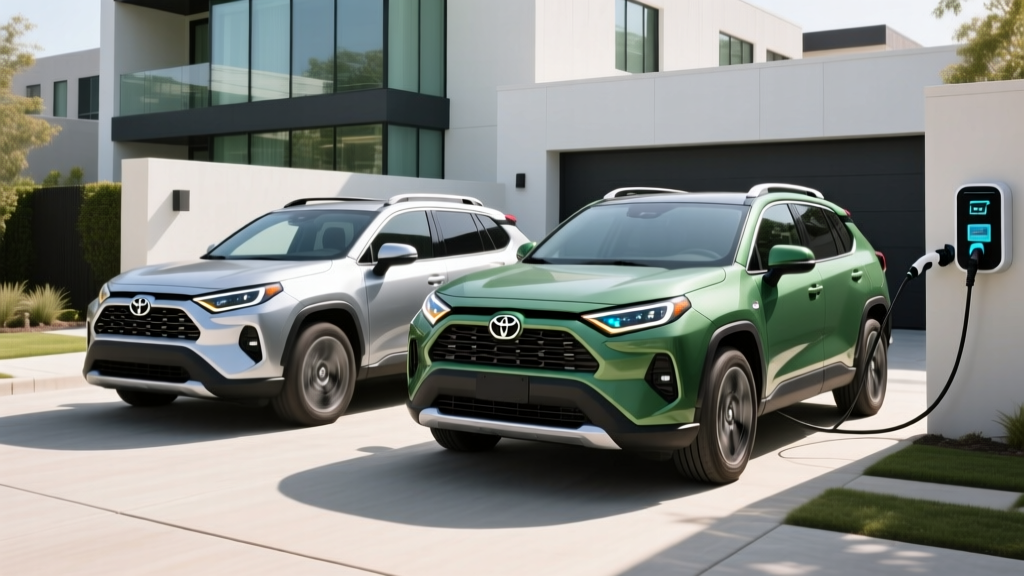
The Toyota RAV4 Hybrid remains one of the best-selling electrified vehicles in the United States, and for good reason: it pairs proven hybrid efficiency with compact-SUV practicality. But buyers researching the 2025 RAV4 Hybrid horsepower figure often encounter confusion between the conventional hybrid (HEV) and the plug-in hybrid RAV4 Prime (PHEV). The two powertrains share a platform but deliver vastly different performance, efficiency, and ownership experiences.
This guide breaks down every critical spec — horsepower, EPA MPG, electric-only range, battery warranty, pricing, and tax-credit eligibility — so you can decide whether the standard RAV4 Hybrid, the RAV4 Prime PHEV, or a full battery-electric vehicle (BEV) is the right move for your driveway.
HEV vs PHEV: Which RAV4 Hybrid Are We Talking About?
Toyota sells two electrified RAV4 variants for the 2025 model year. The distinction matters because it affects everything from horsepower to fuel cost to whether you'll ever plug in.
| Attribute | 2025 RAV4 Hybrid (HEV) | 2025 RAV4 Prime (PHEV) |
|---|---|---|
| Powertrain Type | Conventional Hybrid (self-charging) | Plug-in Hybrid (grid-chargeable) |
| Needs to Plug In? | No — regenerative braking charges battery | Yes — plug in for max electric range |
| Combined Horsepower | 219 hp | 302 hp |
| Battery Capacity | 1.6 kWh (NiMH) | 18.1 kWh (Lithium-ion) |
| Electric-Only Range | N/A (EV assist only, ~1 mi at low speed) | 42 miles (EPA) |
| DC Fast Charge | No | No (Level 2 AC only) |
| 0–60 mph | 7.4 seconds | 5.7 seconds |
Key takeaway: The conventional RAV4 Hybrid never needs a plug. It recovers energy through regenerative braking and the gasoline engine. The RAV4 Prime has a much larger 18.1 kWh battery that you charge at home or at public Level 2 stations, giving you 42 miles of pure electric driving before the gas engine takes over. Neither version supports DC fast charging.
2025 RAV4 Hybrid Horsepower: The Powertrain Explained
The 2025 RAV4 Hybrid horsepower output depends on which powertrain you choose:
Standard RAV4 Hybrid (HEV) — 219 Combined Horsepower
The conventional hybrid pairs a 2.5-liter Dynamic Force four-cylinder engine (176 hp, 163 lb-ft torque) with front and rear electric motors. The combined system output is 219 horsepower. Toyota's eAWD system uses a dedicated rear electric motor (54 hp) to provide all-wheel drive without a mechanical driveshaft, improving traction and responsiveness.
RAV4 Prime (PHEV) — 302 Combined Horsepower
The Prime uses the same 2.5-liter engine but pairs it with significantly more powerful electric motors — a 134 kW (180 hp) front motor and a 40 kW (54 hp) rear motor. Combined system output jumps to 302 horsepower, making the Prime the quickest RAV4 in the lineup and one of the fastest compact SUVs in its class at 5.7 seconds to 60 mph.
| Spec | RAV4 Hybrid LE | RAV4 Hybrid XSE | RAV4 Prime SE | RAV4 Prime XSE |
|---|---|---|---|---|
| Engine | 2.5L I4 + eMotors | 2.5L I4 + eMotors | 2.5L I4 + eMotors | 2.5L I4 + eMotors |
| Combined HP | 219 hp | 219 hp | 302 hp | 302 hp |
| Drivetrain | eAWD | eAWD | eAWD | eAWD |
| 0–60 mph | 7.4 sec | 7.4 sec | 5.7 sec | 5.7 sec |
| EPA Combined MPG | 39 MPG | 39 MPG | 94 MPGe / 38 MPG | 94 MPGe / 38 MPG |
| Base MSRP | $33,575 | $37,075 | $44,915 | $48,415 |
Fuel Economy: EPA MPG and Real-World Expectations
Fuel economy is where the RAV4 Hybrid justifies its existence over the gas-only RAV4 (which returns a combined 30 MPG). Here's the official EPA breakdown, sourced from fueleconomy.gov:
| Model | City MPG | Highway MPG | Combined MPG | MPGe (PHEV EV Mode) |
|---|---|---|---|---|
| RAV4 Hybrid (HEV) | 41 | 38 | 39 | N/A |
| RAV4 Prime (PHEV, gas mode) | 40 | 36 | 38 | 94 MPGe |
Real-World MPG: What to Actually Expect
Hybrids shine in city driving because regenerative braking recaptures energy that would otherwise be lost as heat. In real-world testing, the RAV4 Hybrid routinely exceeds its EPA city rating of 41 MPG during stop-and-go commutes, with many owners reporting 43–45 MPG in urban conditions.
Highway driving tells a different story. At sustained 70–80 mph speeds, the hybrid system's advantages diminish, and real-world highway fuel economy tends to land closer to 35–37 MPG — slightly below the 38 MPG EPA highway sticker. Cold weather (below 40°F) can reduce overall fuel economy by 10–15% due to increased engine warm-up time and cabin heating demands.
For the RAV4 Prime, once the 42-mile electric range is depleted, the vehicle operates as a conventional hybrid at roughly 38 MPG combined. If you charge daily and your commute is under 42 miles round-trip, you may go months between fill-ups.
RAV4 Prime PHEV: Electric-Only Range and Charging
The RAV4 Prime's 18.1 kWh lithium-ion battery delivers 42 miles of EPA-rated electric-only range. That covers the average American's daily round-trip commute (roughly 35 miles, per U.S. Census data) without burning a drop of gasoline.
Charging the RAV4 Prime
The Prime uses a standard J1772 connector for AC charging. It does not support DC fast charging — a deliberate Toyota design choice prioritizing battery longevity and cost. Here's the charging breakdown:
| Charging Level | Power | Time (0–100%) | Notes |
|---|---|---|---|
| Level 1 (120V household) | ~1.4 kW | ~12 hours | Standard outlet; slow but workable overnight |
| Level 2 (240V, 3.3 kW onboard) | 3.3 kW | ~5.5 hours | SE trim; standard home charger |
| Level 2 (240V, 6.6 kW onboard) | 6.6 kW | ~2.5 hours | XSE trim with Premium Package |
Important: The 6.6 kW onboard charger is only available on the XSE trim with the Premium Package. If you opt for the SE trim, you're limited to 3.3 kW, meaning a full charge takes roughly twice as long. Factor this into your trim-level decision if you plan to top up during the workday at a public Level 2 station.
Battery Warranty, Reliability, and Replacement Cost
Hybrid battery longevity is the single most common concern among first-time hybrid buyers. Toyota addresses this with robust warranty coverage:
Toyota Hybrid Battery Warranty
- Hybrid Battery: 10 years / 150,000 miles (whichever comes first)
- Hybrid System Components: 8 years / 100,000 miles
- Applies to: Both RAV4 Hybrid (HEV) and RAV4 Prime (PHEV)
- Transferable: Yes — transfers to subsequent owners at no cost
Toyota's hybrid battery track record is among the best in the industry. The Prius, which shares Toyota's Hybrid Synergy Drive lineage, routinely sees original batteries lasting 150,000–200,000+ miles with minimal degradation. The RAV4 Hybrid's NiMH pack (HEV) is particularly well-proven — NiMH chemistry degrades slowly and predictably.
The Prime's larger lithium-ion pack uses a more energy-dense chemistry, but Toyota engineers a conservative buffer (you never access 100% of the 18.1 kWh) to protect long-term health. Real-world Prime owners report negligible range loss over the first 3–4 years of ownership.
Out-of-Warranty Replacement Cost
If you plan to keep your RAV4 Hybrid well past the warranty period, budget for eventual battery replacement:
- RAV4 Hybrid (HEV) NiMH battery: $3,000–$4,500 (parts + labor)
- RAV4 Prime (PHEV) lithium-ion battery: $7,000–$9,000 (parts + labor)
These are ballpark dealer-installed figures. Independent hybrid shops and refurbished battery options can reduce costs by 30–40%. According to Toyota's official warranty guide, hybrid battery coverage is fully transferable, which supports strong resale values.
Pricing, Trims, and Tax Credit Eligibility
The 2025 RAV4 Hybrid lineup starts just under $34,000 and climbs past $48,000 for a fully loaded Prime XSE. Here's the trim-level pricing breakdown:
| Trim | Powertrain | MSRP | Destination | Total Starting Price |
|---|---|---|---|---|
| LE | HEV | $32,350 | $1,225 | $33,575 |
| XLE | HEV | $34,050 | $1,225 | $35,275 |
| XLE Premium | HEV | $36,150 | $1,225 | $37,375 |
| Woodland Edition | HEV | $36,650 | $1,225 | $37,875 |
| XSE | HEV | $35,850 | $1,225 | $37,075 |
| Limited | HEV | $39,550 | $1,225 | $40,775 |
| SE | Prime PHEV | $43,690 | $1,225 | $44,915 |
| XSE | Prime PHEV | $47,190 | $1,225 | $48,415 |
Federal Tax Credit: Does the RAV4 Hybrid Qualify?
Under current IRS §30D rules, the standard RAV4 Hybrid (HEV) does not qualify for the federal plug-in electric vehicle tax credit. The credit applies only to plug-in vehicles with a battery capacity of at least 7 kWh, which excludes conventional self-charging hybrids.
The RAV4 Prime (PHEV) may qualify for up to $7,500 under §30D, but eligibility is subject to several conditions that change frequently:
- Battery sourcing & critical minerals: The vehicle must meet progressively stricter domestic-content and critical-mineral sourcing thresholds. Toyota has historically sourced components globally, which has affected Prime eligibility in recent years.
- MSRP cap: SUVs must be priced at or below $80,000 (both Prime trims qualify).
- Buyer income cap: AGI must not exceed $150,000 (single), $225,000 (head of household), or $300,000 (joint).
- Point-of-sale transfer: Eligible buyers can apply the credit as an instant dealer discount rather than waiting for a tax refund.
Verify current eligibility before purchasing at IRS.gov's clean vehicle credit page and confirm with your dealer, as sourcing rules are updated periodically.
Some states offer additional rebates for PHEVs (California, Colorado, and New York, for example). Check your state energy office for current programs — these stack with the federal credit where applicable.
RAV4 Hybrid vs. RAV4 Prime vs. Full EV: Which Fits You?
RAV4 Hybrid (HEV)
Pros:
- No plug-in required — works exactly like a gas car
- 39 MPG combined saves ~$600–$900/year vs. gas RAV4
- Lower purchase price ($33,575 starting)
- Proven reliability; excellent resale value
Cons:
- No electric-only driving
- No federal tax credit eligibility
- 219 hp adequate but not exciting
RAV4 Prime (PHEV)
Pros:
- 302 hp — quickest RAV4 available
- 42 miles electric covers most commutes gas-free
- Potential $7,500 federal tax credit
- Still has 38 MPG hybrid mode for road trips
Cons:
- ~$11,000 more expensive than HEV LE
- No DC fast charging
- Cargo space slightly reduced by larger battery
- Tax credit eligibility varies by year/sourcing
Decision Framework
Choose the RAV4 Hybrid (HEV) if: You want maximum simplicity, don't have reliable home charging access, or your budget is under $40,000. The HEV is the default right choice for most compact-SUV buyers who want better fuel economy without lifestyle changes.
Choose the RAV4 Prime (PHEV) if: You can charge at home (Level 2), your daily commute is under 42 miles round-trip, you want the performance upgrade (302 hp / 5.7s 0–60), and you qualify for the federal tax credit — which narrows the price gap significantly.
Choose a full EV (like the Toyota bZ4X or Tesla Model Y) if: You want zero gasoline expenses, have reliable home charging, take few road trips over 300 miles, and want to minimize maintenance (no oil changes, no spark plugs, fewer moving parts). A BEV's total cost of ownership undercuts both hybrid options over 5–7 years for most drivers.
Frequently Asked Questions
How many MPG does the 2025 RAV4 Hybrid get?
The EPA rates the 2025 RAV4 Hybrid at 41 city / 38 highway / 39 combined MPG. Real-world city driving often yields 43–45 MPG thanks to regenerative braking, while sustained highway speeds may return 35–37 MPG.
How far can the RAV4 Prime go on electric only?
The 2025 RAV4 Prime delivers 42 miles of EPA-rated electric-only range. In moderate temperatures and city driving, some owners report 44–46 miles. In cold weather (below 32°F) or at highway speeds, expect 32–36 miles of electric range.
Is the RAV4 Hybrid reliable, and what does battery replacement cost?
Toyota's hybrid system is one of the most proven in the industry, with the hybrid battery covered for 10 years / 150,000 miles. Out-of-warranty replacement runs $3,000–$4,500 for the HEV and $7,000–$9,000 for the Prime's larger lithium-ion pack. Most original batteries last well beyond 150,000 miles.
Does the RAV4 Hybrid qualify for any tax credit?
The conventional RAV4 Hybrid (HEV) does not qualify for the federal §30D tax credit. The RAV4 Prime (PHEV) may qualify for up to $7,500, depending on battery-sourcing rules, buyer income, and MSRP caps. Verify current eligibility on IRS.gov before purchasing.
What is the 2025 RAV4 Hybrid horsepower?
The standard RAV4 Hybrid produces 219 combined horsepower. The RAV4 Prime PHEV produces 302 combined horsepower, making it significantly quicker with a 5.7-second 0–60 mph time.
Do I need to plug in the RAV4 Hybrid?
No. The standard RAV4 Hybrid is a self-charging conventional hybrid — it recovers energy through regenerative braking and the gasoline engine. Only the RAV4 Prime (PHEV) requires plugging in to access its 42-mile electric range.