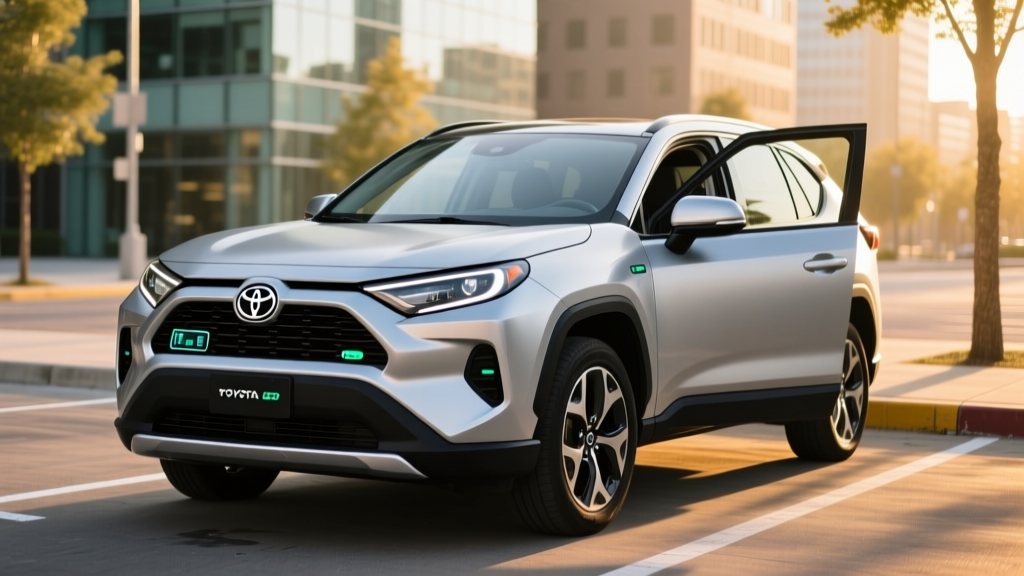
The Toyota RAV4 Hybrid remains one of the best-selling electrified vehicles in the United States, and for buyers doing homework on fuel stops and road-trip logistics, one of the most-searched specs is the 2025 RAV4 Hybrid gas tank size. The answer is straightforward: every 2025 RAV4 Hybrid trim holds 14.5 gallons of fuel. But the tank is only half the story. What matters more is how far that tank takes you, how the hybrid system sips fuel in real-world driving, and whether the plug-in RAV4 Prime variant might be a better fit for your commute.
This guide covers the 2025 RAV4 Hybrid (conventional HEV) and the 2025 RAV4 Prime (plug-in hybrid/PHEV) side by side — fuel economy, electric-only range, powertrain output, battery warranty, pricing, and tax-credit eligibility — so you can decide which version earns a spot in your driveway.
2025 RAV4 Hybrid Gas Tank Size and Total Range
Toyota equips every 2025 RAV4 Hybrid (LE, XLE, XLE Premium, SE, Woodland Edition, Limited) with a 14.5-gallon (54.9-liter) fuel tank. This is the same capacity across all trims and is shared with the RAV4 Prime plug-in hybrid.
With the EPA combined rating of 39 MPG for the most efficient trims, a full 14.5-gallon tank delivers a theoretical maximum of ~565 miles of combined driving. In real-world mixed driving, expect 500–540 miles before the low-fuel warning. Highway-dominant trips at 75+ mph will push that closer to 480 miles; city-dominant commutes can stretch it past 560.
| Trim | Tank Size | EPA Combined | Est. Max Range |
|---|---|---|---|
| LE | 14.5 gal | 39 MPG | ~565 mi |
| XLE / XLE Premium | 14.5 gal | 39 MPG | ~565 mi |
| SE / Woodland Edition | 14.5 gal | 37 MPG | ~537 mi |
| Limited | 14.5 gal | 38 MPG | ~551 mi |
Source: EPA fueleconomy.gov
EPA MPG vs. Real-World Fuel Economy
The 2025 RAV4 Hybrid's EPA ratings vary slightly by trim due to wheel size, weight, and drivetrain tuning. The LE, XLE, and XLE Premium trims achieve the highest numbers, while the sportier SE and off-road-oriented Woodland Edition sacrifice 1–2 MPG for larger wheels and all-terrain tires.
| Trim Group | City | Highway | Combined |
|---|---|---|---|
| LE, XLE, XLE Premium | 41 MPG | 38 MPG | 39 MPG |
| Limited | 41 MPG | 38 MPG | 38 MPG |
| SE, Woodland Edition | 38 MPG | 35 MPG | 37 MPG |
Real-World MPG: Why Hybrids Often Beat the Sticker in Town
Toyota's hybrid system recovers energy during braking and low-speed driving, which means city commutes with frequent stops often return higher than the EPA city number. Owners on fueleconomy.gov's My MPG tracker routinely report 42–44 MPG in suburban and city driving. Highway cruising at 75–80 mph, however, typically yields 33–36 MPG — below the EPA highway sticker — because the electric motor contributes less at sustained high speeds and aerodynamic drag dominates.
Cold-weather note: In sub-freezing temperatures, expect a 5–10% MPG reduction. The gasoline engine runs more frequently to provide cabin heat and maintain catalytic converter temperature, reducing the electric motor's contribution.
RAV4 Hybrid (HEV) vs. RAV4 Prime (PHEV): Which Powertrain Fits?
Toyota offers the RAV4 in two distinct electrified flavors. Understanding the difference is essential before comparing specs.
A conventional hybrid (HEV) like the RAV4 Hybrid never plugs in. It generates all electricity from the gasoline engine and regenerative braking. A plug-in hybrid (PHEV) like the RAV4 Prime has a larger battery you charge from a wall outlet or public charger, giving you a pure-electric driving range before the gas engine kicks in.
| Spec | RAV4 Hybrid (HEV) | RAV4 Prime (PHEV) |
|---|---|---|
| Gas Tank Size | 14.5 gal | 14.5 gal |
| Combined HP | 219 hp | 302 hp |
| Battery (traction) | 1.6 kWh NiMH | 18.1 kWh lithium-ion |
| Electric-Only Range | N/A (always uses gas) | 42 miles (EPA) |
| MPGe (EV mode, PHEV) | N/A | 94 MPGe |
| Gas-Only MPG (PHEV after EV range) | 39 MPG combined | 38 MPG combined |
| 0–60 mph | 7.4 sec | 5.7 sec |
| Plugs In? | No | Yes (J1772 / Level 2) |
| DC Fast Charging | N/A | No (Level 2 AC only) |
| Level 2 Charge Time (0–100%) | N/A | ~2.5 hrs (6.6 kW onboard) |
| Total Combined Range (EV + Gas) | ~565 mi | ~600 mi |
| Base MSRP (2025) | ~$33,500 | ~$44,500 |
Sources: Toyota RAV4 Hybrid specs, Toyota RAV4 Prime specs
RAV4 Prime Electric-Only Range and Charging
The 2025 RAV4 Prime delivers an EPA-rated 42 miles of electric-only driving on a full charge — enough to cover most daily commutes without burning a drop of gasoline. Once the battery depletes, the Prime seamlessly transitions to hybrid mode and returns 38 MPG combined, essentially identical to the standard RAV4 Hybrid.
Charging the Prime's 18.1 kWh battery takes approximately 2.5 hours on a 240V Level 2 charger using its 6.6 kW onboard charger. On a standard 120V household outlet (Level 1), expect roughly 12 hours for a full charge. The RAV4 Prime does not support DC fast charging — a deliberate Toyota engineering choice that keeps cost and weight down, but means public fast-charging stations are irrelevant for this vehicle.
Powertrain Deep Dive: 219 hp vs. 302 hp
Both the RAV4 Hybrid and RAV4 Prime use Toyota's 2.5-liter four-cylinder Dynamic Force engine paired with electric motors and an electronically controlled CVT (eCVT). The difference is in the electric side of the equation.
RAV4 Hybrid (HEV): The 2.5L engine produces 176 hp and 163 lb-ft of torque. Two electric motor-generators supplement this, bringing net system output to 219 hp. All-wheel drive (AWD) is standard on every trim, using a dedicated rear-axle electric motor rather than a mechanical driveshaft — meaning there's no drivetrain hump eating into cabin space.
RAV4 Prime (PHEV): The same 2.5L engine is paired with more powerful electric motors and the larger 18.1 kWh battery, producing a combined 302 hp. This makes the Prime the quickest RAV4 Toyota sells, hitting 0–60 mph in 5.7 seconds — quicker than many turbocharged gas-only competitors. AWD is standard here as well.
Pricing, Trims, and Federal Tax Credit Eligibility
The 2025 RAV4 Hybrid lineup starts around $33,500 (LE trim, including destination) and climbs to roughly $42,000 for a fully equipped Limited. The RAV4 Prime starts around $44,500 (SE trim) and reaches approximately $48,000 (XSE with Premium package).
Does the 2025 RAV4 Hybrid or Prime Qualify for a Federal Tax Credit?
Here's where the HEV vs. PHEV distinction has real financial consequences:
- RAV4 Hybrid (HEV): Does NOT qualify for the federal §30D Clean Vehicle Credit. Conventional hybrids are not plug-in vehicles and are ineligible regardless of battery size or efficiency.
- RAV4 Prime (PHEV): Eligibility for the up-to-$7,500 federal tax credit depends on multiple IRS requirements that have tightened significantly under current rules. Key factors include:
- Vehicle MSRP must be ≤ $80,000 for SUVs (RAV4 Prime qualifies)
- Buyer AGI must not exceed $150K (single) / $300K (joint)
- Battery components must meet North American manufacturing thresholds
- Critical minerals must meet sourcing requirements from FTA countries
- Credit can be transferred to the dealer at point of sale for an upfront discount
- Vehicle must undergo final assembly in North America
Check the latest rules at IRS.gov Clean Vehicle Credit. Battery sourcing requirements have phased in progressively, and some PHEVs that previously qualified for the full $7,500 may now receive a reduced amount or none at all. Consult a tax professional for your specific situation.
Additionally, many states and utilities offer separate rebates for PHEVs — commonly $1,000–$2,500 — though conventional hybrids rarely qualify. Check your state's energy office and local utility for current programs.
Battery Warranty, Lifespan, and Replacement Cost
Battery longevity is consistently the top concern for first-time hybrid buyers. Toyota addresses this with one of the strongest warranty packages in the industry.
RAV4 Hybrid (HEV): 10 years / 150,000 miles (whichever comes first) on the hybrid battery and all hybrid-system components, transferable to subsequent owners.
RAV4 Prime (PHEV): 10 years / 150,000 miles on the traction battery and plug-in hybrid components, with a capacity-retention guarantee. Toyota warrants that the battery will retain sufficient capacity for EV-mode operation during the warranty period.
Replacement cost (out of warranty): RAV4 Hybrid NiMH battery replacement runs approximately $3,000–$4,500 including labor at a dealership. RAV4 Prime lithium-ion battery replacement is significantly higher, estimated at $8,000–$12,000+ due to the larger capacity and lithium-ion chemistry. Independent hybrid-battery shops often offer refurbished replacements for 40–60% less.
How Long Do RAV4 Hybrid Batteries Actually Last?
Toyota's hybrid battery management system is deliberately conservative — it never fully charges or fully discharges the small NiMH pack, keeping it in a narrow state-of-charge window that dramatically extends cycle life. Real-world data from millions of Toyota hybrids on the road shows most original batteries last 150,000–200,000+ miles before meaningful degradation, and many outlast the vehicle itself. The RAV4 Prime's larger lithium-ion pack has less long-term field data, but Toyota's thermal management and charge-buffering are similarly conservative.
Who Should Choose the RAV4 Hybrid vs. a PHEV or Full EV?
The right choice depends on your daily driving pattern, home-charging access, and budget.
- You don't have access to home or workplace charging
- You want maximum simplicity — no plugs, no apps, no charging planning
- Your budget is under $40,000
- You drive 30–60 miles daily and want 40+ MPG without behavior changes
- You take frequent long road trips and don't want to think about range
- You can install a Level 2 charger at home
- Your daily commute is under 40 miles round-trip (gas-free most days)
- You want 302 hp and 5.7-second 0–60 performance
- You may qualify for the federal tax credit, offsetting the ~$11,000 price premium
- You still want gas-engine flexibility for long road trips
- You have reliable home Level 2 charging
- You want zero tailpipe emissions and minimal maintenance
- You drive under 250 miles daily and road-trip infrequently
- You want the lowest per-mile "fuel" cost (electricity vs. gasoline)
- You qualify for the full $7,500 federal credit on an eligible EV
Pros and Cons at a Glance
- 39 MPG combined; often exceeds EPA in city driving
- 565+ mile total range per tank
- Standard AWD on all trims
- 10-year/150,000-mile hybrid battery warranty
- No charging infrastructure needed
- Strong resale value and Toyota reliability reputation
- No federal tax credit (HEV ineligible)
- Modest 219 hp — adequate but not sporty
- Highway MPG drops below EPA at 75+ mph
- Engine noise under hard acceleration (eCVT drone)
- 14.5-gal tank means more frequent stops vs. some larger SUVs
- Infotainment interface lags behind competitors
Frequently Asked Questions
How many gallons does the 2025 RAV4 Hybrid hold?
Every 2025 RAV4 Hybrid trim has a 14.5-gallon fuel tank. This applies to the LE, XLE, XLE Premium, SE, Woodland Edition, and Limited trims, as well as the RAV4 Prime plug-in hybrid.
How many MPG does the 2025 RAV4 Hybrid get?
The EPA rates the most efficient trims (LE, XLE, XLE Premium) at 41 city / 38 highway / 39 combined MPG. The sportier SE and Woodland Edition trims are rated at 38/35/37 MPG. Real-world city driving often returns 42–44 MPG, while sustained highway driving at 75+ mph typically yields 33–36 MPG.
Does the RAV4 Hybrid need to be plugged in?
No. The RAV4 Hybrid is a conventional hybrid (HEV). It charges its small battery through regenerative braking and the gasoline engine. You never plug it in. If you want plug-in capability with electric-only driving, look at the RAV4 Prime (PHEV).
How far can the RAV4 Prime go on electric only?
The 2025 RAV4 Prime achieves an EPA-rated 42 miles of electric-only range on a full charge. After the battery depletes, it operates as a conventional hybrid returning 38 MPG combined, giving a total system range of approximately 600 miles.
Is the RAV4 Hybrid reliable? What does a battery replacement cost?
Toyota's hybrid system is among the most proven in the industry, with millions of units on the road. The hybrid battery is warrantied for 10 years/150,000 miles. Out-of-warranty replacement for the RAV4 Hybrid's NiMH battery typically costs $3,000–$4,500. Most original batteries last well beyond 150,000 miles.
Does the 2025 RAV4 Hybrid qualify for any tax credit?
The conventional RAV4 Hybrid (HEV) does not qualify for the federal §30D Clean Vehicle Credit because it is not a plug-in vehicle. The RAV4 Prime (PHEV) may qualify for up to $7,500 depending on current IRS battery-sourcing rules, buyer income, and MSRP caps. Always verify at IRS.gov before purchasing.
What is the RAV4 Hybrid's 0–60 time?
The 2025 RAV4 Hybrid reaches 0–60 mph in approximately 7.4 seconds — competitive with turbocharged gas-only compact SUVs. The RAV4 Prime is significantly quicker at 5.7 seconds thanks to its 302 hp combined output.