The 2025 Toyota Prius Prime at a Glance
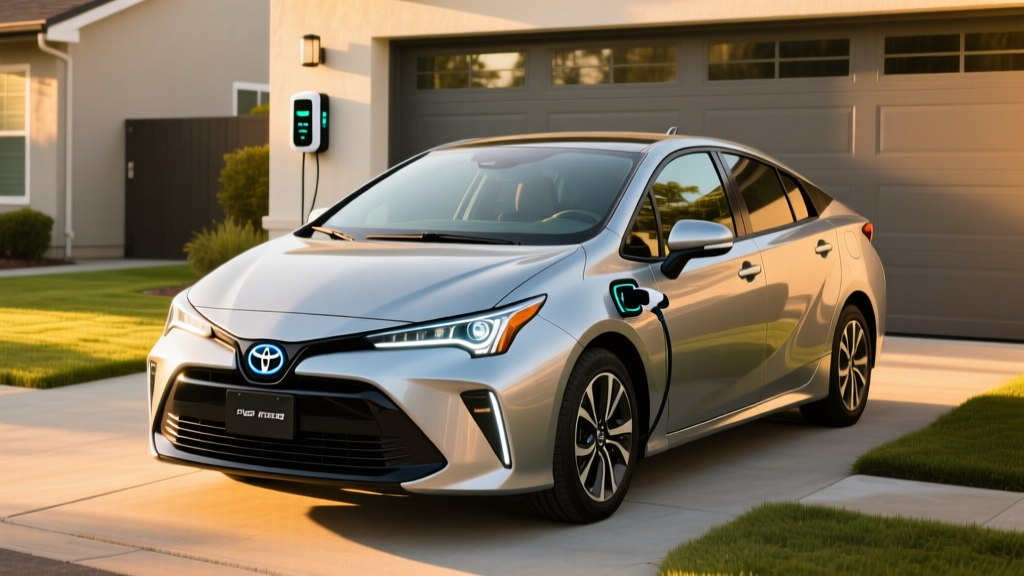
Toyota renamed the Prius Plug-In Hybrid to the Prius Prime starting with the 2023 model year, and the 2025 Prius Prime carries forward the formula that made its predecessor a standout: a genuinely usable electric-only range for daily commuting, a proven hybrid powertrain for longer trips, and a design that no longer looks like an appliance. If you searched for the "2025 Prius plug-in hybrid," this is the vehicle — and it remains one of the most practical bridges between gas and full-electric ownership available today.
For 2025, Toyota offers the Prius Prime in three trims: SE, XSE, and XSE Premium. The SE trim maximizes electric range and efficiency thanks to lighter weight and smaller wheels, while the XSE trims add features at a slight cost to range. Let's get into the numbers that matter.
| Spec | SE Trim | XSE / XSE Premium |
|---|---|---|
| EPA Electric-Only Range | 44 miles | 40 miles |
| Total Combined Range (EV + Gas) | ~440 miles | ~400 miles |
| EPA MPG (Combined / City / Hwy) — Hybrid Mode | 52 / 53 / 51 | 48 / 50 / 47 |
| MPGe (EV Mode) | 127 MPGe | 117 MPGe |
| Battery Capacity (Usable) | 13.6 kWh (Lithium-ion) | |
| Combined System Horsepower | 220 hp | |
| 0–60 mph | ~6.6 seconds | |
| Level 1 (120V) Charge Time | ~11 hours | |
| Level 2 (240V) Charge Time | ~4 hours | |
| DC Fast Charging | Not available | |
| Base MSRP | $33,475 | $36,725 / $40,670 |
| Hybrid Battery Warranty | 10 years / 150,000 miles | |
HEV vs. PHEV: What's the Difference and Why It Matters
Toyota sells two distinct Prius models, and buyers frequently confuse them. Here's the breakdown:
Conventional Prius (HEV — Hybrid Electric Vehicle): Uses a small battery (roughly 1.0 kWh usable) charged entirely by regenerative braking and the gasoline engine. You never plug it in. EPA-rated at 57 MPG combined. Starting MSRP around $28,350.
Prius Prime (PHEV — Plug-In Hybrid Electric Vehicle): Carries a much larger 13.6 kWh battery that you plug in to charge. It can drive up to 44 miles on electricity alone before the gasoline engine activates. Once the battery is depleted, it operates as a conventional hybrid at 52 MPG combined. Starting MSRP around $33,475.
The conventional Prius does not need a plug and cannot drive on electric power alone for meaningful distances. The Prius Prime gives you the best of both worlds — EV commuting during the week, gas-hybrid road trips on the weekend — but costs roughly $5,000 more upfront.
Electric-Only Range: How Far Can the 2025 Prius Prime Go Without Gas?
The EPA rates the 2025 Prius Prime SE at 44 miles of electric-only range, and the XSE trims at 40 miles. That's a meaningful jump from the previous-generation Prime, which topped out around 25 miles.
Real-World Electric Range Expectations: In mild weather (55–75°F) with mixed city/suburban driving, owners consistently report achieving 42–48 miles on a full charge — often meeting or slightly exceeding the EPA estimate. In cold weather (below 32°F), expect that range to drop to roughly 32–38 miles due to cabin heating demands and reduced battery efficiency. At sustained highway speeds above 70 mph, electric range also compresses to approximately 35–38 miles.
For context, the average American one-way commute is roughly 16 miles, according to the U.S. Census Bureau. That means the Prius Prime can cover most daily round-trip commutes entirely on electricity — provided you charge at home overnight.
When the battery depletes, the gasoline engine seamlessly engages and the car continues as a standard hybrid. You'll never be stranded waiting for a charger. Total combined range (electric + a full 11.4-gallon tank) reaches approximately 440 miles in the SE trim.
Fuel Economy Breakdown: Real-World MPG vs. EPA Sticker
Once the electric range is used up, the 2025 Prius Prime operates as a hybrid. Here's the EPA-rated fuel economy according to fueleconomy.gov:
| Trim | City MPG | Highway MPG | Combined MPG | MPGe (EV Mode) |
|---|---|---|---|---|
| SE | 53 | 51 | 52 | 127 |
| XSE | 50 | 47 | 48 | 117 |
| XSE Premium | 50 | 47 | 48 | 117 |
Real-world note: Toyota's hybrid system excels in stop-and-go city driving, where regenerative braking recovers energy constantly. Many owners report exceeding EPA city estimates by 2–4 MPG in urban traffic. Highway driving at 75+ mph tends to return 2–5 MPG below the EPA highway figure, which is typical for all hybrids since the electric motor contributes less at sustained high speeds.
If you charge nightly and have a commute under 40 miles, you may go weeks without visiting a gas station. Owners who plug in regularly report effective "MPG" figures well above 100 MPGe for their combined driving.
Powertrain and Performance: No Longer Slow
The previous-generation Prius Prime was criticized for sluggish acceleration. The 2025 model fixes that emphatically. Toyota's fifth-generation hybrid system pairs a 2.0-liter four-cylinder engine with two motor-generators and a lithium-ion battery pack for a combined system output of 220 horsepower.
The result is a 0–60 mph time of approximately 6.6 seconds — quick enough to merge onto highways confidently and genuinely fun in Sport mode. The CVT (continuously variable transmission) keeps the engine in its efficient power band, though it still drones under hard acceleration, a familiar CVT trait.
The Prius Prime is front-wheel drive only. All-wheel drive is available on the conventional Prius (HEV) but not on the Prime PHEV for 2025.
Charging the 2025 Prius Prime: What You Need to Know
The Prius Prime uses a standard J1772 connector for AC charging. Here's the realistic charging picture:
| Charging Level | Power (kW) | Time to Full (0–100%) | Practical Notes |
|---|---|---|---|
| Level 1 (120V household outlet) | ~1.2 kW | ~11 hours | Works for overnight if you drive <30 mi/day |
| Level 2 (240V home or public) | ~3.5 kW | ~4 hours | Recommended; full charge in a workday or overnight |
| DC Fast Charging | N/A | N/A | Not supported — no DC port |
Key distinction — kW vs. kWh: The battery stores 13.6 kWh of energy (capacity). A Level 2 charger delivers power at roughly 3.5 kW (rate). Dividing capacity by rate gives you the approximate charge time: 13.6 ÷ 3.5 ≈ 3.9 hours.
The lack of DC fast charging is a deliberate engineering trade-off. Adding a DC port would increase cost, weight, and complexity for a battery that's small enough to refill overnight on a standard outlet. For a PHEV with 44 miles of range, this is an acceptable compromise — but it means the Prius Prime is not suited for rapid top-ups on road trips. On longer drives, you'll simply burn gasoline at 52 MPG.
A Level 2 home charger (such as a ChargePoint Home Flex or Emporia Level 2) is strongly recommended. Installation typically costs $500–$1,500 depending on your electrical panel's proximity to the garage, according to industry estimates. A standard 120V outlet works but charges slowly — adequate if your daily driving stays under 30 miles.
Pricing, Trims, and Tax Credit Eligibility
The 2025 Toyota Prius Prime starts at $33,475 (SE trim, including destination). Here's the trim breakdown:
- SE: $33,475 — Best range (44 mi), 17-inch wheels, Toyota Safety Sense 3.0, 8-inch touchscreen
- XSE: $36,725 — 40 mi range, 19-inch wheels, SofTex seats, heated front seats, wireless charging pad
- XSE Premium: $40,670 — 40 mi range, 12.3-inch touchscreen, panoramic fixed glass roof, premium audio, digital rearview mirror
Does the 2025 Prius Prime Qualify for a Federal Tax Credit?
Under current IRS §30D rules, the Prius Prime is eligible for a federal tax credit — but the exact amount depends on your income, the vehicle's battery sourcing compliance, and whether you take the credit at point of sale or on your tax return. The credit can be up to $3,750 for qualifying buyers, based on critical mineral and battery component sourcing requirements that have tightened significantly since 2023.
§30D Federal PHEV Tax Credit Requirements (2025):
- Vehicle MSRP must not exceed $80,000 for SUVs/vans/pickups or $55,000 for sedans — the Prius Prime qualifies (sedan cap)
- Buyer adjusted gross income must not exceed $150,000 (single), $225,000 (head of household), or $300,000 (joint)
- Battery must meet critical mineral and component sourcing thresholds (amount varies; check IRS.gov for current compliance lists)
- Credit is non-refundable — you must have sufficient tax liability to claim it
- Point-of-sale transfer to the dealer is available, reducing your purchase price directly
Important: Tax credit rules and qualifying vehicle lists change frequently. Always verify current eligibility on IRS.gov or consult a tax professional before purchasing. Some states offer additional PHEV rebates — check your state's energy office or AFDC.energy.gov for local incentives.
Reliability and Battery Warranty: What to Expect Long-Term
Toyota's hybrid systems have an exceptional reliability track record spanning over two decades. The Prius line has consistently earned top marks from Consumer Reports and J.D. Power for dependability. The fifth-generation hybrid system in the 2025 Prime is a mature, well-proven architecture.
Hybrid Battery Warranty: Toyota covers the Prius Prime's high-voltage lithium-ion battery for 10 years or 150,000 miles, whichever comes first. This warranty guarantees the battery will retain sufficient capacity for normal operation. For comparison, the federal government mandates a minimum of 8 years / 100,000 miles for PHEV battery warranties — Toyota exceeds this.
How Much Does a Prius Prime Battery Replacement Cost?
Out-of-warranty replacement of the high-voltage battery pack typically costs between $4,000 and $6,500 including labor at a Toyota dealership, based on current parts pricing. However, real-world data from Prius owners suggests that lithium-ion hybrid batteries routinely last well beyond 150,000 miles with gradual capacity loss rather than sudden failure. Many first-generation Prius PHEV batteries (2012–2015) are still in service at over 200,000 miles with reduced but functional electric range.
The 12-volt auxiliary battery (a standard lead-accent or AGM unit) will need replacement every 4–6 years at roughly $200–$350, similar to any conventional vehicle.
Who Should Buy the 2025 Prius Prime — and Who Shouldn't?
Choose the 2025 Prius Prime if:
- Your daily round-trip commute is under 40 miles and you can charge at home
- You want EV-like daily driving without range anxiety on road trips
- You don't have reliable access to DC fast charging infrastructure in your area
- You want to reduce fuel costs significantly without committing to a full BEV
- You value Toyota's long-term reliability and resale value
Consider a full EV (BEV) instead if:
- You have home Level 2 charging and want zero gasoline use
- Your daily driving is consistently under 30 miles and you want the lowest operating cost
- You want access to HOV lanes (varies by state — some states grant lane access only to BEVs)
- You want to eliminate oil changes and engine maintenance entirely
Stick with the conventional Prius (HEV) if:
- You cannot charge at home or at work
- Your budget is tighter and you want to save ~$5,000 upfront
- You drive mostly highway miles where electric range provides minimal benefit
Pros
- 44-mile EV range covers most commutes gas-free
- 52 MPG combined after battery depletion — best-in-class PHEV efficiency
- 220 hp makes it genuinely quick (6.6s to 60)
- 10-year / 150,000-mile battery warranty
- No range anxiety — 440+ total miles of range
- Strong resale value and Toyota reliability
Cons
- No DC fast charging capability
- FWD only — no AWD option on the Prime
- XSE trims sacrifice 4 miles of EV range for larger wheels
- Rear seat and cargo space tighter than compact SUV alternatives
- Federal tax credit amount uncertain due to sourcing rules
- Level 1 charging is slow (11 hours) — Level 2 strongly recommended
Frequently Asked Questions
How many MPG does the 2025 Prius Prime get?
The EPA rates the Prius Prime SE at 52 MPG combined (53 city / 51 highway) once the electric range is depleted. The XSE trims are rated at 48 MPG combined. In real-world city driving, many owners report 54–56 MPG thanks to aggressive regenerative braking. Highway driving at 75+ mph typically returns 46–49 MPG in the SE.
How far can the 2025 Prius Prime go on electric only?
The EPA rates the SE trim at 44 miles of electric-only range and the XSE trims at 40 miles. In mild conditions, real-world results often match or slightly exceed these numbers. In freezing temperatures, expect a 15–25% reduction, bringing effective EV range to roughly 32–38 miles.
Should I buy the Prius Prime PHEV or a full electric vehicle?
If you can charge at home and your commute fits within 44 miles, the Prius Prime gives you electric daily driving with a gasoline safety net for road trips. A full EV (like the Tesla Model 3, Hyundai Ioniq 6, or Chevrolet Equinox EV) offers lower operating costs and zero tailpipe emissions but requires reliable charging access and acceptance of charging stops on long trips. If charging infrastructure in your area is limited, the Prime is the safer choice.
Is the Prius Prime reliable, and what does a battery replacement cost?
Toyota's hybrid systems are among the most proven in the industry, with decades of real-world data supporting their longevity. The high-voltage battery is warranted for 10 years / 150,000 miles. Out-of-warranty replacement runs $4,000–$6,500, though most Prius batteries last well beyond the warranty period with gradual capacity fade rather than catastrophic failure.
Does the 2025 Prius Prime qualify for a federal tax credit?
The Prius Prime may qualify for up to $3,750 under the IRS §30D clean vehicle credit, depending on battery sourcing compliance, your income level, and MSRP caps. The vehicle's MSRP is well under the $55,000 sedan cap. Income limits apply ($150K single / $300K joint). Always check the current qualifying vehicle list on IRS.gov before purchasing, as eligibility can change with updated sourcing rules.
Can the Prius Prime charge at Tesla Superchargers?
No. The Prius Prime uses a J1772 connector for AC charging and has no DC fast-charge port. It cannot use Tesla Superchargers, Electrify America DC stations, or any DC fast-charging network. You charge at home (Level 1 or Level 2) or at public Level 2 stations found at grocery stores, workplaces, and parking garages.
Does the Prius Prime require premium gasoline?
No. The 2025 Prius Prime runs on regular 87-octane unleaded gasoline, keeping fuel costs low.