Quick Verdict: The First Electrified 911 Is a Conventional Hybrid, Not a PHEV
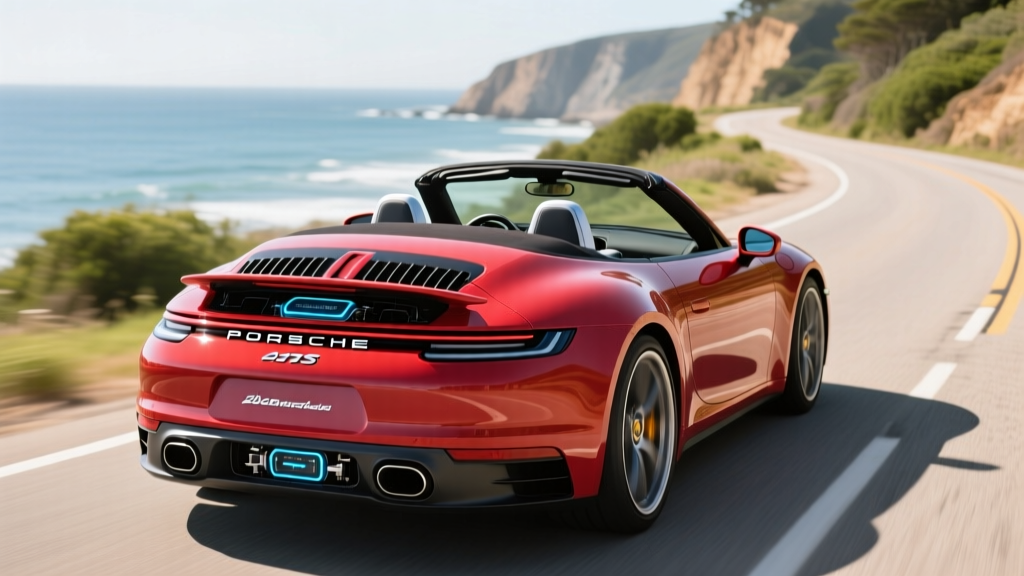
The hybrid-powered 2025 Porsche 911 Carrera GTS Cabriolet marks a watershed moment for Porsche: the first production 911 with an electrified powertrain. But before you search for a charging cable, understand this clearly — the new T-Hybrid system is a conventional hybrid (HEV), not a plug-in hybrid (PHEV). There is no plug, no electric-only driving range, and no home charging setup required. Instead, Porsche uses a compact 1.9 kWh lithium-ion battery and an integrated electric motor to eliminate turbo lag, boost acceleration, and recapture energy under braking.
The result is a 532-horsepower open-top sports car that hits 60 mph in approximately 3.0 seconds while returning measurably better fuel economy than the outgoing pure-gasoline GTS. For buyers researching the hybrid-powered 2025 Porsche 911 Carrera GTS Cabriolet, this guide covers exactly what the T-Hybrid system does, what it doesn't do, and whether it fits your garage.
HEV vs PHEV: Why the 911 GTS T-Hybrid Doesn't Plug In
Conventional Hybrid (HEV) — This Car
- No plug required. The 1.9 kWh battery charges exclusively through regenerative braking and the gasoline engine.
- No electric-only range. The electric motor assists the gas engine but cannot propel the car independently for meaningful distances.
- Purpose: Performance enhancement and efficiency optimization, not zero-emission driving.
Plug-In Hybrid (PHEV) — Not This Car
- Requires Level 1 or Level 2 plug-in charging (typically 8–25 kWh battery).
- Offers 20–50 miles of electric-only range before the gas engine engages.
- May qualify for the federal §30D tax credit (up to $7,500) if MSRP, income, and battery-sourcing requirements are met.
Porsche's decision to go HEV over PHEV in the 992.2-generation 911 is deliberate. A plug-in system with a larger battery pack and onboard charger would add 300–500 pounds — weight that works against the 911's handling DNA. The T-Hybrid system adds roughly 110 pounds compared to the previous GTS, a trade-off Porsche accepted for the performance gains.
Powertrain Deep Dive: 532 HP From a Turbo Six and Electric Motor
| Specification | 2025 Porsche 911 Carrera GTS Cabriolet (T-Hybrid) |
|---|---|
| Combined Output | 532 hp / 465 lb-ft torque |
| Gasoline Engine | 3.6L twin-turbocharged flat-six (new for 992.2 GTS) |
| Electric Motor | Integrated into 8-speed PDK transmission, ~54 hp assist |
| Hybrid Battery | 1.9 kWh lithium-ion (NMC chemistry), located under rear parcel shelf |
| 0–60 mph | ~3.0 seconds (manufacturer estimate) |
| Top Speed | 194 mph |
| Transmission | 8-speed PDK dual-clutch automatic |
| Drivetrain | Rear-wheel drive (AWD available on GTS 4 Cabriolet) |
| Curb Weight | ~3,560 lbs (est.) |
The T-Hybrid's electric motor sits between the engine and the PDK gearbox. Its primary job is torque-fill: while the twin turbos spool up, the electric motor delivers instant torque, effectively erasing the lag that characterized earlier turbocharged 911s. Under hard braking, the motor acts as a generator, sending recaptured energy back into the 1.9 kWh battery. The battery itself is small by PHEV standards — roughly 1/10th the capacity of a Toyota RAV4 Prime — but it's sized for power density, not energy storage.
Fuel Economy: EPA MPG and Real-World Expectations
| Metric | EPA Estimate | Real-World Expectation |
|---|---|---|
| City | ~19–20 MPG | 20–22 MPG (regen assists in stop-and-go) |
| Highway | ~25–27 MPG | 24–26 MPG (less regen benefit at steady speed) |
| Combined | ~21–23 MPG | 20–23 MPG depending on driving style |
Note: Final EPA figures for the 2025 911 Carrera GTS Cabriolet T-Hybrid were pending at the time of writing. Estimates above are based on Porsche's published data, the coupe variant's expected ratings, and fueleconomy.gov patterns for comparable performance hybrids. Check the EPA database for finalized numbers.
Compared to the outgoing 992.1 Carrera GTS (3.0L twin-turbo, no hybrid assist, rated at approximately 18 city / 24 highway / 20 combined), the T-Hybrid system delivers a modest but measurable improvement — roughly 1–3 MPG combined. That's not Prius territory, but for a 532-hp sports car, it's meaningful. The real-world benefit shows up most in city driving, where regenerative braking recaptures energy that would otherwise be lost as brake heat. Expect the hybrid system to shine in urban and canyon-road scenarios; on sustained highway cruising, the advantage narrows.
Pricing, Tax Credits, and the §30D Reality Check
The 2025 Porsche 911 Carrera GTS Cabriolet carries a base MSRP of approximately $164,900 (including destination), with the coupe starting around $153,000. Options, the typical Porsche configurator journey, and dealer allocations push well-equipped examples past $180,000–$200,000.
Does It Qualify for the Federal EV Tax Credit?
No. Under current IRS §30D rules, the federal clean vehicle credit applies only to battery electric vehicles (BEVs) and plug-in hybrid electric vehicles (PHEVs) that meet battery capacity, critical-mineral sourcing, MSRP caps ($55,000 for sedans, $80,000 for SUVs/trucks/vans), and buyer income limits. The 911 Carrera GTS T-Hybrid is a conventional hybrid (HEV) with a 1.9 kWh battery and no plug. It does not qualify for the §30D credit, the point-of-sale transfer, or any federal PHEV incentive.
Some states offer hybrid-specific rebates or HOV lane access for HEVs, but these vary by jurisdiction and change frequently. Check your state's energy or DMV website for current programs.
Battery Warranty, Reliability, and Long-Term Ownership
Hybrid Battery Warranty
Porsche provides a hybrid battery warranty of 8 years / 100,000 miles (whichever comes first), consistent with industry norms for hybrid components. This covers defects and capacity loss below a defined threshold. The 1.9 kWh battery is small, liquid-cooled, and managed by Porsche's thermal system — reducing degradation risk compared to large PHEV/BEV packs that see deeper charge cycles.
The T-Hybrid system adds complexity — an electric motor, power electronics, and a dedicated battery — but Porsche's hybrid lineage (918 Spyder, Panamera E-Hybrid, Cayenne E-Hybrid) spans over a decade. The 918 Spyder's hybrid components have proven robust in long-term ownership, and Porsche's PDK transmission is one of the most battle-tested dual-clutch units in production.
Battery replacement cost: Because the 1.9 kWh pack is compact and purpose-built, out-of-warranty replacement is expected to be significantly less expensive than a full BEV battery swap. Industry estimates for small HEV battery packs in performance applications suggest $2,000–$5,000 for the battery module itself, plus labor. This is a fraction of the $15,000–$25,000 that large BEV or PHEV packs can command. However, official Porsche replacement pricing was not yet published at time of writing.
Maintenance note: The hybrid system does not require separate routine maintenance (no fluid changes specific to the hybrid battery). The regenerative braking system reduces wear on the mechanical brake pads and rotors, potentially lowering long-term brake service costs.
Who Should Choose the 911 GTS T-Hybrid vs. a Full EV or Gas Car?
Choose the Hybrid-Powered 2025 Porsche 911 Carrera GTS Cabriolet If:
- You want a 911 with the sharpest throttle response Porsche has ever delivered to a street car, and the T-Hybrid's torque-fill is the reason.
- You don't have home charging access or don't want to deal with plug-in logistics — this hybrid requires zero behavioral change from a gas car.
- You drive a sports car primarily on weekends, canyon roads, and city streets, where the regen system recovers the most energy.
- You want open-air motoring with modern hybrid efficiency without range anxiety or charging dependency.
Look at a Full EV (e.g., Porsche Taycan, Tesla Roadster) If:
- You have Level 2 home charging and want zero tailpipe emissions for daily driving.
- You want eligibility for the federal §30D tax credit (up to $7,500) and state EV incentives.
- Instant, silent, single-speed torque delivery is your priority over the sound and character of a flat-six.
Stick with a Gas-Only Sports Car If:
- You prioritize the lightest possible curb weight and the simplest mechanical layout (though the 992.2 GTS no longer offers a non-hybrid variant in the US market).
Pros, Cons, and the Bottom Line
Pros
- 532 hp with virtually zero turbo lag — the electric motor's torque-fill transforms throttle response
- No plug-in required; zero lifestyle change from a gas 911
- Improved fuel economy vs. outgoing GTS, especially in city driving
- Reduced brake wear thanks to regenerative braking
- Retains the 911's iconic flat-six sound and open-air Cabriolet experience
- 8-year / 100,000-mile hybrid battery warranty
Cons
- No federal tax credit eligibility — HEV, not PHEV
- Modest MPG gains (~1–3 combined) won't offset the $164,900+ price at the pump
- Added weight (~110 lbs over previous GTS) may be noticeable to track-focused drivers
- Small 1.9 kWh battery means no electric-only creeping in traffic
- High base price; options and allocation markups push well past $180K
- Cabriolet soft-top compromises rear visibility and structural rigidity vs. coupe
Frequently Asked Questions
How many MPG does the hybrid-powered 2025 Porsche 911 Carrera GTS Cabriolet get?
Estimated EPA ratings are approximately 19–20 MPG city, 25–27 MPG highway, and 21–23 MPG combined. Real-world results will vary with driving style; city driving with frequent braking maximizes regenerative energy recovery. Final EPA certification was pending at time of publication — verify at fueleconomy.gov.
How far can the 911 GTS T-Hybrid go on electric only?
It cannot. The T-Hybrid is a conventional hybrid (HEV), not a plug-in hybrid (PHEV). The 1.9 kWh battery and electric motor assist the gasoline engine but do not provide standalone electric-only propulsion for any meaningful distance. There is no EV mode button and no plug.
Hybrid vs PHEV vs EV — which fits my lifestyle?
HEV (this car): Best for buyers who want efficiency gains without any plug-in infrastructure. You fuel up at gas stations, exactly as before.
PHEV: Best for buyers with home charging who want 20–50 miles of daily electric commuting with a gas engine for longer trips.
BEV (full EV): Best for buyers with reliable home/work charging who want zero tailpipe emissions, lower running costs, and eligibility for federal and state EV incentives.
Is the T-Hybrid system reliable, and what does battery replacement cost?
Porsche's hybrid systems have a strong track record from the 918 Spyder and E-Hybrid models. The 1.9 kWh battery is liquid-cooled and shallow-cycled, reducing degradation. The hybrid battery is warrantied for 8 years / 100,000 miles. Out-of-warranty replacement is estimated at $2,000–$5,000 for the battery module — far less than a full BEV pack — though official Porsche pricing was not yet confirmed.
Does the 2025 911 Carrera GTS Cabriolet qualify for any tax credit?
No federal tax credit applies. The IRS §30D clean vehicle credit requires a plug-in vehicle (BEV or PHEV) with a battery capacity of at least 7 kWh, along with MSRP, income, and sourcing requirements. The 911 GTS T-Hybrid has a 1.9 kWh battery and no plug, making it ineligible. Some states may offer minor hybrid incentives — check your state's energy office for details.
Does the T-Hybrid change the 911's driving character?
Subtly but meaningfully. The electric motor's instant torque-fill makes the car feel more responsive at part-throttle and in the initial moment of acceleration. The flat-six still dominates the experience — the sound, the rear-engine weight bias, the steering feedback. The hybrid system is a supporting actor, not the star. Most testers report the car feels like a "better 911," not a "different 911."
Sources: Porsche Newsroom (992.2 911 GTS T-Hybrid announcement), fueleconomy.gov (EPA fuel economy database), IRS §30D Clean Vehicle Credit guidelines.