Quick Verdict: The CX-90 PHEV Bridges Two Worlds
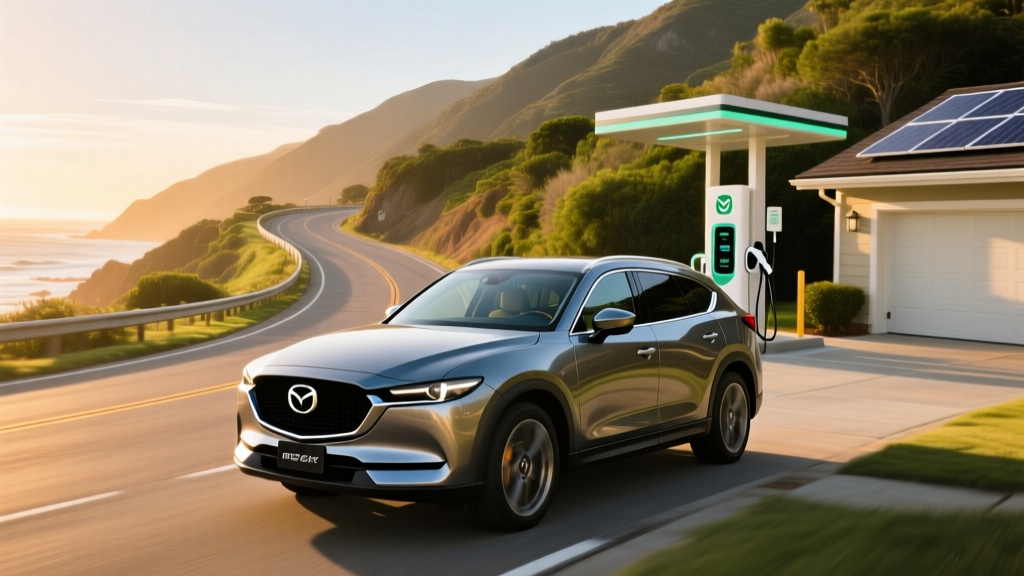
The 2025 Mazda CX-90 PHEV occupies a specific niche: a three-row luxury SUV that lets you commute on electricity and road-trip on gasoline without compromise. With 26 miles of EPA-rated electric-only range, a combined 56 MPGe, and 327 horsepower from its inline-four plug-in hybrid powertrain, it targets buyers who want EV-like daily driving without full battery-electric commitment. Starting at $51,445 (including destination), it undercuts European PHEV rivals while delivering near-luxury interior quality.
But the CX-90 PHEV isn't for everyone. Its 17.8 kWh battery delivers modest electric range compared to rivals like the Toyota RAV4 Prime (42 miles), and DC fast charging is absent. This guide breaks down every number that matters — from real-world MPG to battery warranty — so you can decide if this PHEV fits your garage.
HEV vs PHEV: What's the Difference in the CX-90 Lineup?
Mazda sells the CX-90 with two distinct electrified powertrains. Understanding the difference is critical before you shop.
| Feature | CX-90 Mild-Hybrid (HEV) | CX-90 PHEV |
|---|---|---|
| Powertrain | 3.3L turbo I-6 + 48V mild-hybrid | 2.5L I-4 + electric motor |
| Combined HP | 280 hp / 340 hp (premium) | 327 hp |
| Plug-in capable? | No — self-charging only | Yes — plug in to charge battery |
| Electric-only driving | None (motor assists engine only) | Up to 26 miles EPA |
| Battery size | ~0.5 kWh (48V system) | 17.8 kWh (lithium-ion) |
| EPA combined | 25 MPG | 56 MPGe / 25 MPG (gas-only) |
| Tax credit eligible? | No | Up to $3,750 (§30D, sourcing-dependent) |
The conventional hybrid (HEV) never plugs in — it recovers energy through regenerative braking and uses a small 48-volt system to smooth stop-start and assist acceleration. The PHEV is the focus of this review: it carries a much larger battery, can drive on electricity alone, and must be plugged in to realize its efficiency advantage. If you can't charge at home or work, the PHEV's benefit shrinks significantly.
Powertrain Specs: 327 HP From Four Cylinders and a Motor
| Specification | 2025 Mazda CX-90 PHEV |
|---|---|
| Engine | 2.5L naturally aspirated inline-4 |
| Electric motor | Permanent magnet synchronous (integrated in transmission) |
| Combined output | 327 hp / 369 lb-ft torque |
| Transmission | 8-speed automatic (no torque converter — uses clutch packs) |
| Drivetrain | AWD standard (i-Activ AWD) |
| Battery capacity | 17.8 kWh (total) / ~14.2 kWh usable |
| Battery chemistry | Lithium-ion (NMC) |
| 0–60 mph | ~6.8 seconds (est.) |
| Towing capacity | 3,500 lbs |
| Cargo (behind 3rd row / max) | 14.9 / 75.2 cu ft |
Mazda pairs the 2.5-liter four-cylinder with an electric motor sandwiched inside the 8-speed automatic. Combined output of 327 hp and 369 lb-ft makes this the most powerful CX-90 variant, and the electric motor's instant torque gives strong low-speed thrust. The inline-six mild-hybrid trims feel smoother at highway cruise, but the PHEV wins stoplight-to-stoplight. All-wheel drive is standard across every CX-90 PHEV trim — there's no FWD option.
Electric-Only Range and Total Range: 26 Miles EV, 430+ Miles Combined
EPA electric-only range: 26 miles
EPA combined MPGe: 56 MPGe (electric + gas)
EPA gas-only MPG: 25 combined (24 city / 27 highway)
Total combined range: ~430 miles (full battery + 18.5-gallon tank)
The 26-mile EPA electric range is the CX-90 PHEV's most debated spec. For context, the average American commute is roughly 16 miles one-way, according to FHWA data — so 26 miles covers many round trips entirely on electricity. But if your commute exceeds 30 miles total, or if you run highway speeds in cold weather, expect the gasoline engine to fire up before you reach your destination.
Real-world electric range expectations: In mild weather (55–75°F) with mixed city/suburban driving at speeds under 50 mph, owners report achieving 24–28 miles on a full charge. At sustained highway speeds of 70+ mph, that drops to roughly 18–20 miles. In freezing temperatures (below 32°F), cabin heating and battery efficiency losses can cut electric range to 15–18 miles. The CX-90 PHEV uses a resistive heater for cabin warmth in EV mode, which draws heavily from the battery — unlike some competitors that employ a heat pump for greater efficiency.
Once the battery depletes, the CX-90 operates as a conventional hybrid, blending engine and motor for an EPA-rated 25 MPG combined. In real-world city driving with frequent regenerative braking opportunities, expect 26–28 MPG. Highway cruising at 75 mph yields closer to 23–24 MPG. These figures are respectable for a 5,000-pound three-row SUV, though the Toyota Grand Highlander Hybrid achieves similar numbers without a plug.
Charging: Level 2 Only, No DC Fast Charging
| Charging Level | Power / Voltage | Time (0–100%) | Notes |
|---|---|---|---|
| Level 1 (120V household) | ~1.2 kW | ~14 hours | Emergency/trickle only |
| Level 2 (240V home/public) | Up to 7.2 kW (vehicle-limited) | ~2 hours 30 minutes | Standard J1772 connector |
| DC Fast Charge | Not supported | N/A | No CCS or CHAdeMO port |
The CX-90 PHEV charges exclusively via a J1772 AC port on the driver's side rear quarter panel. The onboard charger accepts up to 7.2 kW on Level 2, meaning a full 0–100% charge takes roughly two and a half hours on a 32-amp or higher Level 2 station. On a standard 120V household outlet (Level 1), a full charge takes approximately 14 hours — adequate for overnight replenishment if you drive under 20 electric miles per day, but slow for heavy EV-mode users.
The lack of DC fast charging is a deliberate engineering choice shared by most PHEVs. The 17.8 kWh battery is small enough that Level 2 replenishes it quickly, and adding DC hardware would increase cost, weight, and packaging complexity. For road trips, this is a non-issue — you simply fill the 18.5-gallon gas tank and drive on. But it means you won't find the CX-90 PHEV at Electrify America or Tesla Supercharger stalls.
Home charging setup cost: Most PHEV owners install a 240V Level 2 home charger. Expect to pay $300–$600 for a quality Level 2 EVSE (ChargePoint Home Flex, Emporia Level 2, or similar) plus $500–$1,500 for electrician installation on a 40- or 50-amp circuit, depending on panel proximity and local permit fees. A 240V outlet in the garage is the single biggest enabler of PHEV ownership satisfaction.
Fuel Economy Breakdown: EPA vs Real-World MPG
| Driving Scenario | EPA Rating | Real-World Expectation |
|---|---|---|
| EV mode — combined | 56 MPGe | 48–58 MPGe (weather/terrain-dependent) |
| Gas-only — city | 24 MPG | 26–28 MPG (regen assists in stop-and-go) |
| Gas-only — highway | 27 MPG | 23–25 MPG (aero drag at 75+ mph) |
| Gas-only — combined | 25 MPG | 24–26 MPG (mixed driving) |
A common PHEV mistake is quoting only the MPGe figure, which blends electric and gasoline operation and can mislead. The 56 MPGe rating applies only when the battery starts fully charged and you drive within the 26-mile electric window. Once the battery depletes, the 25 MPG combined gas-only figure is what you'll see on longer trips. For official EPA data on the CX-90 PHEV, the fueleconomy.gov portal provides the full breakdown.
If 80% of your driving falls within 26 miles and you charge nightly, your annual fuel consumption will be dramatically lower than the gas-only figure suggests. If you regularly drive 60+ miles without charging, the CX-90 PHEV functions as a heavy hybrid and returns mileage comparable to — or slightly below — a conventional midsize SUV due to the extra battery weight (~400 lbs of electrification hardware).
Pricing, Trims, and Tax Credit Eligibility
The 2025 Mazda CX-90 PHEV is offered in three trims, all with standard AWD:
| Trim | MSRP (incl. destination) | Key Features |
|---|---|---|
| Preferred | $51,445 | Leatherette, 10.25" display, power liftgate, 19" wheels |
| Premium | $55,950 | Nappa leather, 12.3" display, heated/ventilated front seats, panoramic roof |
| Premium Plus | $60,450 | Second-row captain's chairs, Nappa quilted leather, 21" wheels, HUD |
Federal §30D Tax Credit — CX-90 PHEV Eligibility (2025 Rules)
- Credit amount: Up to $3,750 (partial credit — critical minerals requirement may not be fully met; battery component sourcing is under review)
- MSRP cap: SUVs must be under $80,000 — all CX-90 PHEV trims qualify
- Buyer income cap: $150,000 single / $225,000 head of household / $300,000 joint (MAGI)
- Point-of-sale transfer: Available — you can apply the credit as a down payment reduction at the dealer, per current IRS guidance
- Battery sourcing: Mazda sources battery cells from suppliers that may not fully meet critical-mineral thresholds for the full $7,500. Verify current eligibility on the IRS qualified vehicles list before purchasing
- State incentives: Vary by jurisdiction — check your state energy office or DSIRE database for local rebates
The CX-90 PHEV's tax credit situation requires careful attention. Unlike some PHEVs that qualify for the full $7,500, the CX-90's battery supply chain means it may earn only the $3,750 battery-component half of the credit, or potentially none at all depending on the current IRS sourcing determination. Always check the IRS qualified plug-in vehicle list before signing paperwork, as eligibility can change with supply-chain updates.
Reliability, Battery Warranty, and Long-Term Costs
Hybrid/PHEV battery warranty: 8 years / 100,000 miles (whichever comes first)
Powertrain warranty: 5 years / 60,000 miles
Bumper-to-bumper: 3 years / 36,000 miles
Battery replacement cost (out of warranty): Estimated $6,000–$9,000 (parts + labor, based on comparable Mazda PHEV packs)
Mazda's 8-year/100,000-mile hybrid battery warranty is federally mandated for emissions-related components in many states and matches the industry standard set by Toyota, Hyundai, and others. The warranty covers capacity loss below a defined threshold (typically 60–70% state of health) as well as complete failure.
PHEV battery degradation in the CX-90's 17.8 kWh pack is expected to be modest. Lithium-ion NMC cells in PHEV applications typically lose 10–15% capacity over 8–10 years of normal use, based on data from similar-size packs in the Toyota RAV4 Prime and Hyundai Tucson PHEV. Because the CX-90 PHEV's battery buffer prevents full 0% or 100% charge states at the cell level, actual degradation should stay within acceptable limits for the vehicle's useful life.
Mazda's overall reliability reputation is strong — the brand consistently ranks in the top third of Consumer Reports and J.D. Power dependability studies. The 2.5-liter naturally aspirated four-cylinder is a proven, low-stress engine with no turbocharger to fail, and the electric motor has far fewer moving parts than a conventional transmission. The most common ownership complaints for the CX-90 generally involve infotainment responsiveness and third-row space, not powertrain issues.
Who Should Choose the CX-90 PHEV vs a Full EV or Gas SUV?
Choose the CX-90 PHEV if:
- You can charge at home (Level 2) and your daily driving is under 30 miles round-trip
- You need three rows and AWD but want to reduce fuel costs on commutes
- You take road trips of 300+ miles regularly and don't want to plan around DC chargers
- You want luxury-adjacent interior quality without paying BMW X5 xDrive50e or Volvo XC90 Recharge pricing
Choose a full EV (e.g., Kia EV9, Tesla Model X) if:
- Your daily driving exceeds 40 miles and you want zero gasoline use
- You have reliable home and workplace charging plus access to DC fast-charging networks
- You want to maximize fuel cost savings and minimize maintenance (no oil changes, fewer brake replacements)
Choose the CX-90 mild-hybrid (gas) if:
- You cannot charge at home or at work
- Your driving is mostly highway/long-distance where the PHEV's electric range provides minimal benefit
- You want a lower purchase price (mild-hybrid trims start around $40,000)
Pros
- 327 hp with strong electric torque — quickest CX-90 variant
- Premium interior materials rivaling entry-level luxury brands
- Standard AWD across all PHEV trims
- 26-mile EV range covers many daily commutes
- 3,500-lb towing capacity with electric assist
- No range anxiety — gas engine covers long trips seamlessly
Cons
- 26-mile EV range trails RAV4 Prime (42 mi) and Tucson PHEV (33 mi)
- No DC fast charging capability
- $51,445 starting price is steep for the Mazda brand
- Third row is tight for adults on longer trips
- Resistive cabin heater reduces EV range significantly in cold weather
- Tax credit limited to $3,750 or possibly $0 depending on sourcing
Frequently Asked Questions
How many MPG does the 2025 Mazda CX-90 PHEV get?
The EPA rates the CX-90 PHEV at 56 MPGe when operating in combined electric and gasoline mode, and 25 MPG combined (24 city / 27 highway) once the battery is depleted and it operates on gasoline alone. In real-world city driving with regenerative braking, expect 26–28 MPG on gas; highway driving at 75+ mph yields 23–25 MPG.
How far can the CX-90 PHEV go on electric only?
The EPA rates it at 26 miles of electric-only range. Real-world results vary: 24–28 miles in mild city driving, 18–20 miles at highway speeds, and as low as 15–18 miles in freezing temperatures due to cabin heating demand and reduced battery efficiency.
Does the 2025 CX-90 PHEV qualify for a federal tax credit?
It may qualify for up to $3,750 under IRS §30D, depending on battery component and critical mineral sourcing requirements. The full $7,500 is unlikely due to supply-chain constraints. Always verify on the IRS qualified vehicles list before purchasing. The credit can be applied at the point of sale as a down payment reduction. Buyer income caps apply ($150K single / $300K joint).
Is the CX-90 PHEV reliable and what does battery replacement cost?
Mazda's hybrid battery is covered by an 8-year/100,000-mile warranty. The 2.5L engine is naturally aspirated and proven, and the electric motor has minimal wear components. Out-of-warranty battery replacement is estimated at $6,000–$9,000 based on comparable PHEV packs. Most PHEV batteries retain 85–90% capacity after 8 years of normal use.
Should I get the CX-90 PHEV or a full EV?
If you can charge at home, drive under 30 miles daily, and take road trips beyond 300 miles without wanting to plan charging stops, the CX-90 PHEV is an excellent bridge. If you want zero gas use, lower maintenance costs, and have access to DC fast charging for road trips, a full EV like the Kia EV9 or Tesla Model X offers greater long-term savings. If you can't charge at home, skip the PHEV and choose the CX-90 mild-hybrid instead.
Does the CX-90 PHEV come with all-wheel drive?
Yes. i-Activ AWD is standard on every CX-90 PHEV trim. There is no front-wheel-drive option.
How long does it take to charge the CX-90 PHEV at home?
On a 240V Level 2 charger (up to 7.2 kW), a full charge takes approximately 2.5 hours. On a standard 120V household outlet (Level 1, ~1.2 kW), a full charge takes roughly 14 hours. Most owners plug in overnight and wake to a full battery every morning.