Quick Verdict: The 2025 Kia Carnival Hybrid SX
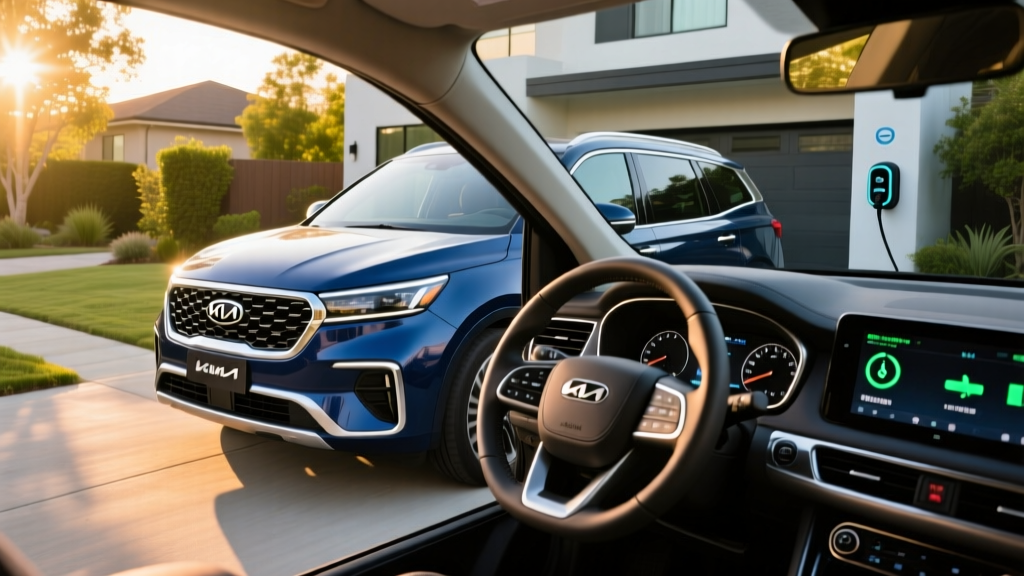
The 2025 Kia Carnival Hybrid SX is the top trim of Kia's refreshed hybrid minivan, pairing a turbocharged 1.6-liter four-cylinder with an electric motor for a combined 242 horsepower and an EPA-estimated 33 MPG combined. Unlike a plug-in hybrid (PHEV), this is a conventional hybrid (HEV) — it never needs to be plugged in and has no electric-only driving range. Instead, it recovers energy through regenerative braking and engine optimization to deliver roughly 40% better fuel economy than a comparable gas-only minivan, without any change to daily driving habits.
For families who want three rows, minivan practicality, and meaningful fuel savings without committing to a fully electric vehicle or managing charging logistics, the Carnival Hybrid SX occupies a practical sweet spot. The SX trim adds premium features like a dual-screen panoramic display, Highway Driving Assist 2, and a power tailgate, pushing the MSRP to approximately $49,900 (including destination). The trade-off: this is not eligible for the federal §30D EV tax credit, because conventional hybrids do not qualify.
HEV vs PHEV: Why the Carnival Hybrid Is a Conventional Hybrid
Before diving into specs, it's essential to understand what the Carnival Hybrid is — and what it is not.
| Feature | Conventional Hybrid (HEV) | Plug-In Hybrid (PHEV) |
|---|---|---|
| Plug-in charging required? | No — refuels with gas only | Yes — plugs in for electric range |
| Electric-only range | None (motor assists engine) | Typically 20–45 miles |
| Battery size | Small (~1.5–2.5 kWh) | Larger (~13–25 kWh) |
| Federal tax credit (§30D) | Not eligible | Up to $7,500 (if eligible) |
| Fuel savings mechanism | Engine assist + regen braking | Electric-only short trips + hybrid |
| Carnival Hybrid? | ✅ Yes — this is an HEV | ❌ Not offered as PHEV |
The Carnival Hybrid uses a compact lithium-ion polymer battery pack (approximately 1.5 kWh) that charges solely through regenerative braking and the gasoline engine. You simply fill up at any gas station, exactly as you would with a conventional car. The electric motor's role is to supplement the turbocharged engine during acceleration, enable brief low-speed electric assist, and smooth out stop-start driving — not to replace the engine for meaningful distances.
Fuel Economy: EPA Ratings and Real-World MPG
| Driving Cycle | EPA Estimate | Real-World Expectation |
|---|---|---|
| City | 34 MPG | 33–37 MPG (hybrids excel in city stop-start) |
| Highway | 31 MPG | 28–32 MPG (less regen benefit at steady speed) |
| Combined | 33 MPG | 30–34 MPG depending on mix and conditions |
How many MPG does the 2025 Kia Carnival Hybrid get? The EPA rates the Carnival Hybrid at 34 city / 31 highway / 33 combined MPG across all trims, including the SX. These figures come from fueleconomy.gov, the official EPA source.
Real-world context: Like most conventional hybrids, the Carnival Hybrid tends to slightly exceed its EPA city rating in urban driving because regenerative braking recaptures energy during frequent stops. Highway driving tells a different story — at sustained 70–80 MPH speeds, the hybrid system provides less benefit, and the minivan's aerodynamic profile and 4,600+ lb curb weight work against efficiency. On a 200-mile highway-heavy road trip, expect closer to 28–30 MPG. In mixed suburban driving with moderate traffic, 33–35 MPG is realistic.
For comparison, the gas-only 2025 Carnival with its 3.5L V6 achieves an EPA-estimated 22 MPG combined — making the hybrid roughly 50% more efficient in combined driving. Over 15,000 miles per year at $3.50/gallon, that's approximately $1,050 in annual fuel savings.
Powertrain, Performance, and Driving Dynamics
| Specification | 2025 Kia Carnival Hybrid SX |
|---|---|
| Engine | 1.6L Turbocharged 4-Cylinder |
| Electric Motor | 47.7 kW (64 hp) permanent-magnet synchronous |
| Combined System Output | 242 hp / 271 lb-ft torque |
| Transmission | 6-Speed Automatic |
| Drivetrain | Front-Wheel Drive |
| 0–60 MPH (est.) | ~8.0 seconds |
| Curb Weight | ~4,700 lbs |
| Towing Capacity | 3,500 lbs (when properly equipped) |
| Fuel Tank | 15.9 gallons |
| Total Range | ~525 miles |
The Carnival Hybrid's powertrain pairs Kia's Smartstream G1.6 turbocharged engine (producing 178 hp on its own) with a 47.7 kW electric motor integrated into the transmission housing. Combined output is 242 horsepower and 271 lb-ft of torque, delivered through a conventional 6-speed automatic transmission — not a CVT, which gives it more natural acceleration feel compared to some hybrid competitors.
Acceleration from 0–60 MPH takes approximately 8.0 seconds, which is adequate for merging and passing but not quick by modern standards. The electric motor provides useful low-end torque fill, making the minivan feel responsive around town. The 6-speed automatic is a deliberate choice by Kia — it avoids the rubber-band sensation of a CVT and delivers familiar shift behavior that most drivers prefer in a family vehicle.
One limitation: the Carnival Hybrid is front-wheel drive only. If you need all-wheel drive for snow or rough conditions, you'll have to look at the Toyota Sienna (AWD available) or the Chrysler Pacifica AWD. Kia does not offer AWD on any Carnival trim, hybrid or gas.
Pricing, Trims, and Tax Credit Eligibility
The 2025 Kia Carnival Hybrid is offered in four trims, with the SX sitting at the top of the lineup:
| Trim | MSRP (incl. destination) | Key Additions Over Prior Trim |
|---|---|---|
| LXS | ~$41,900 | Base hybrid — 8-passenger, dual screens, smart cruise |
| EX | ~$44,500 | Leatherette, power sliding doors, wireless charging |
| SX | ~$47,500 | Premium audio, ventilated front seats, sunroof |
| SX Prestige | ~$51,900 | Nappa leather, 2nd-row VIP lounge seats, head-up display |
Does the 2025 Kia Carnival Hybrid qualify for any tax credit? No. The federal §30D Clean Vehicle Credit applies only to battery electric vehicles (BEVs) and plug-in hybrids (PHEVs) with sufficient battery capacity and qualifying battery sourcing. The Carnival Hybrid is a conventional HEV with a ~1.5 kWh battery — far below the 7 kWh minimum threshold for §30D eligibility. There is no federal tax credit for conventional hybrids.
Some states offer their own incentives for hybrid vehicles, but these are far less common than EV incentives and vary significantly by jurisdiction. Check your state's energy office or department of revenue for current programs. A few utilities offer minor rebates for hybrid purchases, but these are typically $250–$500, not the $7,500 associated with EVs.
The absence of a tax credit means the Carnival Hybrid's value proposition rests entirely on fuel savings and lower operating costs. At current fuel prices, the hybrid premium over the gas Carnival (roughly $2,500–$3,000 depending on trim) pays for itself in approximately 2.5–3 years for a driver covering 15,000 miles annually.
Battery Warranty, Reliability, and Replacement Costs
Hybrid Battery Coverage
- Warranty: 10 years / 100,000 miles (hybrid battery and hybrid system components)
- Powertrain Warranty: 10 years / 100,000 miles
- Bumper-to-Bumper: 5 years / 60,000 miles
- Estimated Battery Replacement Cost: $2,500–$4,000 (after warranty, if needed)
Is the 2025 Kia Carnival Hybrid reliable? Kia's hybrid powertrain has a strong track record since its introduction in the Sorento and Niro. The 1.6T hybrid system is now in its second generation, and Kia backs it with one of the industry's best warranties: 10 years or 100,000 miles on hybrid-specific components including the battery pack, electric motor, and inverter. This matches Hyundai's coverage and exceeds the 8-year/100,000-mile hybrid warranty offered by Toyota.
Conventional hybrid batteries are smaller, less stressed, and typically last longer than EV batteries in terms of calendar years. Real-world data from Kia's earlier hybrid models (Niro, Sorento Hybrid) suggests the battery pack rarely requires replacement within the first 150,000 miles. The compact ~1.5 kWh pack sees shallow charge cycles — it rarely drops below 40% or charges above 80% state of charge — which dramatically reduces degradation compared to a full EV battery.
If replacement is needed after the warranty period, expect to pay $2,500–$4,000 for the hybrid battery pack — a fraction of the $10,000–$20,000+ cost of replacing a full EV battery. Many hybrid owners never face this expense over the vehicle's lifetime.
Who Should Choose the Carnival Hybrid vs a Full EV or Gas Minivan
Choose the Carnival Hybrid if:
- You drive 12,000–20,000 miles per year, mostly in mixed city/suburban conditions
- You want three rows and minivan cargo space without range anxiety on road trips
- You cannot charge at home (apartment, street parking, no garage outlet)
- You want fuel savings without changing your refueling routine
- You frequently tow (3,500-lb capacity) or take long road trips where charging infrastructure is sparse
Choose a Full EV (e.g., Kia EV9, Tesla Model X) if:
- You have reliable Level 2 home charging (240V outlet or installed charger)
- Your daily driving is under 250 miles and road trips are infrequent or well-planned
- You want the lowest per-mile fuel cost (~$0.04–$0.06/mile vs ~$0.11/mile for the hybrid)
- You qualify for the $7,500 federal tax credit, which offsets the EV's higher purchase price
- You prioritize zero tailpipe emissions in your local area
Choose the Gas-Only Carnival if:
- Your annual mileage is under 8,000 miles (fuel savings won't offset the hybrid premium)
- You want the lowest possible purchase price and don't mind 22 MPG combined
- You prefer the V6's slightly higher towing confidence at 3,500 lbs (same rating, but more power reserve)
The Carnival Hybrid makes the most sense for high-mileage families who need minivan space but lack home charging access. The fuel savings compound quickly at 15,000+ miles per year, and there's zero infrastructure dependency. However, if you can install a Level 2 charger at home and your daily routine stays within 200 miles, a three-row EV like the Kia EV9 (EPA range up to 304 miles, eligible for the §30D credit) may offer lower long-term operating costs and a more modern driving experience — at a higher starting price.
Pros and Cons
Pros
- 33 MPG combined — best-in-class for a minivan this size
- No plug-in required — zero change to refueling habits
- 10-year/100,000-mile hybrid battery warranty
- 242 hp provides confident merging and passing
- 6-speed automatic avoids CVT drone
- SX trim is well-equipped with premium features
- ~525 miles of total range on a single tank
Cons
- No federal tax credit eligibility (HEV, not PHEV/BEV)
- FWD only — no AWD option available
- Highway MPG drops to ~28–30 in real-world driving
- SX Prestige pushes past $51,000 — approaching luxury pricing
- Hybrid premium takes ~3 years to recoup at average mileage
- Not as efficient as a PHEV for short electric-only commutes
Frequently Asked Questions
How many MPG does the 2025 Kia Carnival Hybrid get in real-world driving?
The EPA rates it at 34 city / 31 highway / 33 combined. In real-world mixed driving, expect 30–34 MPG depending on your city-to-highway ratio. City-heavy commutes with frequent stops can yield 35+ MPG thanks to aggressive regenerative braking. Sustained highway driving at 75+ MPH typically returns 28–30 MPG.
Does the Carnival Hybrid need to be plugged in?
No. The 2025 Kia Carnival Hybrid is a conventional hybrid (HEV), not a plug-in hybrid. It charges its small battery pack through regenerative braking and the gasoline engine. You refuel it at any gas station, exactly like a standard vehicle. Kia does not currently offer a Carnival PHEV with electric-only range.
Is there a Kia Carnival plug-in hybrid (PHEV) version?
As of the 2025 model year, no. The Carnival is available only as a conventional hybrid or a gas-only V6. If you need a plug-in hybrid minivan with electric-only range, the Chrysler Pacifica PHEV (32 miles electric-only, EPA-estimated) remains the only PHEV option in the minivan segment.
What is the hybrid battery replacement cost?
If the hybrid battery fails after the 10-year/100,000-mile warranty expires, replacement costs are estimated at $2,500–$4,000 including labor. This is significantly less than a full EV battery replacement. In practice, Kia's hybrid batteries in the Niro and Sorento have shown strong longevity, with few reported failures within 150,000 miles.
Does the Carnival Hybrid qualify for the $7,500 federal tax credit?
No. The IRS §30D Clean Vehicle Credit applies only to battery electric vehicles and plug-in hybrids that meet battery capacity, sourcing, MSRP, and buyer income requirements. The Carnival Hybrid is a conventional HEV and does not qualify. Check irs.gov for the latest rules on qualifying vehicles.
How does the Carnival Hybrid compare to the Toyota Sienna Hybrid?
The Toyota Sienna Hybrid is the Carnival's closest competitor and is also a conventional hybrid. The Sienna achieves a slightly higher EPA rating of 36 MPG combined and offers available AWD, but produces only 245 hp from its naturally aspirated 2.5L hybrid system and has a smaller third row. The Carnival Hybrid offers more cargo space, a more powerful turbocharged engine, and a more premium interior at the SX trim level — at the cost of 3 MPG combined and no AWD option.
Can the Carnival Hybrid tow?
Yes. The 2025 Carnival Hybrid is rated to tow up to 3,500 pounds when properly equipped with the factory tow package — the same rating as the gas-only V6 model. This is sufficient for a small boat, utility trailer, or a pair of jet skis, but not a large travel trailer.