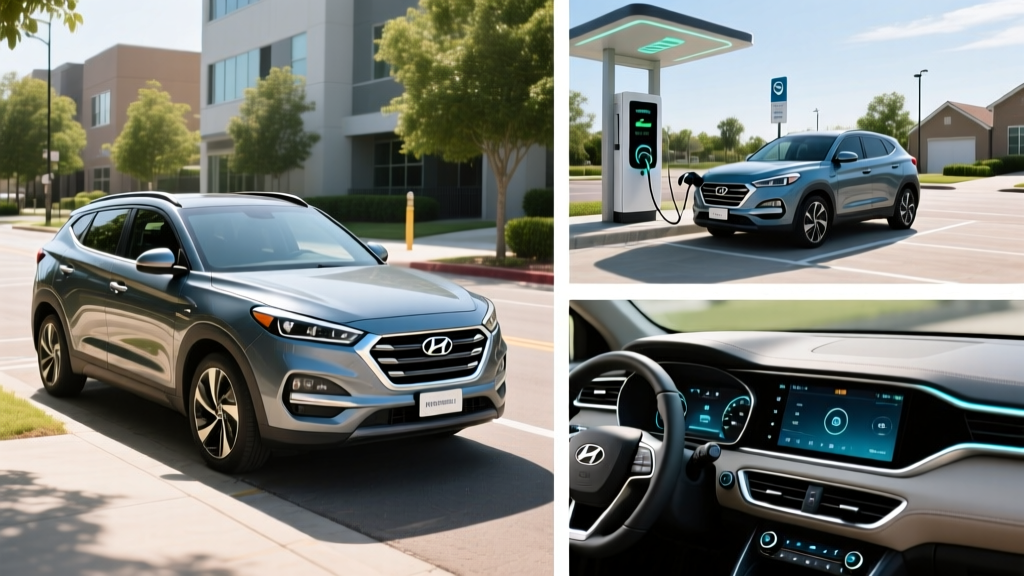
The 2025 Hyundai Tucson Hybrid SEL Convenience occupies a specific niche in the compact crossover segment: it delivers meaningful fuel savings over a gas-only Tucson without requiring a plug, a charging routine, or any change in driving habits. For buyers who want electrified efficiency but lack access to home charging or aren't ready to commit to a full EV, this trim sits in the sweet spot of Hyundai's hybrid lineup — above the base Blue trim in features, below the Limited in price.
This guide breaks down everything you need to know about the 2025 Hyundai Tucson Hybrid SEL Convenience: EPA fuel economy versus real-world MPG, the powertrain under the hood, battery longevity and warranty coverage, pricing, tax credit eligibility, and whether this hybrid — or its PHEV sibling, or a full EV — is the right fit for your garage.
HEV vs. PHEV: Which Tucson Hybrid Are We Talking About?
Hyundai sells the Tucson in three powertrain flavors for 2025: a conventional gas model, a conventional hybrid (HEV), and a plug-in hybrid (PHEV). The SEL Convenience trim is available on the conventional hybrid (HEV) — meaning it does not plug in. It recharges its small battery through regenerative braking and the gasoline engine, just like a Toyota RAV4 Hybrid or Honda CR-V Hybrid.
Tucson HEV vs. Tucson PHEV — Key Differences
| Attribute | Tucson Hybrid (HEV) | Tucson Plug-In Hybrid (PHEV) |
|---|---|---|
| Plugs in? | No | Yes (Level 1/Level 2) |
| Electric-only range | N/A | ~33 miles EPA |
| Battery capacity | ~1.49 kWh (small buffer) | 13.8 kWh usable |
| Combined horsepower | 231 hp | 261 hp |
| Combined MPG / MPGe | 38 MPG (EPA) | 80 MPGe (elec) / 35 MPG (gas) |
| DC fast charging | N/A | No (AC only, ~2 hrs L2) |
| Federal tax credit (§30D) | Not eligible | Up to $7,500 (subject to eligibility) |
If you're reading this for the SEL Convenience specifically, you're looking at the HEV column. The PHEV is offered in SEL Convenience and Limited trims as well, but with different pricing and powertrain specs.
Fuel Economy: EPA Ratings and Real-World MPG
The 2025 Hyundai Tucson Hybrid with AWD (standard on all hybrid trims) carries an EPA-estimated 38 MPG combined, broken down as:
| Cycle | EPA MPG |
|---|---|
| City | 38 MPG |
| Highway | 38 MPG |
| Combined | 38 MPG |
Real-World MPG: What Owners Actually See
The Tucson Hybrid's flat city/highway EPA split is a hallmark of Hyundai's hybrid system, which leans heavily on its electric motor at low speeds. In real-world driving, expect some variance:
- City/suburban driving (under 45 mph): Many owners report 39–42 MPG in stop-and-go traffic, where regenerative braking and electric-motor assist shine. Hybrids often exceed their EPA city estimate in these conditions.
- Highway cruising (70–80 mph): Expect 34–37 MPG. At sustained high speeds, the gasoline engine does most of the work, and the hybrid advantage narrows. Aerodynamic drag on a crossover body also works against efficiency.
- Cold weather (below 30°F): Plan for a 10–15% reduction, putting you in the 32–35 MPG range. The engine runs more frequently to heat the cabin and maintain battery temperature.
- Mountainous terrain: Uphill segments will drop instantaneous MPG into the mid-20s, but regenerative braking on descents partially recovers that energy.
Over a 15,000-mile/year driving schedule at a national average of $3.50/gallon, the Tucson Hybrid's 38 MPG combined saves roughly $600–$800 annually versus the gas-only Tucson AWD (26 MPG combined). Over five years, that's $3,000–$4,000 in fuel savings — a meaningful offset to the hybrid's higher sticker price.
Powertrain Specs: What's Under the Hood
| Specification | 2025 Tucson Hybrid SEL Convenience |
|---|---|
| Engine | 1.6L turbocharged 4-cylinder |
| Electric motor | 44.2 kW permanent-magnet synchronous |
| Combined system output | 231 hp / 271 lb-ft torque |
| Transmission | 6-speed automatic |
| Drivetrain | HTRAC AWD (standard) |
| 0–60 mph | ~7.1 seconds |
| Towing capacity | 2,000 lbs |
| Fuel tank | 13.7 gallons |
| Total range (est.) | ~520 miles |
| Hybrid battery | ~1.49 kWh lithium-ion polymer |
| Cargo volume | 38.7 cu ft (rear seats up) |
The 231-horsepower combined output puts the Tucson Hybrid ahead of the Toyota RAV4 Hybrid (219 hp) and in line with the Honda CR-V Hybrid (204 hp). The turbocharged 1.6L engine provides strong low-end torque, and the 6-speed automatic avoids the "drone" effect some drivers dislike in CVT-equipped competitors. The electric motor fills in torque gaps during acceleration, making the Tucson Hybrid feel punchy around town — particularly in the 0–30 mph range where the motor contributes maximum assist.
Pricing: 2025 Tucson Hybrid SEL Convenience MSRP
For the 2025 model year, the Tucson Hybrid SEL Convenience carries a starting MSRP of approximately $37,715 (including destination charge). This positions it between the Blue trim (~$34,565) and the Limited (~$41,915).
What the SEL Convenience adds over the Blue trim:
- Hands-free smart power liftgate
- SynTex (synthetic leather) seating surfaces
- Heated front seats and heated steering wheel
- Dual-zone automatic climate control
- Wireless phone charging pad
- Hyundai Digital Key (phone-as-key)
- 10.25-inch digital instrument cluster + 10.25-inch infotainment with navigation
- Highway Drive Assist (HDA) — adaptive cruise with lane centering
Does the Tucson Hybrid Qualify for a Federal Tax Credit?
No. The conventional Tucson Hybrid (HEV) does not qualify for the federal §30D Clean Vehicle Credit. That credit applies only to plug-in electric vehicles (BEVs and PHEVs) that meet battery sourcing, MSRP caps, and buyer income limits as defined by the IRS.
If you want a Tucson with tax credit potential, the Tucson Plug-In Hybrid may qualify for up to $7,500 under §30D — but eligibility depends on your adjusted gross income (capped at $150,000 single / $300,000 joint), the vehicle's MSRP (must not exceed $80,000 for SUVs), and critical-mineral/battery-component sourcing requirements that change annually. Consult a tax professional and check the latest IRS guidance before counting on the credit.
Some states and utilities offer their own rebates for conventional hybrids, though these are less common than EV/PHEV incentives. Check your state energy office or local utility for current programs.
Battery Longevity, Warranty, and Replacement Cost
Hyundai Hybrid Battery Warranty
Coverage: 10 years / 100,000 miles (whichever comes first)
What's covered: Hybrid battery pack and hybrid system components (inverter, motor, generator)
Applies to: Original owner; transfers to 5 years / 60,000 miles for second owners
The 10-year/100,000-mile hybrid battery warranty is one of the strongest in the segment, matching Toyota's coverage and exceeding the 8-year/100,000-mile federal minimum for hybrid battery systems.
How Long Will the Hybrid Battery Last?
The Tucson Hybrid's ~1.49 kWh battery is small and operates in a narrow state-of-charge window — typically between 40% and 80% — which dramatically reduces stress on the cells. Hyundai's hybrid system never fully charges or fully depletes the battery, a design choice that prioritizes longevity over electric-only range (which is minimal in a conventional hybrid anyway).
Based on data from Hyundai's earlier hybrid models (Ioniq Hybrid, Sonata Hybrid) and comparable Toyota systems, expect the Tucson Hybrid battery to last 150,000–200,000+ miles before significant degradation. Many Toyota hybrid batteries from the early 2000s are still in service past 200,000 miles.
Battery Replacement Cost
If the hybrid battery does fail outside warranty, replacement costs for Hyundai's conventional hybrid systems typically fall in the $2,000–$4,000 range (parts and labor). This is substantially less than a full EV battery replacement because the pack is small. Individual module replacement (if supported) can bring the cost lower. Given the generous warranty and the battery's conservative operating window, out-of-pocket replacement is an unlikely scenario for most owners.
Tucson Hybrid vs. PHEV vs. Full EV: Which Fits Your Life?
Choose the Tucson Hybrid (HEV) If:
- You don't have access to home or workplace charging
- You want better MPG without changing any habits
- Your budget is under ~$40K
- You drive 12,000–18,000 miles/year in mixed city/highway
- You want AWD for snow/rain without a range penalty
- You plan to own the vehicle 8+ years (warranty peace of mind)
Choose the Tucson PHEV If:
- You can charge at home (Level 1 or Level 2)
- Your daily commute is under 30 miles round-trip
- You want electric-only driving most days but gas flexibility for road trips
- You may qualify for the $7,500 federal tax credit
- You're willing to pay ~$3,000–$4,000 more upfront
Choose a Full EV (e.g., Ioniq 5) If:
- You have reliable home Level 2 charging
- You want zero tailpipe emissions and minimal maintenance
- You drive under 300 miles/day (covers 95%+ of US drivers)
- You want the lowest per-mile fuel cost (~$0.04–$0.06/mi on home electricity)
- You qualify for federal/state EV incentives
Real-World Ownership Considerations
Beyond MPG and MSRP, here's what living with the 2025 Tucson Hybrid SEL Convenience actually looks like:
Maintenance: Hyundai recommends oil changes every 7,500 miles (conventional oil) or 10,000 miles (synthetic). The hybrid system adds virtually no maintenance — there's no hybrid-specific fluid to change, and regenerative braking extends brake pad life significantly (many hybrid owners report 60,000+ miles on original pads).
Insurance: Expect insurance premiums roughly in line with the gas Tucson — hybrids typically carry a 3–5% insurance premium over their gas counterparts, far less than full EVs. Get a quote before purchasing to confirm.
Depreciation: Hyundai hybrids have held value well in recent years as fuel prices remain volatile and buyers seek efficiency without range anxiety. The Tucson Hybrid's strong warranty also supports resale value for second owners (5yr/60K transferable coverage).
Driving feel: The 6-speed automatic is a deliberate choice over a CVT, and it shows — shifts are perceptible and the engine doesn't drone under acceleration. HTRAC AWD provides confident grip in wet and snowy conditions. The trade-off is a slightly firmer ride than some competitors, especially on 19-inch wheels standard on higher trims.
Frequently Asked Questions
How many MPG does the 2025 Hyundai Tucson Hybrid get?
The EPA rates the 2025 Tucson Hybrid AWD at 38 MPG city / 38 MPG highway / 38 MPG combined. In real-world city driving with frequent stops, many owners see 39–42 MPG. Highway driving at 75+ mph typically yields 34–37 MPG. Cold weather reduces efficiency by roughly 10–15%.
Does the Tucson Hybrid need to be plugged in?
No. The Tucson Hybrid (HEV) is a conventional hybrid — it charges its battery through regenerative braking and the gasoline engine. You simply fill it with gas like any other car. If you want a Tucson that plugs in, you're looking for the Tucson Plug-In Hybrid (PHEV), which is a separate model with a larger battery and ~33 miles of electric-only range.
Is the 2025 Tucson Hybrid reliable?
Hyundai's hybrid powertrain has proven reliable across the Ioniq, Sonata, and Tucson lines. The 10-year/100,000-mile hybrid battery warranty is among the best in the industry. Hyundai as a brand has climbed in J.D. Power Vehicle Dependability rankings in recent years. The conventional hybrid system is mechanically simpler than a PHEV or full EV — fewer high-voltage components means fewer potential failure points.
What does it cost to replace the Tucson Hybrid battery?
Out-of-warranty replacement for the Tucson Hybrid's ~1.49 kWh battery pack typically runs $2,000–$4,000 including labor. However, with Hyundai's 10-year/100,000-mile warranty and the battery's conservative charge-window management, most owners will never face this expense. Individual module repair may be possible at lower cost.
Does the 2025 Tucson Hybrid qualify for any tax credits?
The conventional Tucson Hybrid (HEV) does not qualify for the federal §30D Clean Vehicle Credit — that credit is reserved for plug-in vehicles (BEVs and PHEVs). Some states and utilities offer smaller hybrid rebates, but these vary widely. The Tucson Plug-In Hybrid may qualify for up to $7,500 federally, subject to income limits, MSRP caps, and battery-sourcing requirements. Check IRS.gov for current eligibility rules.
How does the Tucson Hybrid compare to the RAV4 Hybrid and CR-V Hybrid?
The Tucson Hybrid's 231 hp exceeds both the RAV4 Hybrid (219 hp) and CR-V Hybrid (204 hp). Its 38 MPG combined is competitive — the RAV4 Hybrid AWD rates at 39–41 MPG depending on trim, and the CR-V Hybrid AWD at 40 MPG. The Tucson's advantages are its longer warranty (10yr/100K vs. Toyota's 10yr/150K hybrid battery but 8yr/100K in some states), more standard tech features on mid-level trims, and a traditional 6-speed automatic that some drivers prefer over the CVTs in both Japanese competitors.