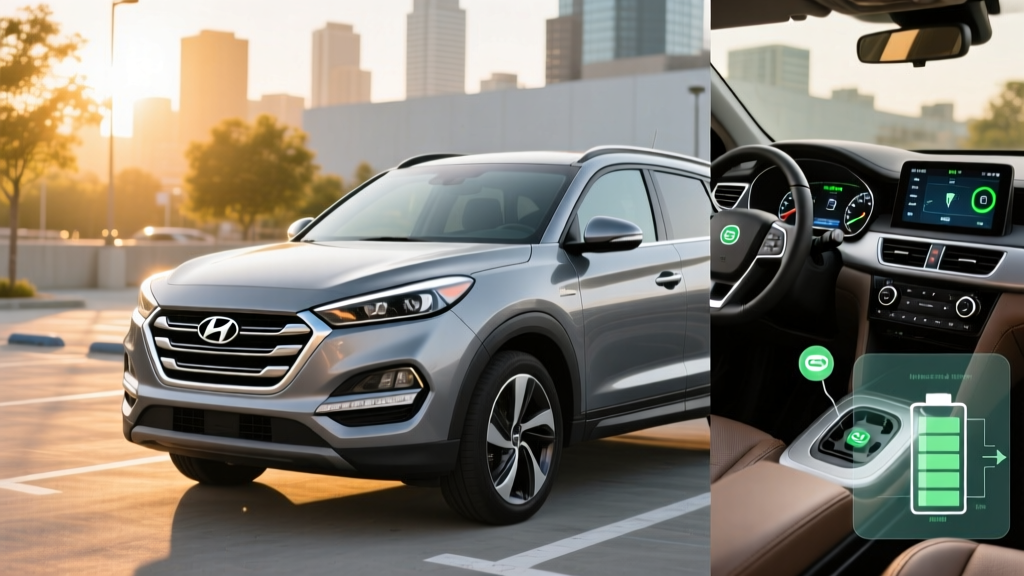
The Hyundai Tucson Hybrid occupies a pragmatic middle ground for compact SUV buyers who want meaningful fuel savings without range anxiety or the need for home charging infrastructure. For 2025, Hyundai continues to offer the Tucson in both a conventional hybrid (HEV) and a plug-in hybrid (PHEV) variant, each with distinct trade-offs in price, efficiency, and daily usability. This guide breaks down the exact 2025 Hyundai Tucson Hybrid price across every trim, real-world MPG expectations, powertrain specs, and whether the PHEV's federal tax credit eligibility changes the math for your household.
2025 Hyundai Tucson Hybrid Price by Trim
The conventional Tucson Hybrid (HEV) is available in three trims for 2025. Pricing below reflects MSRP before destination charges (approximately $1,395) and before any dealer adjustments.
| Trim | MSRP | Key Additions |
|---|---|---|
| Blue | $33,465 | Base hybrid, 18" wheels, best MPG |
| SEL Convenience | $35,715 | Panoramic sunroof, leather seats, power liftgate |
| Limited | $39,615 | HUD, ventilated front seats, Highway Driving Assist 2 |
The Tucson PHEV (plug-in hybrid) is offered in two trims and carries a significant price premium, offset partially by its eligibility for a federal tax credit:
| Trim | MSRP | Federal Credit Eligibility |
|---|---|---|
| SEL Convenience | $40,275 | Up to $3,750 (§30D) |
| Limited | $45,635 | Up to $3,750 (§30D) |
Destination charges add approximately $1,395 to all trims. The HEV does not qualify for the federal §30D new clean vehicle credit because it lacks the minimum battery capacity and plug-in capability required by the IRS. Some states may offer additional rebates for PHEVs — check your state energy office or AFDC state incentive database for current programs.
HEV vs PHEV: Which Tucson Hybrid Fits Your Driving?
Conventional Hybrid (HEV): Generates its own electricity through regenerative braking and the gasoline engine. You never plug it in. The 1.49 kWh battery is small and serves as a buffer for stop-and-go efficiency gains. Think of it as a gas car that's simply more efficient.
Plug-In Hybrid (PHEV): Carries a larger 13.8 kWh battery that you charge via a standard outlet or Level 2 charger. It delivers approximately 33 miles of electric-only driving before the gasoline engine engages, functioning as a conventional hybrid afterward. Ideal if most daily trips fall under 30 miles and you have reliable home charging.
| Attribute | Tucson HEV | Tucson PHEV |
|---|---|---|
| Needs plug-in charging? | No | Yes (for EV range) |
| Battery capacity | 1.49 kWh | 13.8 kWh |
| Electric-only range | N/A | 33 miles (EPA) |
| Combined HP | 226 hp | 261 hp |
| EPA combined MPG | 38 MPG (Blue) | 80 MPGe (EV+gas) / 35 MPG (gas-only) |
| Starting MSRP | $33,465 | $40,275 |
| Federal tax credit | None | Up to $3,750 |
| DC fast charging | N/A | No (Level 1/2 only) |
Fuel Economy: EPA Ratings and Real-World MPG
The 2025 Tucson Hybrid Blue trim carries the highest EPA rating in the lineup, thanks to its lighter 18-inch wheels and aerodynamic tuning. Higher HEV trims (SEL Convenience, Limited) sacrifice 1-2 MPG due to larger 19-inch wheels and added weight from premium features.
| Trim | City | Highway | Combined |
|---|---|---|---|
| Blue (HEV) | 38 MPG | 38 MPG | 38 MPG |
| SEL Convenience (HEV) | 37 MPG | 36 MPG | 37 MPG |
| Limited (HEV) | 37 MPG | 36 MPG | 37 MPG |
| PHEV (all trims, gas-only) | 35 MPG | 35 MPG | 35 MPG |
| PHEV (EV mode) | 80 MPGe combined / 33 mi range | ||
Real-world MPG note: Hyundai's hybrid system, like Toyota's, tends to deliver its best numbers in city driving where regenerative braking and electric-motor assist dominate. Expect to see 39-41 MPG in stop-and-go urban commutes in the Blue trim. Highway cruising at 75+ MPH typically drops to 33-35 MPG as the gasoline engine carries a greater share of the load. In cold weather (below 35°F), anticipate a 5-8% reduction across the board as the engine runs longer to heat the cabin and the battery operates less efficiently. Data from fueleconomy.gov confirms these EPA figures.
For the PHEV, the 33-mile electric range assumes moderate temperatures and speeds under 65 MPH. In practice, expect 28-30 miles of EV range in mixed driving, and as low as 22-25 miles in freezing temperatures with the heater running. Once the battery is depleted, the PHEV operates as a conventional hybrid at approximately 35 MPG combined.
Powertrain and Performance Specs
Both Tucson hybrid variants share Hyundai's Smartstream 1.6-liter turbocharged four-cylinder engine, paired with an electric motor integrated into a 6-speed automatic transmission. Unlike some competitors using CVTs, Hyundai's conventional automatic delivers more natural shift feel and stronger highway passing response.
| Specification | HEV | PHEV |
|---|---|---|
| Engine | 1.6L turbo I4 | 1.6L turbo I4 |
| Engine output | 178 hp / 195 lb-ft | 178 hp / 195 lb-ft |
| Electric motor | 47.7 kW (64 hp) | 74.2 kW (99 hp) |
| Combined system output | 226 hp / 258 lb-ft | 261 hp / 258 lb-ft |
| Transmission | 6-speed automatic | 6-speed automatic |
| Drivetrain | AWD (HTRAC) | AWD (HTRAC) |
| 0-60 MPH (est.) | ~7.1 sec | ~6.5 sec |
| Towing capacity | 2,000 lbs | 2,000 lbs |
| Fuel tank | 13.7 gal | 11.1 gal |
| Total range (est.) | ~520 miles | ~420 mi (gas) + 33 mi (EV) |
The PHEV's larger electric motor and higher combined output give it a noticeably quicker launch from stops and more confident merging acceleration. Both models come standard with HTRAC all-wheel drive, which uses the rear-mounted electric motor to provide rear-axle torque without a mechanical driveshaft — a packaging advantage that preserves cargo space.
PHEV Charging: What You Need to Know
The Tucson PHEV's 13.8 kWh battery charges exclusively via AC power. There is no DC fast-charging capability, which is typical for PHEVs in this segment.
| Charging Method | Power | 0-100% Time | Miles Added per Hour |
|---|---|---|---|
| Level 1 (120V household) | ~1.4 kW | ~10 hours | ~3 mi/hr |
| Level 2 (240V, 32A) | ~7.2 kW | ~2 hours | ~16 mi/hr |
Most PHEV owners find overnight Level 1 charging sufficient to replenish the 33-mile range each morning. However, a Level 2 home charger (240V) is worthwhile if you make multiple short trips per day and want to recharge between outings, or if you want to maximize EV-mode driving. Installation of a Level 2 circuit typically costs $500-$1,500 depending on your electrical panel's proximity to the parking spot and whether a panel upgrade is needed — consult a licensed electrician for your specific situation.
The PHEV uses a standard J1772 connector for AC charging. No CCS or NACS adapter is required, as these are DC fast-charging standards irrelevant to PHEV charging.
Battery Warranty, Reliability, and Replacement Costs
Hybrid Battery Warranty: Hyundai covers the Tucson Hybrid and PHEV high-voltage battery for 10 years / 100,000 miles (whichever comes first) in all 50 states. This is among the longest hybrid battery warranties in the segment. If battery capacity falls below a defined threshold (typically 70% state of health) within the warranty period, Hyundai will repair or replace the battery at no cost.
Hybrid System Warranty: The hybrid system components (inverter, electric motor, control unit) are covered for 10 years / 100,000 miles as well.
Standard Vehicle Warranty: 5 years / 60,000 miles bumper-to-bumper; 10 years / 100,000 miles powertrain.
Reliability outlook: Hyundai's hybrid powertrain has been in production across multiple models (Ioniq, Sonata, Tucson) since 2017, providing a substantial track record. The 1.6L turbo engine and 6-speed automatic are conventional components with well-understood failure modes. The HEV's small 1.49 kWh battery operates under minimal stress compared to a full EV battery, contributing to long service life. The PHEV's 13.8 kWh pack experiences deeper cycling but remains well within Hyundai's thermal management design parameters.
Out-of-warranty replacement cost: If the high-voltage battery requires replacement after the warranty expires, expect approximately $2,500-$4,000 for the HEV battery and $5,000-$8,000 for the PHEV battery (parts and labor). These figures are based on current Hyundai hybrid battery pricing and may fluctuate. Independent hybrid battery shops and refurbished options can reduce this cost by 30-50%.
For reliability data, the IIHS has evaluated the Tucson for crash safety. Check their ratings for the latest model-year assessment.
Federal Tax Credit Eligibility for the Tucson PHEV
The conventional Tucson HEV does not qualify for any federal purchase incentive under IRS §30D, as it lacks the plug-in capability and minimum 7 kWh battery capacity required.
The Tucson PHEV may qualify for a partial federal tax credit. Under current IRS §30D rules, eligibility depends on multiple factors:
- Credit amount: Up to $3,750 for the Tucson PHEV (partial credit; the full $7,500 requires meeting both critical minerals AND battery component sourcing requirements, and the Tucson PHEV currently meets one of the two).
- MSRP cap: The Tucson PHEV must have an MSRP at or below $80,000 (SUV classification). All trims qualify.
- Buyer income cap: Modified adjusted gross income must not exceed $150,000 (single), $225,000 (head of household), or $300,000 (joint filing).
- Point-of-sale transfer: As of 2024, you can transfer the credit to the dealer at purchase, reducing the vehicle price upfront rather than waiting for a tax refund. Confirm dealer participation.
- Battery sourcing requirements: Critical mineral and battery component sourcing rules tighten annually. Verify current-year compliance on the IRS clean vehicle credit page or with your dealer before purchase.
Tax credit rules are subject to change. Always confirm eligibility with a qualified tax professional and consult the official IRS guidance for the tax year in which you take delivery.
Who Should Choose the Tucson Hybrid, PHEV, or a Full EV?
Tucson HEV Pros
- No plug-in charging required — works for apartment/condo dwellers
- 38 MPG combined cuts fuel costs ~40% vs gas-only Tucson (26 MPG)
- Lower starting price ($33,465) than PHEV or comparable EVs
- Strong 10-year hybrid battery warranty
- AWD standard on all trims
Tucson HEV Cons
- No federal tax credit eligibility
- Cannot drive on electric power alone at meaningful speeds
- Fuel savings vs gas Tucson take ~5-6 years to offset the hybrid price premium
- Highway MPG (36) is less impressive than city MPG (38)
Tucson PHEV Pros
- 33-mile EV range covers most daily commutes gas-free
- Up to $3,750 federal tax credit reduces effective price
- 261 hp combined — quickest Tucson variant
- Gas engine eliminates range anxiety on road trips
- Level 1 overnight charging is sufficient for most owners
Tucson PHEV Cons
- $6,810 price premium over HEV Blue (before credit)
- No DC fast charging — irrelevant for PHEV use but limits flexibility
- Smaller fuel tank (11.1 gal) reduces total gas-only range
- EV range drops to ~22-25 miles in freezing weather
- Tax credit eligibility depends on income and sourcing rules
Choose the Tucson HEV if: You don't have access to home or workplace charging, your budget prioritizes lowest purchase price, or you drive long highway routes where hybrid advantages diminish. It's also the right call if you want fuel savings without any behavioral changes — just fill up and drive.
Choose the Tucson PHEV if: You have reliable Level 1 or Level 2 charging at home, your daily round-trip commute is under 30 miles, you qualify for the federal tax credit (bringing the effective price gap to ~$3,000 vs the HEV), and you want EV-like daily driving with gas-engine backup for road trips.
Choose a full EV (like the Ioniq 5) if: You have home Level 2 charging, your daily driving exceeds 30 miles, you want to eliminate gasoline entirely, and you qualify for the full $7,500 federal credit. A full EV offers lower per-mile fuel costs and less maintenance, but requires confidence in public charging infrastructure for longer trips.
Frequently Asked Questions
How many MPG does the 2025 Hyundai Tucson Hybrid get?
The Tucson Hybrid Blue trim achieves an EPA-estimated 38 MPG city, 38 MPG highway, and 38 MPG combined. SEL Convenience and Limited trims rate at 37/36/37 MPG. In real-world city driving, many owners report 39-41 MPG thanks to regenerative braking. Highway driving at 75+ MPH typically yields 33-35 MPG.
How far can the Tucson PHEV go on electric only?
The EPA rates the 2025 Tucson PHEV at 33 miles of electric-only range. Real-world results vary: expect 28-30 miles in moderate temperatures with mixed speeds, and 22-25 miles in cold weather with cabin heating active. Once the battery depletes, the PHEV operates as a conventional hybrid at 35 MPG combined.
Does the Tucson Hybrid need to be plugged in?
No. The conventional Tucson HEV charges its small 1.49 kWh battery through regenerative braking and the gasoline engine. You never plug it in. Only the Tucson PHEV requires plug-in charging to access its electric-only driving range.
Is the Tucson Hybrid reliable and what does battery replacement cost?
Hyundai's hybrid system has been in production since 2017 across multiple models. The Tucson Hybrid and PHEV batteries are covered by a 10-year/100,000-mile warranty. Out-of-warranty replacement costs approximately $2,500-$4,000 for the HEV battery and $5,000-$8,000 for the PHEV battery, though refurbished options are available at lower cost.
Does the 2025 Tucson Hybrid qualify for any tax credit?
The conventional HEV does not qualify for any federal tax credit. The Tucson PHEV may qualify for up to $3,750 under IRS §30D, subject to buyer income limits ($150K single / $300K joint), MSRP caps (under $80K), and battery sourcing requirements that change annually. Confirm eligibility on the IRS website and with a tax professional before purchase.
Can the Tucson PHEV DC fast charge?
No. The Tucson PHEV charges only via AC power (Level 1 at 120V or Level 2 at 240V). This is standard for plug-in hybrids in this class. A full charge on Level 2 takes approximately 2 hours. DC fast-charging capability (CCS or NACS) is not included and is unnecessary given the small battery size.
What's the total driving range of the Tucson Hybrid?
The HEV Blue trim, with its 13.7-gallon fuel tank and 38 MPG combined rating, delivers approximately 520 miles of total range. The PHEV offers roughly 420 miles on gasoline (11.1-gallon tank at 35 MPG) plus 33 miles of electric range, for a combined total of approximately 450 miles.