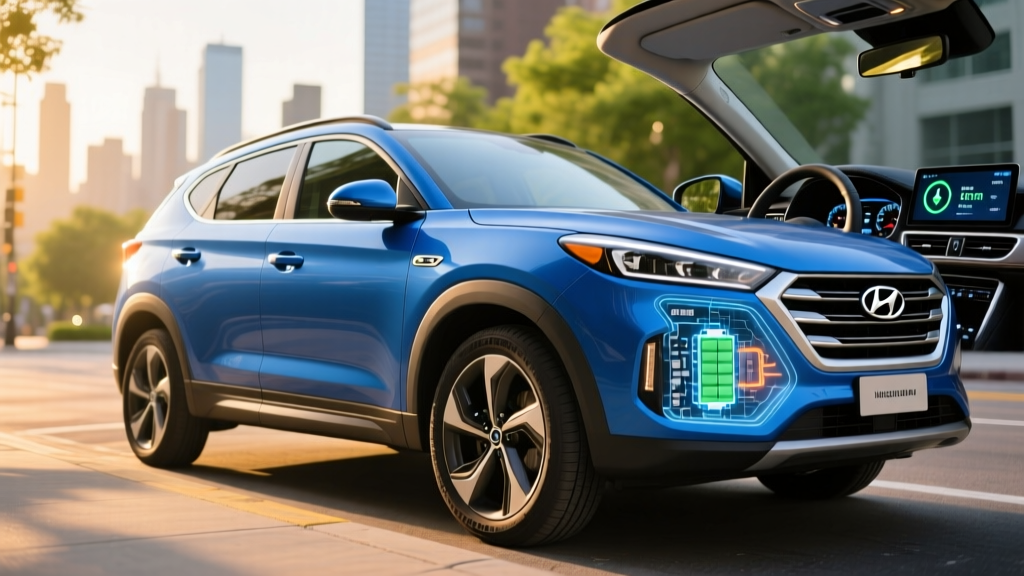
The 2025 Hyundai Tucson Hybrid Blue trim occupies a specific niche in the compact crossover segment: it is the most fuel-efficient version of the Tucson Hybrid lineup, trading a few premium features for maximum MPG. For buyers who want electrified efficiency without plugging in, the Blue trim delivers an EPA-estimated 38 MPG combined — a number that holds up remarkably well in real-world city driving, where hybrid systems shine brightest.
This guide covers everything a research-driven buyer needs: exact EPA fuel economy figures, the 1.6-liter turbo hybrid powertrain, real-world MPG expectations, battery warranty coverage, pricing, and how the Tucson Hybrid Blue stacks up against the Tucson PHEV and full EVs like the Ioniq 5.
EPA Fuel Economy: What the Tucson Hybrid Blue Actually Delivers
The Blue trim's efficiency advantage comes from lighter 18-inch wheels, lower-rolling-resistance tires, and the omission of heavier convenience features found on higher trims. Here is the official EPA breakdown, sourced from fueleconomy.gov:
| Metric | Value |
|---|---|
| City MPG | 38 |
| Highway MPG | 38 |
| Combined MPG | 38 |
| Annual Fuel Cost (est.) | ~$1,550 (15,000 mi/yr at $3.25/gal) |
HEV vs. PHEV: Understanding the Tucson Hybrid Lineup
Hyundai sells the Tucson in three powertrain flavors: a conventional gas model, a standard hybrid (HEV), and a plug-in hybrid (PHEV). The Blue trim is an HEV — it does not plug in. The 1.6 kWh traction battery charges entirely through regenerative braking and the gasoline engine. This is a critical distinction that trips up many shoppers.
| Attribute | Tucson Hybrid (HEV) Blue | Tucson Plug-In Hybrid (PHEV) |
|---|---|---|
| Powertrain | 1.6L turbo + electric motor | 1.6L turbo + larger electric motor |
| Combined Horsepower | 226 hp | 261 hp |
| Battery Capacity | 1.6 kWh (not plug-in) | 13.8 kWh (plug-in) |
| Electric-Only Range | N/A (motor assists only) | 33 miles (EPA) |
| Combined MPG / MPGe | 38 MPG | 80 MPGe (elec) / 35 MPG (gas) |
| Requires Plugging In? | No | Yes, for EV range benefit |
| DC Fast Charging | N/A | No (Level 2 AC only, ~2 hr) |
| Starting MSRP | $33,050 | $39,950 |
The bottom line: If you have reliable home charging and a commute under 30 miles, the PHEV lets you drive mostly on electricity. If you lack charging access or want simplicity, the HEV Blue delivers excellent efficiency with zero lifestyle change.
Powertrain Deep Dive: 226 Horsepower, Smoothly Delivered
The Tucson Hybrid Blue pairs a 1.6-liter turbocharged four-cylinder engine (178 hp, 195 lb-ft) with a 47.7 kW electric motor integrated into a 6-speed automatic transmission. Combined system output is 226 horsepower and 258 lb-ft of torque. Unlike Toyota's planetary-gear hybrid system, Hyundai uses a conventional automatic, which gives more natural shift feel but slightly less seamless electric-motor blending at low speeds.
The HEV system operates in several modes automatically:
- EV Drive: At low speeds and light loads, the Tucson can propel itself on electric power alone for very short distances (typically under 1 mile). This is not a usable "electric range" — it's a efficiency assist.
- Hybrid Mode: The engine and motor work together for normal acceleration.
- Regenerative Braking: Lift-off and braking recapture kinetic energy to recharge the 1.6 kWh battery.
- Engine Charging: Under certain conditions, the engine generates excess electricity to top up the battery.
Acceleration to 60 MPH takes approximately 7.1 seconds — adequate for merging and passing, though not sporty. The electric motor's instant torque fills in the low-RPM gap that turbo lag typically creates, making the Tucson Hybrid feel more responsive than its gas-only sibling around town.
Pricing, Trims, and Tax-Credit Eligibility
The 2025 Tucson Hybrid Blue starts at an MSRP of $33,050 (including destination). It sits at the base of the Hybrid lineup:
| Trim | MSRP | Key Additions Over Blue |
|---|---|---|
| Blue | $33,050 | Base — 18" wheels, max efficiency |
| SEL Convenience | $35,650 | Panoramic sunroof, power liftgate, leatherette |
| Limited | $39,400 | Leather, Bose audio, 360° camera, HUD |
Some states and municipalities offer rebates for conventional hybrids, but these are typically small ($250–$500) and vary widely by jurisdiction. Check your state energy office or utility provider for local programs.
Battery Warranty, Reliability, and Replacement Costs
The 1.6 kWh lithium-ion polymer battery in the Tucson Hybrid is small and operates within a narrow state-of-charge window — it never fully charges or fully depletes. This shallow-cycling approach dramatically extends battery lifespan. Hyundai's hybrid batteries routinely outlast the 10-year warranty period without significant degradation.
Reliability context: Hyundai's 1.6L turbo hybrid powertrain has been in service across the Sonata, Elantra, and Tucson families since 2021 with no widespread battery-failure recalls. The IIHS awarded the 2025 Tucson its Top Safety Pick+ rating. Long-term owner forums report the hybrid system as largely trouble-free, with the most common complaints relating to infotainment software rather than powertrain issues.
If replacement is ever needed (rare within the vehicle's practical lifespan), a Hyundai hybrid battery pack replacement currently runs approximately $2,500–$4,000 including labor — far less than a full EV battery replacement. Independent hybrid-battery refurbishers can sometimes repair individual cells for $1,000–$1,800. Given the 10-year warranty and the shallow-cycling design, battery replacement is not a realistic concern for first or second owners.
Who Should Choose the Tucson Hybrid Blue?
The Blue trim's efficiency comes with deliberate trade-offs. You give up the panoramic sunroof, power liftgate, leatherette seats, and larger 19-inch wheels available on higher trims. What you gain is 1–2 MPG over those trims (the SEL Convenience and Limited are rated at 37 MPG combined) and a lower entry price.
Choose the Tucson Hybrid Blue If:
- You prioritize maximum MPG over premium features
- You lack access to home or workplace charging (ruling out PHEV/EV)
- Your driving is predominantly city/stop-and-go (where hybrids excel)
- You want a lower purchase price with strong warranty coverage
- You drive 15,000+ miles/year and want to minimize fuel spend
Look Elsewhere If:
- You want EV-only driving for your commute → consider the Tucson PHEV or Ioniq 5
- Premium interior features matter more than 1 MPG → step up to SEL Convenience
- You primarily drive highway miles (EVs and diesels close the efficiency gap at steady speed)
- You need third-row seating → look at the Santa Fe Hybrid or Kia Sorento Hybrid
Tucson Hybrid Blue vs. Competitors: MPG and Price
| Model | Combined MPG | HP | Starting MSRP |
|---|---|---|---|
| Hyundai Tucson Hybrid Blue | 38 | 226 | $33,050 |
| Toyota RAV4 Hybrid (LE) | 39 | 219 | $33,425 |
| Honda CR-V Hybrid (Sport) | 37 | 204 | $35,650 |
| Kia Sportage Hybrid (LX) | 38 | 226 | $31,490 |
| Ford Escape Hybrid (Base) | 39 | 210 | $33,340 |
The Tucson Hybrid Blue sits squarely in the competitive middle. The RAV4 Hybrid squeezes out 1 more MPG combined, and the Kia Sportage Hybrid (which shares the Tucson's powertrain) undercuts on price. The Tucson's advantages are its class-leading warranty, slightly more torque (258 lb-ft vs. the RAV4's 163 lb-ft from its naturally aspirated 2.5L), and a more conventional automatic-transmission feel that some drivers prefer over Toyota's eCVT drone.
5-Year Cost of Ownership Snapshot
For a buyer driving 15,000 miles per year at $3.25/gallon:
| Model | Combined MPG | Annual Fuel Cost | 5-Year Fuel Cost |
|---|---|---|---|
| Tucson Hybrid Blue | 38 | ~$1,283 | ~$6,415 |
| Tucson Gas (2.5L AWD) | 28 | ~$1,741 | ~$8,705 |
| 5-Year Savings (Hybrid): | ~$2,290 | ||
The Hybrid Blue's $1,600 MSRP premium over the gas-only Tucson SE (roughly $31,450) pays for itself in fuel savings within approximately 3.5 years at current gas prices — and sooner if fuel prices rise. Factor in the hybrid's stronger resale value and lower brake wear (regenerative braking reduces pad consumption by 30–50%), and the total-cost-of-ownership advantage widens.
Frequently Asked Questions
How many MPG does the 2025 Tucson Hybrid Blue get?
The EPA rates it at 38 MPG city, 38 MPG highway, and 38 MPG combined. In real-world city driving, many owners report 39–42 MPG. Highway-only driving at 75+ MPH typically yields 33–35 MPG.
Does the Tucson Hybrid Blue need to be plugged in?
No. It is a conventional hybrid (HEV), not a plug-in hybrid. The battery charges through regenerative braking and the gasoline engine. You fuel it like any other car.
How far can the Tucson Hybrid drive on electric power alone?
Not meaningfully. The electric motor assists at low speeds and can propel the vehicle for very short distances (under 1 mile) at parking-lot speeds. For usable electric-only range, you need the Tucson PHEV, which delivers 33 miles of EPA-rated EV driving.
Is the Tucson Hybrid reliable?
Yes. Hyundai's 1.6L turbo hybrid system has been in production since 2021 with no widespread failures. The hybrid battery carries a 10-year/100,000-mile warranty, and shallow-cycling design means the battery typically outlasts the vehicle. The Tucson earned IIHS Top Safety Pick+ honors.
What does a Tucson Hybrid battery replacement cost?
If needed outside warranty, approximately $2,500–$4,000 including labor. Independent refurbishers may repair for $1,000–$1,800. In practice, Hyundai hybrid batteries rarely require replacement within the vehicle's practical lifespan.
Does the Tucson Hybrid qualify for any tax credit?
The conventional Hybrid (HEV) does not qualify for the federal §30D Clean Vehicle Credit, which requires plug-in capability. Some state or utility rebates may apply — check local programs. The Tucson PHEV may qualify for federal credits depending on sourcing, income, and MSRP rules.
Hybrid vs. PHEV vs. EV — which should I choose?
HEV (Tucson Hybrid): Best if you lack charging access and want zero lifestyle change with strong efficiency.
PHEV (Tucson PHEV): Best if you can charge at home and want EV commuting with gas-engine backup for road trips.
BEV (Ioniq 5): Best if you have reliable charging, want the lowest operating costs, and are ready to go fully electric.