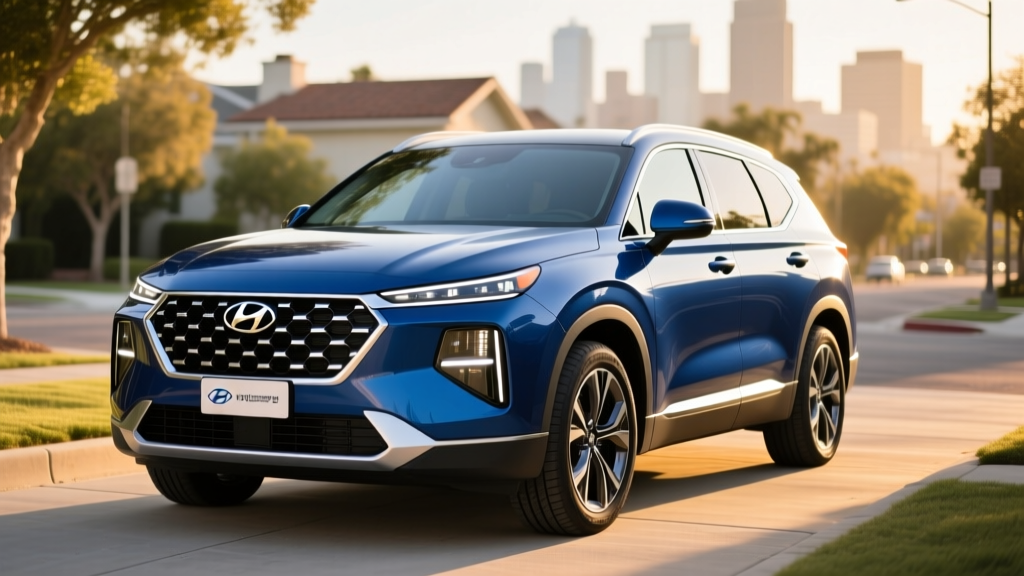
Quick Verdict: The 2025 Hyundai Santa Fe Hybrid Limited
The 2025 Hyundai Santa Fe Hybrid Limited sits at the top of Hyundai's three-row midsize hybrid SUV lineup, pairing a turbocharged 1.6-liter four-cylinder with a 47.7 kW electric motor for a combined 230 horsepower. With an EPA-estimated 36 MPG combined and no plug required, it targets families who want meaningful fuel savings without the behavioral shift of a plug-in hybrid or full EV. The Limited trim pushes the MSRP to approximately $47,450 (including destination), loading up with premium features like a dual 12.3-inch curved display, Nappa leather, a panoramic sunroof, and Hyundai's full suite of ADAS. It's a compelling package — but whether it's the right electrified choice depends on your driving patterns, charging access, and budget.
| Spec | Value |
|---|---|
| Powertrain | 1.6L Turbo GDI I4 + 47.7 kW electric motor |
| Combined Horsepower | 230 hp |
| Combined Torque | 271 lb-ft |
| Transmission | 6-speed automatic |
| Drivetrain | HTRAC AWD (standard on Limited) |
| EPA MPG (City / Hwy / Combined) | 35 / 34 / 36 (FWD) · 33 / 31 / 34 (AWD) |
| Fuel Tank | 17.7 gallons |
| Total Range (AWD) | ~602 miles |
| 0-60 mph | ~7.6 seconds (est.) |
| Towing Capacity | 2,000 lbs |
| Cargo Volume (behind 3rd / 2nd / 1st row) | 14.3 / 40.5 / 79.6 cu ft |
| MSRP (Limited AWD, incl. destination) | ~$47,450 |
| Hybrid Battery Warranty | 10 years / 100,000 miles |
HEV vs PHEV: What the Santa Fe Hybrid Actually Is
Before digging into the numbers, it's critical to understand that the Santa Fe Hybrid is a conventional hybrid electric vehicle (HEV), not a plug-in hybrid (PHEV). Hyundai does not currently offer a PHEV variant of the redesigned Santa Fe in the U.S. market. This distinction drives everything from daily operation to tax credit eligibility.
| Feature | Santa Fe Hybrid (HEV) | Typical PHEV (e.g., Tucson PHEV) | Full EV (e.g., Ioniq 5) |
|---|---|---|---|
| Plug-in charging? | No — refuels with gas only | Yes — optional plug-in for EV miles | Yes — required |
| Electric-only range | None (motor assists engine) | ~30-40 miles | 250-320+ miles |
| Primary fuel | Gasoline | Gasoline + electricity | Electricity only |
| Federal tax credit (§30D) | Not eligible | Up to $7,500 (if eligible) | Up to $7,500 (if eligible) |
| Home charger needed? | No | Recommended (Level 2) | Essential (Level 2) |
| Best for | Drivers without home charging access | Short commutes + weekend road trips | Home chargers + daily driving under 300 mi |
The Santa Fe HEV uses its electric motor to assist the gas engine during acceleration, capture energy through regenerative braking, and enable brief low-speed electric-only crawling in traffic. But it never needs to be plugged in, and you'll never see a "miles of EV range" readout. You fuel it at any gas station and drive. That simplicity is the entire point — and the primary reason buyers choose it over a PHEV or BEV.
Fuel Economy: EPA Ratings and Real-World MPG
The EPA rates the 2025 Santa Fe Hybrid at 35 MPG city, 34 MPG highway, and 36 MPG combined for the front-wheel-drive (FWD) SE and SEL trims. The HTRAC all-wheel-drive system, which comes standard on the Limited, drops those figures to 33 city, 31 highway, and 34 combined. With the 17.7-gallon fuel tank, AWD models deliver roughly 602 miles of total range before refueling — a genuine road-trip strength.
| Drivetrain | City MPG | Highway MPG | Combined MPG | Est. Total Range |
|---|---|---|---|---|
| FWD (SE/SEL) | 35 | 34 | 36 | ~637 miles |
| AWD (Limited) | 33 | 31 | 34 | ~602 miles |
Real-world expectations: Hyundai's hybrid system, like Toyota's, tends to outperform its EPA city rating in stop-and-go traffic because regenerative braking recaptures energy that gas-only vehicles waste as heat. Owners frequently report 36-38 MPG in mixed suburban driving with the AWD Limited, particularly in mild weather. Highway cruising at 75+ MPH, however, can pull numbers down to 29-31 MPG — the boxy, three-row SUV shape creates significant aerodynamic drag. In cold weather below freezing, expect a 2-4 MPG drop as the engine runs more frequently to provide cabin heat and warm the catalytic converter.
For context, the non-hybrid 2.5L turbo Santa Fe AWD returns an EPA 22 MPG combined. The hybrid's 34 MPG combined saves roughly 200 gallons of fuel per year at 15,000 miles — about $650-$750 annually at $3.40/gallon, depending on your local fuel prices.
Powertrain and Driving Impressions
The hybrid powertrain pairs a 1.6-liter turbocharged GDI four-cylinder engine (producing roughly 178 horsepower on its own) with a 47.7 kW (64 hp) electric motor integrated into the transmission housing. Combined system output is 230 horsepower and 271 lb-ft of torque, routed through a 6-speed automatic transmission — not a CVT. That distinction matters: the 6-speed delivers natural, stepped gear changes that feel familiar to drivers coming from conventional vehicles, eliminating the "rubber-band" drone that some CVT-equipped hybrids produce under hard acceleration.
The HTRAC AWD system on the Limited uses a traditional mechanical rear driveshaft rather than a dedicated rear electric motor. This provides confident traction in rain and light snow but doesn't offer the torque-vectoring precision of an e-AWD system like the one in the Toyota Highlander Hybrid. The 2,000-pound towing capacity is adequate for a small utility trailer or a pair of dirt bikes, but it falls well short of body-on-frame SUVs — this is a family hauler, not a tow rig.
Acceleration is respectable for the segment: 0-60 MPH in roughly 7.6 seconds. The electric motor fills in the turbo's low-RPM torque gap, giving the Santa Fe Hybrid a punchy feel around town. At highway speeds, passing power is adequate but not thrilling — the 230 hp total output is moving nearly 4,400 pounds of vehicle.
Pricing, Trims, and Tax Credit Reality
The 2025 Santa Fe Hybrid is offered in three trims: SE (~$39,450), SEL (~$42,650), and Limited (~$47,450), all including Hyundai's $1,495 destination charge. The Limited is the focus here, and it delivers a near-luxury equipment list: Nappa leather seating, a dual 12.3-inch curved panoramic display, a head-up display, a panoramic sunroof, heated and ventilated front seats, heated second-row seats, a hands-free power liftgate, and Hyundai's full Highway Driving Assist 2 (HDA2) suite.
Federal tax credit status: The Santa Fe Hybrid (HEV) does not qualify for the IRS §30D Clean Vehicle Credit. That credit applies only to plug-in electric vehicles (PHEVs and BEVs) with sufficient battery capacity. Conventional hybrids have not qualified for the federal purchase credit since the original 2009 legislation. There is no federal tax incentive for buying the Santa Fe Hybrid — you're paying full MSRP minus whatever negotiation you achieve at the dealership.
Some states offer their own hybrid incentives or HOV lane access for hybrids, but these vary widely and change frequently. Check your state's energy office or DMV for current programs. For buyers who want the §30D credit (up to $7,500), the Hyundai Tucson PHEV or Ioniq 5 BEV are the electrified alternatives in Hyundai's lineup — though neither offers three rows of seating.
Battery Warranty, Longevity, and Replacement Costs
Hyundai Hybrid Battery Warranty
Coverage: 10 years / 100,000 miles (whichever comes first)
What's covered: Hybrid battery pack, hybrid control unit, and related hybrid-system components against defects and excessive capacity loss.
Transferability: The 10-year/100,000-mile hybrid battery warranty transfers to subsequent owners, which supports resale value.
Hyundai's hybrid battery pack in the Santa Fe is a relatively compact lithium-ion unit (approximately 1.5 kWh) located under the rear seats. It's small because its job isn't to drive the vehicle for miles on electricity alone — it's to buffer energy for acceleration assist and regenerative capture. This shallow-cycle usage pattern is actually kinder to battery chemistry than the deep discharge cycles of a full EV, which is why hybrid battery packs routinely last 150,000-200,000+ miles with minimal degradation.
Replacement cost: If the hybrid battery does fail outside of warranty, dealer replacement typically runs between $2,000 and $3,500 for parts and labor. However, independent hybrid specialists can often refurbish or replace individual modules for $800-$1,500. Given the 10-year/100,000-mile warranty and the proven longevity of Hyundai's hybrid systems (carried over from the Tucson Hybrid and Sonata Hybrid), battery replacement is a low-probability expense for most original owners.
The conventional 12-volt auxiliary battery is a separate component — typically a standard AGM battery that will need replacement every 4-6 years at a cost of $200-$350, same as any modern vehicle.
Who Should Buy the Santa Fe Hybrid Limited?
Pros
- 34 MPG combined AWD — excellent for a three-row SUV
- No plug-in required — zero lifestyle change from a gas car
- 600+ mile total range eliminates fuel stops on long road trips
- 10-year/100,000-mile hybrid battery warranty
- 6-speed automatic (no CVT drone)
- Limited trim is loaded with premium features at a mainstream price
- Three-row seating with usable third row for children
Cons
- No federal tax credit eligibility (HEV, not PHEV/BEV)
- Highway MPG drops at 75+ MPH due to boxy aerodynamics
- 2,000-lb towing capacity limits utility
- Third row is tight for adults on longer trips
- AWD is mechanical, not torque-vectoring e-AWD
- No spare tire — tire inflation kit only
- $47,450 MSRP is steep for a Hyundai badge
Decision Framework
Choose the Santa Fe Hybrid Limited if: You need three rows, you can't install a home charger, you drive 15,000+ miles per year (where the MPG savings compound), and you want premium features without stepping into luxury-brand pricing.
Choose a PHEV instead (e.g., Kia Sorento PHEV) if: Your daily commute is under 30 miles, you have home Level 2 charging access, and you want to qualify for the $7,500 federal tax credit while still having gas backup for road trips.
Choose a full EV (e.g., Kia EV9) if: You have reliable home charging, your daily driving is under 250 miles, you want zero tailpipe emissions, and you're willing to plan charging stops on longer road trips.
Frequently Asked Questions
How many MPG does the 2025 Hyundai Santa Fe Hybrid Limited get?
The AWD Limited is EPA-rated at 33 MPG city, 31 MPG highway, and 34 MPG combined. In real-world suburban driving, many owners report 35-38 MPG, while sustained highway driving above 75 MPH can reduce efficiency to 29-31 MPG.
Does the Santa Fe Hybrid need to be plugged in?
No. The Santa Fe Hybrid is a conventional HEV — it charges its small battery pack through regenerative braking and the gas engine. You refuel it at a gas station like any other vehicle. There is no plug, no charging cable, and no electric-only driving range.
Does the 2025 Santa Fe Hybrid qualify for any federal tax credit?
No. The IRS §30D Clean Vehicle Credit applies only to plug-in electric vehicles (PHEVs and BEVs). Conventional hybrids like the Santa Fe HEV are not eligible for the federal purchase credit. Some states may offer separate hybrid incentives — check your state's energy office.
Is the Santa Fe Hybrid reliable, and what does battery replacement cost?
Hyundai's hybrid system has a strong track record across the Tucson, Sonata, and Ioniq Hybrid lineups. The hybrid battery is covered by a 10-year/100,000-mile warranty. Out-of-warranty replacement runs $2,000-$3,500 at a dealer or $800-$1,500 through an independent hybrid specialist, though most packs last well beyond 150,000 miles.
Hybrid vs PHEV vs EV — which is right for me?
If you lack home charging access and want fuel savings with zero lifestyle change, the HEV is the right call. If you have a garage with a 240V outlet and a short commute, a PHEV lets you drive 30-40 miles on electricity daily while keeping gas for road trips — and qualifies for up to $7,500 in federal credits. A full EV offers the lowest per-mile fuel cost and zero tailpipe emissions but requires reliable charging infrastructure and route planning on long trips.
How does the Santa Fe Hybrid compare to the Toyota Highlander Hybrid?
The Toyota Highlander Hybrid is rated at 35 MPG combined (AWD) and starts around $42,000, offering slightly better fuel economy and a stronger e-AWD system with a dedicated rear motor. However, the Santa Fe Hybrid Limited offers more standard premium features at a comparable price, a longer hybrid battery warranty (10 years vs. Toyota's 10 years/150,000 miles for the battery but 8 years/100,000 miles for hybrid components), and a more modern interior design. The Highlander has a slight edge in third-row space and towing capacity (3,500 lbs).
What is the safety rating for the 2025 Santa Fe?
The IIHS has evaluated the 2025 Santa Fe, and Hyundai's HDA2 system includes forward collision-avoidance assist, blind-spot collision-avoidance, rear cross-traffic collision-avoidance, lane keeping assist, and Highway Driving Assist 2 with lane-centering and adaptive cruise control. Check NHTSA and IIHS for the latest crash-test ratings as they are published.
Sources: fueleconomy.gov (EPA ratings), Hyundai USA official specifications, IRS §30D Clean Vehicle Credit guidelines.