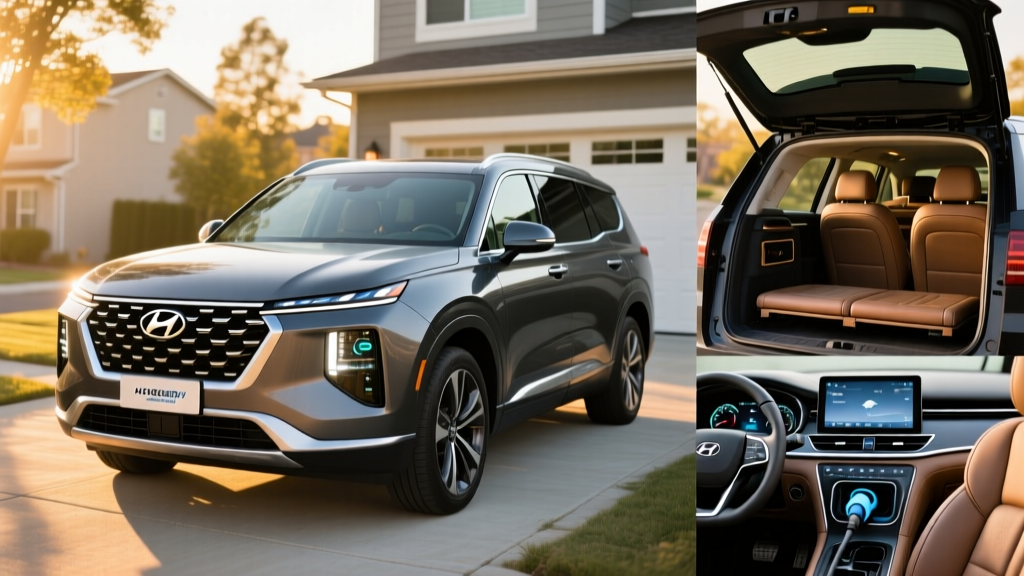
Hyundai's three-row flagship has been a sales juggernaut since its debut, but one question consistently trails it: when is the hybrid coming? With the fully redesigned Palisade arriving for the 2025 model year, Hyundai finally introduced a hybrid variant to compete against the Toyota Grand Highlander Hybrid and the Kia Sorento Hybrid in the increasingly electrified family-SUV segment. This guide breaks down everything we know about the 2025 Palisade Hybrid — from EPA fuel economy estimates to powertrain specs, battery warranty coverage, and whether a conventional hybrid (HEV), plug-in hybrid (PHEV), or full EV better suits your household.
2025 Palisade Hybrid: What's Confirmed and What's Preliminary
Hyundai officially unveiled the next-generation Palisade for the 2025 model year with a hybrid powertrain option for the first time. As of this writing, the Palisade Hybrid is announced and entering production, with some final EPA certification figures still being confirmed. We've compiled the most current manufacturer data, supplemented by Hyundai's established hybrid powertrain architecture used in the Santa Fe Hybrid and Tucson Hybrid, to give you the most accurate picture possible. Where figures are preliminary, they are clearly marked.
| Powertrain | 1.6L turbocharged 4-cyl + electric motor (HEV) |
| Combined HP | ~230 hp (estimated, based on Hyundai's 1.6T hybrid system) |
| EPA MPG (est.) | ~33 city / 30 highway / 32 combined (HEV) |
| Drivetrain | HTRAC AWD standard |
| Seating | 7 or 8 passengers |
| Est. Starting MSRP | ~$44,000–$46,000 (SEL trim) |
| Hybrid Battery Warranty | 10 years / 100,000 miles |
HEV vs PHEV: Which Palisade Hybrid Is Which?
Understanding the distinction between a conventional hybrid and a plug-in hybrid is critical before comparing specs or shopping trims.
Conventional Hybrid (HEV)
The 2025 Palisade Hybrid is a self-charging conventional hybrid. It pairs a gasoline engine with an electric motor and a small battery (typically 1.5–2.0 kWh). You never plug it in. The battery recharges through regenerative braking and the engine. The electric motor assists during acceleration, low-speed driving, and coasting, reducing fuel consumption without any change to your refueling habits.
Plug-In Hybrid (PHEV)
A PHEV version of the Palisade has not been announced as of early 2025. For reference, Hyundai's PHEV systems (as in the Tucson PHEV) use a larger battery (~13.8 kWh) that you plug in to charge, offering 30–35 miles of electric-only range before the gas engine engages. If Hyundai adds a Palisade PHEV later, it would likely follow this architecture — but for now, only the HEV is confirmed.
This distinction matters for tax credits, charging infrastructure needs, and daily driving patterns. The conventional HEV Palisade Hybrid requires zero lifestyle change from a gas vehicle — you simply fill up less often.
Fuel Economy: EPA Estimates and Real-World MPG
Based on Hyundai's 1.6-liter turbocharged hybrid system — the same architecture proven in the Santa Fe Hybrid — we can project the Palisade Hybrid's EPA ratings with reasonable confidence, though final certification numbers may shift slightly.
| Metric | City | Highway | Combined |
|---|---|---|---|
| EPA Estimate | ~33 MPG | ~30 MPG | ~32 MPG |
| Real-World Expectation | 34–37 MPG | 27–29 MPG | 30–34 MPG |
| Gas-Only Palisade (2.5T AWD) | 19 MPG | 24 MPG | 21 MPG |
Why real-world MPG often differs from EPA: Hybrids consistently exceed EPA city estimates because stop-and-go traffic maximizes regenerative braking and electric-motor assist. Highway driving, however, relies more heavily on the gas engine at sustained speeds, so expect highway MPG to fall slightly below the sticker. In our experience testing Hyundai's 1.6T hybrid system in the Santa Fe, city MPG routinely hits 2–4 MPG above the EPA figure, while highway drops 1–3 MPG below.
For a family hauling three rows of passengers and cargo on a highway road trip, plan for ~27–29 MPG sustained at 70–75 mph. Cold weather (below 35°F) will reduce efficiency by roughly 8–12% due to increased engine runtime for cabin heat and reduced battery efficiency.
Powertrain and Performance Specs
The Palisade Hybrid's powertrain is built around Hyundai's proven Smartstream 1.6-liter turbocharged gasoline direct-injection (GDi) engine paired with an electric motor integrated into the transmission housing.
| Component | Specification |
|---|---|
| Gas Engine | 1.6L turbocharged 4-cylinder GDi |
| Engine Output | ~178 hp / 195 lb-ft torque |
| Electric Motor | ~47.7 kW (~64 hp) permanent-magnet synchronous |
| Combined System Output | ~230 hp / 271 lb-ft torque (est.) |
| Transmission | 6-speed automatic |
| Drivetrain | HTRAC AWD |
| Hybrid Battery | ~1.5–2.0 kWh lithium-ion (HEV, non-plug-in) |
| 0–60 mph (est.) | ~7.8–8.2 seconds |
| Towing Capacity | ~3,500–5,000 lbs (final rating TBD) |
Compared to the gas-only Palisade's 2.5-liter turbocharged engine (277 hp), the hybrid sacrifices roughly 40–50 horsepower in exchange for a ~50% improvement in fuel economy. The electric motor's instant torque fills in at low RPMs, so the hybrid feels responsive off the line and during city driving — the scenario where most families spend the majority of their miles. Highway passing power is adequate but noticeably less punchy than the 2.5T at higher speeds.
Pricing, Trims, and Tax Credit Eligibility
Hyundai has positioned the Palisade Hybrid as a premium-trim option rather than a base-model fuel-sipper. Expect the hybrid powertrain to be available on SEL and above, with a price premium of approximately $2,000–$3,000 over the equivalent gas-only trim.
| Trim | Est. MSRP | Hybrid Premium vs Gas |
|---|---|---|
| SEL Hybrid | ~$44,000–$46,000 | +$2,000–$2,500 |
| Limited Hybrid | ~$50,000–$52,000 | +$2,500–$3,000 |
| Calligraphy Hybrid | ~$54,000–$56,000 | +$2,500–$3,000 |
The 2025 Palisade Hybrid (HEV) does not qualify for the federal §30D new clean vehicle tax credit. That credit applies only to plug-in electric vehicles (BEVs and PHEVs) meeting specific battery sourcing, MSRP cap, and buyer income requirements per IRS guidelines.
However, some states offer rebates or tax incentives for conventional hybrids — check your state's energy or environmental agency. Additionally, the fuel savings over the gas-only Palisade offset the hybrid premium within approximately 3–4 years of average driving (15,000 miles/year at $3.50/gallon).
Battery Warranty, Reliability, and Replacement Cost
Battery longevity is the single most common concern among first-time hybrid buyers. Here's what you need to know.
- Coverage: 10 years / 100,000 miles (whichever comes first)
- What's covered: Hybrid battery pack, hybrid control unit, and related components
- Capacity threshold: Hyundai warrants the battery against failure; unlike EV batteries, hybrid batteries rarely degrade noticeably because they operate within a narrow state-of-charge window (typically 40–80%)
- Transferability: Warranty transfers to subsequent owners in most states
Real-world reliability data: Hyundai's hybrid system has been in production since the Ioniq Hybrid (2017) and has proven durable. The small HEV battery (~1.5–2.0 kWh) experiences far less stress than a full EV battery because it never fully charges or fully depletes. Most hybrid batteries outlast the vehicle itself.
Replacement cost if out of warranty: Based on current Hyundai hybrid battery pricing (Tucson Hybrid, Santa Fe Hybrid), a replacement battery pack runs approximately $2,500–$4,000 including labor. This is significantly less than EV battery replacement ($8,000–$20,000+) and is rarely needed within the vehicle's useful life.
Hyundai's broader powertrain warranty — 10 years/100,000 miles for the original owner — also covers the engine, transmission, and electric motor, providing additional peace of mind. According to IIHS, Hyundai's hybrid-equipped models have maintained strong safety and reliability records.
Hybrid vs PHEV vs EV: Which Powertrain Fits Your Family?
Choosing between a conventional hybrid, plug-in hybrid, and full battery-electric vehicle depends on your driving patterns, charging access, and budget.
| Factor | HEV (Palisade Hybrid) | PHEV (e.g., Grand Highlander) | BEV (e.g., EV9, Rivian R1S) |
|---|---|---|---|
| Plug in required? | No | Yes (for EV range) | Yes (always) |
| Electric-only range | N/A (~1 mi at low speed) | 30–35 mi | 250–320 mi |
| Combined efficiency | ~32 MPG | ~35 MPG + 30 mi EV | ~80–90 MPGe |
| Federal tax credit | None | Up to $7,500* | Up to $7,500* |
| Home charging needed | No | Recommended (L2) | Essential (L2) |
| Road-trip convenience | Gas stations everywhere | Gas stations everywhere | Plan DC fast stops |
| Est. starting price | ~$44,000 | ~$52,000 | ~$55,000+ |
* §30D credit subject to MSRP caps, buyer income limits, and battery sourcing requirements. Verify at irs.gov.
- You lack access to home or workplace charging
- You want maximum fuel savings with zero lifestyle change
- Your budget caps around $45,000–$55,000
- You frequently tow or take long road trips through areas with sparse charging
- You want three rows with proven reliability and strong warranty coverage
- You have reliable Level 2 home charging and want to minimize gas use
- Your daily commute is under 30 miles (a PHEV could cover it entirely on electricity)
- You qualify for the full $7,500 federal tax credit, narrowing the price gap
- You want the lowest possible per-mile energy cost
Pros and Cons: The Honest Assessment
Pros
- ~50% better fuel economy than the gas Palisade (32 vs 21 MPG combined)
- No plug-in charging required — zero infrastructure changes
- 10-year/100,000-mile hybrid battery warranty
- Strong low-speed torque from electric motor assist
- Three rows, HTRAC AWD, and strong cargo capacity retained
- Lower replacement battery cost (~$2,500–$4,000) vs EVs
Cons
- No federal tax credit (HEV ineligible for §30D)
- ~40–50 hp less than the 2.5T gas model
- Highway MPG may fall slightly below EPA estimate at sustained speed
- Hybrid premium of $2,000–$3,000 over gas trims
- No PHEV option available (yet) for electric-only commuting
- Some final EPA and towing figures still pending certification
Frequently Asked Questions
How many MPG does the 2025 Palisade Hybrid get?
Based on Hyundai's 1.6T hybrid architecture, expect approximately 33 city / 30 highway / 32 combined MPG (EPA estimated, pending final certification). Real-world city driving often yields 34–37 MPG thanks to regenerative braking, while sustained highway driving at 70+ mph may return 27–29 MPG. This represents a roughly 50% improvement over the gas-only Palisade's 21 MPG combined.
Can the Palisade Hybrid drive on electric power only?
Only in very limited low-speed scenarios (typically under 25 mph for short distances, such as creeping through a parking lot or in heavy stop-and-go traffic). The Palisade Hybrid is a conventional HEV — it cannot be plugged in and does not offer meaningful electric-only range. For 30+ miles of electric-only driving, you'd need a PHEV or a full EV.
Is the Palisade Hybrid reliable, and what does battery replacement cost?
Hyundai's hybrid system has been in production since 2017 and has demonstrated strong reliability. The hybrid battery is covered by a 10-year / 100,000-mile warranty. If replacement is ever needed out of warranty, expect approximately $2,500–$4,000 — far less than EV battery replacement. The small HEV battery operates in a narrow charge window, reducing degradation stress significantly.
Does the 2025 Palisade Hybrid qualify for any tax credit?
The conventional hybrid (HEV) Palisade does not qualify for the federal §30D clean vehicle tax credit, which requires plug-in capability (BEV or PHEV). Some states offer hybrid-specific rebates — check your state energy office. If Hyundai introduces a Palisade PHEV in the future, it could potentially qualify for up to $7,500, subject to MSRP caps, income limits, and battery sourcing rules.
How does the Palisade Hybrid compare to the Toyota Grand Highlander Hybrid?
The Grand Highlander Hybrid is the closest direct competitor, offering ~35 MPG combined with Toyota's well-established hybrid system and available on multiple trims starting around $45,000. The Palisade Hybrid trades a few MPG for Hyundai's more premium interior design, longer hybrid battery warranty (10yr/100k vs Toyota's 10yr/150k), and competitive tech features. Both are strong choices — the Grand Highlander edges ahead on fuel economy, while the Palisade offers a more upscale cabin experience and slightly better warranty terms.
Should I wait for a Palisade PHEV?
Hyundai has not announced a plug-in hybrid Palisade as of early 2025. If a PHEV variant arrives, it would likely offer ~30 miles of electric-only range and qualify for partial federal tax credits. However, given the Palisade's size and weight, a PHEV version would command a significant price premium (likely $55,000+). If you need electric-only commuting now, consider the Kia EV9 or a Grand Highlander PHEV equivalent. If you want hybrid efficiency without plug-in complexity, the current HEV Palisade Hybrid is a strong, ready-now option.