Honda's 2025 Hybrid Lineup at a Glance
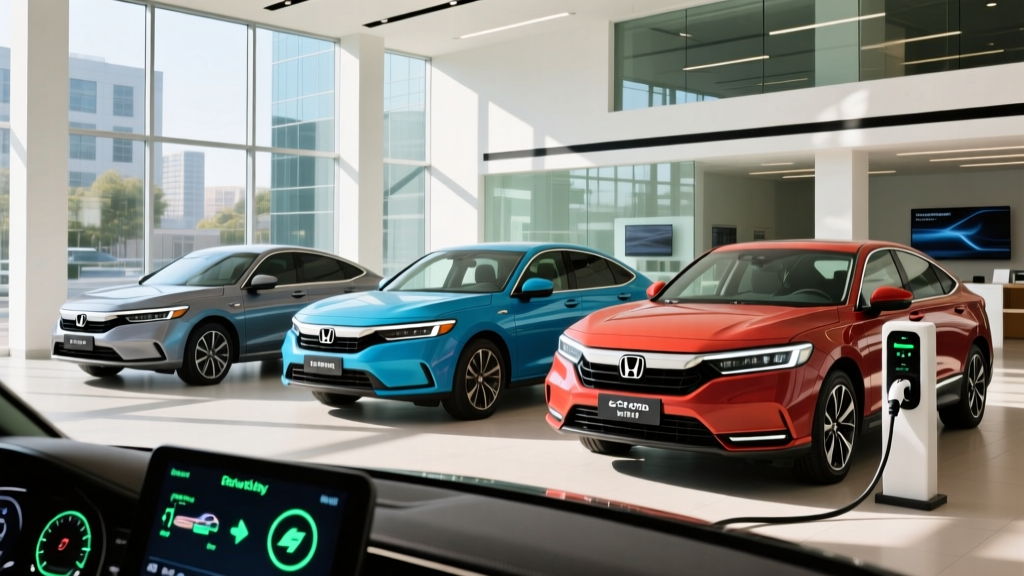
Honda expanded its electrified offerings for the 2025 model year, now offering hybrid powertrains across three of its highest-volume nameplates: the Accord, CR-V, and Civic. Unlike Toyota's broad PHEV push with the RAV4 Prime and Prius Prime, Honda has committed almost entirely to conventional hybrids (HEVs) — vehicles that recharge their small batteries through regenerative braking and the gasoline engine, with no plug required. The sole exception is the Honda Clarity Plug-In Hybrid, which was discontinued after the 2021 model year, leaving Honda's 2025 U.S. lineup without a current PHEV offering.
That makes the 2025 Honda hybrid conversation straightforward: these are HEVs designed to maximize fuel economy without changing your refueling habits. If you want plug-in electric range from Honda in 2025, you'll need to look at the fully electric Prologue — or wait for Honda's next-generation PHEV models expected later this decade.
HEV vs. PHEV: What Honda Offers in 2025
| Feature | Conventional Hybrid (HEV) | Plug-In Hybrid (PHEV) |
|---|---|---|
| Plug-in charging? | No — refuels with gas only | Yes — charges via plug + gas engine |
| Electric-only range | ~1 mile at low speed | 20–50 miles typical |
| Battery size | 1.0–1.8 kWh | 13–20 kWh typical |
| Federal tax credit (§30D) | Not eligible | Up to $7,500 (if eligible) |
| Honda models (2025) | Accord Hybrid, CR-V Hybrid, Civic Hybrid | None currently in U.S. lineup |
2025 Honda Accord Hybrid: MPG, Specs & Real-World Efficiency
The Accord Hybrid returns for 2025 with Honda's fourth-generation two-motor hybrid system, pairing a 2.0-liter Atkinson-cycle four-cylinder engine with two electric motors. Combined output is 204 horsepower and 247 lb-ft of torque, routed to the front wheels via an e-CVT.
| Spec | 2025 Accord Hybrid |
|---|---|
| Powertrain | 2.0L I4 + 2 electric motors (e-CVT) |
| Combined HP | 204 hp / 247 lb-ft |
| EPA City MPG | 51 |
| EPA Highway MPG | 44 |
| EPA Combined MPG | 48 |
| Fuel Tank | 12.8 gallons |
| Total Range | ~614 miles |
| Battery | ~1.3 kWh lithium-ion (not plug-in) |
| 0–60 mph | ~7.2 seconds (est.) |
| Starting MSRP | $34,395 (Sport Hybrid) |
Real-World MPG: Accord Hybrid
The Accord Hybrid's EPA rating of 51 city / 44 highway reflects how Honda's hybrid system works: at low speeds, the electric motor handles most propulsion while the engine acts as a generator. This means city driving often exceeds the EPA estimate, with some owners reporting 53–55 MPG in stop-and-go commutes. Highway driving is where hybrids lose their advantage — expect 40–43 MPG at sustained 70–75 mph speeds, slightly below the EPA sticker. In cold weather (below 30°F), expect a 5–8% efficiency dip as the engine runs more frequently to maintain cabin heat and battery temperature.
2025 Honda CR-V Hybrid: The Family SUV Workhorse
The CR-V Hybrid uses the same fourth-generation two-motor system as the Accord but tuned for the crossover's higher curb weight. The 2.0L engine and dual motors produce 204 hp and 247 lb-ft, with available all-wheel drive (AWD) using a rear-mounted motor rather than a mechanical driveshaft.
| Spec | 2025 CR-V Hybrid (FWD) | 2025 CR-V Hybrid (AWD) |
|---|---|---|
| Combined HP | 204 hp | 204 hp |
| EPA City | 43 MPG | 40 MPG |
| EPA Highway | 36 MPG | 34 MPG |
| EPA Combined | 40 MPG | 37 MPG |
| Fuel Tank | 14.0 gal | 14.0 gal |
| Total Range | ~560 miles | ~518 miles |
| Starting MSRP | $36,395 (Sport Hybrid) | $37,895 (Sport Hybrid AWD) |
Real-World MPG: CR-V Hybrid
The CR-V Hybrid's boxy profile and higher weight work against highway efficiency. Expect 34–36 MPG on the highway with AWD engaged. In city driving, owners frequently match or slightly exceed the 40 MPG combined AWD figure, particularly in moderate climates. The AWD system's rear electric motor engages automatically under acceleration or low-traction conditions and doesn't impose a massive efficiency penalty — roughly 3 MPG combined versus FWD, per EPA data on fueleconomy.gov.
2025 Honda Civic Hybrid: The Efficiency Leader
New for the 2025 model year, the Civic Hybrid brings Honda's two-motor system to its compact sedan for the first time since the 2015 model year. This is the most fuel-efficient vehicle Honda currently sells, targeting buyers who previously looked at the Toyota Prius or Hyundai Elantra Hybrid.
| Spec | 2025 Civic Hybrid |
|---|---|
| Powertrain | 2.0L I4 + 2 electric motors (e-CVT) |
| Combined HP | 200 hp / 232 lb-ft |
| EPA City MPG | 50 |
| EPA Highway MPG | 47 |
| EPA Combined MPG | 49 |
| Fuel Tank | 12.4 gallons |
| Total Range | ~607 miles |
| 0–60 mph | ~6.9 seconds (est.) |
| Starting MSRP | $30,195 (Sport Hybrid) |
Real-World MPG: Civic Hybrid
The Civic Hybrid's lighter platform and aerodynamic profile give it the best real-world consistency of Honda's 2025 hybrids. City commuters can expect 50–53 MPG, while highway cruising at 70 mph yields roughly 44–46 MPG. The 200 hp combined output makes this the quickest Civic outside the Type R — a meaningful upgrade over the 158 hp base turbo engine. Per Honda's official Civic page, the hybrid powertrain adds approximately 150 lb over the gas model, a trade-off most buyers will accept for the 40% efficiency gain.
Battery Warranty, Lifespan & Replacement Cost
Honda Hybrid Battery Warranty
All 2025 Honda hybrids carry a hybrid battery warranty of 8 years / 100,000 miles (10 years / 150,000 miles in California and states that follow CARB emissions standards). This covers capacity loss below a functional threshold and manufacturing defects.
How Long Do Honda Hybrid Batteries Last?
Honda's lithium-ion hybrid batteries are small (roughly 1.0–1.8 kWh) and operate within a narrow state-of-charge window — typically 40–60% SoC — managed by the vehicle's battery management system. This shallow cycling dramatically reduces degradation compared to a full EV battery that cycles from 10–90%. Real-world data from earlier-generation Honda hybrids (Insight, 2010–2014 Accord Hybrid) shows most batteries remain functional well beyond 150,000 miles. Failures before 100,000 miles are uncommon and typically covered under warranty.
Battery Replacement Cost
If a hybrid battery does require replacement outside of warranty, expect to pay between $2,000 and $4,000 for a refurbished or new unit plus labor at a Honda dealership. Third-party hybrid specialists often offer refurbished packs for $1,500–$2,500. This is substantially less than EV battery replacement ($10,000–$20,000+) because the hybrid battery is far smaller and simpler. Individual cell module replacement is sometimes possible for $200–$500 if only one module has degraded.
Pricing, Tax Credits & Ownership Economics
None of Honda's 2025 conventional hybrids qualify for the federal §30D new clean vehicle tax credit. That credit applies only to plug-in vehicles (BEVs and PHEVs) meeting battery sourcing, MSRP cap, and buyer income requirements, as detailed on IRS.gov's §30D page. Honda's hybrids also do not qualify for the $4,000 used EV credit under §25E, which similarly requires plug-in capability.
What Hybrid Buyers Can Save
While no federal tax credit applies, the ownership math still favors Honda hybrids over their gasoline counterparts:
- Fuel savings: A Civic Hybrid at 49 MPG combined vs. the gas Civic at 35 MPG combined saves roughly $400–$550/year at 15,000 miles and $3.40/gallon fuel.
- Hybrid premium payback: The Civic Hybrid costs approximately $2,000 more than the equivalent gas Civic Sport. At $500/year fuel savings, payback occurs in roughly 4 years.
- Insurance: Hybrid insurance premiums are typically 3–5% higher than gas equivalents due to slightly higher repair costs. Factor this into your total cost calculation.
- Resale value: Honda hybrids historically retain value well, often commanding a $1,000–$2,000 premium over gas models at trade-in after 5 years.
Hybrid vs. PHEV vs. Full EV: Which Fits You?
Choose a Honda Hybrid (HEV) If:
- You cannot install a home charger (apartment, street parking, no garage)
- You drive more than 400 miles between fill-ups regularly
- You want maximum simplicity — no plug, no new habits
- Your budget is under $40,000 and you want proven reliability
Choose a PHEV (Toyota RAV4 Prime, etc.) If:
- You have home Level 2 charging and a commute under 40 miles
- You want electric-only daily driving with gas backup for road trips
- You want to access the §30D tax credit (up to $7,500 for eligible buyers)
Choose a Full EV (Honda Prologue, Tesla, etc.) If:
- You have reliable home or workplace charging
- Your daily driving is under 250 miles and you rarely tow
- You want the lowest per-mile fuel cost and zero tailpipe emissions
- You can take advantage of the $7,500 federal tax credit at point of sale
Reliability: What the Data Shows
Honda's hybrid system has a strong reliability track record. The fourth-generation two-motor architecture, introduced in the 2023 Accord and CR-V, eliminated the complex clutch-based mode switching of earlier generations, reducing potential failure points. The system operates primarily in series-hybrid mode (engine generates electricity, motor drives wheels) at low and moderate speeds, switching to direct engine drive only at steady highway cruising. This simplicity translates to fewer mechanical wear components than a traditional automatic transmission.
Per IIHS and NHTSA data, the 2025 Accord and CR-V carry top safety ratings, and the hybrid variants share the same structural platform. Honda Sensing (adaptive cruise, lane-keeping, collision mitigation) is standard on all hybrid trims. Long-term hybrid reliability is supported by the fact that Honda's hybrid components share significant architecture with Toyota's proven HSD system — both use planetary-gear e-CVT designs that have demonstrated 200,000+ mile durability in fleet and taxi service.
Frequently Asked Questions
How many MPG does the 2025 Honda Civic Hybrid get?
The EPA rates the 2025 Civic Hybrid at 50 city / 47 highway / 49 combined MPG. Real-world city driving often yields 50–53 MPG, while sustained highway driving at 70+ mph typically returns 44–46 MPG.
Does the 2025 Honda CR-V Hybrid need to be plugged in?
No. The CR-V Hybrid is a conventional hybrid (HEV). It charges its battery through regenerative braking and the gasoline engine. You refuel it like any gas car — there is no plug and no electric-only driving range beyond about one mile at very low speeds.
Does any 2025 Honda hybrid qualify for a federal tax credit?
No. Honda's 2025 hybrids are conventional (non-plug-in) hybrids and do not qualify for the §30D federal tax credit, which requires plug-in capability with a minimum 7 kWh battery. The fully electric Honda Prologue may qualify for up to $7,500 depending on buyer income, MSRP, and battery sourcing requirements.
How long will the hybrid battery last in a 2025 Honda Accord?
Honda's hybrid batteries are warranted for 8 years / 100,000 miles (10/150,000 in CARB states). Based on historical data from earlier Honda hybrids, most batteries remain functional well past 150,000 miles. Replacement outside warranty costs $2,000–$4,000.
Is the Accord Hybrid slower than the gas Accord?
The Accord Hybrid produces 204 hp versus the gas 1.5T model's 192 hp. The hybrid's instant electric torque gives it stronger off-the-line acceleration, though the gas 2.0T model (252 hp, discontinued for most trims) is quicker at highway passing speeds. The hybrid's 0–60 time of approximately 7.2 seconds is competitive for the midsize sedan segment.
Does Honda offer a plug-in hybrid in 2025?
Not in the U.S. market. The Honda Clarity Plug-In Hybrid was discontinued after 2021. Honda has not announced a replacement PHEV for the American market as of early 2025. Buyers seeking a plug-in hybrid crossover should look at the Toyota RAV4 Prime, Hyundai Tucson PHEV, or Ford Escape PHEV.