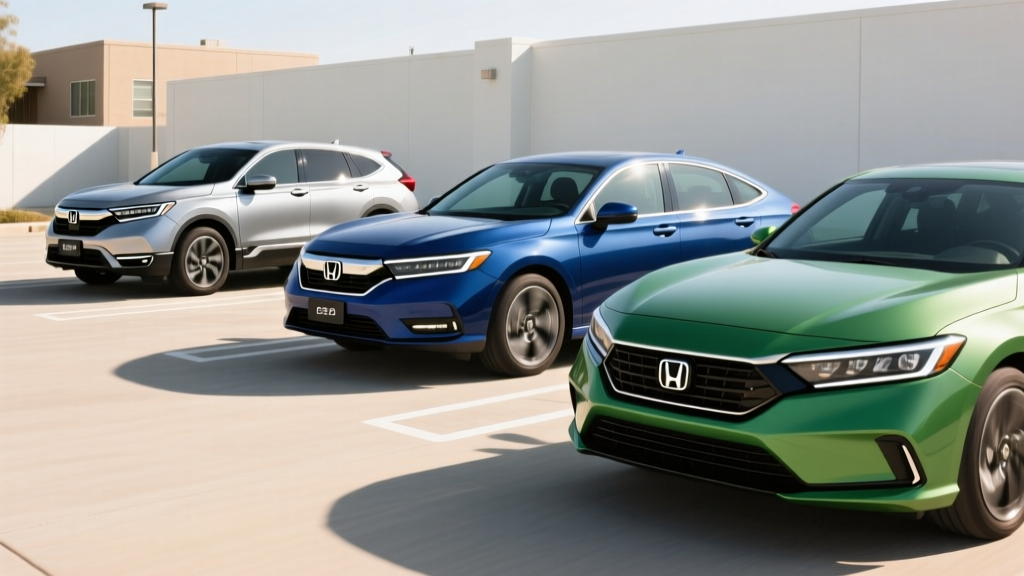
Honda's hybrid strategy in 2025 is straightforward: electrify its three highest-volume models and skip the plug-in complexity. The CR-V Hybrid, Accord Hybrid, and Civic Hybrid all use conventional (HEV) powertrains — no plug required, no range anxiety, and no charging infrastructure dependency. For buyers weighing a 2025 Honda hybrid against a full EV or a rival PHEV like the Toyota RAV4 Prime, this guide breaks down every spec, EPA figure, and ownership reality you need to decide.
HEV vs PHEV vs EV: Where Honda Fits
Before diving into individual models, it's critical to understand what Honda is — and isn't — offering in 2025. Honda's US lineup features only conventional hybrids (HEVs). There are no plug-in hybrids (PHEVs) currently sold in the United States, and no battery-electric vehicles beyond the limited-market Prologue (a GM-Ultium-based SUV).
HEV vs PHEV vs BEV — Quick Reference
| Attribute | HEV (Honda 2025) | PHEV (e.g., RAV4 Prime) | BEV (e.g., Tesla Model Y) |
|---|---|---|---|
| Plug-in required? | No | Yes (Level 1/2) | Yes (Level 1/2/DC) |
| Electric-only range | ~1 mi at low speed | 25–42 mi typical | 250–330+ mi (EPA) |
| Fuel/energy source | Gasoline only | Gasoline + grid electricity | Grid electricity only |
| Home charging needed? | No | Recommended | Essential |
| Federal tax credit (§30D) | No | Up to $7,500 (if eligible) | Up to $7,500 (if eligible) |
| Best for | No garage/outlet, high-mileage commuters | Home chargers with short daily commutes | Home chargers wanting zero gas |
Honda's choice to stay HEV-only means simplicity: you fuel up at any gas station, never think about charging, and still cut fuel consumption by 30–40% versus a gas-only equivalent. The trade-off is that you cannot drive on electricity alone for meaningful distances, and you will not qualify for the IRS §30D federal EV tax credit, which applies only to plug-in vehicles with at least 7 kWh of battery capacity.
2025 Honda CR-V Hybrid: MPG, Specs & Real-World Efficiency
The CR-V Hybrid is Honda's best-selling electrified vehicle in the US, and for good reason. It pairs a 2.0-liter Atkinson-cycle four-cylinder with two electric motors for a combined output of 204 horsepower and 247 lb-ft of torque. All-wheel drive (eAWD) is standard on all hybrid trims — Sport, Sport-L, and Sport Touring — using a rear-mounted electric motor rather than a mechanical driveshaft.
| Spec | Value |
|---|---|
| Powertrain | 2.0L I4 Atkinson + 2-motor hybrid system |
| Combined HP | 204 hp |
| Combined Torque | 247 lb-ft |
| Transmission | e-CVT (no fixed gears) |
| Drivetrain | eAWD (standard on all hybrid trims) |
| Battery | ~1.06 kWh lithium-ion (HEV, not plug-in) |
| EPA MPG (FWD eAWD) | 40 city / 34 highway / 37 combined |
| 0–60 mph | ~7.6 seconds (est.) |
| Cargo Volume | 36.3 cu ft (rear seats up) / 76.5 cu ft (folded) |
| Base MSRP (Sport AWD) | $36,395 |
| Battery Warranty | 8 years / 100,000 miles |
Real-World MPG: What Owners Actually See
The EPA rates the CR-V Hybrid eAWD at 37 MPG combined (40 city / 34 highway). In real-world driving, Honda's two-motor system excels in city traffic where regenerative braking recaptures energy constantly. Many owners report 38–42 MPG in mixed city driving, slightly exceeding the EPA city estimate. Highway-heavy commutes at 75+ mph tend to drop to 31–34 MPG, consistent with the EPA highway figure. In cold weather (below 30°F), expect a 5–8% reduction due to increased engine idling for cabin heat and reduced battery efficiency.
CR-V Hybrid EPA vs Real-World MPG
| Condition | City | Highway | Combined |
|---|---|---|---|
| EPA Estimate | 40 | 34 | 37 |
| Real-world (moderate climate, mixed) | 38–42 | 31–34 | 35–38 |
| Cold weather (below 30°F) | 34–37 | 28–31 | 31–34 |
2025 Honda Accord Hybrid: The Efficiency Sedan
The Accord Hybrid uses the same two-motor architecture as the CR-V but in a lighter, more aerodynamic sedan body — and the efficiency gains are significant. Available in Sport, Sport-L, EX-L, and Sport Touring trims, the Accord Hybrid produces 204 hp from its 2.0L Atkinson-cycle engine and dual-motor system, with an EPA rating that makes it one of the most efficient midsize sedons on the market.
| Spec | Value |
|---|---|
| Powertrain | 2.0L I4 Atkinson + 2-motor hybrid system |
| Combined HP | 204 hp |
| Combined Torque | 247 lb-ft |
| Drivetrain | FWD only (no AWD option) |
| Battery | ~1.06 kWh lithium-ion (HEV) |
| EPA MPG | 51 city / 44 highway / 48 combined |
| 0–60 mph | ~7.1 seconds (est.) |
| Trunk Volume | 16.7 cu ft |
| Base MSRP (Sport) | $34,295 |
| Battery Warranty | 8 years / 100,000 miles |
According to fueleconomy.gov, the Accord Hybrid's 48 MPG combined rating puts it ahead of the Toyota Camry Hybrid (44–46 MPG combined depending on trim) and well ahead of any non-hybrid midsize sedan. The Accord's advantage is most pronounced in city driving, where its 51 MPG EPA city rating shines. Real-world city driving in warm weather routinely yields 49–54 MPG, while sustained highway cruising at 70–80 mph drops to 40–44 MPG.
2025 Honda Civic Hybrid: Compact Efficiency Leader
Reintroduced for 2025 after a hiatus, the Civic Hybrid brings Honda's two-motor system to its compact car platform. The result is an EPA-rated 50 city / 47 highway / 49 combined MPG in the Sport Touring Hybrid sedan — making it one of the most fuel-efficient non-plug-in vehicles available in the US market.
| Spec | Value |
|---|---|
| Powertrain | 2.0L I4 Atkinson + 2-motor hybrid system |
| Combined HP | 200 hp |
| Combined Torque | 232 lb-ft |
| Drivetrain | FWD |
| Battery | ~1.06 kWh lithium-ion (HEV) |
| EPA MPG (Sport Touring) | 50 city / 47 highway / 49 combined |
| 0–60 mph | ~7.3 seconds (est.) |
| Trunk Volume | 14.8 cu ft |
| Base MSRP (Sport Hybrid) | $30,695 |
| Battery Warranty | 8 years / 100,000 miles |
The Civic Hybrid is particularly compelling for urban commuters. Its city MPG exceeds its highway figure — a hallmark of Honda's hybrid system, which runs the engine primarily as a generator at low speeds and uses electric motor torque for propulsion. At highway speeds, the engine can clutch directly to the wheels for efficiency, but aerodynamic drag limits gains.
Side-by-Side: 2025 Honda Hybrid Comparison
| Attribute | CR-V Hybrid eAWD | Accord Hybrid | Civic Hybrid |
|---|---|---|---|
| Body Style | Compact SUV | Midsize Sedan | Compact Sedan |
| Combined HP | 204 hp | 204 hp | 200 hp |
| EPA Combined MPG | 37 | 48 | 49 |
| EPA City MPG | 40 | 51 | 50 |
| EPA Highway MPG | 34 | 44 | 47 |
| Drivetrain | eAWD | FWD | FWD |
| Cargo / Trunk | 36.3 cu ft | 16.7 cu ft | 14.8 cu ft |
| Starting MSRP | $36,395 | $34,295 | $30,695 |
| AWD Available? | Standard | No | No |
Battery Warranty, Reliability & Replacement Costs
Honda Hybrid Battery Warranty
All 2025 Honda hybrids carry an 8-year / 100,000-mile hybrid battery warranty (10 years / 150,000 miles in CARB states including California, New York, Massachusetts, and others). This covers capacity loss below a functional threshold and defects. Honda's lithium-ion hybrid batteries are small (~1.06 kWh) and experience far fewer charge cycles than a full EV battery, making catastrophic failure rare.
Honda's fourth-generation two-motor hybrid system has proven reliable in the field. The CR-V Hybrid and Accord Hybrid have been on sale since 2023 and 2023 respectively with no widespread battery failure campaigns. Because HEV batteries are small and never deeply discharged (the system maintains a state-of-charge buffer between roughly 40–80%), degradation is minimal over the vehicle's lifetime.
If a replacement is needed out of warranty, Honda hybrid battery packs typically cost $2,000–$4,000 including labor — a fraction of a full EV battery replacement ($8,000–$20,000+). Third-party remanufactured batteries are also becoming available for older Honda hybrids at lower cost. According to NHTSA recall data, Honda's current hybrid systems have not been subject to battery-related safety recalls.
Tax Credits & Ownership Economics
Here is the key financial reality: 2025 Honda hybrids do not qualify for the federal §30D Clean Vehicle Credit. That credit — up to $7,500 — applies only to plug-in electric vehicles (PHEVs and BEVs) with battery capacity of at least 7 kWh. Honda's HEVs use ~1 kWh batteries and are classified as conventional hybrids by the IRS.
- Federal §30D credit: Not eligible (HEV, not plug-in)
- State hybrid incentives: Some states offer small rebates ($500–$1,500) for HEVs — check your state energy office
- HOV lane access: Generally not available for HEVs (requires PHEV/BEV in most states)
- Fuel savings vs gas equivalent: At 48 MPG combined (Accord Hybrid) vs 30 MPG (gas Accord), saving ~$700–$900/year at 15,000 miles/year and $3.50/gallon
The value proposition of a Honda hybrid is not incentive-driven — it's efficiency-driven. The Accord Hybrid's ~$2,000 premium over a gas Accord pays back in roughly 2.5–3 years for a 15,000-mile/year driver, with ongoing savings for the life of the vehicle.
Who Should Buy a 2025 Honda Hybrid?
Decision Framework: Honda HEV vs PHEV vs EV
Choose a Honda Hybrid (HEV) if:
- You lack access to home or workplace charging (apartment, street parking)
- You want maximum simplicity — no plugs, no apps, no charging planning
- You drive 15,000+ miles/year and want consistent fuel savings everywhere
- You want AWD in a fuel-efficient SUV (CR-V Hybrid eAWD)
Choose a PHEV (e.g., Toyota RAV4 Prime, Chrysler Pacifica Hybrid) if:
- You have Level 2 home charging and a commute under 40 miles
- You want to drive mostly electric daily but keep gas for road trips
- You want to qualify for the $7,500 federal tax credit (verify eligibility on irs.gov)
Choose a full EV (BEV) if:
- You have reliable home Level 2 charging
- You want zero tailpipe emissions and minimal maintenance
- Your daily driving is under 250 miles and you can plan road-trip charging
Honda Hybrid Pros
- Class-leading city MPG (48–51 combined for sedans)
- No charging infrastructure needed
- Standard AWD on CR-V Hybrid
- Proven reliability, strong battery warranty
- Low battery replacement cost vs EV
- Strong resale value (Honda brand)
Honda Hybrid Cons
- No federal tax credit eligibility
- No EV-only driving for meaningful distances
- No HOV lane access in most states
- Accord/Civic Hybrid are FWD only (no AWD option)
- Highway MPG trails city MPG significantly
- No DC fast charging capability (not applicable for HEV)
Frequently Asked Questions
How many MPG does the 2025 Honda hybrid lineup get?
The 2025 Civic Hybrid leads at 49 MPG combined (50 city / 47 highway). The Accord Hybrid achieves 48 combined (51 city / 44 highway). The CR-V Hybrid eAWD rates at 37 combined (40 city / 34 highway). All figures are EPA-estimated via fueleconomy.gov.
Do Honda hybrids need to be plugged in?
No. All 2025 Honda hybrids are conventional HEVs. They recharge their small battery packs entirely through regenerative braking and the gasoline engine. You never plug them in — just fill up at any gas station.
Does Honda make a plug-in hybrid (PHEV)?
Not in the United States as of 2025. Honda previously sold the Clarity Plug-In Hybrid (discontinued after 2021). Honda's current US electrified strategy focuses on conventional hybrids and the all-electric Prologue SUV. If you need a plug-in Honda, you would need to look at Honda's offerings in other markets or consider a competitor like the Toyota RAV4 Prime or Hyundai Tucson PHEV.
Is the Honda hybrid battery reliable and what does replacement cost?
Honda's hybrid battery systems have proven highly reliable. The ~1 kWh lithium-ion pack is kept within a narrow state-of-charge window (never fully charged or deeply discharged), which minimizes degradation. All 2025 models carry an 8-year/100,000-mile battery warranty (10 years/150,000 miles in CARB states). Out-of-warranty replacement typically costs $2,000–$4,000, far less than an EV battery.
Does a 2025 Honda hybrid qualify for any tax credit?
No federal tax credit applies to conventional hybrids under current IRS §30D rules, which require at least 7 kWh of battery capacity and plug-in capability. Some states may offer modest rebates for hybrid purchases — check your state's energy or environmental agency. The value of a Honda hybrid comes from fuel savings, not incentives.
How does Honda's hybrid system work?
Honda uses a two-motor hybrid system. At low speeds, the gasoline engine acts primarily as a generator, producing electricity that powers the drive motor (series-hybrid mode). At highway cruising speeds, a lock-up clutch connects the engine directly to the wheels for efficiency (parallel-hybrid mode). The system seamlessly switches between modes without driver input, optimizing for efficiency across all conditions.
Which 2025 Honda hybrid gets the best gas mileage?
The Civic Hybrid at 49 MPG combined edges out the Accord Hybrid at 48 combined. However, the Accord Hybrid achieves a higher city rating (51 vs 50 MPG) due to its tuned regenerative braking calibration. For pure highway efficiency, the Civic Hybrid's 47 MPG highway rating leads the lineup.