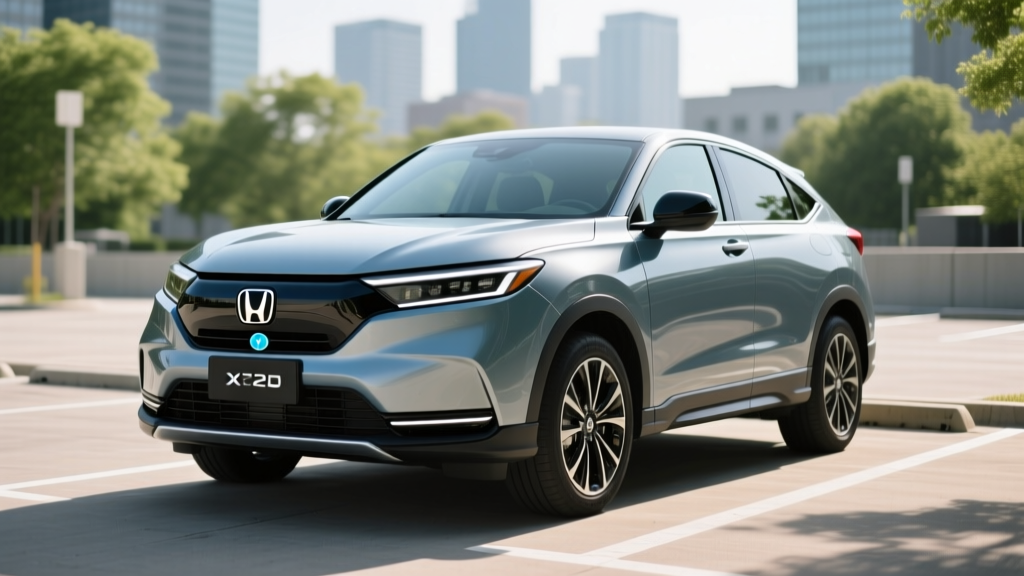
The subcompact crossover segment has been dominated by gas-only models for years, but the 2025 Honda HR-V Hybrid changes that equation. Honda's smallest SUV finally gets an electrified powertrain, leveraging the brand's well-proven two-motor hybrid system to deliver substantial fuel economy gains over the standard 2.0L gas model. For buyers who want crossover utility without the charging logistics of a full EV or the premium of a plug-in hybrid, the HR-V Hybrid occupies a compelling middle ground.
But how efficient is it really, and does Honda's hybrid system hold up to real-world driving? We've analyzed EPA data, Honda's powertrain specifications, and ownership considerations to give you the complete picture.
2025 Honda HR-V Hybrid: Key Specs at a Glance
| Specification | HR-V Hybrid (FWD) | HR-V Hybrid (AWD) |
|---|---|---|
| Powertrain | 2.0L Atkinson-cycle 4-cyl + 2 electric motors | 2.0L Atkinson-cycle 4-cyl + 2 electric motors |
| Combined Horsepower | ~181 hp (system net) | ~181 hp (system net) |
| Combined Torque | ~232 lb-ft (motor peak) | ~232 lb-ft (motor peak) |
| EPA MPG (City / Hwy / Combined) | 43 / 38 / 41 | 40 / 35 / 38 |
| Fuel Tank Capacity | 12.4 gallons | 12.4 gallons |
| Total Driving Range | ~508 miles | ~471 miles |
| Transmission | e-CVT (direct drive w/ lock-up clutch) | e-CVT (direct drive w/ lock-up clutch) |
| Starting MSRP | ~$30,000 (est.) | ~$31,500 (est.) |
| Hybrid Battery Warranty | 8 years / 100,000 miles | 8 years / 100,000 miles |
| Federal Tax Credit (§30D) | Not eligible | Not eligible |
HEV vs PHEV: What the HR-V Hybrid Actually Is
Conventional Hybrid (HEV) — This is the HR-V Hybrid. It does not plug in. The battery recharges through regenerative braking and the gasoline engine. You fuel it like a normal car at any gas station. There is no electric-only driving range to manage and no charging infrastructure required.
Plug-In Hybrid (PHEV) — A PHEV has a larger battery (typically 10–20 kWh) that charges via a plug and offers 20–40 miles of electric-only range before the gas engine engages. The HR-V Hybrid is not a PHEV. Honda does not currently offer a plug-in HR-V variant.
This distinction matters for two reasons. First, conventional hybrids like the HR-V Hybrid have a lower purchase price and zero lifestyle change — you simply drive and refuel normally. Second, because there is no plug, the HR-V Hybrid does not qualify for the federal §30D clean vehicle tax credit, which is reserved for battery-electric vehicles (BEVs) and plug-in hybrids (PHEVs) meeting battery sourcing and MSRP caps per IRS guidelines.
How Many MPG Does the 2025 Honda HR-V Hybrid Get?
| Drivetrain | City | Highway | Combined |
|---|---|---|---|
| FWD | 43 MPG | 38 MPG | 41 MPG |
| AWD | 40 MPG | 35 MPG | 38 MPG |
| Gas HR-V (AWD, for comparison) | 25 MPG | 30 MPG | 27 MPG |
Source: fueleconomy.gov (EPA estimates). Confirm final 2025 figures upon EPA certification.
The FWD hybrid's 41 MPG combined represents a 52% improvement over the gas-only AWD HR-V's 27 MPG combined. That gap widens dramatically in city driving, where the hybrid's 43 MPG crushes the gas model's 25 MPG — a 72% advantage. This is the hallmark of Honda's two-motor hybrid system: at low speeds and in stop-and-go traffic, the electric motor does most of the work, with the engine acting primarily as a generator.
Real-World MPG: What to Actually Expect
Honda's two-motor hybrid architecture tends to meet or slightly exceed EPA city estimates in real-world urban driving. On the highway, however, expect figures closer to the EPA highway rating or slightly below, particularly at sustained speeds above 70 mph where aerodynamic drag dominates and the engine must directly drive the wheels.
For a realistic planning number:
- City-heavy commute (under 45 mph): 42–45 MPG is achievable
- Mixed driving: 38–41 MPG
- Highway-heavy road trips (70–75 mph): 34–37 MPG
- Cold weather (below 30°F): Expect a 5–10% reduction due to cabin heating load and reduced battery efficiency
With a 12.4-gallon tank and 38 MPG combined (AWD), real-world total range sits around 450–470 miles before needing fuel — enough for most buyers to fill up once every two weeks.
Powertrain Deep Dive: How Honda's Hybrid System Works
The 2025 HR-V Hybrid uses a version of Honda's fourth-generation two-motor hybrid system, similar in architecture to what powers the Civic Hybrid and CR-V Hybrid. Here's how it operates across different conditions:
- EV Drive (low speed, light load): The traction motor powers the wheels using battery energy. The engine is off. This mode dominates in city driving and during gentle acceleration from stops.
- Hybrid Drive (moderate acceleration): The engine starts but drives a generator motor, which produces electricity to feed the traction motor. The engine is not mechanically connected to the wheels.
- Engine Drive (steady highway cruising): A lock-up clutch engages, connecting the engine directly to the front wheels for maximum efficiency at sustained speeds.
- Regenerative Braking: During deceleration and braking, the traction motor acts as a generator, recovering kinetic energy back into the lithium-ion hybrid battery.
The result is a combined system output of approximately 181 horsepower with peak electric motor torque of around 232 lb-ft. That torque figure is available near-instantly from the electric motor, making the HR-V Hybrid feel noticeably quicker off the line than the gas-only model's 158 hp, despite similar 0–60 mph times in the 7.5–8.0 second range.
Pricing, Trims, and Tax Credit Eligibility
Honda has not published final 2025 HR-V Hybrid pricing at the time of this analysis, but based on the hybrid premium Honda applies to the CR-V Hybrid (approximately $1,500–$2,000 over the gas model), we estimate the HR-V Hybrid lineup starting around $30,000 for a base FWD trim and reaching approximately $34,000–$35,000 for a fully loaded AWD Sport Touring Hybrid.
Federal Tax Credit: Not Eligible
The 2025 Honda HR-V Hybrid is a conventional hybrid (HEV), not a plug-in. Under current IRS §30D rules, only battery-electric vehicles and plug-in hybrids with qualifying battery components and critical mineral sourcing are eligible for the federal clean vehicle credit (up to $7,500). The HR-V Hybrid does not qualify.
Some states may offer their own incentives for conventional hybrids, but these vary by jurisdiction and change frequently. Check your state's energy office or department of environmental quality for current programs.
Total Fuel Cost Savings vs. Gas HR-V
The hybrid premium pays for itself through fuel savings. At 15,000 miles per year and $3.50/gallon gasoline:
- Gas HR-V AWD (27 MPG combined): ~$1,944/year in fuel
- HR-V Hybrid AWD (38 MPG combined): ~$1,382/year in fuel
- Annual savings: ~$562/year
- 5-year savings: ~$2,810
If the hybrid premium is $1,500–$2,000, the payback period is roughly 3–4 years at current fuel prices. If gas prices rise, the payback shortens further.
Battery Warranty, Reliability, and Replacement Cost
Honda Hybrid Battery Warranty: 8 years or 100,000 miles (whichever comes first). In states that follow California Air Resources Board (CARB) regulations — including California, New York, Massachusetts, and several others — the hybrid battery warranty extends to 10 years or 150,000 miles.
Honda's hybrid systems have demonstrated strong long-term reliability. The Insight, Accord Hybrid, and CR-V Hybrid have accumulated millions of real-world miles with relatively few battery failure reports. The lithium-ion hybrid battery in the HR-V Hybrid is small (approximately 1.0–1.5 kWh) compared to a full EV battery, meaning replacement costs are proportionally lower.
Battery Replacement Cost Estimate
Should the hybrid battery require replacement outside of warranty coverage, expect a total cost (parts + labor) in the range of $2,000–$3,500 based on comparable Honda hybrid models. This is significantly less than EV traction battery replacements, which can exceed $10,000. The smaller battery also degrades more gracefully because the system never deeply cycles it — Honda's battery management software maintains a state-of-charge buffer to maximize longevity.
For the powertrain beyond the battery, Honda's standard warranty covers 5 years / 60,000 miles, and the hybrid system components (inverter, motors) fall under the 8-year/100,000-mile hybrid component warranty.
Who Should Buy the HR-V Hybrid vs. a Full EV or Gas Car?
✓ Choose the HR-V Hybrid If:
- You want 40+ MPG without plugging in
- You lack access to home or workplace charging
- You frequently take long road trips and don't want to plan around charging stops
- You want a subcompact crossover under $35,000
- You live in an area with extreme cold that significantly reduces EV range
✗ Look at a Full EV or PHEV If:
- You have reliable home Level 2 charging and want near-zero fuel costs
- You want to qualify for the $7,500 federal tax credit (BEV/PHEV only)
- Your daily commute is under 40 miles and you want electric-only driving (PHEV)
- You want zero tailpipe emissions for local air quality
- You plan to pair your vehicle with home solar for energy independence
The HR-V Hybrid is the pragmatic choice for buyers who want meaningful efficiency gains without any infrastructure dependency. If you can charge at home and your budget stretches to $38,000+, vehicles like the Hyundai Kona Electric or a used Tesla Model Y offer dramatically lower per-mile energy costs and federal credit eligibility. But for apartment dwellers, frequent road-trippers, and budget-conscious buyers, the HR-V Hybrid delivers the best efficiency-per-dollar in Honda's lineup.
Pros and Cons
Pros
- 41 MPG combined (FWD) — best in subcompact crossover class
- No plug-in required; zero lifestyle change vs. gas car
- Strong city MPG advantage (43 city) from electric motor torque
- ~500-mile total range eliminates fuel-stop frequency
- 8-year/100,000-mile hybrid battery warranty
- Proven Honda two-motor hybrid reliability track record
Cons
- No federal tax credit eligibility (HEV, not PHEV/BEV)
- Estimated $30,000+ starting price is premium over gas HR-V
- AWD drops combined MPG to 38
- No electric-only driving mode for zero-emission operation
- Exact 2025 EPA figures pending final certification
- Subcompact cargo space (~24 cu ft behind rear seats) unchanged from gas model
Frequently Asked Questions
How many MPG does the 2025 Honda HR-V Hybrid get?
The EPA rates the FWD HR-V Hybrid at 43 city / 38 highway / 41 combined MPG. The AWD variant achieves 40 city / 35 highway / 38 combined. Real-world city driving often meets or slightly exceeds these figures thanks to Honda's electric-motor-dominant hybrid system. Highway driving at sustained speeds above 70 mph may return 34–37 MPG.
Does the 2025 HR-V Hybrid need to be plugged in?
No. The HR-V Hybrid is a conventional hybrid (HEV). Its small lithium-ion battery recharges through regenerative braking and the gasoline engine. You never plug it in — you simply refuel at any gas station as you would with a conventional vehicle.
How far can the HR-V Hybrid drive on electric power alone?
The HR-V Hybrid can operate in EV mode for very short distances at low speeds (typically under 1 mile at speeds below 25 mph), such as creeping through a parking lot or in heavy stop-and-go traffic. It is not designed for meaningful electric-only range. If you want 20–40 miles of electric-only driving, you need a plug-in hybrid (PHEV) like the Toyota RAV4 Prime or Hyundai Tucson PHEV.
Is the HR-V Hybrid reliable, and what does battery replacement cost?
Honda's hybrid systems have an excellent reliability track record across the Accord Hybrid, CR-V Hybrid, and Insight nameplates. The hybrid battery is warranted for 8 years/100,000 miles (10 years/150,000 miles in CARB states). Out-of-warranty replacement costs are estimated at $2,000–$3,500, substantially less than EV battery replacement. The battery management system preserves longevity by maintaining charge buffers and avoiding deep cycling.
Does the 2025 Honda HR-V Hybrid qualify for any tax credit?
No. The federal §30D clean vehicle credit applies only to battery-electric vehicles (BEVs) and plug-in hybrids (PHEVs) that meet battery sourcing, MSRP, and buyer income requirements. As a conventional hybrid, the HR-V Hybrid is not eligible. Some state-level programs may offer incentives for hybrids — check your state's environmental or energy agency for current offerings.
How does the HR-V Hybrid compare to the Toyota Corolla Cross Hybrid?
Both are strong choices. The Toyota Corolla Cross Hybrid (AWD standard) achieves an EPA-estimated 42 MPG combined with standard AWD, compared to the HR-V Hybrid AWD's estimated 38 MPG combined. However, the HR-V offers slightly more cargo space and Honda's interior quality advantage. Your choice may come down to brand preference, dealer availability, and which styling you prefer. Test-drive both back-to-back.