Quick Verdict: The CR-V Sport Hybrid Earns Its Spot
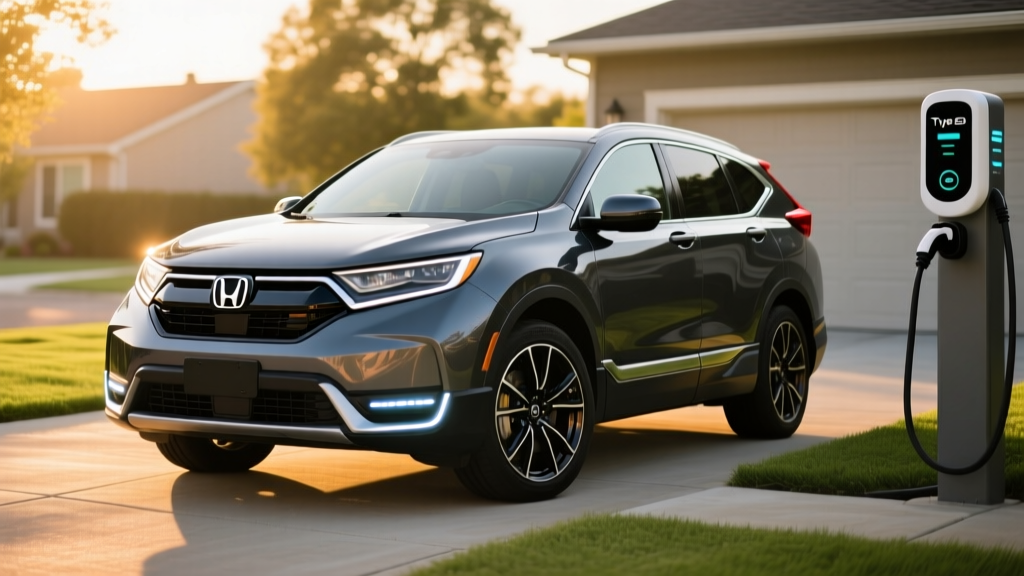
The 2025 Honda CR-V Sport Hybrid sits in the sweet spot of the compact crossover segment: it delivers meaningful fuel savings over the gas-only CR-V without requiring a plug, a lifestyle change, or a steep price premium. With an EPA-rated 40 MPG combined, a refined two-motor hybrid system, and Honda's strong reliability record, the Sport Hybrid trim is arguably the best value in the CR-V lineup for drivers who want efficiency without range anxiety or charging logistics.
But how does that EPA number hold up in real-world driving? And does the hybrid premium over the gas model pay for itself? This guide covers every spec, cost, and ownership detail you need before signing.
HEV vs PHEV: What the CR-V Sport Hybrid Actually Is
Before diving into numbers, it's critical to understand what you're buying — because confusion between conventional hybrids and plug-in hybrids is the single most common mistake shoppers make.
| Feature | Conventional Hybrid (HEV) | Plug-in Hybrid (PHEV) |
|---|---|---|
| Plug-in charging required? | No — refuels with gas only | Yes — plugs in for electric-only miles |
| Battery size | ~1.0–1.5 kWh (small) | ~12–20+ kWh (large) |
| Electric-only range | None (motor assists engine) | Typically 25–45 miles |
| Federal tax credit (§30D) | Not eligible | Up to $7,500 (if eligible) |
| Example | 2025 Honda CR-V Sport Hybrid | Toyota RAV4 Prime, Hyundai Tucson PHEV |
The 2025 Honda CR-V Sport Hybrid is a conventional hybrid (HEV). You never plug it in. It uses a small lithium-ion battery that recharges through regenerative braking and the gasoline engine. Honda does not currently offer a plug-in hybrid (PHEV) version of the CR-V in the United States, so if you want electric-only commuting range, you'll need to look at competitors like the Toyota RAV4 Prime or the Hyundai Tucson PHEV.
Fuel Economy: EPA Ratings and Real-World MPG
The headline number for the 2025 CR-V Sport Hybrid is its EPA-estimated fuel economy. Here's the full breakdown for both FWD and AWD configurations, sourced from fueleconomy.gov:
| Drivetrain | City MPG | Highway MPG | Combined MPG |
|---|---|---|---|
| FWD | 43 | 36 | 40 |
| AWD | 40 | 34 | 37 |
Real-World MPG Reality Check: Honda's two-motor hybrid system excels in city driving, where the electric motor handles low-speed propulsion and regenerative braking recaptures energy at every stop. In real-world mixed driving, many owners report matching or slightly exceeding the EPA city figure — 41–44 MPG in stop-and-go traffic is common. Highway driving is a different story: at sustained 70–80 MPH, expect 33–36 MPG with AWD, since the gasoline engine does most of the work and aerodynamic drag dominates. In cold weather (below 30°F), expect a 5–10% drop as the engine runs more frequently to provide cabin heat.
For comparison, the gas-only 2025 CR-V (1.5L turbo, AWD) earns an EPA 29 MPG combined — meaning the Sport Hybrid AWD delivers roughly 28% better fuel economy in mixed driving, with even larger gains in city traffic.
Powertrain Specs: Two-Motor Hybrid System
The 2025 CR-V Sport Hybrid uses Honda's fourth-generation two-motor hybrid system, which pairs a 2.0-liter Atkinson-cycle four-cylinder engine with two electric motors and an electronically controlled continuously variable transmission (e-CVT).
| Specification | 2025 Honda CR-V Sport Hybrid |
|---|---|
| Engine | 2.0L Atkinson-cycle I-4 |
| Combined System Horsepower | 204 hp |
| Combined System Torque | 247 lb-ft (electric motor torque) |
| Transmission | e-CVT (no traditional gears) |
| Drivetrain Options | FWD or AWD (rear motor-driven) |
| Hybrid Battery Type | Lithium-ion (~1.06 kWh) |
| 0–60 MPH (est.) | ~7.6 seconds |
| Towing Capacity | 1,000 lbs |
| Fuel Tank | 14.0 gallons |
| Total Driving Range (FWD, est.) | ~560 miles |
The two-motor system operates differently than a traditional hybrid like Toyota's planetary-gear setup. At low speeds, the CR-V Sport Hybrid drives primarily on its electric traction motor, with the gas engine acting as a generator to feed electricity. At highway speeds, a lock-up clutch connects the engine directly to the wheels for better efficiency. The result is smooth, responsive acceleration off the line — the 247 lb-ft of electric motor torque is available immediately, which makes the CR-V Hybrid feel noticeably quicker around town than its 190-hp gas-only sibling, even though the 0–60 time is only marginally faster.
Pricing, Trims, and Tax Credit Eligibility
The 2025 Honda CR-V Sport Hybrid is available in two trim levels. Pricing below includes Honda's destination charge:
| Trim | Drivetrain | MSRP (incl. destination) |
|---|---|---|
| Sport Hybrid | FWD | $36,395 |
| Sport Hybrid | AWD | $37,895 |
| Sport-L Hybrid | FWD | $39,695 |
| Sport-L Hybrid | AWD | $41,195 |
| Sport Touring Hybrid | AWD (std) | $45,595 |
Federal Tax Credit: The 2025 Honda CR-V Sport Hybrid does not qualify for the federal §30D Clean Vehicle Credit. That credit — up to $7,500 — applies only to plug-in electric vehicles (BEVs and PHEVs) that meet battery sourcing, critical minerals, MSRP caps, and buyer income requirements as outlined by the IRS. Conventional hybrids like the CR-V Sport Hybrid are excluded.
Some states and local utilities offer rebates or incentives for conventional hybrids, but these vary widely by jurisdiction. Check your state energy office or utility provider for current programs. Do not rely on dealer claims — verify eligibility through official state sources.
Hybrid Battery Warranty and Long-Term Reliability
Hybrid battery longevity is the top concern for first-time hybrid buyers, and it's a fair one — a replacement battery is a significant expense. Here's what Honda covers:
Honda Hybrid Battery Warranty
- Coverage: 8 years / 100,000 miles (10 years / 150,000 miles in CARB states including CA, NY, MA, and others that follow California emissions standards)
- What's covered: Defects and capacity loss below a functional threshold
- Powertrain warranty: 5 years / 60,000 miles (covers engine, motors, e-CVT)
- Replacement cost (out of warranty): Approximately $2,000–$4,000 for the hybrid battery pack, based on current parts pricing and independent shop labor rates
In practice, Honda's hybrid battery packs have proven highly durable. Data from fleet operators and long-term owner surveys suggest that Honda hybrid batteries routinely last 150,000–200,000+ miles before significant degradation. The CR-V Hybrid's relatively small battery (~1.06 kWh) experiences shallow charge cycles — it rarely goes from fully depleted to fully charged — which is gentler on the cells than the deep cycles a full EV or PHEV battery undergoes.
Honda's overall reliability reputation remains strong. The CR-V line consistently earns above-average reliability scores from sources like Consumer Reports and J.D. Power. The hybrid system adds complexity (two motors, power electronics, regenerative braking), but Honda has been refining this architecture since the Insight and Accord Hybrid — there are no first-year teething issues to worry about with the 2025 model.
Hybrid vs PHEV vs EV: Which Powertrain Fits You?
The CR-V Sport Hybrid competes in a segment where shoppers are also considering plug-in hybrids and full electric vehicles. Here's a practical decision framework:
Choose the CR-V Sport Hybrid (HEV) if:
- You don't have access to home or workplace charging (apartment, street parking, no garage outlet)
- You want better fuel economy with zero behavioral change — just fill up with gas
- You regularly drive 300+ miles between stops and don't want to plan around charging
- Your budget is under $42,000 and you want AWD
- You live in an area with sparse public charging infrastructure
Choose a PHEV (like the Toyota RAV4 Prime) if:
- You can charge at home (Level 1 or Level 2) and have a commute under 40 miles
- You want to drive mostly on electricity daily but need gas flexibility for road trips
- You want access to the $7,500 federal tax credit (if eligible under current IRS §30D rules)
Choose a full EV (like the Hyundai Ioniq 5 or Tesla Model Y) if:
- You have reliable home Level 2 charging
- Your daily driving is under 250 miles and you're comfortable with road-trip charging planning
- You want the lowest per-mile fuel cost and minimal maintenance
- You qualify for federal/state EV incentives that offset the higher purchase price
The CR-V Sport Hybrid's advantage is simplicity. You get 37–40 MPG without installing a charger, changing your routine, or worrying about public charging reliability. The trade-off is that you'll always pay for gasoline, and you miss out on the federal tax credit that can make PHEVs and EVs more affordable on paper.
5-Year Cost of Ownership: Hybrid vs Gas CR-V
Does the hybrid premium pay for itself? Let's compare the CR-V Sport Hybrid AWD ($37,895) against the gas-only CR-V EX AWD ($36,295) over 5 years and 75,000 miles, assuming $3.50/gallon regular unleaded and 15,000 miles/year:
| Cost Factor | CR-V Sport Hybrid AWD | CR-V EX AWD (Gas) |
|---|---|---|
| MSRP | $37,895 | $36,295 |
| EPA Combined MPG | 37 | 29 |
| Fuel cost (75,000 mi @ $3.50/gal) | $7,095 | $9,052 |
| Estimated maintenance (5 yr) | ~$2,800 | ~$3,200 |
| 5-year total (purchase + fuel + maint.) | ~$47,790 | ~$48,547 |
The hybrid's $1,600 MSRP premium is largely recovered through fuel savings alone within 5 years — and you'll continue to save for as long as you own the vehicle. The hybrid also tends to have slightly lower brake wear costs thanks to regenerative braking doing much of the deceleration work. Insurance costs are comparable between the two models.
Pros and Cons
Pros
- 40 MPG combined (FWD) — best-in-class for non-plug-in compact SUVs
- Strong low-end torque (247 lb-ft) from electric motor makes city driving effortless
- No plug-in charging required — zero lifestyle adjustment
- Honda's proven hybrid reliability and 8–10 year battery warranty
- Spacious interior with 36.3 cu ft cargo volume (seats up)
- Standard Honda Sensing safety suite (adaptive cruise, lane keeping, AEB)
Cons
- No PHEV option — can't drive on electricity alone or access §30D tax credit
- Highway MPG (34–36) is less impressive than city MPG — highway commuters save less
- Engine drone under hard acceleration (e-CVT characteristic)
- Towing limited to 1,000 lbs (gas CR-V also limited, but worth noting)
- Sport Touring Hybrid trim pushes past $45,000 — approaching luxury crossover territory
Frequently Asked Questions
How many MPG does the 2025 Honda CR-V Sport Hybrid get?
The FWD model is EPA-rated at 43 city / 36 highway / 40 combined MPG. The AWD model drops slightly to 40 city / 34 highway / 37 combined. In real-world city driving, many owners report matching or slightly exceeding the EPA city figure, while sustained highway driving at 75+ MPH typically yields 32–35 MPG.
Does the CR-V Sport Hybrid need to be plugged in?
No. The CR-V Sport Hybrid is a conventional hybrid (HEV), not a plug-in hybrid. Its small lithium-ion battery recharges through regenerative braking and the gasoline engine. You refuel it exactly like a normal gas car — at a gas station.
Does the 2025 CR-V Sport Hybrid qualify for a federal tax credit?
No. The federal §30D Clean Vehicle Credit applies only to plug-in electric vehicles (BEVs and PHEVs) meeting specific battery sourcing, MSRP, and buyer income requirements. Conventional hybrids are not eligible. Check your state and utility for possible local hybrid incentives.
How long will the CR-V Hybrid battery last, and what does replacement cost?
Honda warranties the hybrid battery for 8 years/100,000 miles (10 years/150,000 miles in CARB states). Real-world data suggests these batteries commonly last 150,000–200,000+ miles. Out-of-warranty replacement costs approximately $2,000–$4,000 including parts and labor at an independent shop.
Is the CR-V Sport Hybrid faster than the gas CR-V?
Marginally. The hybrid produces 204 combined system horsepower versus 190 hp for the 1.5L turbo gas model, but the real difference is in feel: the hybrid's 247 lb-ft of electric motor torque delivers instant response at low speeds, making it feel quicker in city driving. The 0–60 MPH time is approximately 7.6 seconds for the hybrid versus about 8.0 seconds for the gas model.
Should I get the CR-V Hybrid or a plug-in hybrid like the RAV4 Prime?
If you can charge at home and your daily commute is under 40 miles, the RAV4 Prime (42 miles electric-only range, eligible for up to $7,500 federal credit) may save you more on fuel and qualify for incentives. If you can't charge at home, drive long distances regularly, or prefer simplicity, the CR-V Sport Hybrid is the better fit — no plug, no planning, just strong MPG.