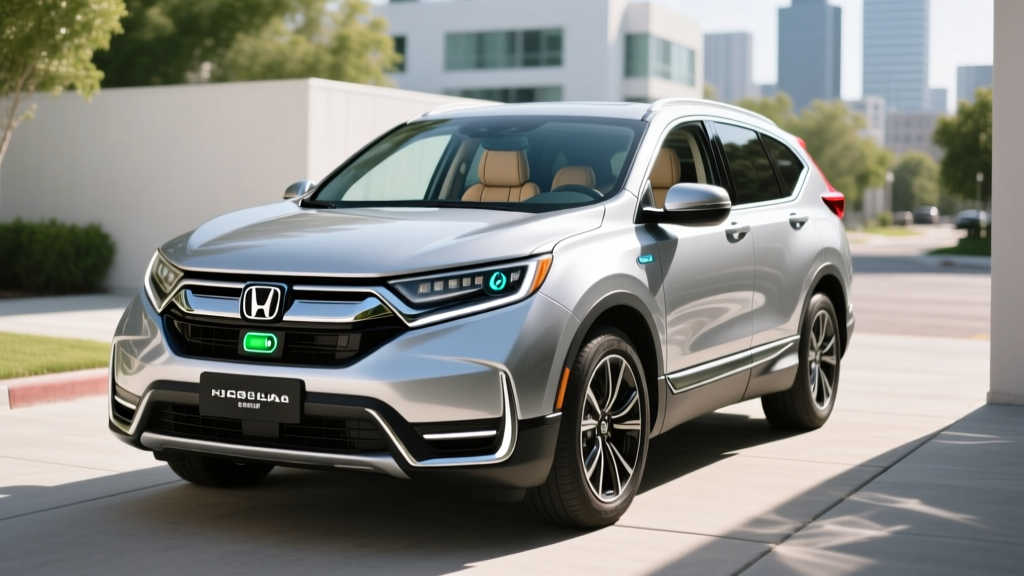
The Honda CR-V Hybrid has quietly become one of the best-selling electrified vehicles in America — not because it's flashy, but because it nails the fundamentals that matter to families: interior space, real-world fuel economy, and long-term reliability. If you've been reading 2025 Honda CR-V Hybrid reviews and wondering whether this SUV actually delivers on its EPA promises, or whether you should look at a plug-in hybrid or full EV instead, this guide breaks down every number that matters.
We'll cover the exact fuel economy figures, powertrain specs, battery warranty terms, trim pricing, and tax-credit eligibility — plus the real-world MPG you can actually expect in daily driving. No marketing fluff, just the data you need to decide.
HEV vs PHEV: What the 2025 CR-V Hybrid Actually Is
Before diving into specs, it's essential to clarify what you're buying. The 2025 Honda CR-V Hybrid is a conventional hybrid electric vehicle (HEV) — not a plug-in hybrid (PHEV). This distinction changes everything about how you own it.
| Feature | HEV (CR-V Hybrid) | PHEV (e.g., Toyota RAV4 Prime) | BEV (e.g., Tesla Model Y) |
|---|---|---|---|
| Plug-in charging | No — refuels at gas station only | Yes — Level 1/2 charging | Yes — Level 1/2/DC fast charging |
| Electric-only range | None (EV assist only at low speed) | ~42 miles (RAV4 Prime) | 260–330 miles |
| Battery size | ~1.06 kWh (small buffer) | ~18.1 kWh usable | 60–82 kWh |
| Home charger needed | No | Recommended (Level 2) | Essential (Level 2) |
| Federal tax credit (§30D) | No | Up to $7,500 (if eligible) | Up to $7,500 (if eligible) |
| Maintenance | Standard hybrid (minimal extra) | Hybrid + EV systems | Minimal (no engine) |
The CR-V Hybrid uses its small lithium-ion battery pack to capture energy from regenerative braking and assist the gasoline engine — you never plug it in. If you want electric-only commuting, you'll need to look at a PHEV or a full battery-electric vehicle (BEV). For drivers who want maximum fuel efficiency without changing their refueling habits, the HEV approach is ideal.
Fuel Economy: EPA Numbers and Real-World MPG
The headline number for the 2025 CR-V Hybrid is its EPA-rated fuel economy, and it's genuinely impressive for a compact SUV with available all-wheel drive.
| Drivetrain | City MPG | Highway MPG | Combined MPG |
|---|---|---|---|
| FWD (Sport / Sport Touring) | 43 | 36 | 40 |
| AWD (Sport / Sport Touring) | 40 | 34 | 37 |
Source: EPA Fuel Economy Guide
Real-World MPG: What Owners Actually Report
Hybrids consistently outperform their EPA ratings in city driving because regenerative braking recovers energy at every stoplight. Based on owner-reported data from Fuelly and Edmunds long-term testing, most CR-V Hybrid drivers see 38–43 MPG combined in mixed suburban and city driving.
However, highway-heavy commutes tell a different story. At sustained 75+ mph speeds, the electric motor provides minimal assist and the 1.5-liter turbocharged engine does most of the work. Expect 32–35 MPG on long highway trips. Cold weather (below 30°F) typically reduces fuel economy by 3–5 MPG due to longer engine warm-up cycles and reduced battery efficiency.
Powertrain and Performance Specs
The 2025 CR-V Hybrid pairs a 1.5-liter turbocharged inline-four engine with Honda's two-motor hybrid system. This isn't a detuned economy setup — it produces meaningful power for merging and passing.
| Specification | 2025 Honda CR-V Hybrid |
|---|---|
| Engine | 1.5L Turbocharged I-4 + 2-motor hybrid system |
| Combined horsepower | 204 hp |
| Combined torque | 247 lb-ft (electric motor torque) |
| Transmission | e-CVT (electronically controlled) |
| 0-60 mph | ~7.4 seconds |
| Drivetrain | FWD or Real Time AWD |
| Towing capacity | 1,000 lbs (not recommended for heavy towing) |
| Battery type | Lithium-ion (approx. 1.06 kWh) |
| Cargo volume | 36.3 cu ft (rear seats up) / 76.5 cu ft (folded) |
The 247 lb-ft of torque from the electric motor gives the CR-V Hybrid strong initial acceleration off the line — it actually feels quicker than the 204 hp figure suggests. The e-CVT eliminates gear-hunting, and the transition between electric and gas power is nearly imperceptible in normal driving. Where the non-hybrid CR-V Turbo produces 190 hp, the Hybrid's extra torque and smoother power delivery make it the more refined choice.
Pricing, Trims, and Tax Credit Eligibility
The 2025 CR-V Hybrid is available exclusively in the Sport and Sport Touring trims, positioning it as the sportier, better-equipped variant within the CR-V lineup.
| Trim | Drivetrain | MSRP (incl. destination) |
|---|---|---|
| Sport Hybrid | FWD | $34,050 |
| Sport Hybrid | AWD | $35,550 |
| Sport Touring Hybrid | AWD (standard) | $38,750 |
Source: Honda Official Specs
Federal Tax Credit: Does the CR-V Hybrid Qualify?
The IRS §30D Clean Vehicle Credit applies only to plug-in electric vehicles (PHEVs and BEVs) with sufficient battery capacity. The CR-V Hybrid's small battery pack does not meet the minimum 7 kWh threshold. No federal purchase credit is available for this vehicle.
Some states offer separate hybrid incentives — check your state's energy office or DMV for current programs. However, the total cost of ownership remains competitive due to fuel savings alone.
5-Year Fuel Cost Advantage
Even without a tax credit, the Hybrid's fuel savings are substantial. At 15,000 miles/year and $3.40/gallon:
- CR-V Hybrid AWD (37 MPG): ~$1,378/year in fuel
- CR-V Turbo AWD (29 MPG combined): ~$1,759/year in fuel
- Annual savings: ~$381/year, or ~$1,905 over 5 years
The $1,500 AWD hybrid premium over a comparable gas AWD trim pays for itself in roughly 4 years of fuel savings alone — and the Hybrid's higher resale value further improves the equation.
Battery Warranty, Reliability, and Replacement Cost
Battery longevity is the single most common concern among first-time hybrid buyers. Here's what Honda covers and what the data shows.
- Hybrid battery: 8 years / 100,000 miles (10 years / 150,000 miles in CARB states including CA, NY, MA, and others)
- Powertrain warranty: 5 years / 60,000 miles
- Hybrid system components: 8 years / 100,000 miles
How Long Do CR-V Hybrid Batteries Actually Last?
Honda's hybrid battery packs are designed for the life of the vehicle. Real-world data from CR-V Hybrid owners (now in their third generation since 2020) shows minimal degradation — most packs retain 90%+ capacity well past 100,000 miles. The small ~1 kWh battery in an HEV undergoes shallow charge/discharge cycles (typically 40–80% state of charge), which dramatically extends cycle life compared to a full EV battery.
If a replacement is ever needed outside warranty, expect a cost of $2,000–$3,500 for the hybrid battery pack (parts and labor). However, based on failure rates from Honda's earlier hybrid systems (Insight, Accord Hybrid), premature battery failure is rare — well under 2% of vehicles require replacement within the first decade.
Reliability Ratings
The CR-V Hybrid carries strong reliability expectations based on Honda's track record with two-motor hybrid systems. The current-generation hybrid powertrain has been in production since 2020 with minimal revisions, suggesting a mature, well-debugged design. IIHS has rated the CR-V as a Top Safety Pick+, and the hybrid variant shares the same structural platform and crash performance.
CR-V Hybrid vs. Competitors: How It Stacks Up
The compact hybrid SUV segment is competitive. Here's how the CR-V Hybrid compares to its two biggest rivals on the specs that matter.
| Spec | 2025 Honda CR-V Hybrid AWD | 2025 Toyota RAV4 Hybrid AWD | 2025 Hyundai Tucson Hybrid AWD |
|---|---|---|---|
| Combined MPG (EPA) | 37 | 39 | 38 |
| Combined HP | 204 | 219 | 226 |
| 0-60 mph | ~7.4 sec | ~7.0 sec | ~7.1 sec |
| Cargo (rear up) | 36.3 cu ft | 37.5 cu ft | 38.7 cu ft |
| AWD MSRP (base) | $35,550 | $34,050 | $34,260 |
| Hybrid battery warranty | 8 yr / 100k mi | 10 yr / 150k mi | 10 yr / 100k mi |
The RAV4 Hybrid edges out the CR-V on EPA fuel economy and cargo space, while the Tucson Hybrid offers the most power. The CR-V Hybrid's advantage lies in driving refinement — its e-CVT tuning is smoother, the cabin is quieter at highway speeds, and Honda's Honda Sensing suite of driver-assistance features is standard across all hybrid trims. If interior quality and ride comfort matter as much as MPG, the CR-V Hybrid makes a compelling case despite the 2 MPG deficit to Toyota.
Who Should Buy the CR-V Hybrid — and Who Shouldn't
Choose the CR-V Hybrid If:
- You drive 12,000–18,000 miles/year in mixed city/suburban conditions and want to cut fuel costs without plugging in
- You want AWD capability for snow or light trails without a fuel-economy penalty
- You don't have access to home or workplace EV charging
- You want a proven hybrid system with strong resale value and a long battery warranty
- You need a spacious compact SUV that can handle family cargo without compromise
Look at a PHEV Instead If:
- You have home charging and a commute under 40 miles (a RAV4 Prime or Tucson PHEV lets you drive mostly on electricity)
- You want to qualify for the $7,500 federal tax credit (subject to income, MSRP, and sourcing requirements)
Look at a Full EV Instead If:
- You have reliable Level 2 home charging and want zero tailpipe emissions
- Your daily driving is under 250 miles and you want the lowest per-mile fuel cost
- You want to eliminate oil changes, spark plugs, and transmission maintenance entirely
Pros and Cons at a Glance
Pros
- 40 MPG combined (FWD) — best-in-class city efficiency at 43 MPG
- Smooth, quiet hybrid powertrain with 204 hp and strong low-end torque
- Spacious cargo area (36.3 cu ft) with no hybrid-compromise packaging
- Standard Honda Sensing ADAS on all hybrid trims
- Strong resale value — CR-V Hybrids hold premium over gas models at trade-in
- No plug-in required — works with your existing routine
Cons
- No federal tax credit eligibility (HEV, not PHEV)
- AWD fuel economy drops to 37 MPG combined — 2 MPG behind RAV4 Hybrid AWD
- Hybrid only available on Sport/Sport Touring trims ($34,050+ starting MSRP)
- 1,000-lb towing capacity — not suitable for trailers or boats
- Highway MPG (34–36) less impressive than city — limited benefit for road-trip-heavy drivers
- No spare tire — tire repair kit only
Frequently Asked Questions
How many MPG does the 2025 Honda CR-V Hybrid get?
The FWD CR-V Hybrid achieves an EPA-rated 43 city / 36 highway / 40 combined MPG. The AWD version rates at 40 city / 34 highway / 37 combined. In real-world mixed driving, most owners report 38–43 MPG combined, with city driving often exceeding the EPA estimate thanks to regenerative braking.
Does the CR-V Hybrid need to be plugged in?
No. The CR-V Hybrid is a conventional hybrid (HEV). Its small lithium-ion battery charges exclusively through regenerative braking and the gasoline engine. You refuel at any gas station — no charging equipment or behavior change is required.
Does the 2025 CR-V Hybrid qualify for any federal tax credit?
No. The IRS §30D Clean Vehicle Credit requires a plug-in vehicle with at least 7 kWh of battery capacity. The CR-V Hybrid's ~1 kWh battery does not qualify. No federal purchase incentive is available, though some states may offer hybrid-specific rebates — check your state energy office.
Is the CR-V Hybrid battery reliable, and what does replacement cost?
Honda's hybrid battery packs have an excellent reliability record, with failure rates well under 2% in the first decade. The battery is warrantied for 8 years/100,000 miles (10 years/150,000 miles in CARB states). Out-of-warranty replacement costs approximately $2,000–$3,500 including labor, though most packs last the life of the vehicle.
Should I buy the CR-V Hybrid or wait for a CR-V PHEV?
Honda has not announced a CR-V PHEV for the US market as of 2025. If you need plug-in electric range, consider the Toyota RAV4 Prime (42 miles EV range, eligible for federal credit) or the Hyundai Tucson PHEV (33 miles EV range). If plug-in capability isn't essential, the CR-V Hybrid is an excellent buy-now option with no charging infrastructure requirements.
How does the CR-V Hybrid compare to a full EV for daily commuting?
A full EV like the Tesla Model Y or Hyundai Ioniq 5 offers lower per-mile fuel costs (roughly $0.04–0.06/mile vs. $0.09/mile for the CR-V Hybrid) and zero tailpipe emissions. However, EVs require home Level 2 charging, have higher upfront costs, and may not suit apartment dwellers or high-mileage road-trippers. The CR-V Hybrid is the pragmatic choice if you want electrified efficiency without infrastructure dependency.
What's the difference between the Sport and Sport Touring Hybrid trims?
The Sport Hybrid ($34,050 FWD / $35,550 AWD) includes Honda Sensing, a 7-inch touchscreen, wireless Apple CarPlay/Android Auto, and heated front seats. The Sport Touring Hybrid ($38,750, AWD only) adds a 9-inch touchscreen with wireless CarPlay, navigation, Bose premium audio, wireless phone charging, heated rear seats, a hands-free power tailgate, and leather-trimmed interior. Both share the identical 204 hp hybrid powertrain.