Quick Verdict: A Compact SUV That Sips Fuel in the City
The 2025 Honda CR-V Hybrid targets buyers who want crossover utility without the fuel bill of a turbocharged gas model — and without the range anxiety or charging logistics of a full battery-electric vehicle. With an EPA-estimated 40 MPG combined, the CR-V Hybrid ranks among the most efficient compact crossovers on the market, and it consistently beats that number in stop-and-go city driving where its two-motor hybrid system recaptures the most energy. If your daily routine involves suburban errands, school drop-offs, or urban commuting, the CR-V Hybrid's efficiency advantage over the gas-only CR-V is substantial and immediately measurable at the pump.
This guide breaks down every efficiency number, the powertrain engineering behind them, real-world fuel economy expectations, battery longevity data, and whether a hybrid, plug-in hybrid, or full EV makes more sense for your household.
2025 Honda CR-V Hybrid MPG: The Official EPA Numbers
The EPA rates the 2025 CR-V Hybrid differently depending on drivetrain configuration. Front-wheel drive (FWD) models edge out all-wheel drive (AWD) variants by a small margin, though both deliver class-leading efficiency for the compact SUV segment.
| Configuration | City MPG | Highway MPG | Combined MPG | Annual Fuel Cost* |
|---|---|---|---|---|
| FWD (Sport / Sport Touring) | 43 | 36 | 40 | ~$1,450 |
| AWD (Sport / Sport Touring) | 40 | 34 | 37 | ~$1,575 |
*Annual fuel cost based on 15,000 miles/year, 55% city / 45% highway, and $3.50/gallon regular unleaded per fueleconomy.gov estimates. Actual costs vary by region and driving habits.
Owners and independent testers routinely report that the CR-V Hybrid exceeds its EPA city rating in genuine urban driving — figures of 44–48 MPG are common in stop-and-go traffic below 40 mph, where the electric motors do the majority of propulsion work. Highway cruising at 70–80 mph, however, tends to yield 32–35 MPG for AWD models, slightly below the EPA highway estimate. Cold weather (below 30°F) can reduce combined efficiency by 5–10% due to increased engine operation for cabin heating and reduced battery efficiency. If your commute is mostly city and suburban, expect to beat the sticker. If you're primarily a highway driver, expect to fall a few MPG short.
How the Two-Motor Hybrid Powertrain Works
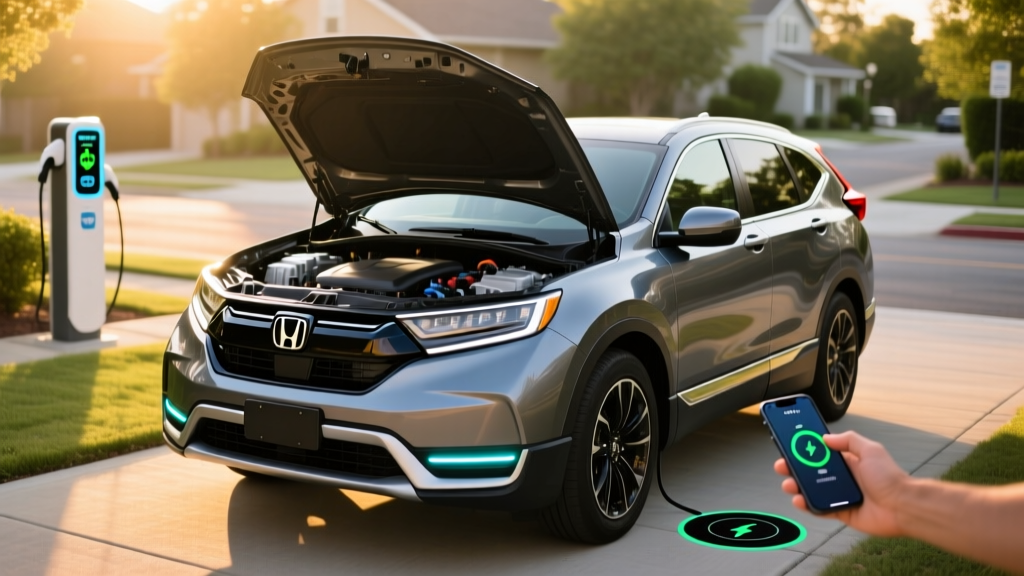
The 2025 CR-V Hybrid uses Honda's fourth-generation two-motor hybrid system. This is a conventional hybrid (HEV) — it does not plug in and has no electric-only driving range to manage. You fuel it like any other car, and the system handles energy recapture and motor assist automatically.
| Specification | Detail |
|---|---|
| Engine | 2.0L DOHC Atkinson-cycle 4-cylinder |
| Engine Output | 145 hp @ 6,100 rpm / 134 lb-ft torque |
| Drive Motors | Two electric motors (one propulsion, one generator/starter) |
| Propulsion Motor Output | 184 hp / 247 lb-ft torque |
| Combined System Output | 204 hp / 247 lb-ft torque |
| Transmission | e-CVT (no traditional gears — motor-driven with engine direct-drive clutch at highway speed) |
| Hybrid Battery | ~1.06 kWh lithium-ion (nominal) |
| Drivetrain | FWD standard; Real Time AWD available |
| 0–60 mph | ~7.8 seconds (FWD) |
| Towing Capacity | 1,000 lbs |
| Fuel Tank | 14.0 gallons (regular unleaded) |
| Total Driving Range | ~518–560 miles (depending on FWD/AWD) |
The system operates primarily as a series hybrid at low and moderate speeds: the gas engine spins the generator motor, which feeds electricity to the propulsion motor driving the wheels. At steady highway speeds (typically above 45–55 mph), a lock-up clutch engages to let the engine drive the wheels directly, bypassing the electrical conversion and improving efficiency. Under hard acceleration, both the engine and propulsion motor work together for the full 204 hp output.
This architecture means the CR-V Hybrid feels more like an EV around town — smooth, linear torque delivery with no traditional gear shifts — while maintaining the range and refueling convenience of a gas vehicle.
HEV vs. PHEV vs. EV: Which Powertrain Fits Your Life?
The CR-V lineup in 2025 is offered only as a conventional hybrid (HEV) or a turbocharged gas model. Honda does not currently offer a plug-in hybrid (PHEV) CR-V in the United States. Understanding the distinction matters because it determines how you fuel the vehicle, what you'll spend, and whether you need home charging infrastructure.
| Factor | HEV (CR-V Hybrid) | PHEV (e.g., Toyota RAV4 Prime) | BEV (e.g., Tesla Model Y) |
|---|---|---|---|
| Plugs in? | No — gas only | Yes — gas + plug-in | Yes — electricity only |
| Electric-only range | None (motor assist only) | 25–42 miles typical | 260–330 miles typical |
| Total range | ~518–560 mi | ~500–600 mi combined | 260–330 mi (no gas backup) |
| Home charging needed? | No | Recommended (Level 2 ideal) | Essential (Level 2 required) |
| Federal tax credit (§30D) | Not eligible | Up to $7,500 (if eligible) | Up to $7,500 (if eligible) |
| Best for | No charging access; wants simplicity | Home charging + gas flexibility | Home charging; mostly under 250 mi/day |
| Fuel cost (est. annual) | ~$1,450–$1,575 | ~$600–$1,200 (varies by electric share) | ~$500–$800 (varies by electricity rate) |
- You live in an apartment or street-park and cannot install a home charger
- You want maximum simplicity — no apps, no charging cables, no planning
- Your budget is below $38,000 and you don't qualify for or want to navigate tax credits
- You regularly drive more than 300 miles between fill-ups and don't want range anxiety
- You have a garage or driveway where a Level 2 charger can be installed
- Your daily driving is under 40 miles and you want near-zero gasoline use on weekdays
- You qualify for the §30D federal tax credit (up to $7,500 point-of-sale) and want to offset a higher purchase price
Pricing, Trims, and Tax Credit Eligibility
The 2025 CR-V Hybrid is offered in two trims — Sport and Sport Touring — both significantly equipped relative to the gas-only lineup. Pricing reflects the hybrid premium over equivalent gas trims, but the fuel savings typically recover that premium within 3–5 years for average drivers.
| Trim | Drivetrain | MSRP (incl. destination) |
|---|---|---|
| Sport Hybrid | FWD | ~$35,850 |
| Sport Hybrid | AWD | ~$37,350 |
| Sport Touring Hybrid | AWD (standard) | ~$40,850 |
The IRS §30D Clean Vehicle Credit applies only to plug-in electric vehicles (PHEVs and BEVs) with a battery capacity of at least 7 kWh. The CR-V Hybrid's ~1.06 kWh battery does not meet this threshold. No federal tax credit is available for conventional hybrids.
- §30D credit: Not applicable (HEV — insufficient battery capacity)
- State/local incentives: Some states offer rebates for high-efficiency hybrids, but these are uncommon and vary by jurisdiction — check your state energy office or AFDC state incentive database
- Used hybrid credit (§25E): If purchasing a qualifying used CR-V Hybrid from a dealer for $25,000 or less, you may be eligible for up to $4,000 (30% of sale price, capped) — income limits apply per IRS §25E rules
Battery Warranty, Longevity, and Replacement Cost
Battery reliability is the single most common concern among hybrid shoppers. Honda addresses this with a comprehensive warranty, and real-world data from Honda's hybrid lineup (now in its third decade, starting with the original Insight) supports long service life.
- Coverage: 8 years / 100,000 miles (10 years / 150,000 miles in CARB states including CA, CO, CT, MA, MD, ME, MN, NJ, NY, OR, RI, VT, WA)
- What's covered: Hybrid battery pack, battery control module, and related hybrid system components against defects and abnormal capacity loss
- Capacity threshold: Honda does not publish a specific State of Health (SoH) percentage trigger, but warranty claims are honored when the battery cannot hold sufficient charge to maintain normal hybrid operation
- Powertrain warranty: 5 years / 60,000 miles (covers engine, transmission, and hybrid motor components)
Real-world longevity: Honda's lithium-ion hybrid battery packs in the CR-V Hybrid are small (~1.06 kWh) and operate within a narrow State of Charge window — typically between 20% and 80%. This shallow cycling significantly reduces degradation compared to the deep charge-discharge cycles in a BEV. Based on data from Honda Accord Hybrid and CR-V Hybrid fleets, most packs retain functional capacity well beyond 150,000 miles. Out-of-warranty replacement is uncommon but, when needed, typically costs between $2,000 and $4,000 for parts and labor at a Honda dealership.
How to maximize hybrid battery life:
- Drive normally — the battery management system handles SoC limits automatically; you don't need to baby it
- Avoid prolonged storage at extreme temperatures (if the car will sit unused for weeks, start it periodically to let the system cycle)
- Keep up with scheduled maintenance — the hybrid system cooling vents should remain unobstructed
CR-V Hybrid vs. Key Competitors: MPG and Value Compared
The compact hybrid SUV segment is competitive. Here's how the CR-V Hybrid stacks up against its primary rivals on the metrics that matter most to efficiency-focused buyers.
| Specification | Honda CR-V Hybrid (FWD) | Toyota RAV4 Hybrid (AWD) | Hyundai Tucson Hybrid (AWD) | Ford Escape Hybrid (FWD) |
|---|---|---|---|---|
| EPA Combined MPG | 40 | 39 | 35 | 39 |
| EPA City MPG | 43 | 41 | 35 | 42 |
| EPA Highway MPG | 36 | 38 | 35 | 36 |
| Combined HP | 204 | 219 | 226 | 200 |
| Cargo Volume (behind rear seats) | 36.3 cu ft | 37.6 cu ft | 38.7 cu ft | 34.4 cu ft |
| Starting MSRP (Hybrid) | ~$35,850 | ~$33,825 | ~$34,585 | ~$34,000 |
| Hybrid Battery Warranty | 8 yr / 100k mi | 10 yr / 150k mi | 10 yr / 100k mi | 8 yr / 100k mi |
The CR-V Hybrid's 43 MPG city rating leads the segment. The RAV4 Hybrid is close and offers a slightly lower entry price and longer battery warranty. The Tucson Hybrid provides the most cargo space but trails on efficiency. The Escape Hybrid is competitive on MPG but has been less consistent in reliability surveys. According to IIHS, the 2025 CR-V earns top safety marks, which matters for family buyers cross-shopping this segment.
- Best-in-class 43 MPG city (FWD) — exceeds EPA in real urban driving
- Smooth, EV-like low-speed driving feel with no plug-in required
- Spacious cabin with 36.3 cu ft cargo volume and comfortable rear seats
- Top IIHS safety ratings and standard Honda Sensing ADAS suite
- Strong resale value — Honda hybrids hold value well in the used market
- AWD models drop to 37 combined MPG — a meaningful penalty vs. FWD
- Hybrid only available in Sport/Sport Touring trims (~$35,850+ starting)
- No federal tax credit eligibility — HEVs don't qualify under §30D
- Highway MPG (34–36) falls short of city numbers — less ideal for road-trip-heavy drivers
- 1,000-lb towing capacity limits utility for boat or camper trailers
- 8-year battery warranty is shorter than Toyota's 10-year coverage
Who Should Buy the 2025 CR-V Hybrid — and Who Shouldn't
The CR-V Hybrid is a purpose-built solution for a specific buyer profile. It excels when your driving is predominantly urban and suburban, you want a no-compromise compact SUV, and you have no interest in managing charging logistics.
Ideal CR-V Hybrid buyer:
- Daily commute of 15–40 miles with significant stop-and-go traffic
- No garage or driveway access for a Level 2 charger (apartment, condo, street parking)
- Wants a single-vehicle household solution that handles road trips without range planning
- Values long-term reliability and low maintenance — hybrids eliminate the traditional starter motor, reduce brake wear via regenerative braking, and use an Atkinson-cycle engine that runs under less stress
- Budget between $35,000 and $42,000
Look elsewhere if:
- You drive mostly highway miles above 70 mph — the hybrid advantage shrinks, and a diesel or efficient gas model may match it
- You need towing capacity above 1,000 lbs — consider the gas CR-V (1,500 lbs) or a midsize SUV
- You have home charging access and a daily commute under 30 miles — a PHEV like the RAV4 Prime (42 miles electric-only) or a BEV will cost less per mile and may qualify for up to $7,500 in federal credits
- You want the lowest possible purchase price — the gas-only CR-V LX starts around $31,450, though you'll spend ~$500–$700 more per year on fuel
Frequently Asked Questions
How many MPG does the 2025 Honda CR-V Hybrid actually get?
The EPA rates the CR-V Hybrid FWD at 43 city / 36 highway / 40 combined, and the AWD at 40 city / 34 highway / 37 combined. In real-world driving, city-dominant commuters often report 44–48 MPG in FWD models, while highway-heavy drivers at 75+ mph typically see 32–35 MPG. Cold weather and aggressive acceleration reduce these figures by roughly 5–10%.
Does the CR-V Hybrid need to be plugged in?
No. The CR-V Hybrid is a conventional hybrid (HEV). It charges its small battery pack entirely through regenerative braking and the onboard gasoline engine. You never plug it in — you simply refuel with regular unleaded gasoline like any other car.
Is there a plug-in hybrid (PHEV) version of the CR-V?
Not in the United States as of the 2025 model year. Honda offers a CR-V e:PHEV in China and Europe, but it has not been introduced to the North American market. If plug-in capability is a priority, the Toyota RAV4 Prime (42 miles electric-only, up to $7,500 federal credit) is the closest competitor in this segment.
Is the CR-V Hybrid reliable, and what does battery replacement cost?
Honda's hybrid system has a strong reliability track record spanning two decades. The CR-V Hybrid's lithium-ion battery pack is warrantied for 8 years/100,000 miles (10 years/150,000 miles in CARB states). Out-of-warranty replacement, while uncommon before 150,000 miles, typically costs $2,000–$4,000 including labor. The hybrid system actually reduces wear on several conventional components — the regenerative braking system extends brake pad life, and there is no traditional starter motor or alternator to replace.
Does the 2025 CR-V Hybrid qualify for any tax credits?
The CR-V Hybrid does not qualify for the federal §30D Clean Vehicle Credit, which requires a plug-in vehicle with at least 7 kWh of battery capacity. Some states may offer minor incentives for high-efficiency hybrids, but these are uncommon. If you purchase a used CR-V Hybrid for $25,000 or less from a dealer, you may qualify for the §25E used clean vehicle credit (up to $4,000), though this credit is more commonly applied to used PHEVs and BEVs. Consult a tax professional or check current rules at IRS.gov.
How does the CR-V Hybrid compare to the gas-only CR-V on fuel cost?
The gas-only 2025 CR-V AWD is EPA-rated at 29 combined MPG. At 15,000 miles per year and $3.50/gallon, you'd spend approximately $1,810 annually on fuel. The CR-V Hybrid AWD at 37 combined MPG costs roughly $1,420 per year — a savings of about $390 annually. Over a 5-year ownership period, that's approximately $1,950 in fuel savings, which largely offsets the hybrid's higher purchase price.
What is the total driving range of the CR-V Hybrid?
With its 14.0-gallon fuel tank, the FWD CR-V Hybrid can travel approximately 560 miles on a fill-up (14.0 × 40 MPG combined). The AWD model delivers roughly 518 miles (14.0 × 37 combined). These figures exceed most BEVs and eliminate any range anxiety on long road trips.