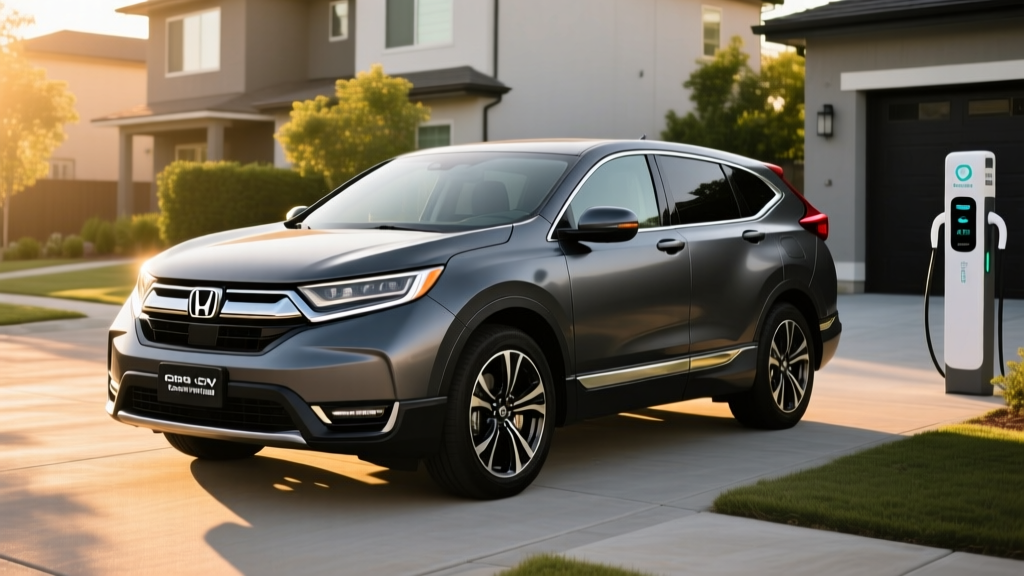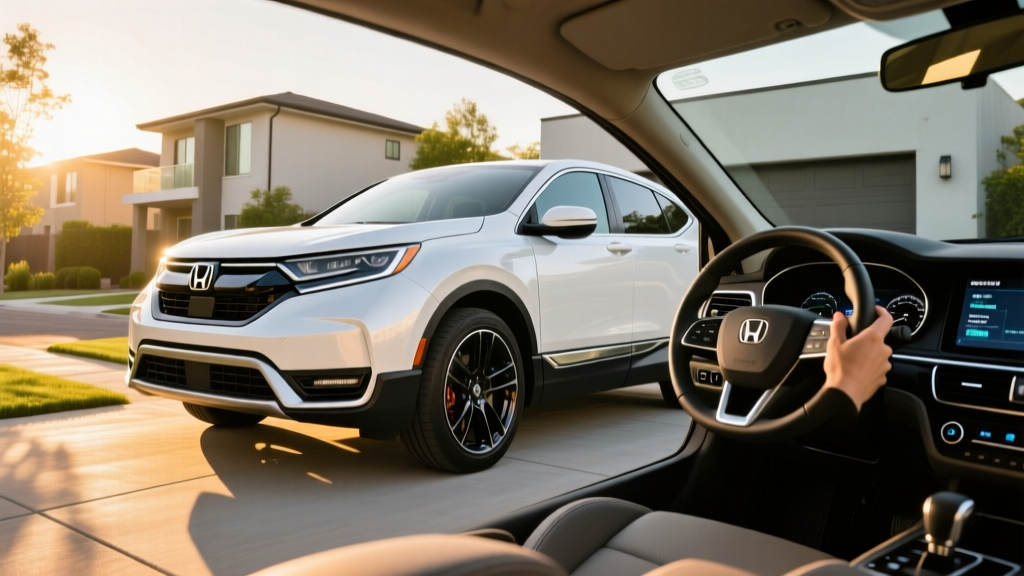
The compact SUV segment is crowded, but the 2025 Honda CR-V Sport Hybrid carves out a distinct position by pairing the practicality of Honda's best-selling crossover with a two-motor hybrid system that prioritizes fuel efficiency without sacrificing everyday usability. If you're cross-shopping compact SUVs and weighing whether a conventional hybrid (HEV) makes more sense than a plug-in hybrid (PHEV) or a battery-electric vehicle (BEV), this guide gives you the exact numbers, warranty details, and ownership math you need to decide.
2025 Honda CR-V Sport Hybrid: Quick Verdict
The CR-V Sport Hybrid is a conventional, self-charging hybrid — meaning it has no plug, no electric-only range to manage, and no charging infrastructure dependency. You fuel it like any other gas car, and the hybrid system handles the rest. The Sport and Sport Touring trims represent Honda's sportier aesthetic packaging for the hybrid powertrain, and they sit above the base LX Hybrid in both features and price. For buyers who want strong city MPG, proven Honda reliability, and zero lifestyle change from their current gas vehicle, this is one of the most rational compact SUVs on the market.
HEV vs PHEV: What the CR-V Sport Hybrid Actually Is
Conventional Hybrid (HEV) — What the CR-V Sport Hybrid Is
- No plug required. The battery recharges through regenerative braking and the gasoline engine.
- No electric-only driving range. The electric motor assists the engine but cannot propel the vehicle alone for meaningful distances.
- Lower upfront cost. Typically $1,000–$3,000 more than a gas-only equivalent, not $5,000–$10,000 like a PHEV.
- No federal tax credit. IRS §30D applies only to plug-in vehicles with ≥7 kWh of battery capacity.
Plug-In Hybrid (PHEV) — What the CR-V Is NOT
- PHEVs like the Toyota RAV4 Prime or Hyundai Tucson PHEV offer 30–42 miles of electric-only range.
- PHEVs require home charging (Level 1 or Level 2) to capture their efficiency advantage.
- PHEVs may qualify for partial or full federal tax credits depending on battery sourcing and buyer income.
If you were hoping the CR-V Sport Hybrid could be plugged in for electric-only commuting, you'll need to look at competitors like the RAV4 Prime (42 mi electric range) or wait to see if Honda introduces a CR-V PHEV for the US market. As of the 2025 model year, Honda offers no plug-in CR-V in the United States.
Fuel Economy: EPA Ratings and Real-World MPG
Fuel economy is the headline reason buyers choose the CR-V Sport Hybrid over its gas-only sibling. Here's how the numbers break down according to EPA data at fueleconomy.gov:
| Drivetrain | City MPG | Highway MPG | Combined MPG |
|---|---|---|---|
| CR-V Sport Hybrid (FWD) | 43 | 36 | 40 |
| CR-V Sport Hybrid (AWD) | 40 | 34 | 37 |
| CR-V Sport Touring Hybrid (AWD only) | 40 | 34 | 37 |
Real-World MPG: What to Actually Expect
Honda's two-motor hybrid system excels in stop-and-go city driving, where regenerative braking recaptures energy and the electric motor handles low-speed propulsion. In real-world mixed driving, owners consistently report meeting or slightly exceeding EPA city estimates — a rarity in the EV/PHEV world where real-world numbers typically fall short.
- City-heavy commuting (under 45 mph): Expect 41–45 MPG in the FWD model. The hybrid system is at its best here.
- Highway cruising (70–80 mph): Expect 32–35 MPG. Aerodynamic drag and the engine running continuously at speed reduce the hybrid advantage.
- Cold weather (below 32°F): Expect a 5–10% reduction, dropping combined to roughly 34–37 MPG for AWD. The engine runs more frequently to provide cabin heat, reducing electric-motor assist time.
- Mixed daily driving: Most owners report 36–40 MPG combined in AWD trims, which tracks closely with the EPA rating.
Compared to the gas-only CR-V AWD (28 MPG combined per EPA), the hybrid delivers roughly 32% better fuel economy — a substantial gain that translates to approximately $400–$600 in annual fuel savings for a driver covering 15,000 miles per year at $3.40/gallon.
Powertrain and Performance Specs
| Specification | 2025 CR-V Sport Hybrid |
|---|---|
| Engine | 2.0L Atkinson-cycle 4-cylinder |
| Engine Output | 145 hp / 138 lb-ft torque |
| Electric Motors | Two-motor hybrid system |
| Combined System Output | 204 hp / 247 lb-ft torque |
| Transmission | e-CVT (no traditional gears) |
| Drivetrain | FWD (Sport) / AWD (Sport & Sport Touring) |
| 0–60 mph (est.) | ~7.5 seconds |
| Towing Capacity | 1,000 lbs |
| Cargo Volume (behind 2nd row) | 36.3 cu ft |
| Cargo Volume (seats folded) | 76.5 cu ft |
Honda's two-motor hybrid system operates differently from Toyota's planetary-gear hybrid setup. At low speeds, the CR-V Sport Hybrid drives primarily on its electric motor, with the gasoline engine acting as a generator to feed electricity. At highway speeds, a lock-up clutch connects the engine directly to the wheels for efficiency. This gives the CR-V a smoother, more EV-like feel in city driving compared to some competitors, though the engine drone under hard acceleration is still noticeable through the e-CVT.
Battery Warranty, Lifespan, and Replacement Cost
Honda Hybrid Battery Warranty
- Hybrid battery coverage: 8 years / 100,000 miles (10 years / 150,000 miles in CARB states including CA, CT, MA, ME, MD, NJ, NY, OR, RI, VT, WA)
- Capacity threshold: Honda warrants the battery against defects and abnormal capacity loss, though no specific percentage retention guarantee is published (unlike some EV makers that warrant 70% capacity).
- Powertrain warranty: 5 years / 60,000 miles (covers engine, transmission, and hybrid components)
How Long Will the CR-V Hybrid Battery Last?
Honda's hybrid battery packs use nickel-metal hydride (NiMH) and lithium-ion chemistry depending on the generation, with the current-generation CR-V Hybrid using a lithium-ion pack. Real-world data from Honda's earlier hybrid systems (Insight, Accord Hybrid) suggests these batteries typically last 150,000–200,000 miles before significant degradation occurs. Failures before 100,000 miles are uncommon but not unheard of — which is exactly why the 8-year/100,000-mile warranty exists.
Hybrid Battery Replacement Cost
If your CR-V Hybrid battery fails outside warranty coverage, expect the following:
- OEM replacement battery: $2,000–$4,000 (parts only, varies by source)
- Dealer-installed replacement: $3,500–$5,500 including labor
- Refurbished/aftermarket options: $1,500–$2,500 installed at independent hybrid specialists
For context, this is dramatically less expensive than a full EV battery replacement ($8,000–$20,000+), because hybrid battery packs are much smaller (roughly 1–2 kWh usable capacity versus 60–100 kWh in a BEV).
Pricing, Trims, and Tax Credit Eligibility
| 2025 CR-V Hybrid Trim | MSRP (approx.) | Drivetrain |
|---|---|---|
| Sport Hybrid | ~$36,300 | FWD or AWD (+$1,500) |
| Sport Touring Hybrid | ~$40,850 | AWD standard |
Does the 2025 CR-V Sport Hybrid Qualify for a Federal Tax Credit?
No. The CR-V Sport Hybrid is a conventional hybrid (HEV), not a plug-in vehicle. Under IRS §30D rules, only plug-in electric vehicles and fuel-cell vehicles with sufficient battery capacity qualify for the federal clean vehicle credit. Conventional hybrids like the CR-V Sport Hybrid, Toyota RAV4 Hybrid, and Ford Escape Hybrid do not qualify for any federal purchase incentive.
Some states may offer minor incentives for high-efficiency vehicles, but these are rare and typically target zero-emission vehicles. Check your state's energy office or AFDC state law database for any local programs. Honda occasionally offers manufacturer rebates or low-APR financing on hybrid trims — check Honda's current incentives page before purchasing.
Who Should Buy the CR-V Sport Hybrid vs. an EV or PHEV?
✓ Choose the CR-V Sport Hybrid If:
- You don't have reliable home or workplace charging access
- You want better MPG with zero change to your fueling routine
- You frequently take long road trips and don't want to plan around charging stops
- You live in an extreme climate where EV range loss is a concern
- Your budget is under $40,000 and you want AWD
- You prioritize proven reliability and strong resale value
✗ Look at a PHEV or BEV Instead If:
- You have home charging and want electric-only commuting (consider RAV4 Prime, Tucson PHEV)
- You want to qualify for the $7,500 federal tax credit (requires a qualifying BEV or PHEV)
- Your daily commute is under 30 miles and you want zero tailpipe emissions on most trips
- You want one-pedal driving and the instant torque of a full EV
- You want access to HOV lane stickers (available for PHEVs/BEVs in CA, CO, and other states)
Decision Framework: Hybrid vs. PHEV vs. BEV
The right electrified vehicle depends on your charging access, daily mileage, and budget:
- No charging access + long trips → Conventional hybrid (CR-V Sport Hybrid, RAV4 Hybrid)
- Home charging + short commute + long trips → PHEV (RAV4 Prime, Tucson PHEV, Wrangler 4xe)
- Home charging + mostly under 250 mi/day → Full BEV (Tesla Model Y, Hyundai Ioniq 5, Honda Prologue)
Frequently Asked Questions
How many MPG does the 2025 Honda CR-V Sport Hybrid get?
The FWD CR-V Sport Hybrid achieves an EPA-estimated 43 city / 36 highway / 40 combined MPG. The AWD version drops to 40 city / 34 highway / 37 combined. In real-world city-heavy driving, many owners report matching or slightly exceeding the city figure, while highway-only trips at 75+ mph may return 30–33 MPG.
Can I plug in the CR-V Sport Hybrid to charge?
No. The CR-V Sport Hybrid is a conventional hybrid (HEV), not a plug-in hybrid (PHEV). It charges its small battery pack through regenerative braking and the gasoline engine. There is no charge port, no electric-only range, and no need to install a home charger.
How far can the CR-V Sport Hybrid drive on electric only?
Essentially zero miles in pure electric mode. The electric motor assists the gasoline engine and can propel the vehicle at very low speeds for brief moments (such as creeping in traffic), but it cannot sustain electric-only driving. If electric-only range is a priority, you need a PHEV like the Toyota RAV4 Prime (42 mi electric) or a full BEV.
Is the Honda CR-V Hybrid reliable?
Honda's hybrid system has a strong reliability track record, with the two-motor architecture used across the Accord Hybrid, CR-V Hybrid, and Civic Hybrid lineups. Honda's hybrid battery is warranted for 8 years/100,000 miles (10/150,000 in CARB states). The CR-V as a platform consistently earns top safety ratings from IIHS and NHTSA. Long-term reliability data for the current generation (introduced for 2023) is still accumulating, but Honda's hybrid components have proven durable across prior generations.
Does the CR-V Sport Hybrid qualify for any tax credit?
No federal tax credit is available for conventional hybrids. The IRS §30D clean vehicle credit applies only to plug-in electric vehicles and fuel-cell vehicles. Some states may offer minor efficiency incentives, and Honda may offer manufacturer rebates — but there is no $7,500 federal credit for this vehicle.
What is the difference between the Sport and Sport Touring Hybrid trims?
The Sport Touring Hybrid adds premium features over the Sport: standard AWD, a Bose 12-speaker audio system, heated rear seats, a heated steering wheel, navigation, wireless phone charging, a hands-free power tailgate, and upgraded interior materials. The powertrain and fuel economy are identical between the two trims (both 204 hp combined).
How does the CR-V Hybrid compare to the Toyota RAV4 Hybrid?
Both are strong choices. The RAV4 Hybrid AWD achieves 41 MPG combined (EPA) and starts around $33,000, while the CR-V Sport Hybrid AWD returns 37 MPG combined and starts around $37,800. The RAV4 Hybrid is slightly more fuel-efficient and less expensive, while the CR-V Hybrid offers more cargo space (36.3 vs. 37.6 cu ft — comparable), a more refined interior, and a smoother hybrid powertrain feel. The RAV4 Prime PHEV variant (42 mi electric, ~$44,000) has no CR-V equivalent in the US market.
Sources: EPA fuel economy data via fueleconomy.gov, Honda Newsroom official specifications, IRS §30D clean vehicle credit guidelines at irs.gov. Pricing and specifications reflect 2025 model year as published; verify with your local dealer for current availability and incentives.