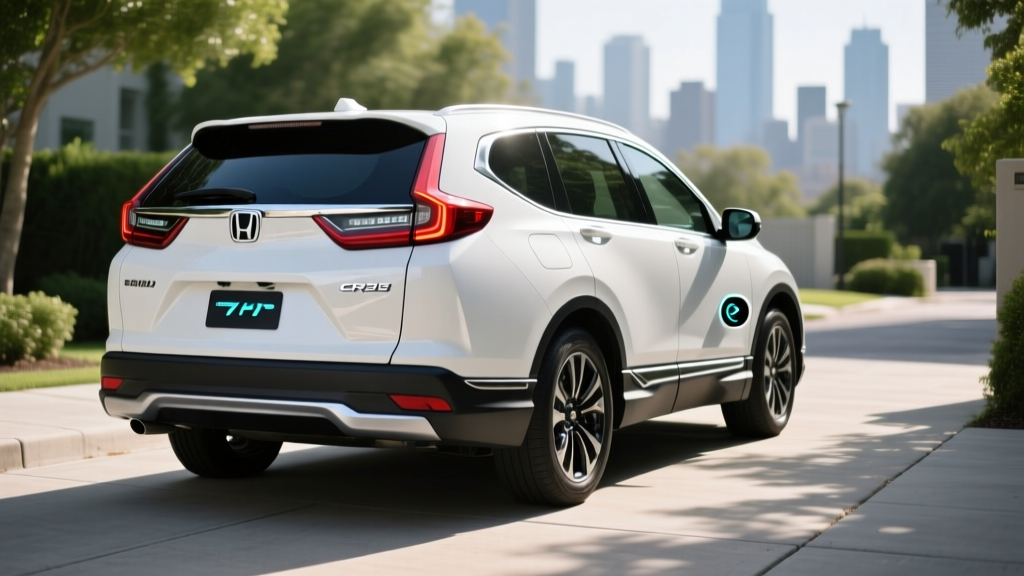
The Honda CR-V has long been a compact SUV benchmark, and its hybrid powertrain is now the volume seller in the lineup. For 2025, Honda offers the CR-V Hybrid across four distinct trims — Sport, Sport-L, Sport Touring, and the newly added e:FCEV hydrogen variant — each with different equipment levels but the same proven two-motor hybrid system. This guide dissects every 2025 Honda CR-V Hybrid trim with the exact EPA fuel economy, real-world MPG expectations, pricing, and ownership data you need before visiting a dealer.
HEV vs. PHEV: What the CR-V Hybrid Actually Is
Important distinction: The 2025 Honda CR-V Hybrid is a conventional hybrid (HEV), not a plug-in hybrid (PHEV). It does not have a charge port, cannot be plugged in, and has no meaningful electric-only driving range. Instead, its 1.3 kWh lithium-ion battery recharges through regenerative braking and the gasoline engine. You fuel it like any other car — the hybrid system simply makes that fuel go further.
If you want electric-only commuting, you'd need a PHEV like the Toyota RAV4 Prime (42 miles EV range) or a full BEV like the Hyundai Ioniq 5. The CR-V Hybrid prioritizes simplicity: no charging infrastructure needed, no range planning, just better MPG.
2025 CR-V Hybrid Trim Lineup and Pricing
| Trim | Drivetrain | MSRP | Key Additions Over Base Hybrid |
|---|---|---|---|
| Sport Hybrid | FWD / AWD | $36,200 / $37,700 | Hybrid powertrain, 19" wheels, heated front seats, 7" touchscreen |
| Sport-L Hybrid | FWD / AWD | $39,850 / $41,350 | Leather-trimmed seats, 9" touchscreen, wireless CarPlay/Android Auto, power liftgate |
| Sport Touring Hybrid | AWD only | $44,150 | BOSE 12-speaker audio, navigation, heated rear seats, wireless charging, Honda Sensing suite with low-speed braking |
| e:FCEV (hydrogen) | FWD | ~$52,000 (est.) | Hydrogen fuel cell, limited California availability, 270-mi range |
The Sport trim is the entry point to the hybrid system, and it's where most buyers land. The Sport-L adds the larger infotainment screen and leather that daily commuters appreciate, while the Sport Touring bundles every available feature but is locked to AWD — which matters if you're in a warm climate and prefer FWD for a slight MPG edge.
The e:FCEV is a niche hydrogen fuel-cell variant available only through select California dealers with hydrogen station access. We'll focus this guide on the mainstream HEV trims that are available nationwide.
Fuel Economy: EPA Ratings and Real-World MPG
| Trim / Drivetrain | EPA City | EPA Highway | EPA Combined |
|---|---|---|---|
| Sport / Sport-L (FWD) | 43 MPG | 36 MPG | 40 MPG |
| Sport / Sport-L / Sport Touring (AWD) | 40 MPG | 34 MPG | 37 MPG |
Data sourced from fueleconomy.gov for the 2025 Honda CR-V Hybrid.
Real-World MPG: What to Actually Expect
Honda's two-motor hybrid system excels in stop-and-go city driving, where the electric motor handles low-speed propulsion and the 2.0L Atkinson-cycle engine acts primarily as a generator. In real-world testing, the CR-V Hybrid frequently exceeds its EPA city rating — 45-47 MPG is achievable on suburban routes with moderate traffic and gentle acceleration.
Highway driving tells a different story. At sustained 70-80 MPH speeds, the engine drives the wheels directly through a single-gear lockup clutch, and aerodynamic drag pushes real-world highway consumption to 32-34 MPG for AWD models. That's still excellent for a compact SUV, but don't expect the EPA highway sticker on a flat-out interstate run.
Real-world fuel cost estimate: At $3.40/gallon (national average) and 15,000 miles/year, the AWD Sport Touring costs roughly $1,378 annually in fuel. A comparable gas-only CR-V EX-L AWD (28 MPG combined) would cost about $1,821 — a savings of ~$443/year with the hybrid.
Powertrain and Performance Specs
Every mainstream CR-V Hybrid trim shares the same fourth-generation two-motor hybrid system:
- Engine: 2.0L DOHC Atkinson-cycle 4-cylinder — 145 HP, 134 lb-ft torque
- Drive motor: 181 HP, 247 lb-ft torque
- Combined system output: 204 HP, 247 lb-ft torque
- Battery: 1.3 kWh lithium-ion (not user-chargeable)
- 0-60 MPH: ~7.6 seconds (AWD)
- Towing capacity: 1,000 lbs
The electric motor provides instant torque from a stop, making the CR-V Hybrid feel noticeably punchier around town than the turbocharged gas model despite similar peak horsepower figures. The transition between EV mode, hybrid mode, and engine-direct-drive is seamless — most drivers won't notice which mode the system is in without watching the power-flow display.
The AWD system uses a rear-mounted electric motor rather than a mechanical driveshaft, which means rear torque is available only when the hybrid battery has sufficient charge. On long uphill grades, AWD engagement can become intermittent as the battery depletes. This is normal hybrid behavior, not a malfunction.
Battery Warranty, Reliability, and Replacement Cost
Honda Hybrid Battery Warranty: 8 years / 100,000 miles (10 years / 150,000 miles in CARB states including CA, CO, CT, ME, MA, NJ, NY, OR, RI, VT, WA). Covers defects and capacity loss below a defined threshold.
Hybrid system components (inverter, electric motors, control unit) are covered under the same 8yr/100k warranty.
Honda's hybrid powertrain has proven durable. The CR-V Hybrid's 1.3 kWh battery is small and operates in a shallow charge window (roughly 40-60% state of charge), which dramatically reduces degradation compared to a full BEV or PHEV that cycles through deeper ranges. Based on data from earlier Honda hybrid models (Accord Hybrid, Insight), battery replacement outside warranty is uncommon before 150,000-200,000 miles.
If replacement is needed out of warranty, expect $2,500-$4,000 for the hybrid battery pack at a dealership, plus $300-$500 for labor. Third-party refurbished packs may be available for $1,500-$2,500 as the model ages. For context, the NHTSA has not issued any battery-related recalls for the current-generation CR-V Hybrid.
General Reliability
The CR-V Hybrid carries strong reliability predictions. The two-motor system has fewer moving parts than a traditional automatic transmission (no torque converter, no multi-speed gearbox), and the Atkinson-cycle engine operates under lower thermal stress than the turbocharged 1.5L in the gas CR-V. Honda Sensing safety features (standard on all trims) include adaptive cruise, lane-keeping, and automatic emergency braking — all of which have performed well in IIHS testing, where the CR-V earned TOP SAFETY PICK status.
Tax Credits and Incentives: What Hybrid Buyers Get
Here's the straightforward answer: the 2025 Honda CR-V Hybrid does not qualify for the federal §30D clean vehicle tax credit. That credit ($7,500 maximum) applies only to plug-in electric vehicles (BEVs and PHEVs) with sufficient battery capacity and compliant battery sourcing. A conventional HEV with a 1.3 kWh battery does not meet the threshold.
- Federal §30D credit: Not eligible — requires plug-in capability and ≥7 kWh battery
- Federal used-EV credit (§25E): Not eligible — applies to used BEVs/PHEVs only
- State incentives: Some states offer rebates for hybrids. Check your state's energy office or IRS clean vehicle credit page for current rules
- Dealer incentives: Honda periodically offers $500-$1,500 loyalty or conquest cash on CR-V Hybrid trims — check Honda.com for current offers
The absence of a federal credit doesn't make the CR-V Hybrid a bad value. The hybrid premium over a gas CR-V EX (roughly $2,500-$3,000) pays for itself in fuel savings within 5-6 years for most drivers, and the hybrid's lower engine wear may reduce long-term maintenance costs.
CR-V Hybrid vs. the Alternatives: Which Should You Choose?
Choose the 2025 CR-V Hybrid if:
- You want better MPG without changing your fueling habits
- You lack access to home or workplace charging (no plug needed)
- You prioritize a smooth, quiet driving experience around town
- You want Honda's safety suite and strong resale value
Choose a PHEV (like the RAV4 Prime or CR-V's future PHEV variant) if:
- You can charge at home and want 30-40 miles of electric-only commuting
- You want to qualify for the $7,500 federal tax credit
- Your daily driving is under 40 miles round-trip
Choose a full BEV (like the Hyundai Ioniq 5 or Tesla Model Y) if:
- You have reliable home Level 2 charging
- You want zero tailpipe emissions and the lowest per-mile fuel cost
- You drive under 250 miles daily and can plan road-trip charging stops
Stick with the gas CR-V (1.5T) if:
- You drive mostly highway miles at 80+ MPH (the hybrid's advantage shrinks)
- You need maximum towing capacity (gas CR-V: 1,500 lbs vs. hybrid's 1,000 lbs)
- Upfront cost is the primary concern and you drive under 10,000 miles/year
Pros
- 43 MPG city (FWD) — best-in-class for a non-plug-in compact SUV
- Smooth, quiet electric-motor launch from stops
- No charging infrastructure needed
- Strong IIHS safety ratings and Honda Sensing standard
- 8yr/100k hybrid battery warranty (10yr/150k in CARB states)
- Excellent cargo space: 36.3 cu ft rear, 76.5 cu ft total
Cons
- No federal tax credit eligibility
- Highway MPG drops to 32-34 real-world at 75+ MPH
- AWD rear motor can disengage on sustained steep climbs
- 1,000-lb towing limit (500 lbs less than gas model)
- 7" base screen feels dated; 9" requires Sport-L or above
- Road noise noticeable above 65 MPH on coarse pavement
Frequently Asked Questions
How many MPG does the 2025 Honda CR-V Hybrid get?
The FWD trims (Sport, Sport-L) are EPA-rated at 43 city / 36 highway / 40 combined MPG. AWD trims including the Sport Touring are rated at 40 city / 34 highway / 37 combined. Real-world city MPG often exceeds EPA by 3-5 MPG; highway MPG tends to run 2-3 MPG below sticker at sustained high speeds.
Does the CR-V Hybrid need to be plugged in?
No. The CR-V Hybrid is a conventional HEV — it charges its small battery through regenerative braking and the gasoline engine. There is no charge port. You simply fill it with regular unleaded gasoline.
Is there a plug-in hybrid (PHEV) version of the CR-V?
Not for the 2025 model year in the US market. Honda sells a CR-V e:PHEV in China and Europe, but it is not currently offered in the United States. If you need a plug-in Honda, the closest option is the discontinued Clarity PHEV (used market) or waiting for potential future US-market PHEV variants.
Is the CR-V Hybrid reliable, and what does battery replacement cost?
Honda's two-motor hybrid system has demonstrated strong long-term reliability across multiple model lines. The hybrid battery is warrantied for 8 years/100,000 miles (10 years/150,000 miles in CARB states). Out-of-warranty replacement runs approximately $2,500-$4,000 at a dealer, though the shallow charge cycle means most batteries last well beyond 150,000 miles.
Does the 2025 CR-V Hybrid qualify for any tax credit?
No. The federal §30D clean vehicle credit applies only to plug-in vehicles (BEVs and PHEVs). The CR-V Hybrid's 1.3 kWh battery and lack of a charge port make it ineligible. Some states may offer minor hybrid incentives — check your state energy office. Honda dealer cash incentives of $500-$1,500 are periodically available.
Which CR-V Hybrid trim is the best value?
The Sport-L Hybrid at $39,850 (FWD) hits the sweet spot: you get the larger 9" touchscreen, wireless phone integration, leather seats, and power liftgate for roughly $3,650 over the base Sport. The Sport Touring adds premium audio and navigation but costs $4,300 more and requires AWD. Budget-conscious buyers should start with the Sport at $36,200 — the hybrid powertrain is identical across all trims.
How does the CR-V Hybrid compare to the Toyota RAV4 Hybrid?
The RAV4 Hybrid (41 MPG combined AWD, $33,825 starting) is slightly less expensive and offers AWD standard on all trims, while the CR-V Hybrid (37 MPG combined AWD, $36,200 starting) provides a more refined interior, slightly more cargo volume, and a smoother ride. The RAV4 Prime PHEV (42 miles EV, $44,410) is the choice if you want plug-in capability and the federal tax credit — something neither the CR-V Hybrid nor RAV4 Hybrid offers.