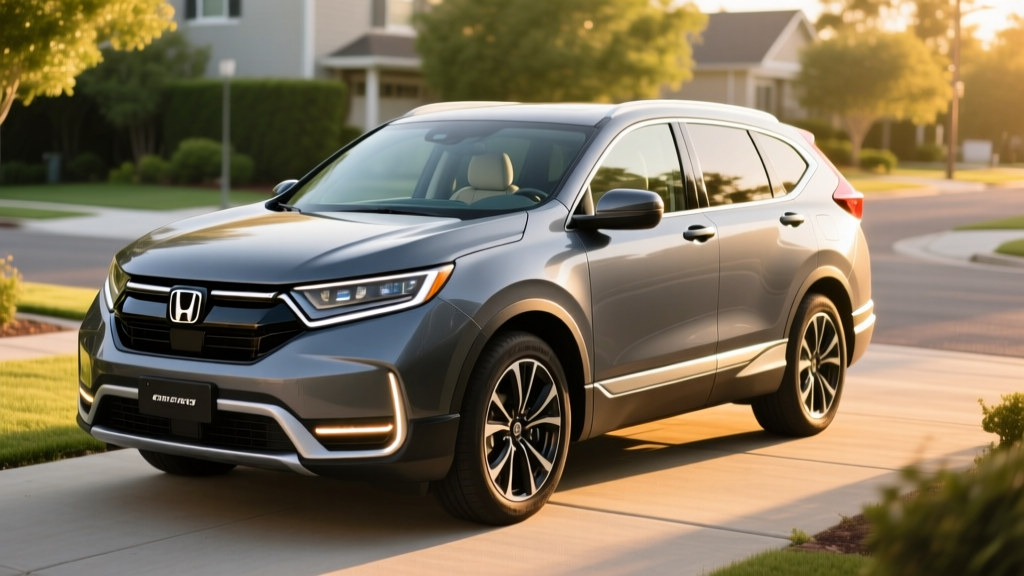
The 2025 Honda CR-V Hybrid SUV occupies a specific niche: buyers who want electrified efficiency without ever plugging in. Honda's two-motor hybrid system pairs a 2.0-liter Atkinson-cycle four-cylinder with dual electric motors to deliver 204 combined horsepower and an EPA-estimated 40 MPG combined. With over 300,000 CR-Vs sold annually in recent years and the hybrid making up a growing share of that volume, understanding exactly what this powertrain delivers—and where it falls short compared to a PHEV or full BEV—is essential before signing the paperwork.
This guide covers the 2025 CR-V Hybrid's real-world fuel economy, powertrain mechanics, trim pricing, battery longevity, and how it stacks up against plug-in alternatives. We'll also clarify a common source of confusion: the CR-V Hybrid is a conventional hybrid (HEV), not a plug-in. Honda discontinued the CR-V Plug-In Hybrid in the U.S. market after the 2022 model year.
HEV vs PHEV: Why the 2025 CR-V Hybrid Is Strictly a Conventional Hybrid
Before evaluating the CR-V Hybrid's numbers, it's critical to understand what it is—and what it isn't.
Conventional Hybrid (HEV) — 2025 CR-V Hybrid
- No plug required. The 1.06 kWh lithium-ion battery recharges exclusively through regenerative braking and the gasoline engine.
- No electric-only driving range. The electric motor assists the engine and enables brief low-speed EV mode, but cannot propel the vehicle for meaningful distances on electricity alone.
- No federal §30D tax credit. Conventional hybrids do not qualify for the up-to-$7,500 federal EV credit under current IRS rules.
Plug-In Hybrid (PHEV) — Not Available for 2025 CR-V
- Requires plug-in charging to access a larger battery (typically 15–20 kWh) for 30–40 miles of electric-only range.
- May qualify for federal tax credits depending on battery sourcing, MSRP caps, and buyer income limits.
- Competitors offering PHEV compact SUVs: Toyota RAV4 Prime (42 mi EV range), Hyundai Tucson PHEV (33 mi EV range), Kia Sportage PHEV (34 mi EV range).
If you're specifically looking for a plug-in Honda SUV, the closest current option is the Honda Clarity Plug-In Hybrid (discontinued after 2022) or stepping up to the Acura RDX, which also lacks a PHEV variant in the U.S. For a Honda-badged PHEV, you'd need to look at international markets or wait for future model announcements.
Fuel Economy: EPA Ratings and Real-World MPG
The 2025 CR-V Hybrid is available exclusively with all-wheel drive (AWD) in the U.S. market. Here's the official EPA breakdown:
| Configuration | City MPG | Highway MPG | Combined MPG | Annual Fuel Cost* |
|---|---|---|---|---|
| 2025 CR-V Hybrid AWD (Sport/Sport-L/Sport Touring) | 40 | 34 | 37 | ~$1,550 |
| 2025 CR-V Hybrid AWD (higher trims with added weight) | 38 | 33 | 36 | ~$1,600 |
*Based on 15,000 miles/year, 55% city / 45% highway, and $3.50/gallon regular unleaded. Source: fueleconomy.gov
Real-World MPG vs. EPA Sticker
Conventional hybrids like the CR-V tend to outperform their EPA ratings in city driving—where regenerative braking and electric-motor assist do the most work—and underperform on sustained highway runs where the gasoline engine carries the full load.
- City/commute driving (stop-and-go, under 45 mph): Expect 38–43 MPG. Many owners report seeing 40+ MPG on suburban commutes with frequent stops.
- Highway cruising (70–80 mph, sustained): Expect 30–34 MPG. The 2.0L engine operates without meaningful electric assist at steady high speeds, and the CR-V's boxy SUV profile creates aerodynamic drag.
- Cold weather (below 32°F): Expect a 10–15% drop, landing around 31–33 MPG combined. The engine runs more frequently to generate cabin heat and warm the catalytic converter.
- Mixed real-world average: Most owners report 35–38 MPG combined across varied driving, closely aligning with the EPA's 37 MPG combined figure.
The CR-V Hybrid's 15.3-gallon fuel tank yields a theoretical range of approximately 566 miles at the combined EPA rating—enough for most road trips without a fuel stop.
Powertrain: How Honda's Two-Motor Hybrid System Works
| Specification | 2025 Honda CR-V Hybrid |
|---|---|
| Engine | 2.0L DOHC Atkinson-cycle 4-cylinder |
| Engine Output | 145 hp @ 6,100 rpm / 138 lb-ft torque |
| Electric Motors | Dual-motor system (propulsion + generator) |
| Combined System Output | 204 hp / 247 lb-ft torque |
| Transmission | Direct-drive (no traditional CVT or gears) |
| Drivetrain | AWD standard (electronic rear-motor AWD) |
| Battery Type | Lithium-ion, 1.06 kWh |
| 0–60 mph | ~7.6 seconds (estimated) |
| Towing Capacity | 1,000 lbs |
| Cargo Volume | 36.3 cu ft (rear seats up) / 76.5 cu ft (folded) |
Honda's hybrid system operates differently from Toyota's planetary-gear Hybrid Synergy Drive. Instead of a power-split device, Honda uses a series-parallel arrangement where the propulsion motor drives the wheels directly in most conditions, while the gasoline engine primarily acts as a generator to feed electricity to that motor. At highway speeds, a lock-up clutch connects the engine directly to the wheels for efficiency.
The result is smooth, electric-like acceleration from a stop (the 247 lb-ft of torque from the electric motor is available immediately) and competitive passing power at speed. The 7.6-second 0–60 time trails the Toyota RAV4 Hybrid's ~7.4 seconds but beats most non-hybrid compact SUVs in this class.
Pricing, Trims, and Tax Credit Eligibility
The 2025 CR-V Hybrid is offered in three trims, all with AWD standard:
| Trim | MSRP (incl. destination) | Key Features |
|---|---|---|
| Sport Hybrid | $36,395 | 18" wheels, 7" touchscreen, wireless Apple CarPlay/Android Auto, Honda Sensing suite |
| Sport-L Hybrid | $38,395 | Leather-trimmed seats, 9" touchscreen, wireless charging, power liftgate |
| Sport Touring Hybrid | $41,395 | BOSE 12-speaker audio, heated rear seats, panoramic roof option, navigation, hands-free liftgate |
Does the 2025 CR-V Hybrid Qualify for a Federal Tax Credit?
No. The federal §30D New Clean Vehicle Credit applies only to plug-in electric vehicles (BEVs and PHEVs) with sufficient battery capacity and qualifying battery-component and critical-mineral sourcing. Because the CR-V Hybrid is a conventional HEV with a 1.06 kWh battery and no plug-in capability, it does not qualify for any federal purchase incentive.
Some states or local utilities may offer modest rebates for purchasing any hybrid vehicle, but these vary by jurisdiction and change frequently. Check your state energy office or utility provider for current programs. Always consult a tax professional for eligibility questions, referencing current IRS §30D guidance.
Battery Longevity, Warranty, and Replacement Cost
2025 CR-V Hybrid Battery Warranty
- Hybrid battery: 8 years / 100,000 miles (10 years / 150,000 miles in CARB states including CA, NY, MA, and others)
- Hybrid system components: 8 years / 100,000 miles (inverter, control unit, cooling system)
- Capacity retention threshold: Honda covers the battery if it falls below a specified state-of-health threshold, though Honda does not publish a specific percentage (unlike some BEV manufacturers that specify 70%)
- Powertrain warranty: 5 years / 60,000 miles (covers the 2.0L engine and transmission)
How Long Will the Hybrid Battery Last?
Honda's hybrid battery packs in the CR-V have proven durable in real-world use. The 1.06 kWh lithium-ion pack is relatively small and operates within a conservative state-of-charge window—Honda's battery management system prevents deep discharges and full charges, which are the primary drivers of lithium-ion degradation.
Based on long-term data from CR-V Hybrid owners and Honda's earlier hybrid models (Insight, Accord Hybrid):
- Expected lifespan: 12–15 years or 150,000–200,000+ miles before significant degradation
- Degradation impact: Unlike a BEV, battery degradation in an HEV primarily affects fuel economy rather than range. A 20% degraded hybrid battery might reduce MPG by 2–4 MPG rather than stranding you.
- Failure mode: Complete hybrid battery failure is rare. More commonly, individual cells weaken and can sometimes be reconditioned or replaced individually.
Battery Replacement Cost
If the hybrid battery does need replacement out of warranty:
- New OEM battery from Honda: $2,500–$4,000 (parts and labor at a dealership)
- Refurbished/remanufactured battery: $1,500–$2,500 from third-party suppliers
- Individual cell replacement: $500–$1,200 if only specific cells have failed (available through specialized hybrid repair shops)
For context, a BEV battery replacement (like a Tesla Model Y or Ford Mustang Mach-E) typically costs $10,000–$20,000. The CR-V Hybrid's small battery is far less expensive to replace, and the likelihood of needing replacement within the warranty period is low based on Honda's track record.
Reliability and Safety Ratings
The 2025 CR-V carries strong safety credentials. The previous-generation CR-V earned a 5-star overall safety rating from NHTSA, and the current generation continues to perform well in crash testing. The IIHS has historically rated the CR-V as a Top Safety Pick or Top Safety Pick+ when equipped with specific headlights.
The Honda Sensing suite comes standard on all trims and includes:
- Adaptive Cruise Control (ACC) with Low-Speed Follow
- Lane Keeping Assist System (LKAS) and Road Departure Mitigation
- Collision Mitigation Braking System (CMBS)
- Traffic Sign Recognition
- Blind Spot Information (Sport-L and Sport Touring)
These are SAE Level 1–2 driver-assistance features. The driver must remain fully engaged at all times—this is not autonomous or self-driving capability.
For reliability, Honda's hybrid powertrain has been in production since the early 2000s (Insight, Civic Hybrid, Accord Hybrid). The two-motor system used in the CR-V Hybrid has been in use since 2017 (Accord Hybrid) and carries a strong track record with no widespread failure patterns reported across model years.
2025 CR-V Hybrid vs. the Competition
| Spec | Honda CR-V Hybrid AWD | Toyota RAV4 Hybrid AWD | Hyundai Tucson Hybrid AWD |
|---|---|---|---|
| EPA Combined MPG | 37 | 39 | 37 |
| Combined HP | 204 | 219 | 226 |
| 0–60 mph | ~7.6 sec | ~7.4 sec | ~7.1 sec |
| Cargo (rear up) | 36.3 cu ft | 37.6 cu ft | 38.7 cu ft |
| Starting MSRP | $36,395 | $34,225 | $33,465 |
| Hybrid Battery Warranty | 8 yr / 100k mi | 10 yr / 150k mi | 10 yr / 100k mi |
| Towing Capacity | 1,000 lbs | 1,750 lbs | 2,000 lbs |
The RAV4 Hybrid leads on fuel economy and cargo space at a lower price. The Tucson Hybrid offers more power and towing. The CR-V Hybrid's advantage lies in its refined driving dynamics, premium-feeling interior (especially at Sport Touring trim), and Honda's resale-value track record.
Pros
- Smooth, linear acceleration feel from the electric-motor-dominant powertrain
- Standard AWD across all hybrid trims
- Strong real-world city MPG (often exceeds EPA)
- Quiet cabin and composed ride quality
- Comprehensive Honda Sensing safety suite standard
- Strong resale value and proven hybrid reliability
Cons
- Higher starting price than RAV4 Hybrid and Tucson Hybrid
- No PHEV option available in the U.S. market
- 1,000-lb towing capacity trails competitors
- Highway MPG drops noticeably vs. city (34 vs 40)
- Smaller 7" base screen on Sport trim
- No federal tax credit eligibility
Hybrid vs PHEV vs Full EV: Which Powertrain Fits You?
Choose the CR-V Hybrid (HEV) if:
- You cannot install a home charger (apartment, street parking, no garage)
- You want better fuel economy without changing any habits—just fill up with gas
- You drive 10,000–15,000 miles/year with a mix of city and highway
- You want the lowest-maintenance electrified option (no charging cables, no plug-in routines)
- Budget is $36,000–$42,000 and you want AWD standard
Choose a PHEV (RAV4 Prime, Tucson PHEV) if:
- You can charge at home (Level 1 or Level 2) and want 30–42 miles of daily electric-only commuting
- Your daily commute is under 40 miles round-trip, meaning you'd rarely burn gas on weekdays
- You want to reduce fuel consumption by 60–80% while keeping gas capability for road trips
- You may qualify for a federal tax credit (check current §30D eligibility on irs.gov)
Choose a Full EV (Tesla Model Y, Hyundai Ioniq 5, Ford Mustang Mach-E) if:
- You have reliable home Level 2 charging and your daily driving is under 250 miles
- You want to eliminate gasoline purchases entirely and benefit from lower per-mile energy costs
- You qualify for the full $7,500 federal tax credit, which can offset the higher purchase price
- You're comfortable planning road trips around DC fast-charging infrastructure
Frequently Asked Questions
How many MPG does the 2025 Honda CR-V Hybrid get?
The EPA rates the 2025 CR-V Hybrid AWD at 40 city / 34 highway / 37 combined MPG. Real-world owners typically see 35–38 MPG combined, with city driving often exceeding the EPA rating and highway driving falling slightly below.
Does the 2025 CR-V Hybrid need to be plugged in?
No. The CR-V Hybrid is a conventional hybrid (HEV), not a plug-in hybrid. Its small 1.06 kWh battery charges through regenerative braking and the gasoline engine. You never plug it in—you just fill it with gasoline like a conventional car.
How far can the CR-V Hybrid drive on electric only?
The CR-V Hybrid can operate in EV mode at very low speeds (typically under 25 mph) for brief distances—roughly a mile or less. It is not designed for meaningful electric-only driving. If you want 30+ miles of electric range, you need a plug-in hybrid like the Toyota RAV4 Prime (42 miles EV range).
Is the Honda CR-V Hybrid reliable?
Honda's two-motor hybrid system has been in production since 2017 (Accord Hybrid) with no widespread reliability issues. The hybrid battery is warranted for 8 years/100,000 miles (10 years/150,000 miles in CARB states). Based on long-term ownership data, the battery typically lasts 150,000–200,000+ miles before significant degradation.
What does a CR-V Hybrid battery replacement cost?
A new OEM hybrid battery from Honda costs approximately $2,500–$4,000 installed. Refurbished batteries run $1,500–$2,500, and individual cell replacements can cost $500–$1,200. This is significantly less than a full BEV battery replacement ($10,000–$20,000).
Does the CR-V Hybrid qualify for a federal tax credit?
No. The federal §30D New Clean Vehicle Credit applies only to plug-in vehicles (BEVs and PHEVs). The CR-V Hybrid is a conventional HEV and does not qualify. Some states or utilities may offer small hybrid rebates—check your local programs.
How does the CR-V Hybrid compare to the RAV4 Hybrid?
The Toyota RAV4 Hybrid achieves 39 MPG combined (vs. the CR-V's 37), offers more cargo space (37.6 vs 36.3 cu ft), has a higher towing capacity (1,750 vs 1,000 lbs), and starts at a lower MSRP ($34,225 vs $36,395). The CR-V Hybrid counters with a more refined interior, smoother ride quality, and Honda's strong resale value.