Quick Verdict: The CR-V Hybrid Sport in One Paragraph
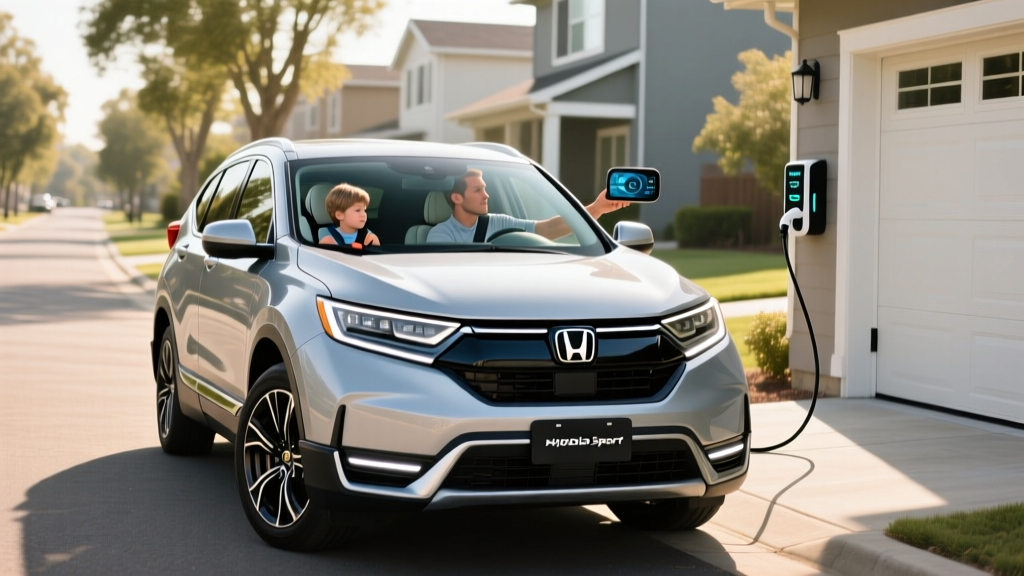
The 2025 Honda CR-V Hybrid Sport occupies a specific niche: buyers who want meaningful fuel savings over a gas-only compact SUV without ever plugging in. Its two-motor hybrid system delivers an EPA-estimated 40 MPG combined, paired with 204 combined horsepower and Honda's well-regarded build quality. It is not a plug-in hybrid — there is no electric-only driving mode and no charging port. Instead, it captures energy through regenerative braking and engine optimization, making it a drop-in replacement for a conventional gas vehicle. For the ~$36,000 starting price, it's one of the most efficient and practical compact hybrid SUVs on the market, though it sacrifices some highway MPG compared to its city performance.
2025 Honda CR-V Hybrid Sport: Core Specifications
| Specification | Value |
|---|---|
| Powertrain Type | Conventional Hybrid (HEV) — no plug |
| Engine | 2.0L Atkinson-cycle 4-cylinder |
| Electric Motors | Dual-motor hybrid system |
| Combined Horsepower | 204 hp |
| Combined Torque | 247 lb-ft (electric motor peak) |
| Drivetrain | FWD standard; AWD available (Sport-L, Sport Touring) |
| Transmission | e-CVT (electronically controlled) |
| EPA MPG (FWD) | 43 city / 36 highway / 40 combined |
| EPA MPG (AWD) | 40 city / 34 highway / 37 combined |
| Fuel Tank Capacity | 15.3 gallons |
| Estimated Total Range | ~560–612 miles (FWD/AWD) |
| 0–60 mph | ~7.8 seconds (estimated) |
| Cargo Volume (rear seats up) | 36.3 cu ft |
| Cargo Volume (rear seats folded) | 76.5 cu ft |
| Towing Capacity | 1,000 lbs |
| Hybrid Battery Warranty | 8 years / 100,000 miles |
| Base MSRP (Sport FWD) | $35,950 (incl. destination) |
Fuel Economy: EPA Numbers vs. Real-World Driving
The EPA rates the 2025 CR-V Hybrid Sport FWD at 43 city / 36 highway / 40 combined MPG. The AWD variant drops to 40 city / 34 highway / 37 combined. These figures represent a substantial improvement over the gas-only CR-V AWD, which returns 27 city / 32 highway / 29 combined.
| Configuration | City MPG | Highway MPG | Combined MPG |
|---|---|---|---|
| CR-V Hybrid Sport FWD | 43 | 36 | 40 |
| CR-V Hybrid Sport AWD | 40 | 34 | 37 |
| CR-V Gas AWD (EX, for comparison) | 27 | 32 | 29 |
Hybrid vs. Plug-In Hybrid vs. Full EV: Which Fits Your Life?
The CR-V Hybrid Sport is a conventional hybrid (HEV). Understanding how it differs from a plug-in hybrid (PHEV) or a battery-electric vehicle (BEV) is essential before you buy.
| Feature | HEV (CR-V Hybrid Sport) | PHEV (e.g., Toyota RAV4 Prime) | BEV (e.g., Tesla Model Y) |
|---|---|---|---|
| Plug in to charge? | No — self-charging | Yes — has a charge port | Yes — charge port required |
| Electric-only driving | No (EV assist only at low speeds) | Yes — typically 25–42 miles | Yes — 250–330+ miles |
| Gasoline engine | Yes — primary power source | Yes — backup after battery depletes | No engine |
| Fuel/energy cost per mile | ~$0.10–0.12 | ~$0.04 (electric) / $0.10 (gas) | ~$0.03–0.05 (home charging) |
| Home charging needed | No | Recommended (Level 2) | Essential (Level 2) |
| Federal tax credit (§30D) | No | Up to $7,500 (if eligible) | Up to $7,500 (if eligible) |
| Best for | No home charging access; simple ownership | Short commutes + occasional road trips | Home charging + mostly under 300 mi/day |
Powertrain Deep Dive: How Honda's Hybrid System Works
Honda uses a two-motor hybrid architecture that differs fundamentally from Toyota's planetary-gear system. Here's how it operates across driving scenarios:
- Low-speed / city driving: The gasoline engine generates electricity, and the propulsion motor drives the wheels. The engine never directly turns the wheels at these speeds, which is why city MPG is so strong.
- Cruising / highway: A lock-up clutch engages, connecting the engine directly to the wheels for mechanical efficiency. The electric motors assist during overtaking or hill climbs.
- Hard acceleration: Both the engine (as generator) and the battery feed the propulsion motor for maximum combined output of 204 hp and 247 lb-ft of electric torque.
- Braking / deceleration: Regenerative braking captures kinetic energy, converting it to electricity stored in the hybrid battery. Paddle shifters let you adjust regen intensity across four levels.
The 2.0L Atkinson-cycle engine produces 146 hp on its own, but the system's combined output of 204 hp and the instant torque from the electric motor make the CR-V Hybrid feel responsive around town. The e-CVT is smooth with no shift shock, though it produces the characteristic "drone" under hard acceleration that some drivers find unpleasant. The Sport trim includes paddle shifters that simulate stepped gear ratios, partially mitigating this.
Pricing, Trims, and Tax Credit Eligibility
The 2025 Honda CR-V Hybrid is available across four trims, all using the same powertrain:
| Trim | Drivetrain | MSRP (incl. destination) |
|---|---|---|
| Sport | FWD | $35,950 |
| Sport | AWD | $37,450 |
| Sport-L | AWD | $39,150 |
| Sport Touring | AWD | $42,150 |
For the money, the Sport FWD at $35,950 is the value pick. You get the full 43 city MPG, Honda Sensing (adaptive cruise, lane-keeping, automatic emergency braking), a 7-inch touchscreen with wireless Apple CarPlay/Android Auto, and 18-inch alloy wheels. The Sport-L adds leather-trimmed seats and a power liftgate for $3,200 more. The Sport Touring tops the range with a 9-inch touchscreen, wireless charging, Bose audio, and a heated steering wheel — but at $42,150, it encroaches on PHEV territory where a tax credit could offset the cost.
Battery Longevity, Warranty, and Replacement Costs
Hybrid battery anxiety is the most common concern we hear from first-time hybrid buyers. Here's what the data shows for the CR-V Hybrid:
The CR-V Hybrid uses a lithium-ion battery pack of approximately 1.1 kWh. Unlike a full EV battery, this small pack operates within a narrow state-of-charge window — typically between 40% and 80% — which dramatically reduces stress and degradation. Honda's hybrid system never fully charges or fully depletes the battery, a design choice that prioritizes longevity over maximum electric assist.
Real-world longevity data: Honda's two-motor hybrid system has been in production since 2014 (Accord Hybrid) and has proven highly reliable. Third-generation systems used in the current CR-V have no widespread failure patterns reported. Industry data suggests modern hybrid batteries routinely last 150,000–200,000+ miles before meaningful degradation occurs. Unlike early-generation hybrids (circa 2005–2010), modern lithium-ion packs rarely require full replacement within normal ownership periods.
Replacement cost if out of warranty: A Honda hybrid battery replacement currently runs between $2,000 and $3,500 including labor at a dealership. Independent hybrid specialists often offer refurbished packs for $1,200–$2,000. Given the narrow SoC operating window and robust thermal management, most owners will sell the vehicle before this expense arises.
Ownership Economics: CR-V Hybrid vs. Gas CR-V
The Hybrid Sport commands a ~$2,400 premium over the gas-only CR-V EX AWD ($35,950 Hybrid Sport FWD vs. ~$33,550 gas EX AWD, though trims differ slightly). Here's how the math works over five years at 15,000 miles per year:
| Cost Factor | CR-V Hybrid Sport FWD | CR-V EX AWD (Gas) |
|---|---|---|
| MSRP | $35,950 | $33,550 |
| EPA Combined MPG | 40 | 29 |
| Annual fuel cost (15k mi, $3.40/gal) | $1,275 | $1,759 |
| 5-year fuel cost | $6,375 | $8,795 |
| Fuel savings over 5 years | $2,420 saved with Hybrid | |
The fuel savings nearly offset the purchase premium within five years, and the hybrid continues saving money for as long as you own it. Factor in typically strong hybrid resale values and the total cost of ownership tips clearly in the Hybrid's favor. Insurance costs are comparable between the two — typically within $50–$100/year of each other depending on your profile.
Who Should Buy the 2025 CR-V Hybrid Sport?
- You cannot install a Level 2 home charger (apartment, street parking, no garage)
- Your driving is predominantly city and suburban (where the hybrid shines at 43+ MPG)
- You want a simple, no-behavior-change transition from a gas vehicle
- You value Honda's reliability record and strong resale value
- You need cargo space (36.3 cu ft behind rear seats) without stepping up to a larger SUV
- You have home charging access and a short commute — a PHEV like the RAV4 Prime or Tucson PHEV will save more on fuel
- You primarily drive long highway miles — the hybrid advantage shrinks to ~33–36 MPG at 75 mph
- You want electric-only driving for zero tailpipe emissions on local trips — you need a PHEV or BEV
- You need serious towing capacity — the 1,000-lb limit is light-duty only
Frequently Asked Questions
How many MPG does the 2025 Honda CR-V Hybrid Sport actually get?
The EPA rates the FWD model at 43 city / 36 highway / 40 combined MPG, and the AWD at 40 city / 34 highway / 37 combined. In real-world driving, expect 38–42 MPG combined in moderate climates. City drivers often exceed the EPA estimate (44–47 MPG is common in warm weather), while sustained highway driving at 70+ mph typically yields 33–36 MPG. Cold weather reduces city efficiency by 5–8 MPG due to increased engine operation for cabin heating.
Does the CR-V Hybrid need to be plugged in?
No. The CR-V Hybrid Sport is a conventional hybrid (HEV), not a plug-in hybrid. It has no charging port. The hybrid battery recharges through regenerative braking and the gasoline engine. You fuel it exactly like a conventional gas car — the hybrid system operates entirely automatically.
How far can the CR-V Hybrid drive on electric power alone?
The CR-V Hybrid cannot drive on electric power alone for any meaningful distance. At very low speeds (under ~25 mph in specific conditions), the electric motor can propel the vehicle briefly, but the gasoline engine starts almost immediately when additional power is needed. This is by design — the small 1.1 kWh battery is optimized for efficiency assist, not electric-only range. If you want electric-only driving, you need a PHEV or BEV.
Is the CR-V Hybrid reliable, and what does a battery replacement cost?
Honda's two-motor hybrid system has a strong reliability track record since its 2014 introduction. The hybrid battery is covered by an 8-year/100,000-mile warranty (10 years/150,000 miles in CARB states). Modern lithium-ion hybrid batteries operating in narrow SoC windows typically last 150,000–200,000+ miles. If replacement is needed out of warranty, expect $2,000–$3,500 at a dealer, or $1,200–$2,000 for a refurbished pack from an independent specialist.
Does the 2025 CR-V Hybrid qualify for any tax credits?
No. The IRS §30D Clean Vehicle Credit applies only to plug-in vehicles (PHEVs and BEVs) with a battery capacity of at least 7 kWh. The CR-V Hybrid's ~1.1 kWh battery and lack of a charge port make it ineligible. Some state utilities offer small hybrid rebates ($250–$500) — check your local programs. If a federal tax credit is important to you, consider a PHEV or BEV instead.
How does the CR-V Hybrid compare to the Toyota RAV4 Hybrid?
The Toyota RAV4 Hybrid AWD is rated at 41 city / 38 highway / 39 combined MPG. The CR-V Hybrid AWD returns 40 city / 34 highway / 37 combined. Toyota's hybrid offers slightly better highway MPG and standard AWD across all trims, while the Honda provides more cargo space (36.3 vs 37.6 cu ft — comparable), a more refined interior, and a smoother ride. Both are class leaders; test-driving both is the best way to decide.
Is AWD worth the MPG penalty on the CR-V Hybrid Sport?
AWD costs you 3 MPG combined (40 → 37) and adds $1,500 to the MSRP. If you live in a region with frequent snow, ice, or rain, the traction benefit is worth the trade. In mild climates where you rarely encounter slippery roads, the FWD model saves money at purchase and at the pump. Honda's AWD system uses a mechanical rear driveshaft powered by the engine (not a separate rear electric motor), so it adds minimal weight and complexity compared to some competitors.