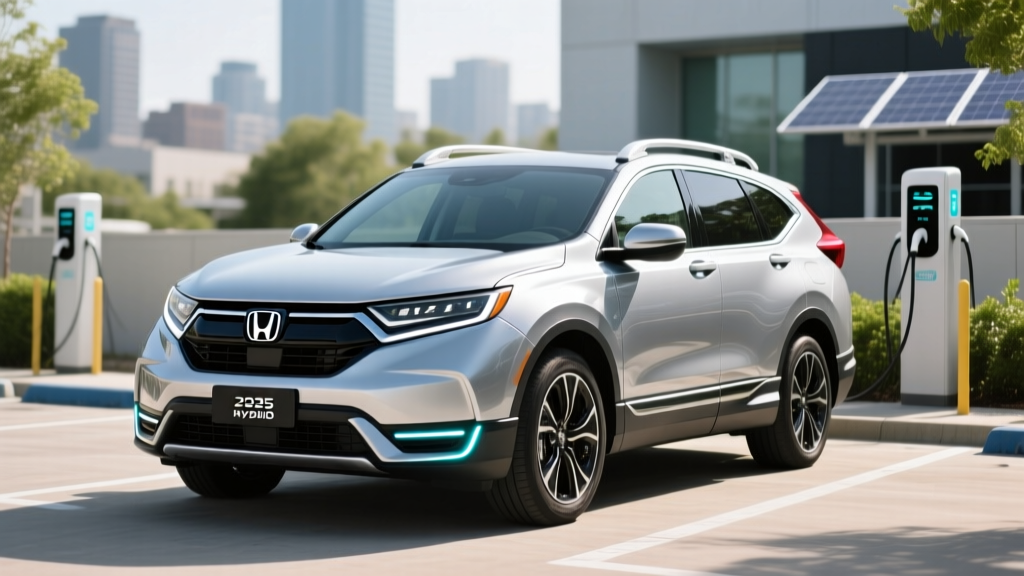
The Honda CR-V Hybrid has quietly become the volume seller in Honda's compact-SUV lineup, and for good reason: it offers meaningful fuel savings over the gas model without asking buyers to plug in or change their habits. For shoppers researching the 2025 Honda CR-V Hybrid MSRP and trying to figure out whether the hybrid premium is worth it, this guide breaks down every trim's pricing, real-world MPG expectations, powertrain details, and the battery-warranty questions that matter most at the dealership.
2025 Honda CR-V Hybrid MSRP by Trim Level
The 2025 CR-V Hybrid is offered in four trims, all built around Honda's fourth-generation two-motor hybrid system paired with a 2.0-liter Atkinson-cycle four-cylinder engine. Front-wheel drive (FWD) is standard; all-wheel drive (AWD) adds $1,500 across the board. Below is the full MSRP breakdown before destination charges:
| Trim | Drivetrain | MSRP | Key Additions |
|---|---|---|---|
| Sport Hybrid | FWD | $36,700 | Hybrid powertrain, 19-inch wheels, dual-zone climate |
| Sport Hybrid | AWD | $38,200 | Real-time AWD with torque vectoring |
| Sport-L Hybrid | FWD | $39,150 | Leather-trimmed seats, power liftgate, wireless CarPlay/Android Auto |
| Sport-L Hybrid | AWD | $40,650 | AWD + leather package |
| Sport Touring Hybrid | AWD (std) | $43,350 | Bose 12-speaker audio, navigation, heated rear seats, hands-free liftgate |
Destination adds $1,395 to all trims, bringing the effective starting price to approximately $38,095 for the Sport Hybrid FWD. The hybrid carries roughly a $1,150–$1,500 premium over comparable gas-only CR-V trims (LX starts around $31,450), which Honda positions as easily recouped through fuel savings over a typical ownership period.
EPA Fuel Economy: How Many MPG Does the CR-V Hybrid Get?
The 2025 CR-V Hybrid's EPA ratings depend on drivetrain choice. According to fueleconomy.gov, here is the official breakdown:
| Drivetrain | City MPG | Highway MPG | Combined MPG |
|---|---|---|---|
| FWD | 43 | 36 | 40 |
| AWD | 40 | 34 | 37 |
For comparison, the gas-only 2025 CR-V AWD is rated at 27 city / 32 highway / 29 combined. The hybrid AWD's 37 combined represents a roughly 28% improvement over the gas model — and the gap widens dramatically in city driving, where the hybrid's electric motors do the heavy lifting.
Real-World MPG: What to Actually Expect
Honda's hybrid system excels in stop-and-go traffic because the electric motors handle low-speed propulsion while regenerative braking recaptures energy. In real-world driving:
- City / suburban errands: Expect to match or slightly exceed EPA city figures — 41–45 MPG is common in warm weather with moderate traffic.
- Highway cruising (70–75 mph): The engine takes over more at sustained speeds; expect 32–35 MPG for AWD models, slightly below the EPA highway number.
- Cold weather (below 35°F): Engine runs more frequently for cabin heat and battery warm-up; city MPG can drop to 35–38 for AWD models.
- Combined real-world average: Most owners report 36–40 MPG combined year-round, closely tracking the EPA sticker.
The CR-V Hybrid's 14.5-gallon fuel tank gives it a real-world range of approximately 520–580 miles depending on conditions — enough for most drivers to visit the gas station once every two weeks.
Hybrid vs. PHEV vs. EV: Which Powertrain Fits You?
Honda does not offer a plug-in hybrid (PHEV) version of the 2025 CR-V in the United States. The CR-V e:PHEV exists in other markets but is not part of the U.S. lineup. Here is how the conventional hybrid (HEV) stacks up against the alternatives:
| Factor | CR-V Hybrid (HEV) | Typical PHEV SUV | Typical EV SUV |
|---|---|---|---|
| Plug in required? | No — self-charging | Yes, for EV range | Yes, always |
| Electric-only range | ~1 mile (low-speed only) | 25–40 miles | 250–350 miles |
| Total range | ~550 miles | ~400–500 miles | 250–350 miles |
| Home charging needed? | No | Recommended (Level 2) | Essential |
| Starting MSRP range | $36,700–$43,350 | $40,000–$55,000 | $42,000–$60,000+ |
| Federal tax credit | Not eligible | Up to $7,500 (if eligible) | Up to $7,500 (if eligible) |
Choose the CR-V Hybrid if you want lower fuel costs without changing your refueling routine, lack access to home charging, or prefer the lowest entry price. Consider a PHEV or EV if you have reliable home charging, a short commute you could cover on electricity alone, and want to reduce or eliminate gas purchases.
Powertrain Specs: What's Under the Hood
The 2025 CR-V Hybrid uses Honda's fourth-generation two-motor hybrid system. Here are the key specifications:
| Specification | Detail |
|---|---|
| Engine | 2.0L Atkinson-cycle DOHC 4-cylinder |
| Engine output | 145 hp @ 6,100 rpm / 134 lb-ft torque |
| Electric motors | Dual-motor system (propulsion + generator) |
| Motor output | 181 hp / 247 lb-ft torque |
| Combined system output | 204 hp / 247 lb-ft torque |
| Transmission | Electronically controlled CVT (e-CVT) |
| 0–60 mph | ~7.6 seconds (AWD) |
| Towing capacity | 1,000 lbs |
The system operates in three modes: EV Drive (battery powers the motor at low speeds), Hybrid Drive (engine spins the generator to feed the propulsion motor), and Engine Drive (a lock-up clutch connects the engine directly to the wheels at highway cruising speeds). The transition between modes is nearly imperceptible in normal driving — one of the system's strongest attributes.
Battery Warranty, Lifespan, and Replacement Cost
Hybrid battery longevity is consistently a top concern for buyers. Honda addresses this with strong warranty coverage:
Honda Hybrid Battery Warranty
- Coverage: 8 years / 100,000 miles (10 years / 150,000 miles in CARB states including CA, CT, MA, ME, MD, NJ, NY, OR, RI, VT, WA)
- What's covered: Hybrid battery pack, battery control module, and related hybrid-system components
- Capacity threshold: Honda warrants against abnormal degradation; coverage applies if the battery fails or loses significant capacity
In practice, Honda's hybrid battery packs have proven durable. The lithium-ion battery in the CR-V Hybrid is relatively small (approximately 1.1 kWh usable) and is kept within a narrow state-of-charge window by the system's software — it never fully charges or fully depletes. This shallow-cycling strategy dramatically extends cell life. Based on long-term data from Honda's hybrid lineup, most batteries outlast the warranty period without issue.
If replacement is needed out of warranty, a new OEM hybrid battery for the CR-V typically costs $2,000–$3,500 including labor. Third-party refurbishment options exist for roughly $1,200–$2,000. Given the battery's track record, most owners will never face this expense.
Tax Credits and Incentives: Does the CR-V Hybrid Qualify?
The 2025 Honda CR-V Hybrid is a conventional hybrid (HEV), not a plug-in hybrid or battery-electric vehicle. As such, it does not qualify for the federal §30D Clean Vehicle Credit, which requires a plug-in vehicle with a minimum battery capacity of 7 kWh. The IRS limits this credit to PHEVs and BEVs — see the IRS §30D guidelines for full eligibility rules.
However, buyers should check for:
- State-level incentives: Some states offer rebates or tax credits for any hybrid vehicle, though these are less common than PHEV/EV incentives. Check your state's energy or environmental agency website.
- Dealer incentives: Honda periodically offers loyalty cash, low-APR financing, or lease deals on the CR-V Hybrid — these can offset the hybrid premium.
- Fuel savings: At 37–40 combined MPG vs. the gas model's 29 combined, a driver covering 15,000 miles/year at $3.40/gallon saves approximately $450–$600 annually — recouping the $1,150 hybrid premium in roughly two to three years.
Pros and Cons at a Glance
Pros
- 40 MPG combined (FWD) — class-leading for a compact hybrid SUV
- No plug-in charging required; identical refueling to a gas car
- Smooth, quiet powertrain with seamless mode transitions
- Strong 8yr/100k-mi battery warranty (10yr/150k in CARB states)
- Spacious cabin with 36.3 cu ft cargo volume (rear seats up)
- Standard Honda Sensing suite (adaptive cruise, lane-keep, AEB)
Cons
- AWD highway MPG drops to 34 — less impressive on road trips
- No PHEV option for electric-only commuting in the U.S.
- 1,000-lb towing capacity limits utility for trailers/boats
- Hybrid premium of ~$1,500 over gas trims (takes 2–3 years to recoup)
- Sport Touring trim pushes $44,745 with destination — steep for a CR-V
Frequently Asked Questions
How many MPG does the 2025 Honda CR-V Hybrid get in real driving?
Most owners average 36–40 MPG combined year-round. City driving often exceeds the EPA rating (41–45 MPG in warm weather), while sustained highway driving at 75 mph can dip to 32–34 MPG for AWD models. Cold weather reduces city MPG by roughly 5–8 MPG due to increased engine runtime for cabin heating.
Does the CR-V Hybrid need to be plugged in?
No. The 2025 CR-V Hybrid is a conventional self-charging hybrid (HEV). It recovers energy through regenerative braking and the gasoline engine — there is no plug and no electric-only range to speak of. You refuel it exactly like a standard gas car.
Is there a plug-in hybrid (PHEV) version of the 2025 CR-V?
Not in the United States. Honda sells the CR-V e:PHEV in China and Europe, but the U.S. market only receives the conventional hybrid. If plug-in capability is a priority, consider the Toyota RAV4 Prime (42 miles electric-only) or the Hyundai Tucson PHEV (33 miles electric-only).
How long will the CR-V Hybrid battery last, and what does replacement cost?
Honda's hybrid battery is warranted for 8 years/100,000 miles (10 years/150,000 miles in CARB states). In practice, these batteries frequently last 150,000+ miles without significant degradation due to shallow-cycling software management. Out-of-warranty replacement costs approximately $2,000–$3,500 for a new OEM pack.
Does the 2025 CR-V Hybrid qualify for a federal tax credit?
No. The federal §30D Clean Vehicle Credit applies only to plug-in hybrids (PHEVs) and battery-electric vehicles (BEVs) with at least 7 kWh of battery capacity. The CR-V Hybrid's ~1.1 kWh battery does not qualify. Check your state's energy office for any local hybrid incentives, and watch for Honda dealer financing promotions that can reduce the effective cost.
How does the CR-V Hybrid compare to the Toyota RAV4 Hybrid?
The RAV4 Hybrid (219 hp combined, 39 combined MPG, starting ~$33,575) is the CR-V Hybrid's closest rival. The Toyota offers slightly more horsepower and a lower starting price, while the Honda delivers marginally better city MPG (FWD), a more refined interior, and a slightly roomier rear seat. Both are excellent choices — the decision often comes down to styling preference and dealer pricing.