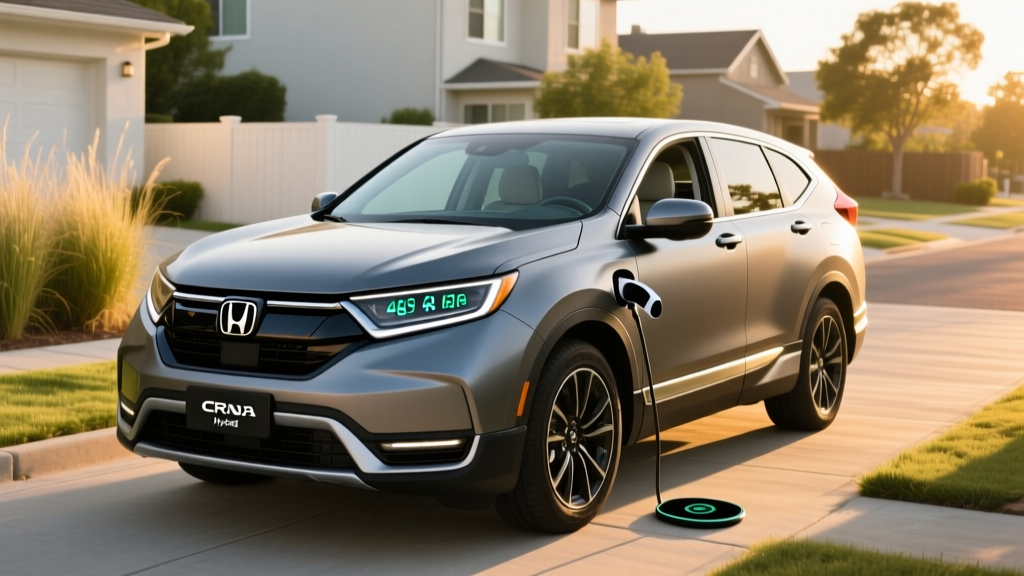
The Honda CR-V Hybrid has become one of the best-selling electrified SUVs in America, and for good reason: it delivers meaningful fuel savings without requiring a plug, a lifestyle change, or a steep price premium. For shoppers researching the 2025 Honda CR-V Hybrid EPA MPG numbers, the headline figure is a 37 MPG combined rating on front-wheel-drive trims — but real-world results often tell a more nuanced story depending on your commute, climate, and driving style.
This guide covers everything a data-driven buyer needs: exact EPA city/highway/combined figures, how the CR-V Hybrid's two-motor powertrain works, real-world MPG expectations, battery longevity, warranty coverage, and how it stacks up against plug-in hybrids and full EVs in total cost of ownership.
2025 Honda CR-V Hybrid EPA MPG: Official Ratings
The 2025 Honda CR-V Hybrid uses Honda's fourth-generation two-motor hybrid system, pairing a 2.0-liter Atkinson-cycle four-cylinder engine with two electric motors. The EPA publishes separate ratings for front-wheel-drive (FWD) and all-wheel-drive (AWD/eAWD) configurations, and the difference is worth noting if you live in a snowy climate.
| Drivetrain | City MPG | Highway MPG | Combined MPG | Annual Fuel Cost* |
|---|---|---|---|---|
| FWD (Sport, Sport-L, Sport Touring) | 40 | 35 | 37 | ~$1,550 |
| AWD / eAWD | 38 | 33 | 35 | ~$1,650 |
*Based on 15,000 miles/year at $3.50/gallon regular unleaded. Source: fueleconomy.gov.
The FWD hybrid's 40 MPG city rating is the standout figure. Like most hybrids, the CR-V benefits disproportionately from stop-and-go driving, where regenerative braking recaptures energy and the electric motor handles low-speed propulsion without burning fuel. Highway MPG drops to 35 because aerodynamic drag dominates at speed and the gasoline engine does more direct work.
Real-World MPG vs. EPA Sticker: What Owners Actually See
EPA estimates are standardized laboratory tests — useful for comparison, but not a guarantee. Based on owner-reported data from Fuelly and real-world testing by automotive publications, here's what to expect from the 2025 CR-V Hybrid in daily driving:
- City/suburban commuting (under 45 mph): 38–43 MPG. Hybrids shine here. Short trips with frequent stops maximize regen braking and electric-motor use. Some owners report exceeding the 40 MPG city sticker in warm weather.
- Highway cruising (65–75 mph): 31–35 MPG. Sustained highway speeds reduce the hybrid advantage. Expect numbers at or slightly below the 35 MPG EPA highway rating, especially with roof racks or cargo.
- Cold weather (below 30°F): 30–34 MPG combined. The engine runs more often to provide cabin heat and maintain operating temperature. Expect a 10–15% drop from combined ratings in winter.
- Mixed driving (annual average): 34–38 MPG for most owners, aligning closely with the 37 MPG combined FWD rating.
Powertrain Specs: How the Two-Motor Hybrid System Works
The 2025 CR-V Hybrid uses Honda's e-CVT two-motor system — not a traditional continuously variable transmission with belts or pulleys. Instead, one motor primarily generates electricity from the gasoline engine, while the second motor drives the wheels. At highway speeds, a lock-up clutch connects the engine directly to the wheels for efficiency.
| Specification | Value |
|---|---|
| Engine | 2.0L Atkinson-cycle DOHC 4-cylinder |
| Engine Output | 146 hp @ 6,100 rpm / 134 lb-ft torque |
| Electric Drive Motor | 181 hp / 247 lb-ft torque |
| Combined System Output | 204 hp / 247 lb-ft torque |
| Transmission | e-CVT (two-motor direct-drive) |
| Hybrid Battery | ~1.06 kWh lithium-ion (self-charging HEV) |
| 0–60 mph | ~7.6 seconds (FWD) |
| Towing Capacity | 1,000 lbs |
| Fuel Tank | 14.0 gallons (regular unleaded) |
The 204 combined horsepower is competitive with the non-hybrid CR-V's 1.5L turbo (190 hp), but the hybrid's 247 lb-ft of torque — available instantly from the electric motor — makes it feel noticeably quicker off the line. The eAWD system adds a rear-mounted electric motor for traction without a mechanical driveshaft.
Hybrid (HEV) vs. Plug-In Hybrid (PHEV) vs. Full EV: Which Fits You?
The CR-V Hybrid is a conventional hybrid (HEV) — it does not plug in. It recovers energy through regenerative braking and engine-generated electricity. Honda does not currently offer a CR-V Plug-In Hybrid (PHEV) in the US market. If you want a plug-in Honda SUV, the closest option is the Honda Clarity PHEV (discontinued) or you'd need to look at competitors like the Toyota RAV4 Prime or Hyundai Tucson PHEV.
| Factor | HEV (CR-V Hybrid) | PHEV (e.g., RAV4 Prime) | BEV (e.g., Tesla Model Y) |
|---|---|---|---|
| Plugs in? | No | Yes (Level 1/2) | Yes (Level 1/2/DC) |
| Electric-only range | N/A (motor assists) | 25–42 miles typical | 250–330 miles (EPA) |
| Uses gasoline? | Yes, always | Yes, after battery depletes | No |
| Home charging needed? | No | Recommended (240V) | Essential (240V) |
| Federal tax credit | None | Up to $7,500 (varies) | Up to $7,500 (varies) |
| Starting MSRP range | $34,900–$40,700 | $43,000–$50,000+ | $36,000–$55,000+ |
| Best for | No home charging; simple ownership | Short commute + home charger | Home charging + low running costs |
- Choose the CR-V Hybrid (HEV) if: You can't install a home charger (apartment, street parking), you want zero behavior change from a gas car, or you want the lowest upfront price with meaningful MPG gains.
- Choose a PHEV if: Your daily commute is under 40 miles, you can charge at home overnight, and you want to drive mostly on electricity while keeping a gas engine for road trips.
- Choose a full EV (BEV) if: You have reliable home Level 2 charging, your daily driving is under 250 miles, and you want the lowest per-mile fuel cost and zero tailpipe emissions.
Pricing, Trims, and Tax Credit Eligibility
The 2025 Honda CR-V Hybrid is available in three trims, all featuring the same 204-hp powertrain:
| Trim | Drivetrain | MSRP |
|---|---|---|
| Sport Hybrid | FWD | $34,900 |
| Sport Hybrid | AWD | $36,400 |
| Sport-L Hybrid | FWD | $37,100 |
| Sport-L Hybrid | AWD | $38,600 |
| Sport Touring Hybrid | AWD (standard) | $40,700 |
Federal tax credit: The conventional CR-V Hybrid (HEV) does not qualify for the IRS §30D Clean Vehicle Credit. That credit applies only to plug-in electric vehicles (PHEVs and BEVs) meeting battery sourcing, MSRP cap, and buyer income requirements. There is no current federal incentive for self-charging hybrids.
State incentives: A small number of states offer rebates for conventional hybrids, but these are uncommon and change frequently. Check your state energy office or DMV for current programs.
Battery Warranty, Reliability, and Replacement Cost
Hybrid battery longevity remains a top concern for buyers switching from a conventional gas vehicle. Honda's track record here is strong — the company has been building hybrid systems since the early 2000s Insight, and the current-generation two-motor system is proven across the Accord Hybrid, Civic Hybrid, and CR-V Hybrid.
- Hybrid battery (traction): 8 years / 100,000 miles (10 years / 150,000 miles in CARB states including CA, CT, ME, MA, NJ, NY, OR, VT, WA)
- Hybrid system components: 8 years / 100,000 miles
- Basic vehicle warranty: 3 years / 36,000 miles
- Powertrain warranty: 5 years / 60,000 miles
The hybrid battery warranty covers defects and capacity loss below a functional threshold — typically defined as the battery's inability to hold sufficient charge for normal hybrid operation. Source: Honda Warranty Information.
Real-world reliability: The CR-V Hybrid's lithium-ion traction battery is relatively small (~1.06 kWh) and is managed conservatively by Honda's battery management system. It never fully charges or fully depletes, which dramatically reduces stress and extends cycle life. Based on data from earlier Honda hybrid systems, these batteries routinely last 150,000–200,000+ miles without replacement.
Replacement cost: If the hybrid battery does fail out of warranty, a replacement from Honda typically costs $2,000–$4,000 including labor — far less than a full EV battery pack. Third-party refurbishers offer reconditioned units for $1,200–$2,500. For context, the average CR-V Hybrid owner will save $4,000–$6,000 in fuel over 150,000 miles compared to the gas-only CR-V (at $3.50/gallon), more than covering any eventual battery replacement.
2025 CR-V Hybrid Pros and Cons
Pros
- 40 MPG city (FWD) — class-leading for a compact SUV
- No plug required — zero lifestyle change from gas
- 204 hp with instant electric torque feels responsive
- Spacious interior: 39.3 cu ft cargo (rear seats up)
- Strong IIHS safety ratings (Top Safety Pick eligible)
- Proven hybrid reliability with 8–10 yr battery warranty
- Lower MSRP than PHEV or EV competitors
Cons
- No PHEV variant available (no electric-only range)
- No federal tax credit (HEV ineligible for §30D)
- AWD drops combined MPG to 35
- Engine drone under hard acceleration (e-CVT character)
- Towing limited to 1,000 lbs
- 1,000-lb tow rating trails some turbo-gas competitors
- Hybrid trims start at Sport — no base LX hybrid option
CR-V Hybrid vs. Key Competitors: MPG and Price
| Model | Combined MPG (FWD) | Combined HP | Starting MSRP |
|---|---|---|---|
| Honda CR-V Hybrid | 37 | 204 | $34,900 |
| Toyota RAV4 Hybrid | 39 | 219 | $33,350 |
| Hyundai Tucson Hybrid | 38 | 226 | $33,475 |
| Kia Sportage Hybrid | 38 | 227 | $30,590 |
| Ford Escape Hybrid | 39 | 210 | $34,495 |
The CR-V Hybrid sits in the middle of this pack on MPG but leads on interior volume and perceived build quality. The Toyota RAV4 Hybrid edges it out by 2 MPG combined and starts ~$1,500 lower, but the CR-V's cargo space (39.3 cu ft vs. 37.5 cu ft in the RAV4) and Honda Sensing safety suite are strong counterpoints. The Kia Sportage Hybrid undercuts all competitors on price while matching MPG, though its long-term reliability data is thinner.
Frequently Asked Questions
How many MPG does the 2025 Honda CR-V Hybrid get?
The EPA rates the FWD CR-V Hybrid at 40 city / 35 highway / 37 combined MPG. The AWD version drops to 38 city / 33 highway / 35 combined. Real-world results typically fall between 34–43 MPG depending on driving conditions, with city-heavy commutes yielding the best numbers.
Does the CR-V Hybrid need to be plugged in?
No. The CR-V Hybrid is a conventional (self-charging) hybrid. It generates electricity through regenerative braking and the gasoline engine. You fuel it like a normal car — there is no plug, no charging cable, and no electric-only driving range to manage.
Is there a Honda CR-V Plug-In Hybrid (PHEV)?
Not in the United States. Honda offers a CR-V e:PHEV in China and Europe, but it is not sold in the US market. American buyers seeking a plug-in compact SUV should consider the Toyota RAV4 Prime (42 miles electric range), Hyundai Tucson PHEV (33 miles), or Kia Sportage PHEV (34 miles).
Does the 2025 CR-V Hybrid qualify for a federal tax credit?
No. The IRS §30D Clean Vehicle Credit applies only to plug-in vehicles (PHEVs and BEVs) with qualifying battery components and critical minerals sourcing. Conventional hybrids like the CR-V Hybrid do not qualify. Check IRS.gov for current credit rules and eligible vehicles.
How long will the CR-V Hybrid battery last?
Honda covers the hybrid battery for 8 years / 100,000 miles (10 years / 150,000 miles in CARB states). In practice, Honda's hybrid batteries routinely last 150,000–200,000+ miles. The small 1.06 kWh battery is managed conservatively — it never fully charges or depletes, which minimizes degradation. Out-of-warranty replacement runs $2,000–$4,000.
Is the CR-V Hybrid reliable?
Yes. Honda's two-motor hybrid system has been refined over multiple generations and is shared with the Accord and Civic Hybrid lines. The CR-V earns strong reliability scores from Consumer Reports and JD Power. The e-CVT has no belts, pulleys, or traditional transmission fluid to change, reducing long-term maintenance costs versus a conventional automatic.
How much does it cost to fuel the CR-V Hybrid vs. the gas version?
At $3.50/gallon and 15,000 miles/year, the FWD Hybrid costs approximately $1,420/year in fuel (37 MPG combined). The gas-only CR-V AWD (28 MPG combined) costs roughly $1,875/year — a difference of about $455 per year, or $2,275 over five years. The Hybrid's ~$2,000–$3,000 price premium pays for itself within 4–6 years for most drivers.