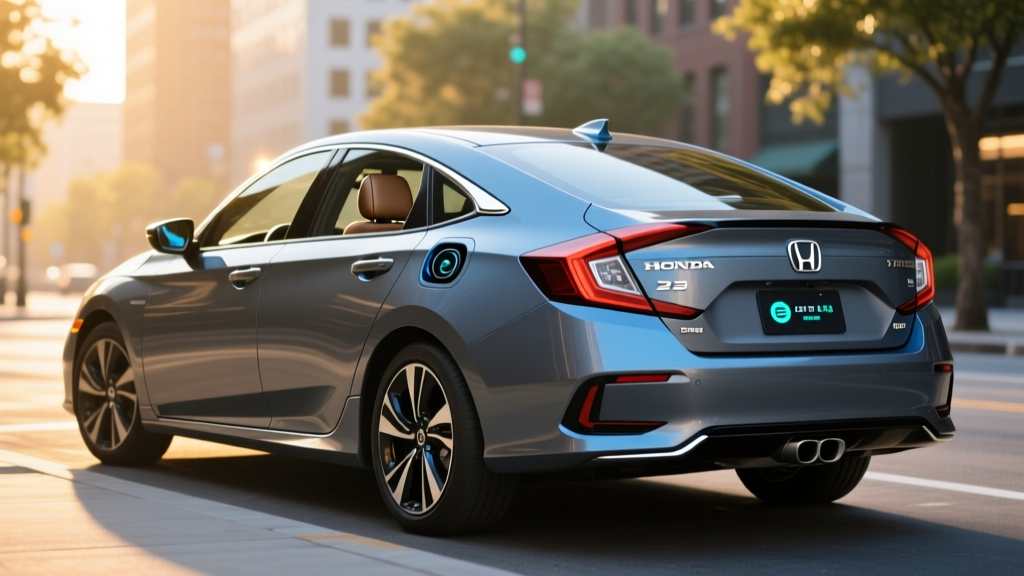
The 2025 Honda Civic Touring Hybrid sits at the top of Honda's compact hybrid lineup, pairing a 2.0-liter Atkinson-cycle four-cylinder with a two-motor hybrid system for a combined 200 horsepower. It is not a plug-in hybrid — it's a conventional self-charging hybrid (HEV) that requires no charging cord and no change in daily habits. For buyers weighing the Civic Touring Hybrid against a full EV or a gas-only compact, this guide covers the exact fuel economy figures, real-world efficiency expectations, powertrain details, battery warranty, and total ownership picture you need before signing the paperwork.
| Spec | Value |
|---|---|
| Powertrain | 2.0L Atkinson-cycle I4 + two-motor hybrid system |
| Combined Horsepower | 200 hp |
| Combined Torque | 232 lb-ft (electric motor) |
| Drivetrain | Front-wheel drive (e-CVT) |
| EPA Fuel Economy (City / Hwy / Combined) | 50 / 47 / 49 MPG |
| Fuel Tank Capacity | 12.4 gallons |
| Total Driving Range | ~607 miles (EPA combined) |
| 0–60 mph | ~7.2 seconds (est.) |
| Hybrid Battery Type | Lithium-ion |
| Hybrid Battery Warranty | 8 years / 100,000 miles (10 yr / 150,000 mi in CARB states) |
| Starting MSRP (Touring Sedan) | $31,950 (incl. destination) |
HEV vs PHEV: What the Civic Touring Hybrid Actually Is
Before diving into fuel economy, it's critical to understand what you're buying — because the terminology trips up many shoppers.
| Feature | HEV (Civic Hybrid) | PHEV (e.g., Toyota Prius Prime) | BEV (e.g., Tesla Model 3) |
|---|---|---|---|
| Plug-in charging required? | No | Yes (for EV range) | Yes (only propulsion) |
| Electric-only range | ~1 mile at low speed | 25–44 miles typical | 250–360+ miles |
| Gas engine | Yes (primary + regen) | Yes (backup) | None |
| Fuel/energy | Gasoline only | Gasoline + electricity | Electricity only |
| Federal tax credit (§30D) | Not eligible | Up to $7,500 (if qualified) | Up to $7,500 (if qualified) |
| Best for | No home charging access | Short commutes + road trips | Home charging + daily driving |
The 2025 Honda Civic Touring Hybrid is a conventional hybrid (HEV). It recovers energy through regenerative braking and uses its small lithium-ion battery pack to assist the gas engine and enable brief electric-only motoring at low speeds. You never plug it in. You fuel it like any other car at a gas station. This is the same architecture Toyota uses in the Prius (non-Prime) and the Camry Hybrid.
Fuel Economy: EPA Numbers and Real-World MPG
The EPA rates the 2025 Civic Hybrid Touring sedan at 50 MPG city, 47 MPG highway, and 49 MPG combined, per fueleconomy.gov. (The Sport Touring trim with larger 18-inch wheels drops slightly to 50/45/47.) These are strong numbers for a compact sedan with 200 horsepower.
| Trim | City MPG | Highway MPG | Combined MPG |
|---|---|---|---|
| Sport Hybrid | 50 | 47 | 49 |
| Sport Touring Hybrid | 50 | 45 | 47 |
Real-World MPG: What Owners Actually See
Conventional hybrids like the Civic often exceed their EPA city rating in real-world stop-and-go driving, because regenerative braking recaptures energy that gas-only cars waste as heat. On the highway, where regen opportunities are fewer and aerodynamic drag dominates, real-world MPG tends to land closer to — or slightly below — the EPA highway number.
Based on owner-reported data and third-party testing:
- City / suburban driving: 48–55 MPG is typical. Short trips in warm weather with moderate stops can push toward the upper end.
- Highway cruising (70–75 mph): Expect 42–47 MPG. At higher sustained speeds, the 2.0L engine does more of the work directly.
- Cold weather (below 32°F): Expect a 5–10% reduction, landing around 44–47 MPG combined. The engine runs more frequently to heat the cabin and warm the hybrid battery.
- Overall mixed driving: Most owners report 46–51 MPG combined over thousands of miles.
At 49 MPG combined and a national average gas price of roughly $3.15/gallon (early 2026), fueling the Civic Touring Hybrid costs approximately $0.064 per mile — roughly half what a 30 MPG gas compact costs to fuel.
Powertrain Deep Dive: 200 HP from Two Motors and a 2.0L
Honda's fourth-generation two-motor hybrid system is the heart of the Civic Hybrid. Here's how it works:
- 2.0L Atkinson-cycle I4 engine: Produces roughly 146 hp on its own. The Atkinson cycle prioritizes thermal efficiency over peak power by keeping the intake valve open slightly longer during the compression stroke.
- Propulsion motor: The primary drive motor delivers 184 hp and 232 lb-ft of torque. In most city and suburban driving, this electric motor is what actually turns the wheels — the gas engine acts as a generator.
- Generator motor: A second motor functions as a starter, generator, and occasionally a direct-drive assist at highway speeds.
The combined system output is 200 horsepower. The e-CVT transmission has no fixed gears — it manages the blend of engine and motor power seamlessly. In practice, the Civic Hybrid accelerates with the smooth, immediate torque characteristic of electric drive, making it feel quicker than its 7.2-second 0–60 time suggests in around-town driving.
One note: Honda does not publish the hybrid battery's kWh capacity for the Civic Hybrid, as it is a small pack designed for power assist rather than energy storage. It is not comparable to a PHEV or BEV battery.
Pricing, Tax Credits, and Total Cost of Ownership
The 2025 Honda Civic Touring Hybrid sedan carries an MSRP of approximately $31,950 including destination charges. The Sport Touring Hybrid is priced similarly. These are the top-of-line trims, so they include Honda Sensing (ADAS suite), a 9-inch touchscreen with wireless Apple CarPlay and Android Auto, Bose premium audio, wireless phone charging, leather-trimmed seats, and a moonroof.
Federal Tax Credit Eligibility
The 2025 Honda Civic Hybrid does not qualify for the federal §30D clean vehicle tax credit. That credit applies only to plug-in electric vehicles (BEVs and PHEVs) that meet specific battery capacity, critical-mineral sourcing, MSRP, and buyer income thresholds. Conventional hybrids like the Civic Hybrid are excluded under current IRS rules.
Some states offer separate incentives for hybrids, but these are uncommon and vary by jurisdiction. Check your state's energy or environmental agency for current programs.
Five-Year Cost Comparison
| Vehicle | Combined MPG / MPGe | Est. 5-Year Fuel Cost |
|---|---|---|
| 2025 Civic Touring Hybrid | 49 MPG | ~$4,820 |
| 2025 Civic 1.5T Touring (gas) | 35 MPG | ~$6,750 |
| 2025 Tesla Model 3 RWD | 132 MPGe | ~$2,700 (electricity) |
The hybrid saves roughly $1,900 in fuel over 5 years compared to the gas-only Civic — enough to offset the hybrid's price premium within the first few years of ownership. A BEV saves more on fuel, but comes with a higher purchase price, charging-access requirements, and different insurance considerations.
Battery Warranty, Reliability, and Replacement Cost
Honda Hybrid Battery Warranty
Standard coverage: 8 years or 100,000 miles, whichever comes first.
CARB-state coverage: 10 years or 150,000 miles in states that follow California Air Resources Board emissions rules (CA, CO, CT, DE, ME, MD, MA, MN, NJ, NM, NY, OR, RI, VT, WA, and others adopting CARB standards).
The warranty covers battery capacity loss below a defined threshold (typically 70% of original capacity) and defects. Honda covers the hybrid system components — including the power control unit and electric motors — under the same warranty period.
How Long Do Honda Hybrid Batteries Last?
Honda's hybrid battery packs in the Civic and Accord have proven durable in real-world use. Based on long-term data from Honda's hybrid lineup (Insight, Accord Hybrid, CR-V Hybrid), most hybrid batteries retain functional capacity well beyond 150,000 miles. Degradation in conventional hybrids is slower than in BEVs because the battery operates in a narrow state-of-charge window — typically between 40% and 80% — which minimizes stress on the cells.
If a replacement is needed out of warranty, expect the following cost range:
- OEM battery pack: $2,000–$4,000 (parts + labor at a Honda dealer)
- Refurbished / aftermarket pack: $1,200–$2,500
- Individual cell replacement: Some independent hybrid specialists can replace degraded cells for $500–$1,500
For context, this is significantly cheaper than a BEV traction battery replacement, which can exceed $10,000–$18,000. The Civic Hybrid's small battery is one of its lowest-risk ownership components.
Reliability Track Record
Honda's hybrid powertrain has accumulated years of field data across multiple models. The e-CVT design has no traditional transmission fluid, clutch packs, or belts to wear out — reducing long-term maintenance compared to conventional automatic transmissions. According to IIHS and owner surveys, the Civic platform consistently rates well for build quality and mechanical reliability. The Touring trim's added electronics (Bose audio, navigation, Honda Sensing suite) are the more common sources of minor complaints rather than the hybrid system itself.
Who Should Choose the Civic Touring Hybrid vs an EV or Gas Car?
Pros
- 49 MPG combined — no plug, no range anxiety, no behavior change
- 200 hp with smooth electric-motor torque in city driving
- ~607 miles total range per tank — excellent for road trips
- Top-trim Touring features (Bose, leather, Honda Sensing) at a reasonable price
- Low hybrid battery replacement risk and strong warranty
- No home charging infrastructure needed
Cons
- No electric-only driving range (unlike a PHEV)
- No federal tax credit eligibility
- Highway MPG drops to 45–47 — less advantage vs gas at sustained speed
- Cold-weather fuel economy penalty of 5–10%
- Not eligible for HOV lane stickers in most states (unlike PHEVs/BEVs)
Decision Framework
Choose the Civic Touring Hybrid if: You want maximum fuel savings without plugging in, you lack access to home or workplace charging, you take regular road trips beyond 300 miles, or you want a feature-rich compact sedan under $33,000.
Choose a PHEV (e.g., Toyota Prius Prime) if: You have home Level 2 charging, your daily commute is under 40 miles round-trip (covering it on electricity), but you still want gas-engine flexibility for longer trips.
Choose a BEV (e.g., Tesla Model 3, Hyundai Ioniq 6) if: You have reliable home charging, your daily driving is under 250 miles, you want to eliminate gas entirely, and you qualify for the §30D tax credit to offset the higher purchase price.
Stick with the gas Civic if: Your annual mileage is under 8,000 miles per year (the fuel savings won't offset the hybrid premium quickly), or you want the lowest possible purchase price.
Charging, Maintenance, and Ownership Practicalities
Since the Civic Touring Hybrid is a conventional HEV, there is no charging to plan. You refuel at any gas station with regular unleaded (87 octane). The hybrid system handles all energy management automatically.
Maintenance is straightforward:
- Oil changes: Every 7,500–10,000 miles (the Atkinson-cycle engine runs less than a conventional engine, so oil stays cleaner longer)
- Brake pads: Often last 60,000–80,000+ miles thanks to regenerative braking reducing friction brake use
- Transmission: The e-CVT has no conventional transmission fluid service interval in most Honda hybrid models
- Tire rotation: Every 5,000–7,500 miles, same as any Civic
Insurance costs for the Civic Touring Hybrid are typically in line with the gas Touring trim — hybrids don't carry the insurance premiums that some BEVs do. Expect $1,400–$1,800/year depending on your profile and state.
Frequently Asked Questions
How many MPG does the 2025 Honda Civic Touring Hybrid get?
The EPA rates it at 50 MPG city, 47 MPG highway, and 49 MPG combined. Real-world owners typically report 46–51 MPG in mixed driving, with city driving sometimes exceeding the EPA rating thanks to regenerative braking.
Does the Civic Touring Hybrid need to be plugged in?
No. The Civic Hybrid is a conventional hybrid (HEV), not a plug-in hybrid (PHEV). It charges its small lithium-ion battery through regenerative braking and the gas engine. You simply fuel it at a gas station like any other car.
Does the 2025 Civic Hybrid qualify for a federal tax credit?
No. The federal §30D clean vehicle credit applies only to plug-in electric vehicles (BEVs and PHEVs). Conventional hybrids are not eligible. Some states may offer minor hybrid incentives — check your local energy agency.
How long will the Honda Civic Hybrid battery last?
Honda's hybrid batteries are designed to last the life of the vehicle. The battery is covered by an 8-year/100,000-mile warranty (10 years/150,000 miles in CARB states). Real-world data from Honda's hybrid lineup shows most packs remain functional well past 150,000 miles. If replacement is ever needed, expect $2,000–$4,000 for an OEM pack.
Is the Civic Hybrid faster than the gas Civic?
Yes, modestly. The hybrid's 200 combined horsepower and 232 lb-ft of electric motor torque give it stronger low-end acceleration than the 1.5T gas engine (180 hp, 177 lb-ft). The 0–60 time is roughly 7.2 seconds for the hybrid vs. approximately 7.5–8.0 seconds for the 1.5T. The difference is most noticeable in city and suburban driving where electric torque is immediate.
Hybrid vs PHEV vs EV — which should I choose?
If you can't charge at home, choose the hybrid (HEV). If you can charge at home and commute under 40 miles daily but want road-trip flexibility, consider a PHEV. If you can charge at home, drive under 250 miles daily, and want to eliminate gas, choose a BEV. The Civic Touring Hybrid is ideal for buyers who want fuel savings with zero lifestyle changes.
What is the total driving range of the Civic Touring Hybrid?
With a 12.4-gallon fuel tank and 49 MPG combined, the EPA-estimated total range is approximately 607 miles. In real-world mixed driving, expect 550–620 miles between fill-ups depending on conditions.