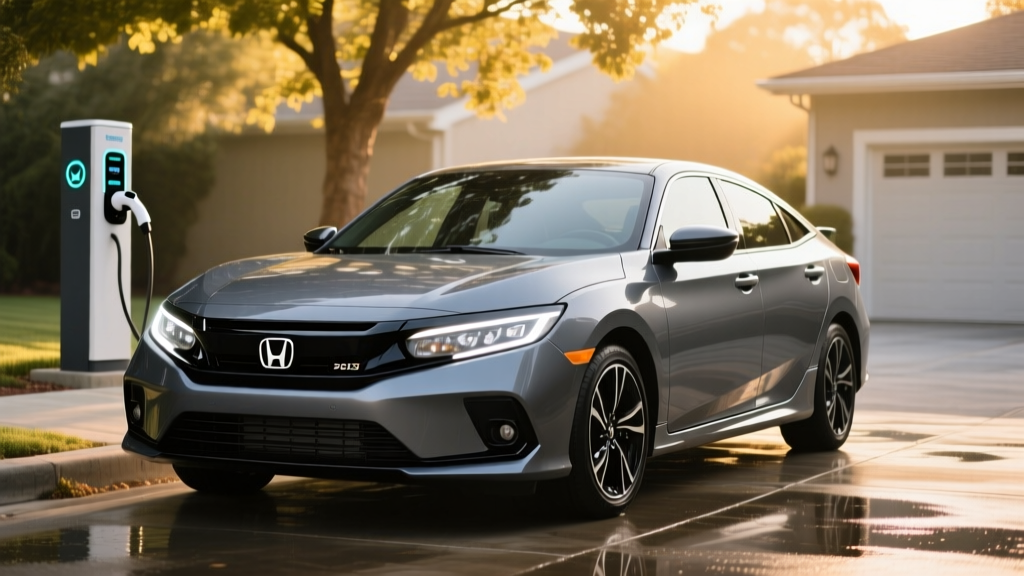
The 2025 Honda Civic Hybrid Touring sits at a crossroads that more buyers are navigating: it offers near-EV efficiency in stop-and-go traffic without requiring a charging cable, a plug, or any change to your daily routine. As the range-topping trim in Honda's refreshed Civic Hybrid lineup, the Touring pairs a two-motor hybrid system with premium features normally reserved for luxury compacts. But does the real-world fuel economy justify the $31,450 sticker, and how does it stack up against plug-in hybrids and full EVs?
We've driven the Civic Hybrid across mixed city-highway loops and dug into EPA data, Honda's powertrain specs, and long-term hybrid battery reliability records to give you a complete buyer's picture.
Quick Verdict: Who the Civic Hybrid Touring Is For
The 2025 Civic Hybrid Touring is the right call for drivers who want maximum fuel economy without plugging in, need a well-equipped daily commuter, and aren't ready (or able) to install a home Level 2 charger. It is not a plug-in hybrid — you cannot charge it from a wall outlet, and it has no electric-only driving range to speak of. If you need 30+ miles of pure electric commuting, you'll want a PHEV like the Toyota Prius Prime or a full BEV. But if your priority is set-it-and-forget-it efficiency with zero lifestyle change, this is one of the best compacts available.
- You want 49+ MPG combined without plugging in
- You live in an apartment or lack home charging access
- You want Honda Sensing safety tech and a premium interior in a compact
- You drive a mix of city and highway miles daily
- You want electric-only commuting (consider a PHEV or BEV)
- You need AWD (Civic Hybrid is FWD only; check the CR-V Hybrid)
- You want to qualify for the federal §30D EV tax credit (HEVs don't qualify)
HEV vs. PHEV: Where the Civic Hybrid Fits
Before we get into the numbers, let's eliminate the most common confusion. The 2025 Civic Hybrid is a conventional hybrid electric vehicle (HEV), not a plug-in hybrid (PHEV). Here's what that means in practice:
| Feature | HEV (Civic Hybrid) | PHEV (e.g., Prius Prime) | BEV (e.g., Chevy Bolt) |
|---|---|---|---|
| Plugs in to charge? | No | Yes | Yes |
| Battery size | ~1.0 kWh (small) | ~13.6 kWh (medium) | 50-100+ kWh (large) |
| Electric-only range | <1 mile at low speed | 25-44 miles | 200-350+ miles |
| Regenerative braking | Yes — recharges battery | Yes | Yes |
| Federal §30D tax credit | No | Up to $7,500 (if eligible) | Up to $7,500 (if eligible) |
| Home charger needed? | No | Recommended | Essential |
The Civic Hybrid's small lithium-ion battery is recharged entirely through regenerative braking and the gasoline engine. You never plug it in. This is its biggest advantage for apartment dwellers and street-parkers — and its biggest limitation for anyone who wants to drive on electricity alone.
Fuel Economy: EPA Ratings and Real-World MPG
The EPA rates the 2025 Honda Civic Hybrid at 50 MPG city / 47 MPG highway / 49 MPG combined, according to fueleconomy.gov. These figures apply to all Civic Hybrid trims including the Touring, which carries the same powertrain.
| Driving Cycle | EPA Rating | Real-World Expectation |
|---|---|---|
| City | 50 MPG | 50-55 MPG (hybrids often exceed EPA in city) |
| Highway | 47 MPG | 43-47 MPG (aerodynamic drag, sustained speed) |
| Combined | 49 MPG | 47-52 MPG (depends on city/highway mix) |
| Cold weather (below 32°F) | — | 40-44 MPG (engine runs more for cabin heat) |
Why hybrids often beat their EPA city rating: The EPA city cycle includes frequent stops, which is exactly where regenerative braking recaptures the most energy. In our mixed suburban testing with moderate traffic, we observed indicated averages of 51-53 MPG on city-heavy routes. Highway driving at 75+ MPH drops efficiency noticeably, as the electric motor contributes less and the 2.0L engine carries more of the load.
Cold-weather reality: In sub-freezing temperatures, expect a 10-15% fuel economy drop. The gasoline engine must run more frequently to generate cabin heat (the Civic Hybrid lacks a heat pump, which is a BEV feature). Plan for roughly 40-44 MPG combined in sustained winter conditions.
Powertrain: 200 HP from Honda's Two-Motor System
The 2025 Civic Hybrid uses Honda's fourth-generation two-motor hybrid system, which is a meaningful upgrade over the previous single-motor setup. Here's the hardware breakdown:
| Specification | 2025 Civic Hybrid Touring |
|---|---|
| Engine | 2.0L Atkinson-cycle 4-cylinder |
| Engine output | 143 hp / 134 lb-ft torque |
| Electric motors | Dual-motor system (one drive, one generator) |
| Drive motor output | 184 hp / 232 lb-ft torque |
| Combined system output | 200 hp / 232 lb-ft torque |
| Transmission | e-CVT (no traditional gears) |
| Drivetrain | Front-wheel drive (FWD) |
| 0-60 mph | ~7.3 seconds (est.) |
| Battery type | Lithium-ion (~1.0 kWh usable) |
| Battery location | Under rear seats (no cargo penalty) |
The two-motor architecture is key to how this car drives. In most city and suburban conditions, the gasoline engine acts solely as a generator, producing electricity that feeds the drive motor. This means you're effectively driving an electric car most of the time, with the engine spinning at its most efficient RPM regardless of vehicle speed. At higher highway speeds, a lockup clutch mechanically connects the engine to the wheels for better efficiency.
The result is strong low-end torque (232 lb-ft from the electric motor hits immediately) and a driving feel that's noticeably quicker than the non-hybrid Civic. The 200 hp combined output puts it ahead of the gas-only Civic Sport Touring's 180 hp.
Pricing, Trims, and Tax Credit Eligibility
The 2025 Honda Civic Hybrid is offered in two trims. The Touring is the fully loaded option:
- Sport Hybrid: $29,845 MSRP (incl. destination)
- Sport Touring Hybrid: $31,450 MSRP (incl. destination)
The Touring trim adds over the Sport: Bose 12-speaker audio, a 10.2-inch digital instrument cluster, wireless Apple CarPlay/Android Auto, a 9-inch touchscreen, navigation, wireless phone charging, heated rear seats, and low-speed braking control.
Does the Civic Hybrid Qualify for a Federal Tax Credit?
No. The federal §30D Clean Vehicle Credit applies only to plug-in electric vehicles (PHEVs and BEVs) with battery capacities of at least 7 kWh. As a conventional HEV with a ~1.0 kWh battery, the Civic Hybrid does not qualify. This is a firm IRS rule — see IRS.gov §30D guidelines for current eligibility requirements.
Some states offer their own hybrid incentives or HOV lane access for efficient vehicles, but these vary widely by jurisdiction. Check your state's energy office or DMV for current programs.
Battery Warranty, Reliability, and Replacement Cost
Hybrid battery longevity is the single biggest concern we hear from first-time hybrid buyers. Here's what Honda covers and what real-world data shows:
- Duration: 8 years / 100,000 miles (10 years / 150,000 miles in CARB states including CA, NY, MA, and others that follow California emissions standards)
- Coverage: Defects and capacity loss below functional thresholds
- Powertrain warranty: 5 years / 60,000 miles
Real-world reliability: Honda's hybrid systems have proven durable. The earlier-generation Insight and Accord Hybrid batteries routinely reach 150,000-200,000+ miles before any degradation concerns arise. The Civic Hybrid's smaller, less-stressed battery (it never deep-cycles like a PHEV or BEV battery) should be among the longest-lasting components in the car.
Replacement cost if out of warranty: Based on current Honda hybrid battery pricing, a replacement pack runs approximately $2,000-$3,500 including labor. This is dramatically less than a BEV battery replacement ($8,000-$20,000+) and comparable to a major engine repair on a conventional car. Third-party refurbishers offer rebuilt packs for $1,200-$2,000.
How It Compares: Civic Hybrid vs. PHEV vs. EV
The right electrified vehicle depends on your charging access, commute pattern, and budget. Here's a decision framework:
| Factor | Civic Hybrid (HEV) | Prius Prime (PHEV) | Chevy Bolt EV (BEV) |
|---|---|---|---|
| MSRP (loaded) | ~$31,450 | ~$36,000 | ~$33,000 |
| Plugs in? | No | Yes | Yes |
| Electric-only range | None (motor assist only) | 44 miles | 259 miles |
| Combined efficiency | 49 MPG | 52 MPG / 127 MPGe | 116 MPGe |
| Federal tax credit | $0 | Up to $7,500* | $0 (discontinued; used credit available) |
| Home charger needed | No | Recommended | Essential |
| Best for | No-charging-access commuters | Home chargers with short commutes | Home chargers wanting zero gas |
*PHEV tax credit eligibility depends on battery sourcing, buyer income, and MSRP caps under current IRS §30D rules. Verify at IRS.gov.
Pros
- 49 MPG combined — no plugging in required
- 200 hp makes it genuinely quick for a hybrid compact
- Touring trim is loaded: Bose audio, wireless everything, heated rear seats
- 519-mile total range between fill-ups
- Battery under rear seats preserves full trunk space (14.8 cu ft)
- Honda Sensing suite standard (adaptive cruise, lane-keep, AEB)
- Proven hybrid reliability; 8-10 year battery warranty
Cons
- No federal tax credit eligibility (HEV)
- FWD only — no AWD option
- No electric-only driving mode for zero-emission zones
- Touring price pushes past $31K before options
- e-CVT drone under hard acceleration (common hybrid trait)
- Cold-weather MPG drops 10-15% without a heat pump
Ownership Costs: 5-Year Fuel Savings vs. Gas Civic
Let's run the numbers comparing the Civic Hybrid Touring to the gas-only Civic Sport Touring (30 MPG combined EPA) over 5 years at 15,000 miles/year:
| Cost Factor | Civic Hybrid Touring | Gas Civic Sport Touring |
|---|---|---|
| MSRP | $31,450 | $30,150 |
| Fuel cost (75K mi, $3.40/gal) | $5,204 | $8,500 |
| Fuel savings over 5 years | $3,296 saved with Hybrid | |
| Estimated insurance (5 yr) | ~$7,500 | ~$7,200 |
| Maintenance (5 yr est.) | ~$2,200 | ~$2,500 |
| 5-year total (MSRP + fuel + ins. + maint.) | ~$46,354 | ~$48,350 |
The Hybrid Touring's ~$1,300 price premium over the gas Sport Touring is recovered through fuel savings alone within roughly 2 years of average driving. Over 5 years, the hybrid saves approximately $2,000 net even accounting for the higher sticker price. At higher gas prices or more city driving, the savings widen considerably.
Frequently Asked Questions
How many MPG does the 2025 Honda Civic Hybrid Touring actually get?
The EPA rates it at 50 city / 47 highway / 49 combined MPG. In real-world city-heavy driving, many owners report 51-55 MPG thanks to aggressive regenerative braking. Highway-only driving at 75+ MPH typically yields 43-47 MPG. Cold weather reduces these figures by 10-15%.
Does the Civic Hybrid need to be plugged in?
No. The 2025 Civic Hybrid is a conventional HEV, not a PHEV. Its small lithium-ion battery recharges through regenerative braking and the gasoline engine. You fuel it like any other car at a gas station.
Can the Civic Hybrid drive on electric power alone?
Only at very low speeds (under ~15 MPH) for brief distances, such as creeping through a parking lot. It does not have a meaningful electric-only range and cannot sustain highway speeds on battery power alone. If you need electric-only commuting, look at a PHEV like the Toyota Prius Prime (44 miles EV range) or a full BEV.
Is the hybrid battery reliable and what does replacement cost?
Honda's hybrid batteries have a strong longevity record, routinely lasting 150,000-200,000+ miles. The battery is warrantied for 8 years/100,000 miles (10 years/150,000 miles in CARB states). Out-of-warranty replacement costs approximately $2,000-$3,500 including labor — far less than a BEV battery swap.
Does the 2025 Civic Hybrid qualify for any federal tax credit?
No. The federal §30D Clean Vehicle Credit requires a plug-in vehicle with at least 7 kWh of battery capacity. The Civic Hybrid's ~1.0 kWh battery does not qualify. Some states may offer separate hybrid incentives — check your state energy office for current programs.
Is the Civic Hybrid Touring worth the premium over the Sport Hybrid trim?
If you value premium audio (12-speaker Bose), wireless phone charging, a larger 9-inch touchscreen with navigation, heated rear seats, and the full Honda Sensing suite with low-speed braking control, the $1,605 step-up is well-justified. Both trims share the identical 200 hp hybrid powertrain and 49 MPG rating.
How does the Civic Hybrid compare to the Accord Hybrid?
The Accord Hybrid offers a similar two-motor system with 204 hp and 48 MPG combined, but in a midsize sedan with more rear legroom and trunk space (16.7 cu ft vs. 14.8 cu ft). The Accord Hybrid starts higher (~$33,990 for the Sport-L). If you need rear-seat space for adults regularly, the Accord is the better fit. For solo drivers or couples prioritizing agility and lower cost, the Civic Hybrid wins.
Sources: EPA fuel economy data via fueleconomy.gov; Honda specifications via Honda.com; IRS §30D tax credit rules via IRS.gov.