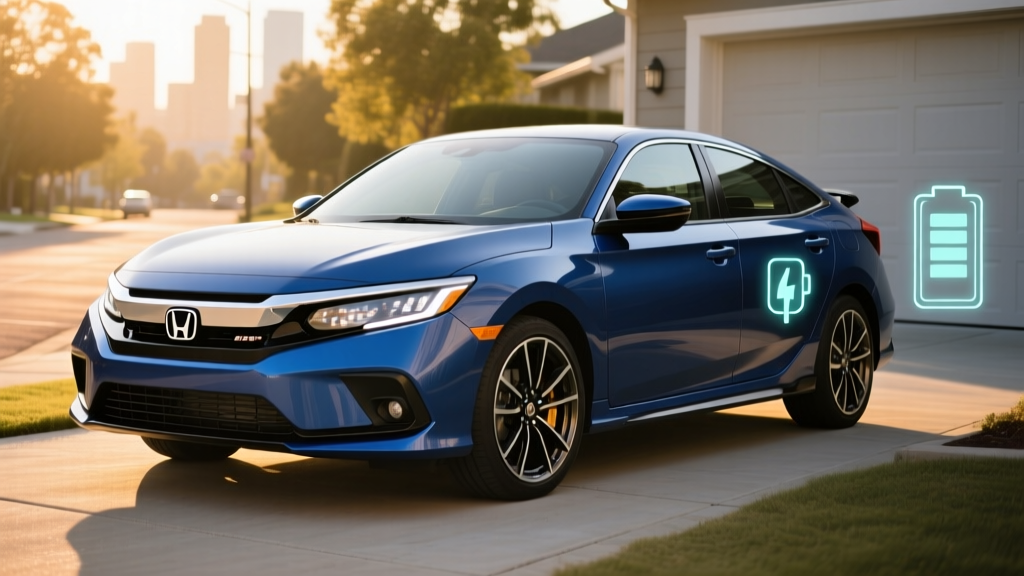
The 2025 Honda Civic Hybrid Sport Touring sits at a crossroads that many buyers find themselves at in 2026: Do you go full electric, stick with a conventional gas engine, or split the difference with a hybrid? Honda's answer is a conventional hybrid (HEV) — not a plug-in — that pairs a 2.0-liter Atkinson-cycle four-cylinder with a two-motor hybrid system to deliver 200 horsepower and an EPA-estimated 49 MPG combined. The Sport Touring trim tops the Civic Hybrid lineup with premium features, but does it make financial sense compared to a plug-in hybrid (PHEV) or a battery-electric vehicle (BEV)?
This guide breaks down every number that matters: real-world MPG versus EPA stickers, battery longevity and warranty coverage, ownership costs, and whether any federal tax credits apply. If you're researching the 2025 Honda Civic Hybrid Sport Touring, here's the data-driven analysis you need before visiting a dealer.
Hybrid vs. PHEV vs. EV: Where Does the Civic Hybrid Fit?
Before diving into specs, it's critical to understand what the Civic Hybrid is — and what it isn't. The 2025 Civic Hybrid is a conventional hybrid (HEV). It does not plug in. It has no electric-only driving range. Instead, it uses a small battery pack (approximately 1.1 kWh) that charges through regenerative braking and the gasoline engine, assisting with acceleration and enabling brief low-speed electric motoring.
| Feature | HEV (Civic Hybrid) | PHEV (e.g., Toyota Prius Prime) | BEV (e.g., Tesla Model 3) |
|---|---|---|---|
| Plug-in charging required? | No | Yes (Level 1 or 2) | Yes (Level 2 + DC fast) |
| Electric-only range | 0 miles (assist only) | ~30-44 miles | 250-350+ miles |
| Total range | ~500+ miles | ~400-500+ miles | 250-350+ miles |
| Battery size | ~1.1 kWh | ~13.6 kWh | 50-82 kWh |
| Federal tax credit (§30D) | Not eligible | Up to $7,500* | Up to $7,500* |
| Best for | No home charging access | Short commutes + road trips | Home charging + low running cost |
*§30D credit eligibility depends on MSRP caps, buyer income limits, battery sourcing, and point-of-sale transfer rules. See IRS.gov for current-year requirements.
The Civic Hybrid is engineered for buyers who want better fuel economy without changing their fueling habits. You'll never hunt for a charger or worry about range — you simply fill up at any gas station. The trade-off is that you remain dependent on gasoline prices, and you won't qualify for the federal clean vehicle tax credit.
Fuel Economy: EPA Ratings and Real-World MPG
The 2025 Honda Civic Hybrid Sport Touring carries EPA estimates of 50 MPG city / 47 MPG highway / 49 MPG combined, according to fueleconomy.gov. These numbers apply to the Sport Touring trim with its standard 18-inch alloy wheels — the Sport trim with identical powertrain achieves the same ratings.
| Driving Condition | EPA Estimate | Real-World Expectation |
|---|---|---|
| City | 50 MPG | 48-54 MPG (hybrids often exceed EPA in stop-and-go) |
| Highway (70+ mph) | 47 MPG | 42-46 MPG (aero drag reduces hybrid advantage) |
| Combined | 49 MPG | 45-51 MPG depending on driving mix |
| Cold weather (below 32°F) | — | 40-44 MPG (engine runs more for cabin heat) |
One of the defining characteristics of conventional hybrids is that they tend to outperform their EPA city estimate in real-world stop-and-go driving. The Civic's two-motor system recaptures energy during every deceleration event, and the engine shuts off at stops. On suburban errand routes with frequent lights and low speeds, owners commonly report 52-54 MPG.
Highway driving tells a different story. At sustained speeds above 70 mph, the electric motor's assistance diminishes and the gasoline engine does most of the work. Expect 42-46 MPG on long interstate trips. Cold weather compounds this: the engine must run continuously to provide cabin heat (the Civic Hybrid lacks a heat pump, which is a BEV/PHEV feature), dropping efficiency to roughly 40-44 MPG in winter conditions.
With a 10.6-gallon fuel tank, the Civic Hybrid Sport Touring delivers approximately 500-520 miles of total range in mixed driving — competitive with the best in the compact hybrid segment.
Powertrain Specs: 200 HP From a Two-Motor System
The 2025 Civic Hybrid uses Honda's fourth-generation two-motor hybrid system, which is fundamentally different from the parallel hybrid setups in older vehicles. Here, the electric motor is the primary drive unit; the gasoline engine mostly acts as a generator, only directly driving the wheels at higher cruising speeds via a lock-up clutch.
| Specification | 2025 Civic Hybrid Sport Touring |
|---|---|
| Engine | 2.0L DOHC Atkinson-cycle 4-cylinder |
| Engine output | 143 hp / 134 lb-ft torque |
| Drive motor output | 184 hp / 232 lb-ft torque |
| Combined system output | 200 hp / 232 lb-ft torque |
| Transmission | e-CVT (no traditional gears) |
| Drivetrain | Front-wheel drive |
| 0-60 mph | ~7.3 seconds (est.) |
| Battery capacity | ~1.1 kWh (lithium-ion) |
| Curb weight | ~3,100 lbs |
| Fuel tank | 10.6 gallons |
| Total range | ~500-520 miles |
The 200-horsepower combined output makes the Civic Hybrid noticeably quicker than most compact hybrids. The electric motor's 232 lb-ft of torque is available instantly from a stop, giving the car a responsive, EV-like feel around town. The e-CVT eliminates shift shock, though it can produce the characteristic "drone" under hard acceleration as the engine holds at a fixed RPM. For daily commuting and merging, the powertrain feels smooth and adequately quick — this is no economy-car penalty box.
Pricing, Trims, and Tax Credit Eligibility
The 2025 Honda Civic Hybrid is offered in two trims: Sport and Sport Touring. The Sport Touring is the fully loaded variant.
| Trim | MSRP | Key Features |
|---|---|---|
| Civic Hybrid Sport | $29,845 | 18" wheels, Bose audio, heated seats, Honda Sensing suite |
| Civic Hybrid Sport Touring | $32,845 | Leather seats, wireless CarPlay/Android Auto, Bose 12-speaker, navigation, wireless charging |
Prices include destination charge. Source: Honda.com
Does the Civic Hybrid Qualify for a Federal Tax Credit?
No. The 2025 Honda Civic Hybrid does not qualify for the federal §30D Clean Vehicle Credit. This credit — worth up to $7,500 for new vehicles — is available only for plug-in electric vehicles (PHEVs and BEVs) that meet specific battery capacity, critical mineral sourcing, and MSRP requirements. Because the Civic Hybrid is a conventional HEV with no plug-in capability and a battery far below the §30D threshold, it is ineligible.
Some states offer their own incentives for hybrid vehicles, though these are increasingly rare and typically favor plug-in vehicles. Check your state's energy office or department of environmental quality for current programs. A tax professional can confirm whether any local rebates apply to your purchase.
Battery Warranty, Reliability, and Replacement Costs
Honda Hybrid Battery Warranty: 8 years / 100,000 miles (10 years / 150,000 miles in CARB states including California, New York, Massachusetts, and others adopting California emissions standards). Coverage applies if battery capacity falls below a defined threshold, typically around 60-70% of original capacity.
Honda's hybrid system has matured over multiple generations, and the 2025 Civic Hybrid benefits from that refinement. The lithium-ion battery pack is modest in size (~1.1 kWh) and operates within a narrow state-of-charge window — it never fully charges or fully depletes — which significantly reduces degradation stress. This shallow-cycling strategy is why hybrid batteries routinely outlast their warranty periods.
Real-world data from earlier Honda hybrid models (Insight, Accord Hybrid, CR-V Hybrid) shows that hybrid battery failures before 150,000 miles are uncommon. When failures do occur outside warranty, replacement costs for a Civic-class hybrid battery typically range from $2,000 to $4,000 including labor, depending on whether you use a new OEM unit, a refurbished pack, or an independent hybrid specialist.
For context, this is substantially less than a BEV battery replacement, which can run $8,000-$20,000+. The Civic Hybrid's small battery is both cheaper to replace and less likely to need replacement within the vehicle's typical ownership life.
Honda Sensing — the brand's ADAS suite — comes standard on all Civic Hybrid trims and includes adaptive cruise control, lane-keeping assist, collision mitigation braking, and traffic sign recognition. This is a SAE Level 2 driver-assistance system, meaning the driver must remain fully engaged and hands on the wheel at all times. It is not autonomous or "self-driving."
Sport Touring Trim: What You Get for the Premium
The $3,000 step up from Sport to Sport Touring adds substantial comfort and technology:
- Leather-trimmed seats (vs. cloth/leatherette on Sport)
- 12-speaker Bose premium audio system
- Wireless Apple CarPlay and Android Auto (Sport requires USB)
- Integrated navigation system
- Wireless phone charging pad
- Heated rear outboard seats
- Low-speed braking control and front/rear parking sensors
- Auto-dimming rearview mirror with HomeLink
For buyers who plan to keep the vehicle 5+ years, the Sport Touring's feature set holds resale value well and eliminates the need for aftermarket upgrades. The Bose system and wireless connectivity are the most noticeable daily-use improvements.
Who Should Buy the Civic Hybrid Sport Touring — and Who Shouldn't
Choose the Civic Hybrid If:
- You lack access to home or workplace charging (apartment, street parking)
- You want 49+ MPG without changing any fueling habits
- Your budget is $30,000-$35,000 and you want a premium compact sedan
- You take frequent road trips and don't want to plan around chargers
- You want a proven, low-risk powertrain with strong warranty coverage
Look at a PHEV or BEV Instead If:
- You have home Level 2 charging and a short commute (PHEV/BEV saves more)
- You want to qualify for the $7,500 federal tax credit
- You want electric-only driving for zero tailpipe emissions on daily trips
- Your electricity rate is low and gas prices in your area are high
- You want one-pedal driving and full regenerative braking feel
The Civic Hybrid Sport Touring's sweet spot is the buyer who wants hybrid efficiency but can't practically charge at home. If you have a garage with a 240V outlet, a PHEV like the Toyota Prius Prime (44 miles electric-only, up to $7,500 credit) or a BEV like the Chevrolet Equus EV or Tesla Model 3 will deliver lower per-mile costs — but they require charging infrastructure and lifestyle adaptation.
For a five-year ownership comparison: at 15,000 miles/year and $3.50/gallon gas, the Civic Hybrid's annual fuel cost is approximately $1,070. A comparable gas-only Civic at 33 MPG combined would cost roughly $1,590/year. That's about $520/year in fuel savings, or $2,600 over five years — meaningful, though not enough to offset the tax credit a qualifying PHEV or BEV would receive.
Frequently Asked Questions
How many MPG does the 2025 Honda Civic Hybrid Sport Touring get?
The EPA rates it at 50 city / 47 highway / 49 combined MPG. In real-world driving, expect 48-54 MPG in city conditions and 42-46 MPG on sustained highway trips above 70 mph. Cold weather reduces efficiency to approximately 40-44 MPG.
Does the Civic Hybrid need to be plugged in?
No. The 2025 Civic Hybrid is a conventional hybrid (HEV). Its small battery charges through regenerative braking and the gasoline engine. You fuel it exactly like a regular car — no plug, no charger, no behavior change required.
How far can the Civic Hybrid drive on electric power alone?
The Civic Hybrid cannot drive on electric power alone for any meaningful distance. The electric motor assists the gasoline engine during acceleration and can propel the car at very low speeds (under ~15 mph) for brief moments, but the engine is always running or ready to engage. For electric-only commuting range, you'd need a PHEV or BEV.
Is the Honda Civic Hybrid reliable?
Honda's hybrid powertrain has been refined over multiple generations across the Accord, CR-V, and previous Insight models. The hybrid battery is warrantied for 8 years/100,000 miles (10 years/150,000 miles in CARB states). Hybrid battery failures within the warranty period are uncommon, and the system's shallow-cycling design promotes longevity. Honda Sensing ADAS is standard and has strong safety ratings from the IIHS.
What does a Civic Hybrid battery replacement cost?
Outside of warranty, expect $2,000-$4,000 for a replacement hybrid battery pack including labor. Costs vary by whether you choose a new OEM battery, a refurbished unit, or an independent hybrid repair shop. Given the battery's small size (~1.1 kWh) and conservative charge management, most owners never need a replacement within the vehicle's life.
Does the 2025 Civic Hybrid qualify for any tax credit?
The Civic Hybrid does not qualify for the federal §30D Clean Vehicle Credit, which is limited to plug-in vehicles (PHEVs and BEVs). Some states may offer separate hybrid incentives, but these are uncommon and vary by jurisdiction. Consult your state energy office or a tax professional for current local programs.
How does the Civic Hybrid compare to the Toyota Prius?
The Toyota Prius (57 MPG combined, FWD) is more efficient but offers less power (194 hp combined vs. 200 hp for the Civic Hybrid). The Prius also has a more polarizing design and slightly less cargo space. The Civic Hybrid Sport Touring offers a more premium interior and a more engaging driving experience at the cost of ~8 MPG combined. Both are excellent choices; your preference for styling, interior quality, and driving feel should guide the decision.