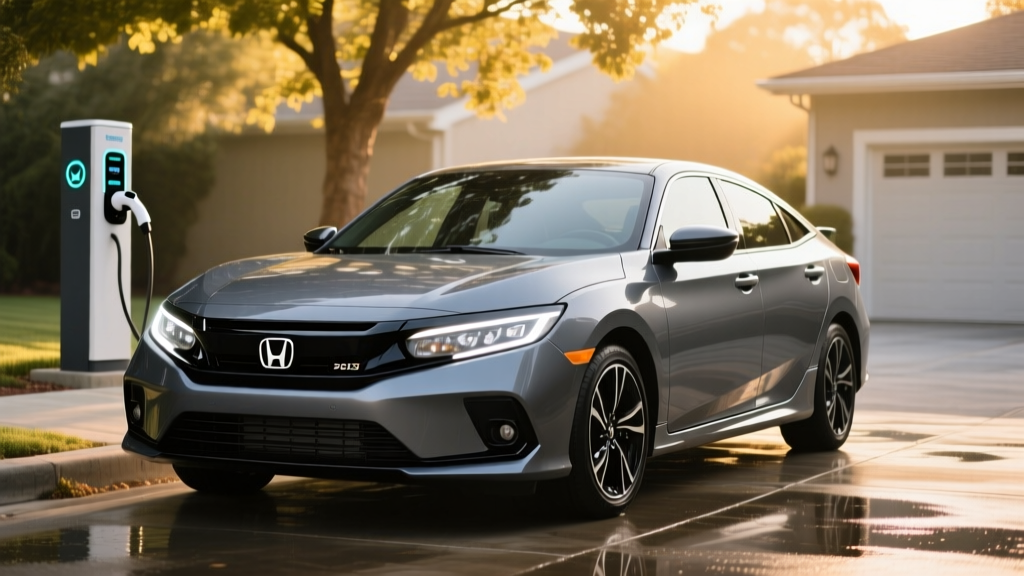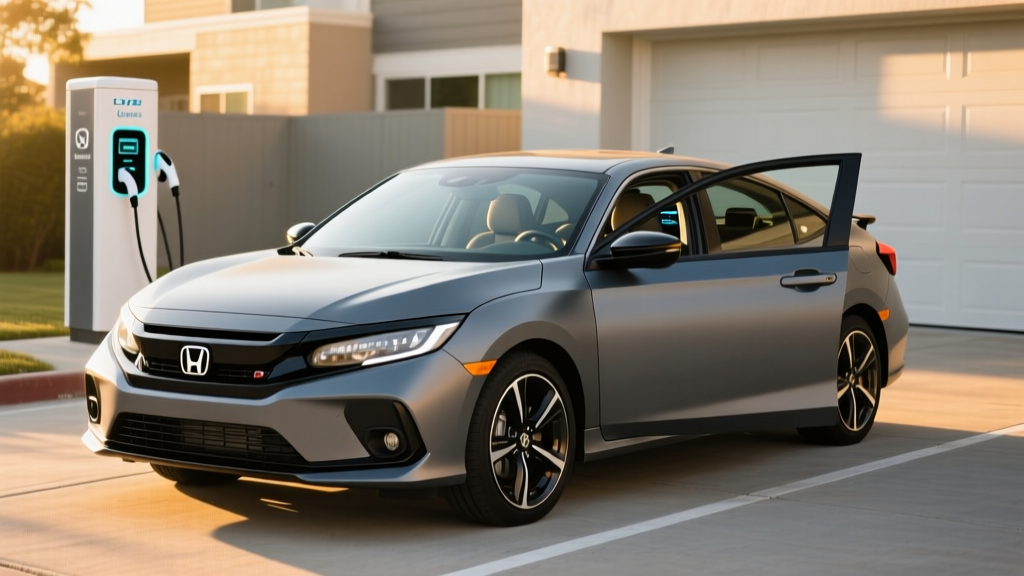
The 2025 Honda Civic Hybrid Sport Touring Hatchback occupies a specific niche that full battery-electric vehicles can't yet fill for every buyer: it delivers exceptional fuel economy without requiring any change in refueling behavior. No plugs, no charging apps, no range planning. You drive it like a normal car, and it returns numbers that rival vehicles costing twice as much at the pump.
For the 2025 model year, Honda expanded the Civic Hybrid lineup to include the hatchback body style in the top-tier Sport Touring trim — pairing the two-motor hybrid system with a more practical cargo area, premium features, and Honda's full suite of driver-assistance technology. Here's what the numbers actually look like, and where this car fits in the broader electrified-vehicle landscape.
HEV vs PHEV: What the Civic Hybrid Actually Is
Before examining the specs, it's critical to understand what this car is — and what it isn't. The 2025 Civic Hybrid is a conventional hybrid electric vehicle (HEV), not a plug-in hybrid (PHEV). That distinction drives everything from how you fuel it to whether it qualifies for federal tax incentives.
HEV vs PHEV — Key Differences
| Feature | HEV (Civic Hybrid) | PHEV (e.g., Toyota Prius Prime) |
|---|---|---|
| Plugs in? | No — regenerative braking charges battery | Yes — Level 1/2 charging |
| Electric-only range | ~1 mi at low speed | 25–44 mi typical |
| Battery size | ~1.0 kWh | 10–18 kWh |
| Federal tax credit (§30D) | Not eligible | Up to $7,500 if eligible |
| Fueling | Gas station only | Gas + plug-in |
The Civic Hybrid's battery is small — roughly 1.0 kWh — and charges exclusively through regenerative braking and the gasoline engine. You never plug it in. The electric motor assists the engine and enables brief electric-only driving at very low speeds (think parking lots and stop-and-go traffic), but this is not a vehicle that can commute on electricity alone.
If you need electric-only commuting capability, you'd be looking at a PHEV like the Toyota Prius Prime or a full BEV. The Civic Hybrid's value proposition is simpler: dramatically better fuel economy than a gas car, with zero behavioral change required.
Fuel Economy: EPA Ratings and Real-World MPG
The headline number for the 2025 Honda Civic Hybrid Sport Touring Hatchback is an EPA-estimated 50 MPG combined — broken down as 50 MPG city and 49 MPG highway, per fueleconomy.gov. That places it among the most fuel-efficient non-plug-in vehicles sold in the United States.
| Metric | Value |
|---|---|
| City MPG | 50 |
| Highway MPG | 49 |
| Combined MPG | 50 |
| Fuel tank capacity | 12.4 gal |
| Total range (est.) | ~620 mi |
Real-World MPG vs EPA Sticker
Honda's two-motor hybrid system excels in city driving, where the electric motor handles low-speed propulsion and regenerative braking recaptures energy at every stop. In real-world city and suburban driving, many owners report matching or slightly exceeding the 50 MPG city estimate — a rarity in the automotive world where real-world numbers usually fall short.
Highway driving tells a different story. At sustained speeds above 70 MPH, the gasoline engine does most of the work, and aerodynamic drag reduces efficiency. Expect 44–47 MPG on extended highway trips, particularly in cold weather or with a full cargo load. In winter conditions with temperatures below freezing, a 5–10% efficiency reduction is typical, bringing combined real-world numbers to roughly 45–47 MPG.
For comparison, the gas-only 2025 Civic Hatchback Sport Touring (with the 1.5L turbo) is EPA-rated at 30 MPG combined — meaning the hybrid delivers roughly 40% better fuel economy in mixed driving.
Powertrain: 200 Horsepower From a Two-Motor System
The Civic Hybrid's powertrain pairs a 2.0-liter Atkinson-cycle four-cylinder engine with two electric motors — one serving as the primary drive motor and the other as a generator/starter. Combined system output is 200 horsepower and 232 lb-ft of torque, routed to the front wheels through Honda's e-CVT (which uses a fixed gear ratio rather than a traditional belt-driven CVT).
| Spec | Value |
|---|---|
| Engine | 2.0L Atkinson-cycle I4 |
| Combined system HP | 200 hp |
| Combined system torque | 232 lb-ft |
| Drive motor output | 184 hp / 232 lb-ft |
| Transmission | e-CVT (fixed ratio) |
| Drivetrain | FWD |
| 0–60 MPH (est.) | ~7.2 sec |
The 200-hp figure is significant: it makes the Civic Hybrid Sport Touring Hatchback the most powerful Civic you can buy short of the Type R. The electric motor's instant torque delivery (232 lb-ft available from near-zero RPM) gives it strong off-the-line acceleration that the 180-hp turbo gas model can't match in everyday stoplight-to-stoplight driving. The trade-off is highway passing power above 60 MPH, where the smaller displacement engine feels less punchy than a turbocharged setup.
Honda's hybrid system operates in three modes seamlessly and without driver input: EV Drive (battery powers the motor at low speeds), Hybrid Drive (engine generates electricity for the motor), and Engine Drive (engine directly drives the wheels at highway cruising speeds via a lock-up clutch). You'll rarely notice the transitions.
Pricing, Trims, and Tax Credit Eligibility
The 2025 Honda Civic Hybrid is available in two hatchback trims: the Sport and the Sport Touring. Here's the MSRP breakdown:
| Trim | MSRP (incl. destination) |
|---|---|
| Civic Hybrid Sport Hatchback | $29,850 |
| Civic Hybrid Sport Touring Hatchback | $31,450 |
The Sport Touring trim adds a 9-inch touchscreen with wireless Apple CarPlay and Android Auto, a 12-speaker Bose audio system, wireless phone charging, a power moonroof, heated rear seats, a power-adjustable driver's seat, leather-trimmed interior, and Honda's full Honda Sensing suite (adaptive cruise control, lane-keeping assist, blind-spot monitoring, rear cross-traffic alert).
Federal Tax Credit: Not Eligible
The 2025 Honda Civic Hybrid does not qualify for the federal §30D Clean Vehicle Credit (up to $7,500). Per IRS guidelines, the §30D credit applies only to plug-in electric vehicles (BEVs and PHEVs) with sufficient battery capacity. Conventional hybrids like the Civic Hybrid are excluded.
Some states offer their own incentives for hybrid vehicles, but these vary widely by jurisdiction and change frequently. Check your state's energy or DMV website for current programs. A few states offer reduced registration fees or HOV lane access for hybrids, though most HOV-lane perks have shifted to plug-in vehicles.
Battery Warranty, Reliability, and Replacement Costs
Hybrid battery longevity is consistently the top concern for first-time hybrid buyers. Here's what Honda covers:
Battery & Hybrid System Warranty
- Hybrid battery: 8 years / 100,000 miles (10 years / 150,000 miles in CARB states including CA, NY, MA, and others)
- Hybrid system components (inverter, motor, control unit): 8 years / 100,000 miles
- Powertrain warranty: 5 years / 60,000 miles
- Limited vehicle warranty: 3 years / 36,000 miles
Honda's hybrid system has a strong reliability track record. The two-motor architecture used in the Civic Hybrid is an evolution of the system Honda has deployed across the Accord Hybrid, CR-V Hybrid, and other models since 2014. The lithium-ion battery pack is small (~1.0 kWh), which means fewer cells, less thermal stress, and lower replacement cost compared to larger hybrid or PHEV batteries.
If the hybrid battery does require replacement outside of warranty, expect a cost in the range of $2,000–$4,000 for the battery pack itself, plus labor. This is significantly less than PHEV or BEV battery replacements, which can run $8,000–$20,000+. In practice, hybrid batteries from major manufacturers routinely last 150,000–200,000+ miles before capacity degradation becomes meaningful — and the Civic's small battery sees relatively gentle duty cycles compared to a PHEV that's constantly cycling through deeper charge/discharge ranges.
Honda also equips the Civic Hybrid with an active thermal management system for the battery, which helps prevent the heat-related degradation that plagued early-generation hybrids from other manufacturers.
Cargo, Tech, and the Hatchback Advantage
The hatchback body style is the practicality play. Behind the rear seats, the Civic Hybrid Hatchback offers 24.4 cubic feet of cargo space — roughly double what the Civic Hybrid Sedan provides (14.8 cu ft). Fold the rear seats and you get a flat load floor suitable for furniture, bikes, or a week's worth of camping gear.
The Sport Touring trim's tech suite includes:
- 9-inch touchscreen with wireless Apple CarPlay / Android Auto
- 12-speaker Bose premium audio
- Wireless Qi phone charging pad
- 10.2-inch digital instrument cluster with hybrid-specific energy flow display
- Honda Sensing: ACC with low-speed follow, LKAS, road departure mitigation, traffic sign recognition
- Blind-spot information system with rear cross-traffic alert
- Low-speed braking control and collision mitigation braking
It's worth noting that Honda Sensing is a Level 2 driver-assistance system per the SAE automation scale. It provides steering and acceleration/braking support, but requires the driver to remain fully engaged with hands on the wheel and eyes on the road at all times. It is not a self-driving system.
Who Should Choose the Civic Hybrid vs a PHEV or Full EV
The decision between a conventional hybrid, a plug-in hybrid, and a full battery-electric vehicle comes down to three factors: charging access, daily driving distance, and budget.
Decision Framework
Choose the Civic Hybrid (HEV) if:
- You lack reliable access to home or workplace charging (apartment dwellers, street parking)
- You want maximum fuel economy with zero behavioral change
- Your budget is under $35,000 and you want a loaded compact car
- You drive a mix of city and highway miles and want strong real-world MPG in both
- You don't want to think about charging, range planning, or charging-network reliability
Choose a PHEV (e.g., Prius Prime) if:
- You have home Level 2 charging and a commute under 40 miles
- You want electric-only daily driving with gas-engine flexibility for road trips
- You qualify for the §30D federal tax credit (income and sourcing rules apply)
Choose a full EV (e.g., Chevy Equinox EV, Tesla Model 3) if:
- You have reliable home charging and want the lowest per-mile fuel cost
- Your daily driving is under 250 miles and you're comfortable with road-trip charging planning
- You want maximum §30D tax credit benefit and lower long-term maintenance costs
The Civic Hybrid Sport Touring Hatchback's strongest competitive position is against other compact hatchbacks — both gas and hybrid. Against the gas-only Mazda3 Hatchback (26 MPG combined), the Civic Hybrid saves roughly $700–$900 per year in fuel costs at 15,000 miles driven annually and $3.50/gallon regular unleaded. The hybrid premium over the gas Civic Sport Touring Hatchback (~$2,000) pays for itself in roughly 2–3 years of typical driving.
Pros and Cons at a Glance
Pros
- 50 MPG combined EPA — best-in-class for a compact hatchback
- 200 hp makes it the quickest non-Type R Civic
- 24.4 cu ft cargo with hatchback practicality
- Strong real-world city MPG (often meets or beats EPA)
- No charging infrastructure needed
- Sport Touring trim is well-equipped for the price
- 8yr/100k-mi hybrid battery warranty
Cons
- No federal tax credit eligibility
- Highway MPG drops to ~44–47 in real-world driving
- No AWD option (available on CR-V Hybrid)
- FWD only — not ideal for heavy snow regions
- Engine drone under hard acceleration (common to Atkinson-cycle hybrids)
- ~$2,000 premium over gas Civic Sport Touring
Frequently Asked Questions
How many MPG does the 2025 Civic Hybrid Sport Touring Hatchback get?
The EPA rates it at 50 MPG city, 49 MPG highway, and 50 MPG combined. In real-world driving, expect 48–52 MPG in city and suburban conditions, and 44–47 MPG on extended highway trips. Cold weather reduces efficiency by approximately 5–10%.
Does the Civic Hybrid need to be plugged in?
No. The 2025 Civic Hybrid is a conventional HEV. Its small lithium-ion battery charges exclusively through regenerative braking and the gasoline engine. You fuel it at a gas station like any other car.
How far can the Civic Hybrid drive on electric power alone?
Only about 1 mile at very low speeds (under 25 MPH) in ideal conditions. The electric motor's primary role is assisting the gasoline engine and enabling regenerative braking — not providing standalone propulsion for commutes. If you need electric-only range, a PHEV or BEV is the right choice.
Is the Civic Hybrid reliable, and what does battery replacement cost?
Honda's two-motor hybrid system has a strong reliability record across multiple models since 2014. The hybrid battery is covered by an 8-year/100,000-mile warranty (10yr/150k in CARB states). Out-of-warranty replacement typically costs $2,000–$4,000. Most hybrid batteries from major manufacturers last 150,000–200,000+ miles.
Does the 2025 Civic Hybrid qualify for any tax credit?
It does not qualify for the federal §30D Clean Vehicle Credit, which is limited to plug-in vehicles (BEVs and PHEVs). Some states may offer minor hybrid incentives, but these vary by jurisdiction. Check your state's energy office or DMV for current programs.
How does the Civic Hybrid compare to a full EV on operating cost?
At 50 MPG and $3.50/gallon, the Civic Hybrid costs roughly $0.07 per mile in fuel. A comparable EV averaging 3.5 miles/kWh at $0.14/kWh (national residential average) costs about $0.04 per mile. The EV saves roughly $450/year at 15,000 miles — but requires home charging access and a higher upfront purchase price (partially offset by the §30D credit).
Is the Sport Touring the only hybrid hatchback trim?
No. Honda offers the Civic Hybrid Hatchback in both Sport ($29,850) and Sport Touring ($31,450) trims. The Sport trim includes a 7-inch touchscreen, wired smartphone integration, and an 8-speaker audio system. The Sport Touring adds the 9-inch display, Bose audio, wireless charging, leather seats, power driver's seat, and moonroof.