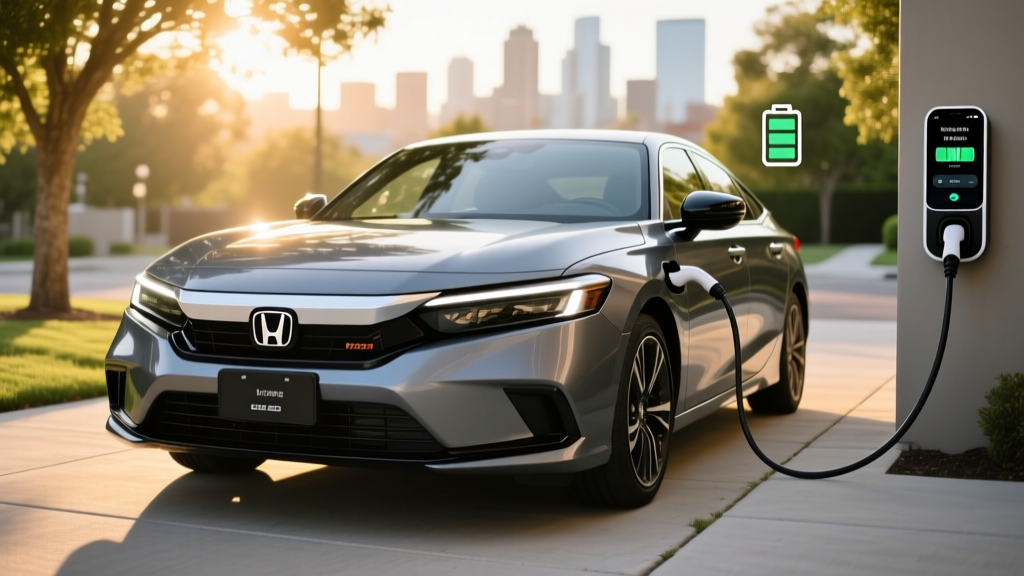
The 2025 Honda Civic Hybrid returns to the lineup as a high-efficiency alternative to the standard turbocharged Civic, targeting buyers who want exceptional fuel economy without plugging in. With an EPA-estimated 50 MPG combined, it slots between conventional gas compacts and full electric vehicles in both price and complexity. Below, we break down exactly what the 2025 Civic Hybrid delivers in real-world driving, what it costs, and how it compares to plug-in hybrids and battery-electric alternatives.
2025 Honda Civic Hybrid MPG: EPA Ratings and Real-World Results
The headline number for the 2025 Civic Hybrid is its EPA fuel economy, which Honda rates at 50 MPG combined for the Sport sedan and 49 MPG combined for the Sport Touring sedan. The Sport Touring Touring trim (with larger 18-inch wheels and additional equipment) drops slightly to 47 MPG combined. Here is the full EPA breakdown by trim:
| Trim | City MPG | Combined MPG | |
|---|---|---|---|
| Sport Sedan | 50 | 47 | 50 |
| Sport Touring Sedan | 50 | 47 | 49 |
| Sport Touring (18" wheels) | 48 | 45 | 47 |
Source: EPA fueleconomy.gov
Hybrid (HEV) vs. Plug-In Hybrid (PHEV): Which Is the Civic?
The 2025 Honda Civic Hybrid is a conventional hybrid electric vehicle (HEV), not a plug-in hybrid. This is a critical distinction that affects how you fuel it, what it costs, and whether it qualifies for federal incentives.
Conventional Hybrid (HEV)
Example: 2025 Civic Hybrid
- No plug — charges itself via engine and regen braking
- Small battery (~1.0 kWh usable)
- Cannot drive on electric power alone for meaningful distances
- Fuels exclusively with gasoline
- No federal tax credit (does not meet §30D plug-in requirement)
Plug-In Hybrid (PHEV)
Example: Toyota RAV4 Prime, Chrysler Pacifica Hybrid
- Plugs into a wall outlet or Level 2 charger
- Larger battery (12–20 kWh typical)
- 20–45 miles of electric-only driving before engine starts
- Runs on electricity first, then gasoline
- May qualify for partial or full $7,500 §30D federal credit
Honda does not currently offer a Civic plug-in hybrid in the United States. If you need electric-only commuting capability, you would need to look at a PHEV from another brand or consider a full battery-electric vehicle (BEV).
Powertrain Specs: Two-Motor Hybrid System
The 2025 Civic Hybrid uses Honda's two-motor hybrid system, which pairs a 2.0-liter Atkinson-cycle four-cylinder engine with two electric motors integrated into the transmission housing. The system operates primarily as a series hybrid at low and moderate speeds — meaning the gas engine acts as a generator to feed electricity to the drive motor — and switches to direct mechanical drive via a lock-up clutch at highway cruising speeds.
| Specification | Value |
|---|---|
| Engine | 2.0L Atkinson-cycle 4-cylinder |
| Engine Output | 143 hp @ 6,000 rpm / 134 lb-ft torque |
| Drive Motor Output | 184 hp / 232 lb-ft torque |
| Combined System Output | 200 hp / 232 lb-ft torque |
| Hybrid Battery | Lithium-ion, ~1.0 kWh (not plug-in) |
| Transmission | e-CVT (single-speed direct drive with lock-up clutch) |
| Drivetrain | Front-wheel drive |
| 0–60 MPH | ~7.2 seconds (est.) |
| Fuel Tank | 12.4 gallons |
| Total Driving Range | ~620 miles (at 50 MPG combined) |
The 200 combined horsepower makes the Civic Hybrid noticeably quicker than the non-hybrid Civic with the 2.0L naturally aspirated engine (158 hp) and comparable to the 1.5T turbo variant (180 hp). The electric motor's instant 232 lb-ft of torque provides strong low-speed acceleration that feels responsive in city driving.
Pricing, Trims, and Tax Credit Eligibility
The 2025 Civic Hybrid is available in two main trim levels for the sedan body style, with pricing as follows:
| Trim | MSRP | With Destination (~$1,095) |
|---|---|---|
| Sport Sedan | $29,845 | ~$30,940 |
| Sport Touring Sedan | $32,845 | ~$33,940 |
Source: Honda.com
Battery Warranty, Reliability, and Replacement Cost
Hybrid battery longevity is one of the top concerns for buyers switching from a conventional gas car. Honda addresses this with a robust warranty:
- Duration: 8 years / 100,000 miles (whichever comes first)
- Coverage: Defects in materials/workmanship and excessive capacity loss
- Extended in CARB states: 10 years / 150,000 miles in states that follow California Air Resources Board emissions rules (CA, CO, CT, DE, ME, MD, MA, NJ, NY, OR, RI, VT, WA, and others adopting CARB standards)
Honda's hybrid systems have a strong reliability track record. The two-motor architecture used in the Civic Hybrid is a proven design shared with the Accord Hybrid and CR-V Hybrid, both of which have accumulated years of real-world data. The hybrid battery itself is relatively small (~1.0 kWh) compared to a PHEV or BEV pack, which means even a full out-of-warranty replacement is significantly cheaper than an EV battery swap.
Estimated out-of-warranty hybrid battery replacement cost: $2,000–$4,000 including labor, based on current Honda hybrid battery pricing. This is a fraction of the $8,000–$20,000+ that larger EV battery replacements can cost. In practice, Honda hybrid batteries in models like the Insight and Accord Hybrid have shown minimal degradation over 150,000+ miles when properly maintained.
How the Civic Hybrid Fits: HEV vs. PHEV vs. Full EV
Choosing between a conventional hybrid, a plug-in hybrid, and a full battery-electric vehicle depends on your driving patterns, home charging access, and budget. Here is a practical decision framework:
- Choose the Civic Hybrid (HEV) if: You want maximum fuel economy with zero lifestyle changes — no plug, no range planning, no charging apps. You drive a mix of city and highway and want 500+ miles between fill-ups. Your budget is under $35,000.
- Choose a PHEV if: You have home charging (Level 1 or 2) and a short commute (under 30 miles round-trip) that you want to cover on electricity, but you also take regular road trips and don't want to rely on public charging infrastructure.
- Choose a full EV (BEV) if: You have reliable home Level 2 charging, your daily driving is under 250 miles, you want to eliminate gasoline costs entirely, and you want access to the $7,500 federal tax credit (subject to income, MSRP, and battery-sourcing rules).
The Civic Hybrid makes the most sense for apartment dwellers without charging access, high-mileage commuters who want low running costs without infrastructure dependency, and buyers who aren't ready to commit to plug-in ownership. It is also the lowest-friction upgrade from a conventional gas car — you simply drive and refuel as you always have, but burn roughly 35% less gasoline.
Pros and Cons at a Glance
Pros
- 50 MPG combined EPA — best-in-class for compact sedans
- 200 hp combined — quicker than base Civic
- No plug required — zero infrastructure dependency
- 620+ mile total range on a single tank
- Strong 8yr/100k-mile hybrid battery warranty
- Proven Honda hybrid reliability
- Under $31,000 starting (with destination)
Cons
- No federal tax credit eligibility
- Not a plug-in — cannot drive on electric power alone
- Sport and Sport Touring trims only (no LX Hybrid)
- Highway MPG drops to mid-40s at sustained 75+ MPH
- FWD only — no AWD hybrid option
- Engine noise under hard acceleration (CVT drone)
- No sedan Hybrid in Canada (hatchback only there)
Frequently Asked Questions
How many MPG does the 2025 Honda Civic Hybrid actually get?
The EPA rates the Civic Hybrid Sport sedan at 50 MPG combined (50 city / 47 highway). In real-world driving, city-heavy routes with frequent stops often yield 50–53 MPG thanks to regenerative braking. Sustained highway driving at 75+ MPH typically returns 42–46 MPG. Cold weather reduces efficiency by roughly 5–10%.
Does the Civic Hybrid need to be plugged in?
No. The 2025 Civic Hybrid is a conventional hybrid (HEV), not a plug-in hybrid. It charges its own small battery through regenerative braking and the gasoline engine. You never plug it in — you simply refuel at a gas station as you would with any other car.
Can the Civic Hybrid drive on electric power alone?
Only for very short distances at low speeds (typically under 1 mile at under 25 MPH). The hybrid battery is approximately 1.0 kWh — far too small for meaningful electric-only range. The system uses electric assist to improve efficiency, not to replace gasoline driving.
Does the 2025 Civic Hybrid qualify for any tax credit?
No. The federal §30D Clean Vehicle Credit requires a plug-in vehicle with at least 7 kWh of battery capacity. The Civic Hybrid has no plug and a battery well under that threshold. It does not qualify for the federal EV tax credit. Check your state's energy office for any local hybrid incentives, which are uncommon but occasionally available.
Is the hybrid battery reliable and what does replacement cost?
Honda covers the hybrid battery for 8 years/100,000 miles (10 years/150,000 miles in CARB states). Out-of-warranty replacement is estimated at $2,000–$4,000 — significantly less than EV battery replacement. Honda's hybrid systems in the Accord and CR-V have demonstrated strong long-term reliability with minimal degradation.
How does the Civic Hybrid compare to the Toyota Corolla Hybrid?
The Toyota Corolla Hybrid is rated at 50 MPG combined (53 city / 46 highway for FWD) and offers available AWD (47 MPG combined). The Civic Hybrid matches or slightly exceeds the Corolla on the highway (47 vs. 46 MPG) and offers more horsepower (200 hp vs. 138 hp), a more refined interior, and a sportier driving experience. The Corolla Hybrid starts approximately $2,000 lower and offers AWD, which Honda does not.