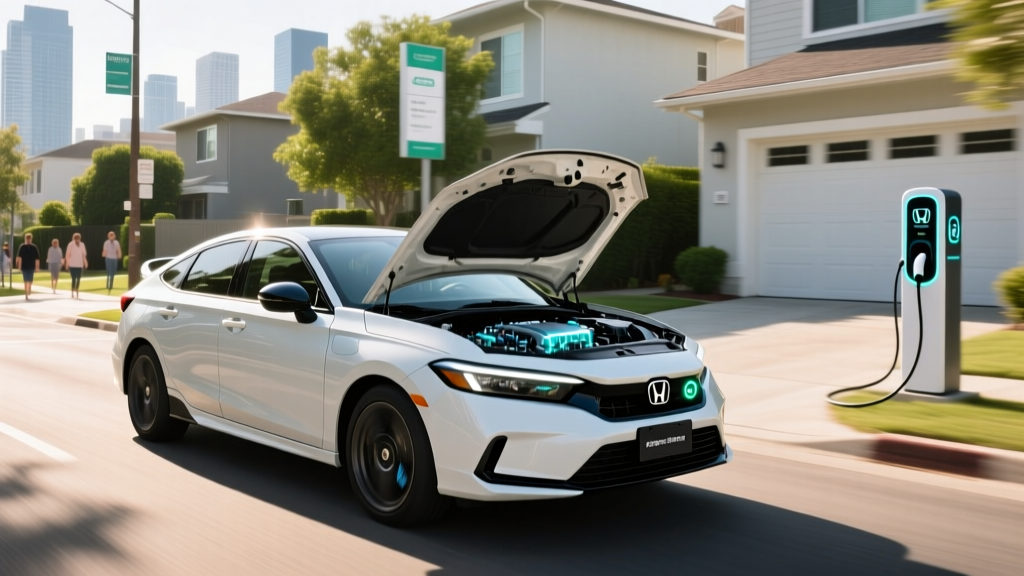
The 2025 Honda Civic Hatchback Sport Hybrid occupies a specific niche: buyers who want electrified efficiency without plugging in, charging-route planning, or paying an EV premium. It pairs a 2.0-liter Atkinson-cycle engine with Honda's two-motor hybrid system for a combined 200 horsepower and an EPA-estimated 50 MPG combined. That puts it among the most efficient non-plug-in hatchbacks on the market, wrapped in a body that offers 24.5 cubic feet of cargo space behind the rear seats.
This guide breaks down exactly what you get — real-world fuel economy expectations, powertrain details, battery longevity, pricing, and whether this conventional hybrid (HEV) is the right bridge between a gas car and a full battery-electric vehicle (BEV).
2025 Honda Civic Hatchback Sport Hybrid: Key Specs at a Glance
| Attribute | 2025 Civic Hatchback Sport Hybrid |
|---|---|
| Powertrain Type | Conventional Hybrid (HEV) — no plug-in |
| Engine | 2.0L DOHC Atkinson-cycle 4-cylinder |
| Combined Output | 200 hp / 232 lb-ft torque |
| Transmission | e-CVT (Honda two-motor hybrid system) |
| Drivetrain | FWD (AWD available on Sport Touring Hybrid) |
| EPA Fuel Economy (City / Hwy / Combined) | 50 / 45 / 50 MPG (Sport FWD) |
| Fuel Tank | 10.6 gallons |
| Total Range | ~530 miles (combined estimate) |
| 0–60 mph | ~7.5 seconds (est.) |
| Cargo Volume (rear seats up / folded) | 24.5 / 48.5 cu ft |
| Base MSRP (Sport Hybrid CVT) | $30,950 (incl. $1,095 destination) |
| Hybrid Battery Warranty | 8 years / 100,000 miles (10 yr/150k mi in CARB states) |
Fuel Economy: EPA Ratings vs. Real-World MPG
| Driving Scenario | EPA Estimate | Real-World Expectation |
|---|---|---|
| City | 50 MPG | 48–54 MPG (hybrids often beat EPA in stop-and-go) |
| Highway (70 mph cruise) | 45 MPG | 41–46 MPG |
| Combined | 50 MPG | 46–52 MPG |
| Cold Weather (sub-30°F) | N/A | 40–46 MPG (engine runs more for cabin heat) |
Honda's two-motor hybrid system is at its best in city driving, where the electric motor handles low-speed propulsion and the engine acts primarily as a generator. This is why the city EPA rating matches or exceeds the combined figure — the opposite of a conventional gas car. On the highway, the engine engages directly via a lock-up clutch, but aerodynamic drag and sustained speed reduce the electric motor's contribution.
In mixed real-world driving — suburban commutes, some highway, moderate climate — owners consistently report 48–52 MPG. If your commute is heavily stop-and-go, expect to land at or above the 50 MPG city mark. If you drive predominantly highway miles at 75+ mph, plan for low-to-mid 40s. Cold weather forces the engine to run more frequently for cabin heating, which typically drops observed economy by 8–15%.
HEV vs. PHEV vs. EV: Which Powertrain Fits You?
The 2025 Civic Hatchback Sport Hybrid is a conventional hybrid (HEV). It does not plug in. It has no electric-only range rating. It recovers energy through regenerative braking and engine-driven charging to keep its small lithium-ion battery at optimal state of charge. If you're comparing this to a plug-in hybrid or full EV, here's how they differ:
| Factor | HEV (This Car) | PHEV (e.g., Toyota Prius Prime) | BEV (e.g., Chevy Equinox EV) |
|---|---|---|---|
| Plug-in Required? | No | Yes (for EV range) | Yes |
| Electric-Only Range | None (EV assists at low speed) | 25–44 miles typical | 250–315+ miles |
| Fuel / Energy Cost | Gas only (~$0.09/mi at 50 MPG) | Electric (~$0.04/mi) + gas | Electric only (~$0.04/mi) |
| Home Charging Needed? | No | Recommended (Level 2) | Required (Level 2 ideal) |
| Federal Tax Credit (§30D) | Not eligible | Up to $7,500 (if eligible) | Up to $7,500 (if eligible) |
| Upfront Price Premium | Low ($1k–$2k over gas) | Moderate ($4k–$7k over gas) | Higher ($8k–$15k over gas) |
| Best For | No home charging access; long trips | Home charging + short commutes | Home charging + daily driving under 250 mi |
The Civic Sport Hybrid makes sense if you lack reliable home or workplace charging, regularly drive long distances, or want to reduce fuel costs without changing your refueling habits. It's the lowest-friction entry into electrified efficiency.
Powertrain Deep Dive: 200 HP Two-Motor System
Honda's fourth-generation two-motor hybrid system in the 2025 Civic Hatchback Sport Hybrid pairs a 2.0-liter direct-injected Atkinson-cycle four-cylinder engine with two electric motors — one primarily functioning as a generator and the other as a drive motor.
- Engine output: 143 hp / 134 lb-ft
- Drive motor output: 184 hp / 232 lb-ft
- Combined system output: 200 hp / 232 lb-ft
The system operates in three modes: EV Drive (battery powers the drive motor at low speeds), Hybrid Drive (engine spins the generator motor to feed electricity to the drive motor), and Engine Drive (a lock-up clutch mechanically links the engine to the wheels at steady highway speeds). The transitions are seamless — most drivers won't notice mode switches.
The result is responsive off-the-line acceleration (the electric motor delivers peak torque instantly) and relaxed highway cruising. The 0–60 mph time of approximately 7.5 seconds puts it ahead of most compact hybrid competitors and makes merging and passing confident. The Sport trim also includes paddle-shifters that let you adjust regen intensity across four levels, though it doesn't offer true one-pedal driving like a BEV or PHEV.
Pricing, Trims, and Tax Credit Eligibility
The 2025 Honda Civic Hatchback Sport Hybrid is available in two trims:
- Sport Hybrid (FWD): $30,950 MSRP (including $1,095 destination)
- Sport Touring Hybrid (AWD): $34,950 MSRP
The Sport trim includes a 7-inch touchscreen, wireless Apple CarPlay/Android Auto, Honda Sensing suite (adaptive cruise, lane-keeping, automatic emergency braking), dual-zone climate control, and 18-inch alloy wheels. The Sport Touring adds a 9-inch touchscreen, wireless phone charging, Bose 12-speaker audio, leather-trimmed seats, heated front and rear seats, and a heated steering wheel.
Hybrid Battery Longevity, Warranty, and Replacement Cost
Hybrid battery durability is the top concern for first-time hybrid buyers, and it's an area where Honda has a strong track record. The 2025 Civic Sport Hybrid uses a lithium-ion hybrid battery pack (approximately 1.1 kWh total capacity — small by BEV standards, but sufficient for hybrid assist and regen buffering).
| Item | Detail |
|---|---|
| Battery Chemistry | Lithium-ion (high-power hybrid cells) |
| Battery Capacity | ~1.1 kWh (hybrid buffer, not plug-in) |
| Federal Warranty (all states) | 8 years / 100,000 miles |
| CARB-State Warranty | 10 years / 150,000 miles (CA, CO, CT, ME, MD, MA, NJ, NY, OR, RI, VT, WA) |
| Warranty Threshold | Covers battery if capacity drops below ~60–70% of original |
| Out-of-Warranty Replacement Cost | $2,000–$4,000 (dealer, including labor) |
| Expected Battery Lifespan | 150,000–200,000+ miles with normal use |
Honda's hybrid systems have demonstrated excellent longevity in the field. The battery is never fully charged or fully depleted — the system keeps state of charge in a narrow middle band (roughly 40–60%), which dramatically reduces cell stress and extends cycle life. Most Honda hybrid batteries outlast their warranty periods by a significant margin. If replacement is eventually needed, independent hybrid specialists often offer refurbished packs for $1,500–$2,500, and individual cell module replacement can bring costs even lower.
According to Honda's official specifications, the hybrid system is sealed and requires no scheduled maintenance. The battery cooling system uses cabin air, so keeping the rear-seat vent area clear is the only owner action needed.
Real-World Ownership: What to Expect
Beyond the spec sheet, here are the practical ownership realities of the 2025 Civic Hatchback Sport Hybrid:
- Fuel cost savings: At 50 MPG combined and $3.40/gallon (national average), you'll spend roughly $0.068 per mile on fuel. A comparable gas-only compact at 30 MPG costs about $0.113/mi. Over 15,000 miles/year, that's ~$675 in annual fuel savings.
- Insurance: Hybrid variants typically carry a 5–10% insurance premium over gas equivalents due to higher repair costs for the hybrid system. Get a quote before purchasing.
- Maintenance: Hybrids often have lower maintenance costs than gas cars. Regenerative braking extends brake pad life (60,000–100,000 miles is common). There's no starter motor or alternator to fail. Oil changes are still required, but engine run-time is reduced.
- Resale value: Honda Civics hold value well, and the hybrid variant's fuel efficiency appeals strongly in the used market. Expect stronger retention than a gas-only compact.
- Cargo practicality: The hatchback body provides 24.5 cu ft behind the rear seats — nearly double the Civic sedan's trunk — and 48.5 cu ft with seats folded. The hybrid battery is packaged under the rear seats, so cargo space is not compromised.
Pros and Cons
Pros
- 50 MPG combined — class-leading for a non-plug-in hatchback
- 200 hp provides confident acceleration; feels quicker than EPA numbers suggest
- No charging infrastructure needed — refuel at any gas station
- 24.5 cu ft cargo volume with hatchback utility
- Honda Sensing ADAS suite standard on all trims
- Strong hybrid battery warranty (up to 10 yr / 150k mi in CARB states)
- AWD available on Sport Touring Hybrid
Cons
- Not eligible for the $7,500 federal §30D tax credit (HEV, not PHEV)
- Engine drone under hard acceleration (e-CVT characteristic)
- No EV-only driving mode for zero-emission short trips
- Road noise on coarse pavement (Honda improved this for 2025, but it's still present)
- Sport Touring Hybrid pushes $35K — enters PHEV/compact-EV price territory
- Regen paddle adjustment isn't true one-pedal driving
Who Should Buy the 2025 Civic Hatchback Sport Hybrid?
- You rent or live somewhere without reliable home or workplace charging
- You want to cut fuel costs by ~40% without changing any habits
- Your commute is city-heavy (where the hybrid system shines)
- You need hatchback cargo versatility in a compact footprint
- You plan to keep the car 8–12 years and want proven hybrid reliability
- You have Level 2 home charging and a commute under 40 miles round-trip
- You want to drive mostly on electricity and qualify for the §30D tax credit
- You're willing to pay a higher upfront price for lower per-mile energy costs
- You have reliable home charging and drive under 250 miles/day
- You want zero tailpipe emissions and the lowest per-mile cost (~$0.04/mi)
- You're ready to plan around DC fast charging on road trips
Frequently Asked Questions
How many MPG does the 2025 Honda Civic Hatchback Sport Hybrid get?
The EPA rates it at 50 city / 45 highway / 50 combined MPG for the FWD Sport trim. Real-world results typically range from 46–54 MPG depending on driving mix. City-heavy driving often exceeds the EPA estimate because the hybrid system recovers energy through regen braking and operates the electric motor more frequently at low speeds.
Does the 2025 Civic Sport Hybrid need to be plugged in?
No. This is a conventional hybrid (HEV). It charges its small lithium-ion battery through regenerative braking and the gasoline engine. You simply fill up at a gas station as you would with any car. There is no plug, no charging port, and no electric-only range rating.
Does it qualify for any federal tax credit?
No. The IRS §30D Clean Vehicle Credit applies only to plug-in hybrids (PHEVs) and battery-electric vehicles (BEVs) that meet battery-capacity, critical-mineral sourcing, MSRP cap, and buyer income requirements. The Civic Sport Hybrid is an HEV and does not qualify. However, some states offer separate hybrid incentives — check the Alternative Fuels Data Center for your state's programs.
Is the hybrid battery reliable, and what does replacement cost?
Honda's hybrid batteries have an excellent longevity record. The battery is warranted for 8 years/100,000 miles federally and 10 years/150,000 miles in CARB states. Most hybrid batteries last 150,000–200,000+ miles. Out-of-warranty dealer replacement runs $2,000–$4,000; independent shops may offer refurbished packs for $1,500–$2,500.
How does the Sport Hybrid compare to the Civic Sport Touring Hybrid?
The Sport Touring Hybrid adds AWD (which drops EPA fuel economy slightly to 47/42/46 city/highway/combined), a larger 9-inch infotainment screen, Bose premium audio, leather seats, heated front and rear seats, a heated steering wheel, and wireless phone charging. The powertrain is identical (200 hp combined). The $4,000 price gap is justified if you need AWD for snow-belt climates or want the premium features.
Can I tow with the 2025 Civic Hatchback Sport Hybrid?
Honda does not rate the Civic Hatchback for towing, and the owner's manual advises against it. If you need towing capability, look to a compact hybrid SUV like the Honda CR-V Hybrid (1,500 lb rating) or Toyota RAV4 Hybrid (1,750 lb rating).
How does this compare to the Toyota Prius or Prius Prime?
The Toyota Prius (57 MPG combined) beats the Civic Hybrid on pure efficiency but offers less cargo space and a lower driving position. The Prius Prime (PHEV, ~44 miles EV range, up to $7,500 tax credit) is a strong alternative if you have home charging and want electric-only commuting. The Civic Hatchback Sport Hybrid wins on interior space, hatchback utility, and driving dynamics. Per fueleconomy.gov, the Prius achieves 57 combined MPG while the Civic Sport Hybrid achieves 50 combined — a meaningful gap if maximizing fuel economy is your sole priority.